

The tax mess when you’re married but living in different states is wildly underestimated. Most couples do it wrong their first year.
You are not just “filing married with a higher refund.” You’re playing 4‑D chess with:
- Federal rules about married filing jointly vs separately
- Two (sometimes three) different state tax systems
- Residency definitions that do not care about your marriage at all
Let’s walk straight into the chaos and sort it out.
1. First, Get Your Situation on Paper (Not in Your Head)
If your spouse is a physician in another state—residency, fellowship, attending job—you need to map your situation before touching any forms. Otherwise you will miss something and a state will send you a very unfriendly letter 18 months from now.
Write this out on one page:
- Where each of you:
- Lives (actual physical home, not “where you get your mail”)
- Works
- Owns property (rented out or personal)
- Is registered to vote / has driver’s license
- Income sources for each:
- W‑2 jobs (which states listed on the W‑2?)
- 1099 locums / moonlighting (which states did you actually perform the work in?)
- Telemedicine (where were you physically sitting when you worked?)
- Side gigs, K‑1s, rental income, etc.
- Your legal marital status and timeline:
- When you got married (month/year)
- When you moved (if one of you moved during the year)
Why? Because state tax is obsessed with:
- Where you physically are
- Where your “domicile” is (your permanent home in the legal sense)
- Where the income was earned
If you try to shortcut this step, you’ll guess. And your guesses will almost always be wrong for at least one state.
2. Federal: Decide Joint vs Separate With Eyes Wide Open
For federal, your marriage gives you two main options:
- Married Filing Jointly (MFJ)
- Married Filing Separately (MFS)
Most of the time? Joint wins. But in physician households with state issues, student loans, or big income differences, you actually have to run the numbers.
Here’s what MFJ vs MFS really looks like when one spouse is a physician and living in another state.
| Factor | Married Filing Jointly | Married Filing Separately |
|---|---|---|
| Federal tax brackets | More favorable | Worse (hit higher rates sooner) |
| Credits (EITC, education, child credits) | Usually available | Often disallowed |
| Student loan IDR (if using spouse‑exclusion strategy) | Can be worse | Can be much better |
| Complexity | Moderate | High |
| State returns with different states | Usually manageable | Sometimes easier, sometimes worse |
If you:
- Have large federal student loans on IDR that only count your income when you file separately
- Or one spouse has major medical deductions / casualty losses / other weird stuff
…you may need MFS for a few years. But understand this:
Federal MFS is like “hard mode.” Many deductions and credits get nuked or limited.
What I see with physician couples in different states:
- Year 1–3 of training with heavy loans: sometimes MFS makes sense to lower IDR payments
- After that: usually switch to MFJ because the tax penalty of MFS starts to bite hard
Action step:
Run a mock federal return both ways (MFJ and MFS). Don’t just look at the total tax—also look at:
- What credits/deductions vanish
- Impact on student loans (run a loan simulator or talk to a student loan pro)
Then decide. Federal status is going to drive what’s even possible at the state level.
3. State Residency: You and Your Spouse Are Separate People
This is where people get burned.
You are married.
The states do not care.
Each of you has your own residency status in each state. You can be:
- Resident of State A, nonresident of State B
- Your spouse: Resident of State B, nonresident of State A
Both true at the same time. Perfectly legal. Very common in medical training.
Typical physician couple example:
- You live and work in Illinois (Chicago) – you’re an IL resident
- Your spouse is a resident physician in Wisconsin (Milwaukee) – they’re a WI resident
For state purposes:
- Illinois sees you as full‑year resident
- Wisconsin sees your spouse as full‑year resident
- Each state may also see the other spouse as a nonresident if they earned income there
So you can end up with:
- 2 state resident returns (one each)
- 1 or 2 nonresident returns (depending on cross‑border work)
Do not assume “we’re married so we file the same way in both states.” That’s how you double pay tax on the same income.
4. The Core Scenarios You’re Actually In
Let’s break this down into concrete patterns. You’re probably in one of these:
Scenario A: One Earner Physician, Other Spouse No Income (Different States)
Example:
- Physician spouse: NY resident, living in Manhattan for residency
- Non‑physician spouse: Still in Pennsylvania with family, not working this year or in grad school
Federal:
- Almost always file MFJ. MFS would hurt and offers no real benefit.
State:
- NY: Resident return for physician, including all income
- PA: Maybe no return if the non‑earning spouse has no income and PA doesn’t require it
Key point:
The non‑earning spouse’s residence doesn’t cause automatic tax filing requirements if they have no income in that state, but you still need to understand their state’s rule about filing thresholds.
Problem I’ve seen:
Couple assumes “we’re married so we both owe NY tax” or “we have to file the same way in both states.” Wrong. One spouse can be totally off the grid, tax‑wise, if they truly have zero income and no filing requirement.
Scenario B: Both Earning, Each in Different States
Example:
- You: Resident in Texas, remote nonclinical role, no state income tax
- Spouse: Resident physician in California
Federal:
- Usually MFJ unless you have a loan-driven reason to do MFS.
State:
- You: No TX income tax return
- Spouse: CA resident return: includes their income and usually your income too on the joint CA return if you choose a joint CA filing
This is where most couples get annoyed. High‑tax states like CA, NY, and others love to grab the whole household income when you file jointly, then “allocate” what portion is taxable by them.
Plan:
- Decide whether to file the state returns jointly or separately (not always the same as federal). Some states allow:
- File federal MFJ
- File state as married filing separately or “married filing separately on same return” and only report the resident spouse’s income
You must check your spouse’s residency state rules. They differ wildly.
Scenario C: You Split the Year / Move States Mid‑Year
Example:
- You got married in March
- In June, you move from Ohio to join your spouse in North Carolina where they’re a fellow
Now we have:
- Part‑year residency in OH
- Part‑year residency in NC
- Possibly different dates for you vs your spouse
That means:
- Federal: One full‑year MFJ or MFS return
- States: Part‑year resident returns, each of you may have different allocations of income earned before/after the move
This is the year returns get messy. Not impossible—but don’t DIY this your first time unless you like spreadsheets and instructions that contradict each other.
5. The “State Credits So You Don’t Pay Twice” Problem
When you or your spouse earn income in a state where you’re not a resident, you usually do:
- Nonresident return for the work state
- Resident return for your home state
To avoid double tax, your resident state usually gives you a “credit for taxes paid to another state.”
Basic order of operations:
- Step 1: File nonresident state first (where the income was earned)
- Step 2: File resident state, claim credit for the tax already paid
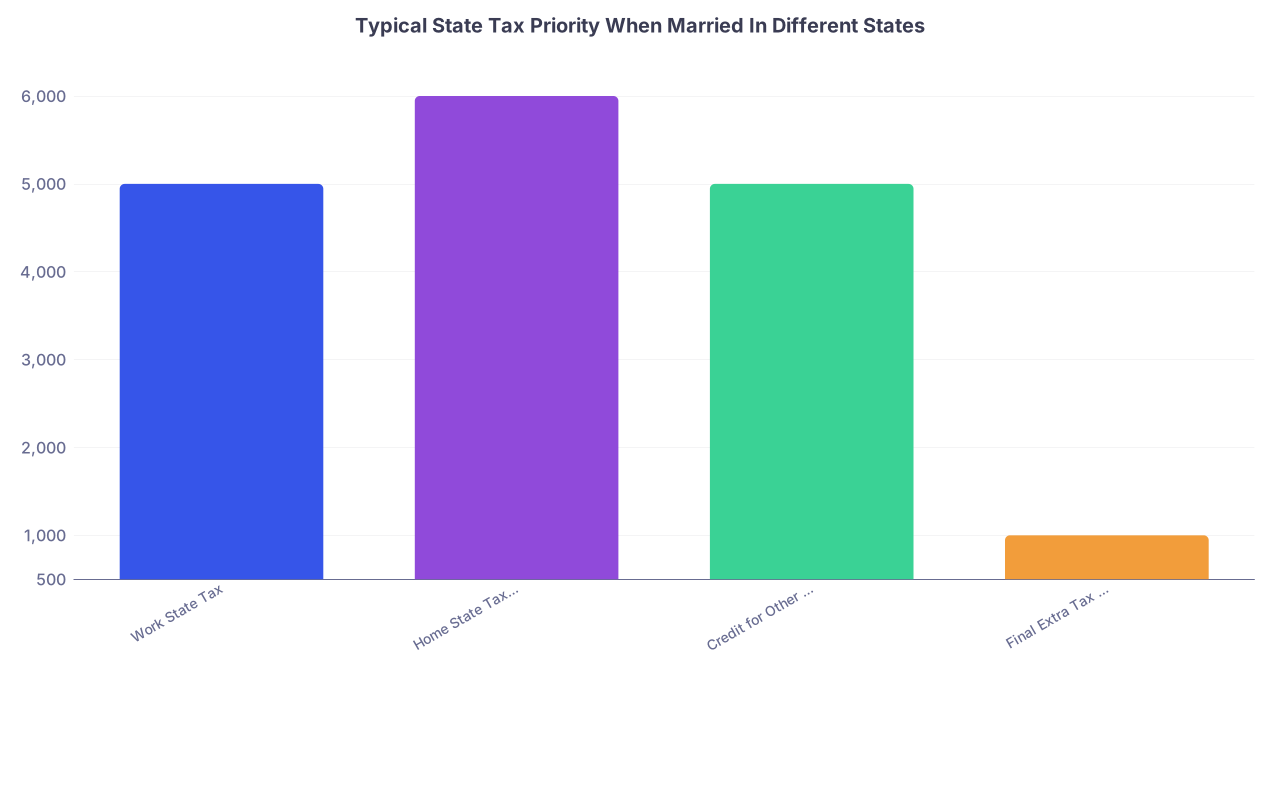
| Category | Value |
|---|---|
| Work State Tax | 5000 |
| Home State Tax Before Credit | 6000 |
| Credit for Other State | 5000 |
| Final Extra Tax Owed at Home | 1000 |
So in that example:
- Work state gets $5,000
- Your home state would have charged $6,000 on that income, but gives you a credit for the $5,000 you already paid
- You end up only paying an extra $1,000 to your home state
Pitfalls:
- Credit usually limited to the lesser of:
- Tax actually paid to other state
- Or what your home state would have taxed that same income
- Credits do not usually cross spouses. Your spouse’s tax paid to their state doesn’t automatically reduce your resident tax in your different state
Bottom line:
You do not typically get taxed twice on the same income. But you can absolutely end up paying more than you expected if one state’s rate is higher than the other’s or if you misunderstand how credits work.
6. Community Property vs Common Law States: The Quiet Killer Detail
If one of you is in a community property state and the other is not, welcome to advanced mode.
Community property states (as of now): AZ, CA, ID, LA, NV, NM, TX, WA, WI (and sometimes AK if opted in).
What this means for married couples:
- By default, most income earned by either spouse while domiciled in a community property state is considered 50/50 owned
- Some states and the IRS want you to split that income down the middle on separate returns
So if:
- Spouse A is a resident in Texas (community property, no state tax)
- Spouse B is physically working in New York (common law, high tax)
Federal MFS + community property = special “community property allocation” forms that split your incomes. It can get ugly fast. MFJ usually simplifies this as long as states allow joint filing consistent with federal.
If you are:
- Married, living apart
- One spouse domiciled in a community property state
- Considering MFS at federal
Get a CPA who knows community property rules. Not “has heard of them.”
I’ve seen more butchered returns here than anywhere else.
7. Step‑By‑Step: How to Actually Coordinate Your Returns
Here’s the practical workflow for a married couple, physician in a different state.
Step 1: Lock in Federal Filing Status
- Run mock MFJ vs MFS
- Consider:
- Student loans (especially REPAYE/SAVE and PAYE)
- Big deductions that change with MFS
- Decide: MFJ or MFS. Do not bounce between them after you start state planning.
Step 2: Determine Each Spouse’s Resident State(s) for the Year
For each of you, answer:
- Where were you domiciled? (Driver’s license, voter reg, where you “intend to return” long‑term)
- Did you move mid‑year?
- Did you meet statutory residency tests anywhere (e.g., >183 days plus a permanent place of abode)?
Result:
You get a clear list like:
- Spouse 1: Resident of IL all year
- Spouse 2: Resident of WI all year
or
- Spouse 1: Part‑year resident OH (Jan–Jun), part‑year resident NC (Jul–Dec)
- Spouse 2: Full‑year resident NC
Write that down.
Step 3: Map Income by Person and by State
Take your W‑2s and 1099s. For each item, note:
- Which spouse
- Which state it belongs to (where the work was physically done, or if rental, where the property is)
- Whether that state will treat you as resident or nonresident
This is the part tax pros do in their head. You should do it on paper.

| Step | Description |
|---|---|
| Step 1 | Start |
| Step 2 | Choose federal MFJ or MFS |
| Step 3 | Determine each spouse resident state |
| Step 4 | Map income by state and spouse |
| Step 5 | Prepare nonresident returns first |
| Step 6 | Prepare resident returns and claim credits |
| Step 7 | Review community property or special rules |
| Step 8 | File and save all workpapers |
Step 4: File Nonresident State Returns First
Wherever either of you:
- Worked but were not residents
File those returns first. That gives you:
- Exact income taxed there
- Exact tax paid
You need that for the resident state credits.
Step 5: Then File Resident State Returns
For each resident/part‑year resident situation:
- Report all income required by that state
- Claim credits for tax paid to other states (for that spouse’s income)
If your resident state offers:
- Separate vs joint state filing that differs from federal, evaluate both:
- Sometimes filing separate in the high‑tax state saves money
- But can cost you in credits/deductions
This is where tax software often falls apart or over‑simplifies. If your returns involve:
- 2+ states
- Different residency statuses
- Mixed W‑2 and 1099 income
You might want a human involved, at least once, to set up a template you can follow.
8. When You Absolutely Should Not DIY This
You can learn this stuff. But there are red flags where I tell people: pay for help at least your first year.
Red flags:
- You’re in or married to someone in CA, NY, NJ, or another high‑complexity state
- One or both of you changed states mid‑year
- One of you has 1099/locums/telemed in multiple states
- Community property state is involved and you’re considering MFS
- One of you has a small business, S‑corp, or partnership K‑1
Paying $600–$1,500 for a competent CPA for a couple of years while you’re in the most chaotic part of training or early attending life is not luxury. It’s insurance against multi‑state audits and penalties you really do not have time for.
9. Clean‑Up Steps for Next Year (So It Sucks Less)
You do not want to go through this blind every April. Set up the next year properly now.
Do this:
- Update HR/payroll for each job:
- Correct resident state
- Correct local tax info
- If you know you’ll be in different states for a while:
- Keep clean documentation of where you are day‑to‑day (locums, travel calendar, call schedules)
- Avoid casual “side work” in random states without understanding the tax footprint
And once you finally reunite in one state permanently?
Do a “residency cleanup” year:
- Change driver’s license and voter reg to the new state
- Update professional licenses, main mailing address, legal documents
- Confirm that old states no longer consider you residents
FAQ (Exactly 5 Questions)
1. If my spouse and I live in different states, do we have to file federal returns separately?
No. Your physical locations do not dictate federal filing status. You choose between Married Filing Jointly or Married Filing Separately based on tax impact, student loans, and other factors. Most couples still file jointly, even when they live in different states. The state returns then have to adapt to that choice, not the other way around.
2. Can one state tax my spouse’s income even if they never lived or worked there?
Sometimes, yes—indirectly. For example, if you’re a resident of California and file a joint CA return, California may require you to list and allocate your entire household income to compute tax, then tax only the portion they consider CA‑sourced or attributable to the CA resident. The other spouse’s income may increase the effective rate. This is why you sometimes consider separate filing at the state level even if you file jointly federally.
3. We got married mid‑year. Do we split the year as single and married for taxes?
For federal, no. The IRS considers you married for the entire tax year if you’re legally married on December 31. You’ll file as married (jointly or separately) for the full year. States may have part‑year residency issues if you moved, but they don’t treat you as “half single, half married” either. What changes mid‑year is usually your residency, not your marital status for tax purposes.
4. My spouse is a resident physician in a state with high income tax. I live and work remotely in a no‑tax state. Will I owe tax to their state?
You might, but not automatically. If you never set foot in your spouse’s state for work and you’re not deemed a resident there, your salary typically isn’t taxed by that state. However, if you file a joint state return in that high‑tax state, they may try to pull in your income to determine the tax rate or claim some portion of it. In that case, you look at whether that state allows a separate filing option or a separate allocation schedule for nonresident spouses.
5. How much does it usually cost to have a CPA handle multi‑state married returns?
For a typical physician couple with 2–3 states involved, W‑2 income, maybe a little 1099 moonlighting, you’re often looking at roughly $600–$1,500 for federal plus all states. If you add a small business, K‑1s, multiple moves, or community property complications, it can go higher. The main question is not “What does it cost this year?” but “What will it cost if we screw this up and get a multi‑state audit later?”
With these pieces in place, you can survive the weird years of being married across state lines. Once you eventually land in the same state, the tax picture gets simpler. Then the game shifts from “avoid landmines” to “optimize aggressively”—but that is a battle for another year.


