

The fastest way to light your money on fire as a physician is to mix W‑2 and 1099 income and pretend the IRS will “sort it out” for you.
If you’re doing both full‑time employment and locums, you’re in a tax structure that rewards people who plan and punishes people who wing it. The rules aren’t that complicated, but the consequences of ignoring them are brutal: surprise tax bills, penalties, underpayment interest, and missed deductions that can easily cost you five figures a year.
Let’s walk through exactly what to do if you’re a physician with a full‑time W‑2 job and side locums income.
1. Know What You Are Tax‑Wise (W‑2 vs 1099 vs Entity)
First thing: your job titles do not matter. Your tax roles do.
You are usually three things at once:
- A W‑2 employee for your primary job
- A self‑employed independent contractor for locums
- Possibly an owner of an entity (LLC/PLLC/S‑corp) for the locums
Here’s how those actually show up to the IRS:
| Role | Typical Form | Where It Flows On Return | Taxes Withheld Automatically? |
|---|---|---|---|
| Full-time employee | W-2 | Form 1040 via wages | Yes (income, SS, Medicare) |
| Locums contractor | 1099-NEC | Schedule C | No |
| Locums via S-corp | K-1 / W-2 | 1040 + Schedule E | Partial (on salary only) |
The key differences:
- W‑2 income: employer handles withholding. You can be almost asleep and still not be totally wrecked at tax time.
- 1099 income: no one is withholding. If you do not proactively send the IRS money, they’ll come asking later, plus penalties.
- Entity income: same as 1099 underneath, but with more levers (especially S‑corp).
If your locums company is handing you a W‑2, you’re not an independent contractor there; you’re just working two W‑2 jobs. This article is mainly for the true locums 1099 situation.
2. Understand the Big Tax Hit on Locums Income
Locums 1099 income is hit three ways:
- Federal income tax
- State income tax (if applicable)
- Self‑employment tax (15.3% on the first Social Security base, then 2.9% Medicare, plus 0.9% additional Medicare above thresholds)
On your W‑2 job:
- Social Security and Medicare are withheld automatically.
- Income tax is withheld according to your W‑4.
On your locums 1099:
- No withholding.
- You pay both the “employee” and “employer” side of Social Security and Medicare on that income (via self‑employment tax).
Let me make this concrete. I’ve watched people learn this the hard way.
You’re a hospitalist making $280k W‑2, and you do $120k of locums 1099.
- W‑2: employer has already paid half your FICA, and you’ve mostly maxed Social Security.
- 1099: you still owe Medicare and additional Medicare on that full $120k and income tax and usually state.
If you just spend your locums checks, expecting a small refund like you always had in residency, you’re setting yourself up for a $30–$50k tax bill next April. I’ve seen attendings cry over this.
So: you must treat every locums check as pre‑tax money.
3. Set Up a Simple Cash Flow System So You Don’t Get Crushed
Here’s the basic system I recommend for a locums‑plus‑W‑2 doc who wants to keep it sane.
Step 1: Open Dedicated Accounts
You want three accounts minimum:
- Personal checking (life stuff)
- Business checking (locums income and expenses)
- Tax savings account (high‑yield savings)
Optional but helpful: a business credit card used only for locums expenses.
Every locums payment should go into your business account, not into the same checking you use for groceries and Netflix. That separation alone fixes half the mess I usually see.

| Category | Value |
|---|---|
| Taxes | 40 |
| Business Expenses | 10 |
| Personal Pay to You | 50 |
Step 2: Allocate Every Locums Check
As a rough but functional rule of thumb for high‑income physicians:
- 35–45% → tax savings account
- 5–15% → left in business for expenses (CME, travel, licenses, etc.)
- Rest → transfer to personal checking as “pay”
If your total income (W‑2 + 1099) is above ~$350k and you’re in a high‑tax state, lean toward 45–50% for taxes. If you’re in Texas/Florida/Wyoming etc., maybe closer to 35–40%.
This is not about precision. It’s about making sure you never face a five‑figure surprise.
4. Estimated Taxes: When and How to Pay So You Avoid Penalties
If you have significant 1099 income, you’re expected to pay as you go, not just at year‑end.
You do this via quarterly estimated tax payments:
- Due: April 15, June 15, September 15, January 15 (for the previous year)
There are two main safe harbors that keep you from penalties, even if you underpay a bit:
- Pay at least 100% of last year’s total tax (110% if your AGI was over $150k), via withholding + estimates, or
- Pay at least 90% of this year’s eventual tax bill
For physicians, I usually prefer aiming at 100/110% of last year—it’s predictable.
How to Make It Easy
Option A: Adjust W‑2 Withholding Up Aggressively
You can use your full‑time job to “soak up” locums tax liability. You file a new W‑4 and add an extra flat dollar amount per paycheck. For example:
- You estimate you’ll owe an extra $36k for locums this year.
- You’re paid biweekly: 26 pay periods.
- Ask payroll to withhold an extra $36,000 / 26 ≈ $1,385 per paycheck.
This counts just like estimated payments but is usually easier to manage psychologically.
Option B: Make Actual IRS Quarterly Payments
You keep your W‑2 withholding normal and send in quarterly payments from your tax savings account. Use IRS Direct Pay or EFTPS, log the payment, and move on.
Plenty of physicians do a hybrid: modestly bump W‑2 withholding and still send quarterly payments.
If this is your first year doing locums, I’d rather see you overpay than underpay. Overpay and you get a refund. Underpay and you get penalties and a nasty surprise.

| Step | Description |
|---|---|
| Step 1 | Have Locums Income? |
| Step 2 | No Quarterly Payments Needed |
| Step 3 | Estimate Extra Tax Owed |
| Step 4 | Increase W-2 Withholding |
| Step 5 | Make Quarterly Payments |
| Step 6 | Monitor Paystubs and Adjust |
| Step 7 | Use W-2 Withholding? |
5. Deducting Locums Expenses Without Doing Something Dumb
Here’s where locums shines compared to straight W‑2: you actually get to deduct business expenses.
As an employee, most unreimbursed work expenses are dead. As a contractor, they’re very much alive.
Common legitimate deductions for locums physicians:
- Licensing and DEA fees related to locums
- State license applications and renewals in states you actually work
- CME, conferences, board review paid out of pocket
- Malpractice premiums if you’re buying your own
- Travel for locums assignments (flight, mileage, hotel, rental car, reasonable meals)
- Portion of cell phone and internet used for work
- Equipment: laptop, iPad, white coat, stethoscope (if not reimbursed)
- Professional services: tax prep, legal fees for contracts (prorated if partially personal)
The big mistakes I see:
Treating every possible expense as 100% deductible.
No, your entire phone bill is not purely work. Your trip to Hawaii with two days of “maybe I’ll pick up a shift” isn’t a full write‑off.Not keeping any documentation.
If it’s not written, in the IRS’ eyes, it did not happen.
Simple Record‑Keeping System That Actually Works
Use one of these patterns:
- Business checking + business credit card + accounting software (QuickBooks, Wave, etc.), or
- Business checking + spreadsheet + folder of PDFs
You don’t need to overengineer this. But separate locums spending from your life spending.
For travel: keep the itineraries, receipts, and the contract showing that travel was required or tied to a specific assignment.
For home office: claim it only if it’s a real, exclusive workspace used regularly for locums (charting, admin, telehealth). Don’t get aggressive here; the IRS knows this one is often abused. But if it’s legitimate, it’s perfectly fine to use.

6. Should You Use an LLC or S‑Corp for Locums?
This is where the internet gets loud and mostly unhelpful. Let me cut through it.
LLC vs No LLC
Tax-wise, a single‑member LLC is just a disregarded entity by default. Your income still lands on Schedule C of your 1040. Same rate, same self‑employment tax.
Why bother then?
- Cleaner separation of accounts and contracts
- Liability structuring (though for malpractice, your professional liability is not magically shielded)
- Professional appearance and easier future transitions to S‑corp
If you’re doing $10k of locums a year, you don’t need an LLC. If you’re doing $100k+, I’d seriously consider one for structure and future flexibility.
S‑Corp: When It Actually Helps
An S‑corp can reduce self‑employment tax by splitting your locums profit into:
- Reasonable W‑2 salary (pays payroll taxes)
- Distributions (not subject to self‑employment tax)
Roughly, the math starts to make sense around $150k+ of net locums profit, especially if your W‑2 already maxes Social Security. But you must:
- Run payroll (yourself or via a service)
- File corporate tax returns
- Pay yourself a “reasonable salary” that the IRS won’t laugh at for your specialty and region
It’s not a free lunch. It’s a more advanced lever. And if you’re already overwhelmed by the idea of quarterly estimates, S‑corp is probably step 3, not step 1.
| Locums Net Income Level | Best Fit Structure | Comments |
|---|---|---|
| Under $25k | Sole prop (no LLC ok) | Just keep clean records |
| $25k–$100k | Sole prop or LLC | Consider LLC for separation |
| $100k–$200k | LLC, evaluate S-corp | Run numbers with CPA |
| $200k+ | LLC electing S-corp | Often tax savings justify cost |
Do not let a random online forum push you into an S‑corp because “everyone does it.” Have a CPA run your numbers first.
7. Retirement and Health Deductions: Where You Can Actually Win
This is the part no one talks about in those angry Facebook threads about taxes: having 1099 income actually opens doors.
Solo 401(k) or SEP IRA
With 1099 income, you can set up:
- A solo 401(k), or
- A SEP IRA
But you need to understand the coordination with your W‑2 job’s 401(k)/403(b).
- Employee deferral limit (the $23,000 or similar, depending on year) is shared across all 401(k)s.
- Employer/“profit‑sharing” contributions are separate per plan and capped at 20% of net self‑employment income for your locums business (in a simplified sense), up to the overall annual limit.
Practically:
- If you’re already maxing the employee deferral at your W‑2 job, you can still make employer contributions from your locums income into a solo 401(k), often in the tens of thousands.
- This effectively shelters part of your 1099 income at your marginal tax rate. Real money.
SEP IRAs are simpler but can interfere with backdoor Roth IRA strategies due to the pro‑rata rule. Many high‑income docs prefer solo 401(k) for that reason.
Health Insurance and HSA
If you’re not on your W‑2 employer’s health plan (less common but it happens), and you buy your own coverage as a self‑employed person, those premiums can often be deducted above the line.
If you have a high‑deductible plan, max the HSA. That’s triple tax‑advantaged money. Think of it as a stealth extra retirement account.
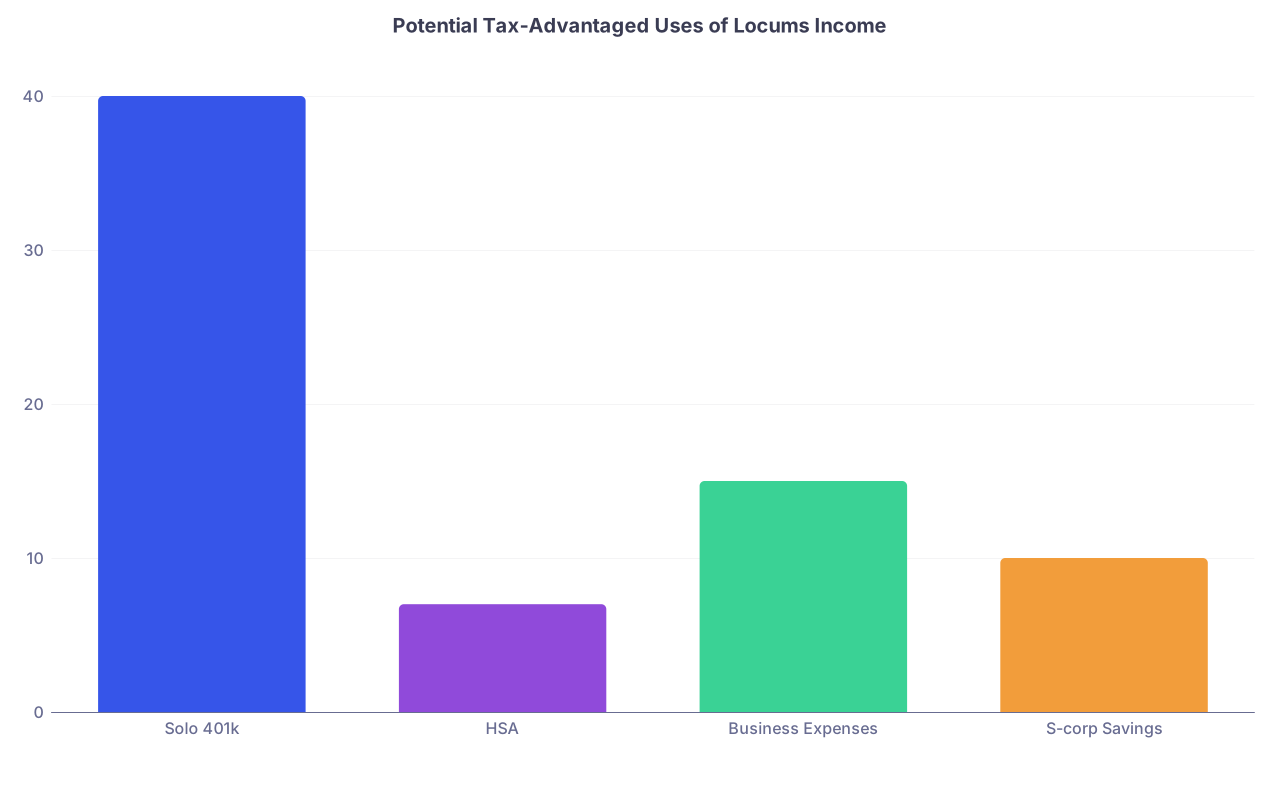
| Category | Value |
|---|---|
| Solo 401k | 40 |
| HSA | 7 |
| Business Expenses | 15 |
| S-corp Savings | 10 |
(Values here are illustrative thousands of dollars for a high‑earning doc.)
8. Multi‑State Locums: The Hidden Complexity
If you’re doing locums across state lines, the complexity multiplies fast.
You may:
- Owe income tax in multiple states
- Need to file non‑resident returns
- Deal with states that tax income you earned while physically there, even if you live elsewhere
Two practical tips:
Before accepting an out‑of‑state gig, ask bluntly:
“Are you withholding any state income tax for me?”
Most of the time the answer for 1099 is no—but occasionally systems get weird.Track days worked per state in a simple spreadsheet. Date, location, hours. Your CPA will love you and your return will be cleaner.
If you live in a no‑income‑tax state (TX, FL, etc.) but work locums in high‑tax states (CA, NY, etc.), you won’t pay your home state, but you will pay the work states. Do not assume your home state rules magically apply everywhere.

9. What to Actually Do This Month If You’re Already In It
Let me be very concrete. If you’re currently doing both locums and full‑time work and haven’t handled taxes well so far, here’s the triage plan:
- Open a separate business checking account. Today. Route all future locums payments there.
- Go through this year’s locums deposits and total them.
- Multiply that total by 35–45%. That’s your approximate tax exposure.
- Compare how much has already been withheld from your W‑2 (look at your latest paystub: “federal withholding”) plus any estimates you’ve actually paid.
- If you’re behind, schedule a catch‑up estimated payment through IRS Direct Pay and/or increase your W‑2 withholding ASAP.
- Gather receipts/emails for:
- Licenses
- CME
- Travel
- Malpractice
- Any professional services
- Book a meeting with a CPA who actually works with physicians with 1099 income. Not your cousin’s tax guy who mostly files 1040‑EZs.
If you do those seven things, you’ve already dodged 80% of the disaster scenarios I see.
FAQs
1. Can I just have my full‑time job withhold “extra” and skip quarterly estimated payments for locums?
Yes, if you do it correctly. The IRS doesn’t care whether tax gets paid through payroll withholding or quarterly estimates, just that it’s paid on time and in sufficient amounts. Many physicians find it easier to bump W‑2 withholding (using line 4(c) on the W‑4 for an extra flat dollar amount per paycheck) than to remember four separate estimated payments. Just make sure the total paid in (W‑2 plus any estimates) hits one of the safe harbors: 100/110% of last year’s total tax or 90% of this year’s.
2. Do I really need an LLC for my locums work?
No, you don’t “need” it. You can operate as a sole proprietor under your own name and Social Security number and you’ll report the income the same way on Schedule C. An LLC mainly helps with organization and future flexibility, not magical tax savings by itself. If your locums income is modest (say under $25k/year), clean bookkeeping and a separate account matter far more than forming an entity. Once you’re consistently doing $75–100k+ of locums, an LLC becomes more attractive as a base for possibly electing S‑corp status later.
3. If my main job already maxes Social Security, do I still pay self‑employment tax on locums income?
Partially, yes. Social Security tax (the 12.4% portion of self‑employment tax) is capped at the annual wage base, and your W‑2 income usually fills that up first. Once that’s maxed, your 1099 income is no longer hit with that 12.4%, but you still owe Medicare tax (2.9% total) plus the 0.9% additional Medicare tax above the threshold. So the self‑employment tax impact on locums income is reduced, but not gone. This is one of the reasons S‑corp planning can get interesting at higher combined incomes—but you still need to run the numbers carefully.
Key points to remember:
- Treat every locums dollar as pre‑tax business income and carve out 35–45% immediately for taxes.
- Use your W‑2 withholding and/or quarterly estimates deliberately so you never face a giant bill with penalties.
- Keep locums finances separate, track real expenses, and only mess with LLCs/S‑corps when the income and your bandwidth justify the extra complexity.


