The residency years are exactly when most doctors quietly double the real cost of their student loans.
Not in some dramatic, one-time blunder. In a slow drip of small, “I’ll deal with it later” decisions that compound into six-figure mistakes.
If you’re in residency or about to start, you’re walking through a financial minefield. And most of the mines are labeled “normal,” “standard,” or “recommended.”
Let me walk you through the biggest residency-year money errors that quietly explode your loan cost—and how to step around them.
1. Ignoring Your Loans During Intern Year
This is the classic error: assuming “I can’t afford payments in residency anyway, so I’ll just ignore everything until I’m an attending.”
That’s exactly how you turn a $250,000 balance into $400,000+ by the time you finish fellowship.
The dangerous version of “ignoring” looks like this:
- You never log in to your servicer account after graduation.
- You let your loans automatically enter the “standard” 10-year plan, then switch to forbearance when the payment looks insane.
- You don’t know your interest rates, servicer, or total principal.
- You never pick a real repayment strategy. You’re just surviving.
Here’s what this does to you:
- Interest accrues every single day, even if you’re in forbearance (and usually even in many income-driven repayment plans if your payment doesn’t cover all interest).
- Capitalization events (more on that later) turn that unpaid interest into new principal.
- Your future payments are calculated on a bloated balance that never needed to get that big.
If you only do one thing this month, do this:
- Find out:
- Total federal loan balance
- Interest rate(s)
- Current repayment plan
- Whether you’re on track for PSLF or not
And don’t delegate this to “future you.” That person is already tired and overcommitted.
2. Choosing the Wrong Repayment Plan “Just to Survive”
The worst loan mistakes in residency aren’t dramatic. They’re the subtle ones where you pick the path that seems emotionally easiest in the moment.
The big three traps:
- Forbearance as your default
- Extended or graduated plans when you might qualify for PSLF
- Randomly picking an income-driven plan without understanding how it treats interest and your future attending income
Forbearance is the most toxic one.
You see a required payment of $2,000/month on the standard plan. You panic, click “forbearance,” feel relief, and tell yourself you’ll “revisit this next year.”
Here’s what you just did: you started a silent interest bomb.
| Category | Value |
|---|---|
| Year 1 | 16250 |
| Year 2 | 16250 |
| Year 3 | 16250 |
| Year 4 | 16250 |
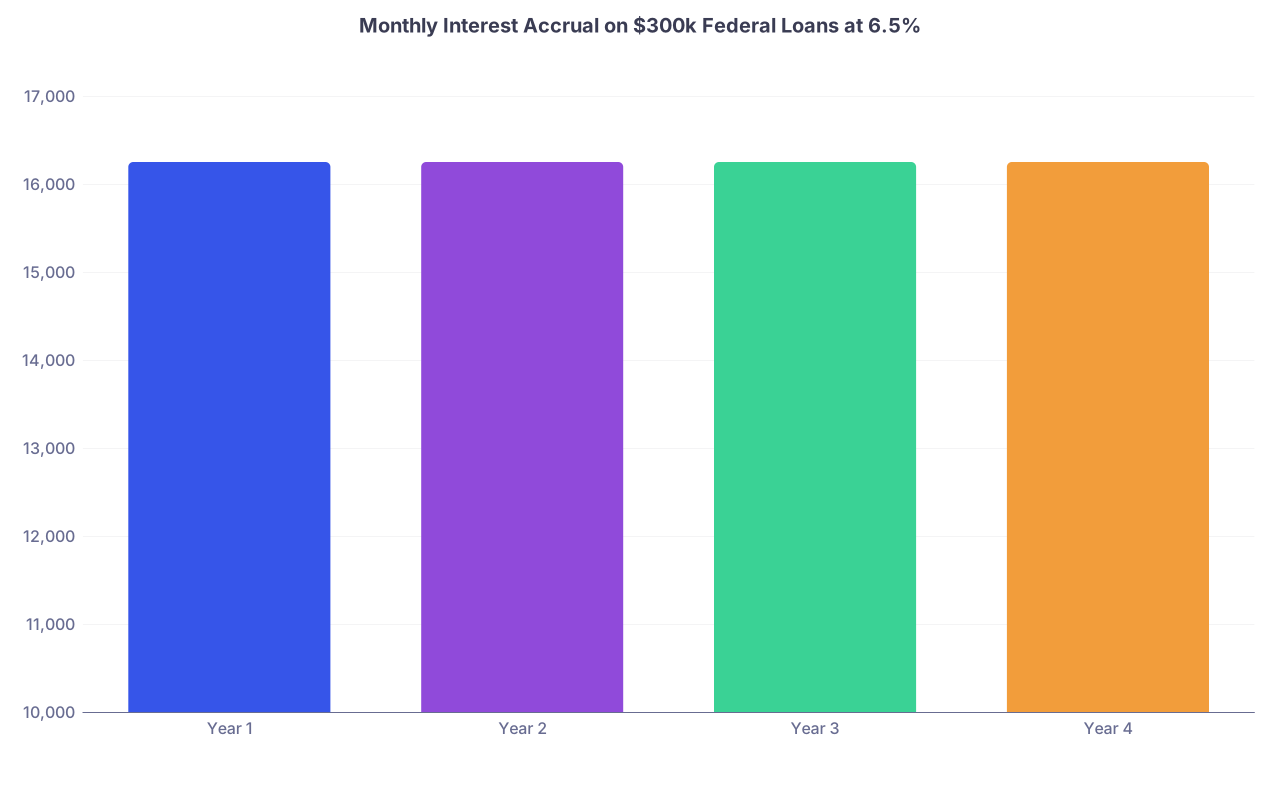
That’s roughly $16,250 in interest each year of residency if you pay nothing. Over 4 years, that’s $65,000 added to your balance—before capitalization.
For most residents, income-driven repayment (IDR) is the least bad option, especially:
- SAVE (if available to you)
- PAYE (if you’re still allowed to enroll)
- Old IBR (not ideal, but sometimes the only option)
Why they’re better than forbearance:
- Your payments are tied to your residency income, not your debt.
- You may get partial interest subsidies (especially with SAVE).
- Every qualifying payment counts toward PSLF if you’re in a nonprofit hospital system.
The mistake isn’t “not paying a lot in residency.” That’s normal. The mistake is choosing forbearance over an IDR plan without doing the math.
3. Misunderstanding Interest Capitalization (And Getting Burned Repeatedly)
Residents underestimate this one constantly. They think interest capitalization is a technical detail. It’s not. It’s the part where your loans level up into a harder boss.
Interest capitalization = your unpaid interest gets added to your principal. Then your new bigger principal starts generating MORE interest.
People trigger capitalization way more than they realize. Common landmines:
- Leaving forbearance and entering repayment
- Switching certain repayment plans
- Consolidating loans at the wrong time
- Failing to recertify your income on time for IDR
- Letting grace periods expire without a plan
Picture this:
- You graduate with $280,000 at 6.5%.
- You do a year of forbearance during intern year: roughly $18,200 in interest piles up.
- At the end of forbearance, that $18,200 capitalizes. Your new principal is ~$298,200.
- For the rest of your life, every interest calculation is based on that larger number.
Do this multiple times—grace period, forbearance, a consolidation at the wrong time—and you end up with a balance that looks fake.
The smarter move:
- Minimize the number of times you trigger capitalization.
- If you’re going to consolidate, do it early and intentionally, not after years of accrued interest.
- Get on an IDR plan as soon as it makes sense, not after bouncing in and out of forbearance.
You don’t need to be a loan nerd. You just need to know: any time you change your status, ask, “Will this capitalize interest?” If the answer is yes, think twice.
4. Screwing Up PSLF During the Only Years That Are Basically Free
This one physically hurts to watch.
You’re:
- At a 501(c)(3) hospital
- Working 70–80 hours/week
- Making $60–75k
- Crushed by loans
And still somehow not getting PSLF credit because of paperwork sloppiness or bad assumptions.
The quiet disasters I see all the time:
- Residents who spend 3–4 years in forbearance at a nonprofit hospital—zero PSLF progress.
- People on the wrong repayment plan (e.g., extended) that doesn’t qualify for PSLF.
- Residents who never submit the Employment Certification Form (ECF) yearly, then discover a decade later that half their time didn’t count for some avoidable reason.
- People who consolidate late and unintentionally reset their PSLF clock.
Here’s the part everyone misses: your residency years are premium PSLF years.
You’re:
- At qualifying employers
- Making low income (which makes your IDR payments low)
- Getting maximum forgiveness bang for each small payment
So what destroys PSLF during residency?
- Not being on a qualifying repayment plan (must be an IDR or certain standard plans)
- Not consolidating FFEL or Perkins loans into Direct Loans when needed
- Not documenting your employment annually
- Letting your servicer “advise” you into forbearance because “you can’t afford payments”
If there’s even a 20–30% chance you’ll work at a nonprofit system for 10+ years total (residency + attending), you protect your PSLF eligibility aggressively.
Send the ECF annually. Confirm your plan is qualifying. Keep copies of everything. Do not assume the system will track this correctly for you. It won’t.

| Step | Description |
|---|---|
| Step 1 | Start Residency |
| Step 2 | PSLF not likely |
| Step 3 | Check Loan Types |
| Step 4 | Consolidate to Direct |
| Step 5 | Choose IDR Plan |
| Step 6 | Submit ECF Yearly |
| Step 7 | Track PSLF-qualifying payments |
| Step 8 | Nonprofit Hospital |
| Step 9 | Direct Loans |
5. Refinancing Too Early (Or Never At All)
Refinancing is not an automatic “smart” move in residency. It’s a dangerous tool if used without context.
Two opposite and equally expensive mistakes:
- Refinancing federal loans to private during residency when you might qualify for PSLF or need federal protections.
- Never refinancing—even after training—when you’re definitely not doing PSLF and could drop your interest rate by 2–3%.
What refinancing does:
- Converts federal loans → private loans
- Locks in a rate (fixed or variable)
- Permanently kills:
- PSLF eligibility
- Federal IDR options
- Federal forbearance/deferment protections
- Any future federal relief programs
During residency, refinancing sometimes makes sense. Example: you’re 100% sure you’re going private practice, non-academic, no PSLF, and a resident refi program offers you a much lower rate with small required payments.
But many residents refi because:
- A company advertises aggressively at your program.
- Their co-residents are doing it.
- Someone told them, “Always lower your rate when you can.”
That “always” is how people lose $200k+ of potential PSLF because they wanted to save a few thousand in interest during residency.
On the flip side, the “never refinance” crowd:
- Finishes training
- Takes a high-paying private job
- Has $350,000 in federal loans at 7%
- Definitely not going for PSLF
- And still doesn’t refi for years out of fear of “doing it wrong”
That can cost you tens of thousands in unnecessary interest.
Here’s a simple mental rule:
- If PSLF is even possibly on the table → Do not refinance federal loans to private.
- If PSLF is clearly off the table and your debt-to-income ratio is strong → You probably are wasting money by not refinancing.
| Feature | Federal Loans | Private Refi Loans |
|---|---|---|
| PSLF eligible | Yes | No |
| IDR plans | Yes | Sometimes (worse terms) |
| Forbearance options | Stronger | Limited/variable |
| Interest rates | Often higher | Can be lower |
| Future relief (policy) | Possible | Very unlikely |
6. Letting Lifestyle Creep Outrun Your Future Self
This isn’t about buying coffee or having Netflix. That’s noise.
The real residency lifestyle mistake is locking yourself into a high fixed-cost life that assumes your future attending income will magically erase your past.
I’ve seen this exact pattern:
- PGY-1: Reasonable rent, used car, no kids or one kid, low fixed costs.
- PGY-3–4: New car lease, bigger apartment, second car, daycare, maybe a house purchase as chief year hits.
- Fellowship: Move again, repeat costs, now with higher expectations.
Individually, nothing looks insane. Together, they leave you with no room to attack your loans later. You finish training with:
- $350–450k in student loans
- $40–60k in car loans
- A mortgage with minimal down payment
- No emergency fund
- Credit card debt that started as “moving expenses”
The hidden danger: if your first attending job isn’t the dream job—or the comp package disappoints—you’re financially trapped. You can’t pivot to academic or lower-paying but more sustainable roles without feeling like you’re drowning.
You don’t need to live like a monk. But you do need to avoid permanent commitments that assume future-you will always be making top-quartile attending money and love their job.
Simple red flag test: if a resident purchase locks you into payments >3 years (cars, houses, big lifestyle upgrades), you better be very sure about your training path and post-training plan.
7. Ignoring Taxes, Moonlighting, and Side Income Strategy
Residents often chase moonlighting and side income with no tax or loan strategy. That’s how you accidentally make a lot of money and keep very little of it.
Common traps:
- Picking up tons of 1099 moonlighting without setting aside taxes, then getting hammered with a $5–10k bill.
- Not understanding that higher income this year may raise your IDR payment next year if it’s used in recertification.
- Failing to use pre-tax space (401(k)/403(b), 457(b), HSA) that could lower your AGI, reduce IDR payments, and speed up PSLF forgiveness.
You want to avoid the “floating but stuck” zone: where you’re working more, paying more tax, and not meaningfully changing your long-term loan picture.
If you’re going for PSLF:
- High income during PSLF years can actually increase your total paid (since you want lower IDR payments).
- Sometimes, directing more into pre-tax retirement as a resident is a double win: future savings and lower PSLF-qualifying payments.
If you’re not going for PSLF:
- Side income can be very helpful, but only if it’s not getting torched by poor tax handling or thrown into more lifestyle creep.
- You need a plan for every extra dollar: loans, emergency fund, high-interest debt—not random spending.
The mistake is working yourself sick with extra shifts and ending up with almost nothing to show for it.
8. Assuming “Any Lawyer/Advisor/Servicer Rep Will Protect Me”
Let me be blunt: loan servicers are not your friends, and a shocking number of financial advisors do not understand medical training or PSLF at a granular level.
The mistakes here:
- Calling your servicer, asking what to do, and treating their answer as gospel.
- Taking PSLF advice from HR people who have never read the fine print.
- Hiring generic financial advisors who get paid on assets under management, then unsurprisingly emphasize investing while treating $400k in 7% loans like background noise.
I’ve seen servicer reps recommend:
- Forbearance during residency “so you can focus on training” to people at nonprofit hospitals who would’ve crushed PSLF progress.
- Non-qualifying repayment plans to PSLF candidates.
- Consolidations that reset PSLF clocks with zero warning.
They’re not evil. They’re under-trained and rushed.
You don’t need to become a full-time loan expert. But you do need to:
- Verify everything yourself from official PSLF and federal loan resources.
- Be skeptical of any advice that:
- Minimizes the impact of interest rates and capitalization
- Assumes PSLF is “too good to be true” or “will go away” without any evidence
- Pushes private refinancing quickly, especially during residency
If an advisor can’t clearly explain:
- How your loans will behave (balance and payment) over the next 10–20 years under different scenarios
- How PSLF actually counts payments
- How IDR payments are calculated and recertified
Then they’re not the one to guide you through this.
9. Not Having a Simple Written Plan (And Letting Anxiety Run the Show)
The last mistake is more psychological than technical: drifting.
You procrastinate decisions because they’re stressful. You toggle between online calculators, half-listen to co-residents, maybe sign up for an IDR plan in a hurry, then never revisit it.
What this does:
- Keeps you in permanent low-level financial anxiety.
- Leads to inconsistent decisions (forbearance here, random plan changes there).
- Guarantees you wake up 5–7 years later with a bigger balance and no clear path.
You don’t need a 40-page binder.
You need a one-page plan that answers:
- Am I aiming for PSLF, or am I planning to pay these off myself?
- What’s my repayment plan during residency?
- What events will make me reconsider (switching to private sector, getting married, big income changes)?
- When will I consider refinancing (if ever)?
That’s it. That bare minimum level of intention will put you ahead of most residents financially.
FAQ (Exactly 5 Questions)
1. I’m starting intern year with $320k in loans. Should I use my 6-month grace period or start payments immediately?
Don’t just burn the grace period by default. If you’re going for PSLF and can get on an IDR plan right away at a nonprofit hospital, starting qualifying payments sooner is often better than a “free” grace period that only racks up unpaid interest. If you are truly cash-strapped and not sure about your path, you might use part of the grace period, but make that a conscious trade-off, not just autopilot.
2. How do I know if my hospital counts for PSLF during residency?
PSLF is based on the employer, not your specialty or role. Look up your institution in IRS nonprofit databases or check if it’s a 501(c)(3). Most big academic medical centers qualify. But don’t trust hallway gossip—confirm in writing if you can, and then submit a PSLF Employment Certification Form so the servicer acknowledges it.
3. Is it ever smart to refinance during residency?
Sometimes. If you are 100% sure you will not pursue PSLF (e.g., your program and future job are both private, non-501(c)(3)), and a resident refi program offers a substantially lower rate with affordable payments, it can save interest. But the bar is high. Any significant chance of PSLF, any uncertainty about your career path, and you should keep federal loans federal during training.
4. My spouse has no debt but a good income. How does that affect my residency repayment strategy?
Their income can raise your IDR payment if you file jointly, which may be good or bad depending on whether you’re pursuing PSLF. Sometimes, residents going for PSLF file taxes separately to keep IDR payments lower, trading some tax efficiency for larger eventual forgiveness. That’s a numbers decision—run both scenarios before choosing. Don’t just default to “married filing jointly” without checking the loan impact.
5. I feel overwhelmed and behind. Is it too late if I’m already PGY-3 with growing balances?
No, but stop letting that feeling paralyze you. You can still: consolidate correctly if needed, get onto a qualifying IDR plan, start PSLF-eligible payments if your employer qualifies, and avoid further capitalization events. You may not undo past mistakes, but you can absolutely stop adding new ones. The most expensive years are the ones where you keep doing nothing because you’re embarrassed you didn’t start sooner.
You do not need to be perfect with your loans during residency. But you can’t afford to be careless.
If you remember nothing else:
- Forbearance and ignorance are how balances quietly double.
- PSLF during residency can be insanely valuable—do not sabotage it with paperwork laziness or bad advice.
- Pick a simple, written strategy and stop letting “I’ll figure it out later” make the decisions for you.