
You’re three years out of school. You finally make a real salary. You’re staring at:
- Six figures of student loans
- A 401(k) enrollment email from HR
- A taxable brokerage account that’s been bleeding red ink this year
And you’re thinking: “I’m trying to crush these loans. Am I insane for even thinking about tax-loss harvesting or retirement savings right now?”
Let me break this down specifically. Because “just pay off debt first” is oversimplified, and “always max retirement before everything” is also wrong for a lot of high-debt professionals.
You’re juggling three levers at once:
- Aggressive loan payoff
- Tax-advantaged retirement savings
- Tax-loss harvesting in a taxable account
You need a priority framework, not random tips.
1. The Real Question: What Are You Optimizing For?
You are not deciding between “being good” and “being bad with money.” You are deciding between:
- Guaranteed return from shrinking debt
- Probable long-term return (with tax advantages) from retirement accounts
- Pure tax optimization moves in your taxable account
If you are aggressively paying loans, you’re doing the right thing on one axis: reducing guaranteed negative yield. But if you ignore the tax and retirement side completely, you leave money on the table.
Start with this mental model:
- Retirement accounts = tax structure
- Tax-loss harvesting = tax timing and rate arbitrage
- Loan payoff = risk and cash-flow control
Your job is to combine them in a sequence, not choose them one-at-a-time in isolation.
2. First Filter: Your Loan Situation Drives the Strategy
Before we talk tax-loss harvesting, I need to know what world you live in:
- Are you on a forgiveness track (PSLF or long-term IDR forgiveness)?
- Or are you truly trying to erase every dollar ASAP?
Because those are completely different universes.
| Profile | Typical Goal | Core Loan Strategy |
|---|---|---|
| PSLF-bound public worker | 10-year forgiveness | Pay minimum, certify employment |
| Private practice high earner | No forgiveness | Aggressively pay off in <10 years |
| Mixed/uncertain | Not sure yet | Preserve flexibility, do not overcommit |
If you are PSLF-bound:
Aggressive payoff usually makes no sense. You should be minimizing payments, not principal, and maximizing retirement and tax efficiency. Tax-loss harvesting becomes more valuable because lower AGI can reduce IDR payments and increase effective PSLF subsidy.
If you are a private practice/high earner:
Then yes, aggressive payoff can be rational. But you still need to know whether the after-tax return on retirement contributions beats the after-tax “interest saved” from faster payoff.
3. The Core Priority Stack (If You’re Truly Aggressively Paying Loans)
I’ll assume this base case, since that is what you asked for:
- You are not planning on PSLF
- Your loans are federal Direct or private, interest rate 4–8%
- You are paying well above minimums
- You still want to be smart about taxes and retirement
Here’s the strict priority framework I use with people in your situation:
- Emergency buffer (bare minimum: 1–3 months essential expenses)
- Capture any true employer retirement match (401(k)/403(b))
- Evaluate loans vs. pre-tax vs. Roth contributions
- Use tax-loss harvesting in taxable accounts to reduce current tax cost and improve flexibility
- Direct “extra” cash either to loans or additional retirement based on interest vs. expected after-tax return
Let’s go stepwise.
4. Retirement Savings vs Loan Payoff: Math, Not Feelings
Forget slogans like “debt-free as fast as possible.” You want to compare:
- Effective after-tax return from loan payoff
- Effective after-tax return from retirement contribution
Step 1: Effective after-tax cost of your loans
If your loans are not deductible (most are not, especially if your income is high and you phase out the student loan interest deduction), the effective cost is just the stated rate.
- 6.8% loan with no deductibility → 6.8% after-tax guaranteed cost
If you have some deductibility (most residents and lower earners):
- 6.8% interest, marginal federal + state rate say 24%
- After-tax cost ≈ 6.8% × (1 − 0.24) ≈ 5.2%
That is your “risk-free return” from paying them down.
Step 2: Effective return on retirement contributions
Pre-tax 401(k)/403(b):
- Immediate benefit = marginal tax rate savings on contribution
- Long-term benefit = tax-deferred growth
- Long-term cost = taxes on withdrawal in retirement
Example:
You are in 32% combined marginal bracket now. You put $10,000 into pre-tax 401(k). You save $3,200 in taxes this year. If your retirement tax rate is 22%, you basically:
- Convert $10,000 of “today at 32% tax” into “tomorrow at 22% tax”
- That is a permanent 10% rate arbitrage, plus decades of sheltered growth
Roth 401(k)/Roth IRA:
- No immediate tax savings
- Future withdrawals are tax-free
- Makes sense when your current marginal rate is low relative to future rate (residents, early career with low income, or clearly under-taxed years)
So the choice is not “pay loans vs invest.” It is:
- Do I want a guaranteed ~5–7% payoff (loan)
- Or a tax-arbitrage + long-term market growth bet (retirement account)
For most high earners with rates above ~5–6%, the correct answer is usually:
- Always capture match
- Strongly consider at least some pre-tax retirement contributions while paying loans, because the tax savings themselves can be used to accelerate payoff
5. Where Tax-Loss Harvesting Actually Fits
Now to your main buzzword: tax-loss harvesting (TLH).
Tax-loss harvesting is not “more investing.” It is tax engineering in your taxable account. You realize capital losses by selling investments that are down and pairing those losses against:
- Capital gains this year (or in future, via carryforwards)
- Up to $3,000 of ordinary income per year
It does not change your investment risk if you do it properly. You sell Fund A at a loss and buy a similar (not “substantially identical”) Fund B the same day. Same market exposure, better tax position.
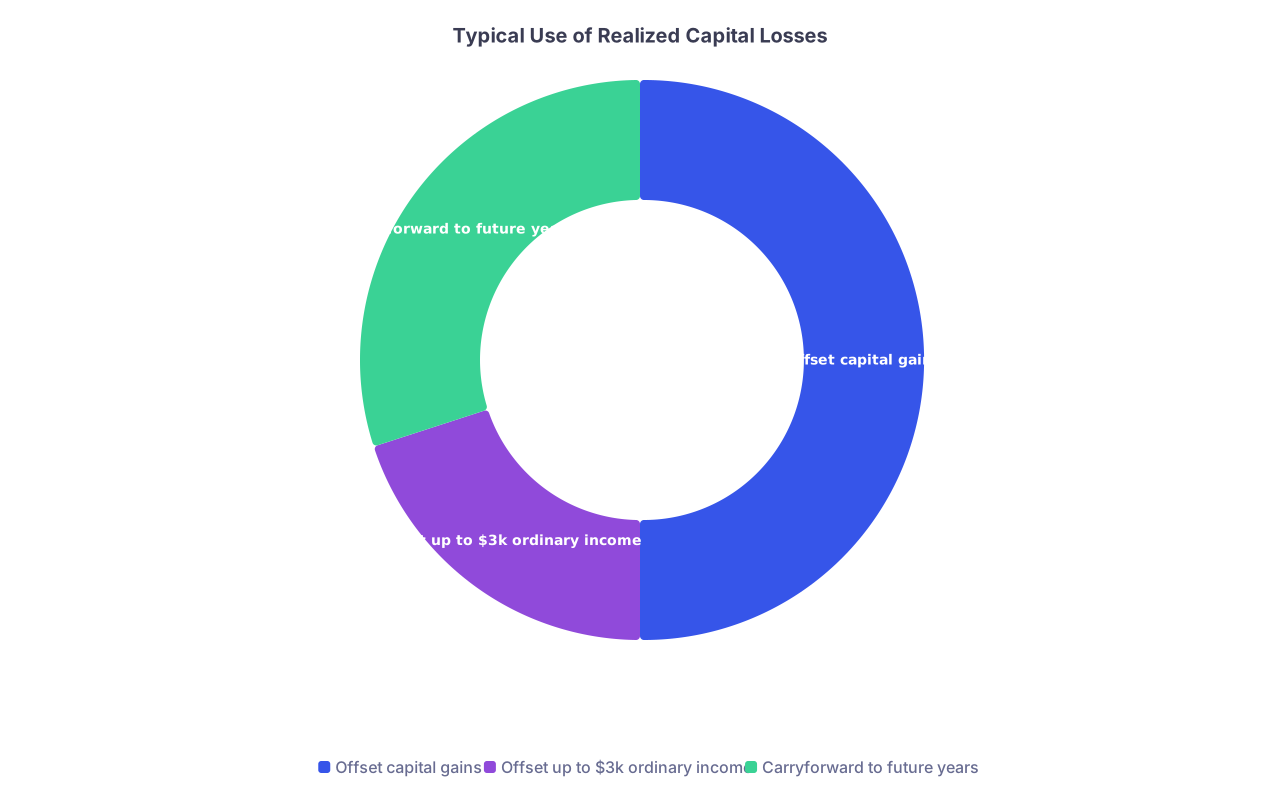
| Category | Value |
|---|---|
| Offset capital gains | 50 |
| Offset up to $3k ordinary income | 20 |
| Carryforward to future years | 30 |
Where does this fit while aggressively paying loans?
- It decreases your current tax bill
- Lower tax bill = more take-home cash you can direct to loans or retirement
- Over time, loss carryforwards let you realize gains later with little/no tax cost
So TLH is an efficiency layer that sits on top of your real decision: how much cash goes to loans vs. retirement vs. taxable investing.
If you already have a taxable account (pre-med, pre-residency, or a signing bonus you invested), TLH is almost always worth doing when markets are down. It is not in conflict with aggressive loan payoff.
6. A Concrete Integrated Example
Let’s build a realistic scenario, because abstractions get fuzzy.
- Age 30, attending physician
- Income: $260,000
- Federal + state marginal tax rate: ~35%
- Student loans: $250,000 at 6.5%, no PSLF, goal to pay in 7–10 years
- Employer 403(b) with 4% match, plus access to Roth and pre-tax options
- Taxable brokerage from previous years: $40,000 in broad index funds, currently at a $6,000 unrealized loss
You are tempted to throw every spare dollar at loans.
Here is a rational integrated plan.
Step A: Capture the free money
Contribute at least enough to 403(b) to get the full 4% match. Non-negotiable.
- 4% of $260k = $10,400 employee
- Employer adds $10,400
- Immediate 100% return on the match, plus tax benefits
You are not “sacrificing” loan payoff to do this. Doing otherwise is just lighting compensation on fire.
Step B: Decide pre-tax vs. Roth for additional contributions
At a 35% marginal rate now, with likely lower rates in retirement, pre-tax is extremely strong:
- Every $10,000 pre-tax contribution saves ~$3,500 in current tax
- If your blended retirement rate ends up 22%, you permanently captured a 13% rate gap besides the compounding
So you might:
- Contribute $19,500–$23,000 pre-tax to 403(b) (depending on current limits), not just up to the match
- Use the tax savings to support aggressive payoff
Step C: Use tax-loss harvesting to produce extra cash flow
You harvest the $6,000 loss in taxable:
- Realize −$6,000 capital loss
- First, it offsets any realized capital gains (maybe you have some from rebalancing or RSUs)
- Remaining loss up to $3,000 can offset ordinary income
Let’s say you have no gains this year and you take the full $3,000 against ordinary income:
- $3,000 × 35% = $1,050 tax savings this year
- The other $3,000 carries forward to next year
Now look at the integration:
You never changed your asset allocation. You simply:
- Sold Total US Stock Fund A at a loss
- Bought Total US Stock Fund B from a different issuer / slightly different index
Same risk. But $1,050 less in taxes. That $1,050 can go straight to loan principal.
Step D: What about the “aggressive payoff” part?
You now build a monthly plan:
- Minimum loan payment: say $2,600 / month
- Extra aggressive payment: additional $1,400–$2,000 / month
- Retirement: $1,700–$2,000 / month into 403(b) pre-tax
The key insight:
The dollars going into retirement are not “lost” from your loan strategy. The tax savings from those contributions plus TLH partially “refund” you, and you re-route that refund into the debt paydown.
Put differently: you are using the tax code to help you pay your loans and fund retirement simultaneously.
7. The Mechanics of Tax-Loss Harvesting (Without Screwing It Up)
If you already have a taxable account, here is how TLH works in practice.
Step 1: Identify loss positions
- Scan holdings for positions trading below your cost basis
- Focus on broadly diversified ETFs or mutual funds, not individual stocks you are emotionally attached to
Step 2: Be aware of the wash-sale rule
Wash-sale rule (simplified):
- If you sell a security at a loss and buy the same or substantially identical security within 30 days before or after, the loss is disallowed (deferred by adding to basis).
You want to:
- Sell Fund A (e.g., Vanguard Total US Stock ETF) at a loss
- Immediately buy Fund B (e.g., iShares Core S&P Total US Stock ETF)
Same general exposure, different issuer and benchmark. You stay invested, but the loss is valid.
Watch out for:
- Automatic dividend reinvestments buying the same fund within that ±30-day window
- Buying in a different account (Roth IRA, spouse’s account) that triggers the same issue
Disable auto-reinvest temporarily if you are actively harvesting.
Step 3: Record-keeping and carryforwards
Your brokerage and tax software will track realized losses and carryforwards, but do not abdicate your brain:
- Verify 1099-B every year
- Confirm that capital loss carryforwards are rolling forward correctly on Schedule D
And do not get cute: no day-trading style churning just to harvest micro-losses. You are not gaming the system; you are aligning it with your reality.
8. Special Case: When You Are on IDR / PSLF and “Aggressively Paying”
There is a group that thinks they are aggressively paying loans while on a forgiveness track. They are usually making two mistakes:
- Paying more than required while still likely to have forgiveness
- Not using the tax system strategically to minimize IDR payments
If you are PSLF-bound at a nonprofit hospital:
- Extra payments now typically do not improve your total cost. They just reduce how much is forgiven later. That is bad math.
- What matters is minimizing required payments (taxable income and filing status) and surviving the 120 qualifying payments.
In that context:
- Maximize pre-tax retirement contributions → reduces AGI → reduces IDR payment → increases effective PSLF subsidy
- Tax-loss harvesting that produces $3,000 of extra deduction each year also marginally lowers AGI → slightly lower IDR payment
So TLH and retirement savings are not “nice to haves.” They are part of your loan strategy.

| Step | Description |
|---|---|
| Step 1 | High Debt Federal Loans |
| Step 2 | Use IDR Plan |
| Step 3 | Aggressive Payoff |
| Step 4 | Max Pre-tax Retirement |
| Step 5 | Lower AGI |
| Step 6 | Lower IDR Payment |
| Step 7 | More Forgiveness |
| Step 8 | Tax Loss Harvesting |
| Step 9 | Eligible for PSLF? |
If you insist on “aggressively paying” while PSLF-eligible, realize you’re likely subsidizing the government.
9. Behavioral Reality: Risk Tolerance and Sleep-at-Night Factor
Pure math says:
- If your loan rate is 3% and your expected after-tax market return over 20–30 years is 5–7%, you should not aggressively prepay.
- If your loan rate is 8% and your realistic expected return is 5–6%, you should favor payoff heavily.
Most people do not live by pure math. And that is fine. I have seen plenty of high earners who perform significantly better once the psychological weight of debt is gone, even if they “lost” a little on optimization.
So I will say this directly:
- If having a $0 loan balance is a major psychological goal, you can tilt more towards payoff, but still capture match and some tax benefit.
- If you are comfortable with leverage and volatility, you can lean more into retirement savings and just pay loans on a brisk but not insane schedule.
Where TLH fits either way:
- It is low-friction. Low emotional cost.
- It is almost always “free money” if you are already investing in taxable accounts.
- It does not conflict with either payoff philosophy.
10. A Simple Decision Framework You Can Actually Use
Here is the distilled version you can run through each year.

| Step | Description |
|---|---|
| Step 1 | Start of Year |
| Step 2 | Emergency Fund 1 to 3 Months |
| Step 3 | Get Full Employer Match |
| Step 4 | Max Pre-tax Retirement |
| Step 5 | Compare Loan Rate vs Expected Return |
| Step 6 | Increase Extra Loan Payments |
| Step 7 | Increase Retirement Contributions |
| Step 8 | Tax Loss Harvest When Available |
| Step 9 | Direct Any Tax Savings Toward Chosen Priority |
| Step 10 | On PSLF Track? |
| Step 11 | Loan Rate High >6%? |
And for TLH specifically:
- If you have taxable accounts → check a few times a year, or after sharp market drops
- If there are meaningful losses and you can swap into a similar fund without wash-sale problems → harvest
- Use tax savings to support your current top priority (loans or retirement)
11. Timing: When Does TLH Actually Matter for You?
Let’s be blunt. TLH is not the first-order problem for a resident with no taxable account and $300 in a savings account. But for many early attendings and professionals, it becomes relevant fast.
Typical trajectory:
Year 0–2 out of training:
- Cash is tight, loans dominate mental space
- Little or no taxable account, maybe some small previous investments
- Focus: match, emergency buffer, then loan payoff intensity
Year 3–7 out:
- Income jumps
- You build a 401(k)/403(b), maybe backdoor Roth, and you start a taxable account
- Market volatility creates real opportunities to harvest 5–30k in losses
- TLH now becomes material to your total tax bill
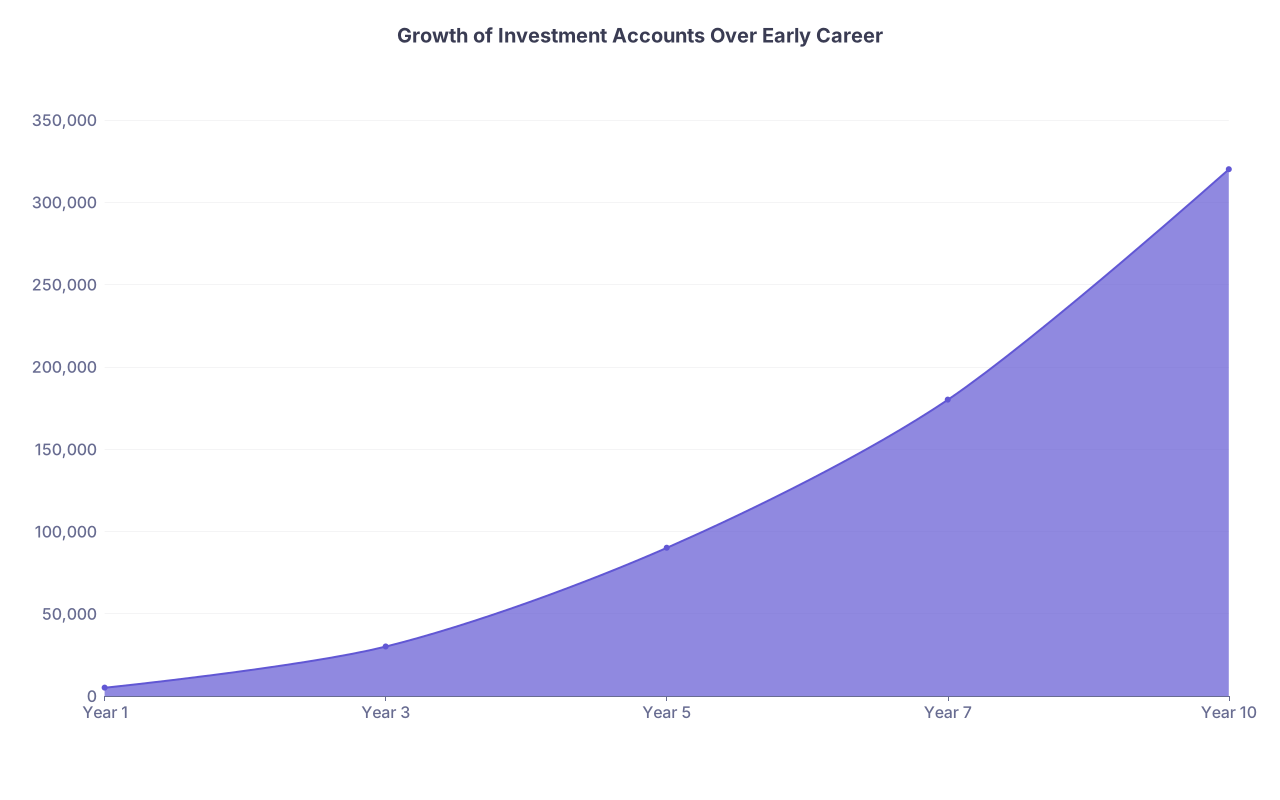
| Category | Value |
|---|---|
| Year 1 | 5000 |
| Year 3 | 30000 |
| Year 5 | 90000 |
| Year 7 | 180000 |
| Year 10 | 320000 |
Past year 7–10:
- Loans often gone or much smaller
- Retirement accounts and taxable accounts larger
- TLH is simply part of your yearly tax routine
So if you are at the early attending stage with even $20–50k in taxable and down markets, ignore the “I’m too focused on loans for that” instinct. You can do both in parallel.
12. Don’t Do These Three Dumb Things
I see people sabotage themselves with the same mistakes repeatedly:
Ignoring the employer match “because I’m focused on loans.”
This is like refusing free money to make a symbolic point. Wrong move.Day-trading TLH and turning a tax tool into a gambling habit.
TLH should not change your underlying asset allocation or long-term plan. If it does, you’re off-track.Mixing PSLF strategy with aggressive payoff logic.
Either you are minimizing payments and maximizing forgiveness, or you are paying to zero. The in-between “I’ll see how it goes” while throwing extra money at loans is usually the most expensive option.
13. Quick Implementation Checklist
If you want something you can literally do in the next month:
- Confirm: Are your loans on a forgiveness track (PSLF/IDR) or payoff track? Decide intentionally.
- Make sure you are getting 100% of your employer retirement match, at minimum.
- Decide pre-tax vs. Roth contributions for this year based on your marginal tax rate and expectations.
- If you have a taxable account, run through your positions for unrealized losses and set up a TLH plan with appropriate partner funds.
- Take any tax savings generated (from pre-tax contributions and TLH) and explicitly direct them either to:
- Extra principal payments (if payoff track with high rate), or
- Additional retirement savings (if loans are relatively cheap or forgiveness-based).
You do this consistently for 5–10 years, you will be in the top decile of outcomes among your peers. Not because you found some secret product, but because you stacked the basic levers correctly.
FAQ (Exactly 6 Questions)
1. If I am aggressively paying loans, should I ever invest in a taxable account at all?
Yes, but in sequence. First, capture your employer match. Second, decide how much additional retirement to fund vs. extra loan payments. Only once you are consistently doing those and still have surplus cash should you build a taxable account for long-term goals or flexibility. If your loans are 7–8% and you are not on a forgiveness track, taxable growth is usually lower priority than either payoff or tax-advantaged retirement savings.
2. How big do my unrealized losses need to be before tax-loss harvesting is “worth it”?
There is no magic number, but I generally ignore anything under $1,000 per position for high earners, because the tax benefit is small and not worth the hassle. Losses in the $3,000–$10,000+ range start to move the needle when your marginal rate is high. At a 35% bracket, a $10,000 loss can mean $3,500 of tax impact (spread over gains and ordinary income offset), which is absolutely worth doing.
3. Can tax-loss harvesting reduce my income-driven repayment amount on federal loans?
Indirectly, yes. Realized capital losses can offset up to $3,000 of ordinary income per year, which slightly reduces your Adjusted Gross Income. Since IDR payments are based on AGI (or a similar income measure), that can reduce your monthly payment and increase effective forgiveness over time. The effect per year is not huge, but layered with pre-tax retirement contributions, it adds up across 10+ years of PSLF.
4. Should I ever prioritize Roth contributions over loan payoff if my interest rate is high (6–8%)?
You can, but it needs a clear reason: either you are in an unusually low tax year relative to your expected future bracket (e.g., final year of training, part-time work) or you are close to retirement and trying to diversify tax risk. Otherwise, with 6–8% nondeductible loan interest and a high current marginal tax rate, pre-tax contributions and/or extra loan payoff usually beat Roth in pure financial terms. Roth is most attractive when your current tax rate is modest and you expect it to be higher later.
5. Does refinancing my loans change the way I should think about retirement vs. payoff vs. TLH?
Yes. If you refinance from, say, 7% to 3.5% or 4%, the “risk-free return” from extra payoff drops dramatically. At that point, the math leans much more toward: capture match, aggressively fund pre-tax retirement, then consider whether extra payoff still beats long-term expected after-tax returns. TLH becomes more relevant because you are more likely to accumulate taxable investments while comfortably servicing a lower-interest loan.
6. Is there any situation where tax-loss harvesting is a bad idea while I am aggressively paying loans?
It is a bad idea if doing it causes you to:
- Drift into a riskier or inappropriate asset mix just to realize losses, or
- Trigger wash-sale problems repeatedly and confuse your tax records, or
- Encourage you to trade excessively and detach from your long-term plan.
If you can keep your asset allocation stable, avoid wash sales, and treat TLH as a periodic maintenance task rather than a game, it is almost always beneficial, regardless of how aggressively you are paying your loans.
Key points, no fluff:
- Get the sequence right: emergency buffer → employer match → pre-tax vs. payoff decision → taxable and TLH.
- Use the tax code—pre-tax retirement and tax-loss harvesting—to generate cash that supports whichever priority you choose, loans or retirement.
- Do not mix forgiveness strategy with aggressive payoff logic; commit to one path and align your tax and investment moves accordingly.