The biggest PSLF disaster physicians face isn’t denial. It’s thinking they’re on track for forgiveness when the paperwork says otherwise.
I’ve watched attendings discover—ten, eleven, twelve years in—that half their “qualifying” payments never counted. Not because they weren’t working full-time. Not because they weren’t serving at a nonprofit hospital. Because of stupid, preventable documentation mistakes.
If you’re a physician planning to use Public Service Loan Forgiveness, you cannot treat paperwork as an afterthought. PSLF is a paper trail program. No paper trail, no forgiveness. Period.
Let’s walk through the most expensive documentation mistakes I see doctors make—and how to avoid burning six figures because someone “thought HR submitted it” or “assumed FedLoan/MOHELA would fix it.”
1. Assuming HR or GME “Took Care of It”
This is the most expensive lie in PSLF: “Our GME office handles that for residents.”
No. They do not. They might help. They might sign forms. But they are not tracking your qualifying payments, filing annual certifications, or checking whether your loans and repayment plan actually qualify. That’s your job.
Here’s the scenario I’ve seen too many times:
- Resident at a big academic hospital starts repayment.
- Someone in orientation says, “We’re a qualifying PSLF employer, you’re all set.”
- Resident assumes that means they’re enrolled in PSLF.
- Five years later, at fellowship or first attending job, they check and discover they have 12 qualifying payments instead of 60.
Why? Because:
- They never filed an Employment Certification Form (ECF) during residency.
- Their loans weren’t all Direct Loans.
- Their repayment plan wasn’t actually qualifying.
- HR never sent anything. Or sent it to the wrong place. Or it got rejected and no one followed up.
You avoid this mistake by adopting one rule:
Assume nothing is done until you see it in writing on your PSLF payment count.
That means:
- You personally download, fill out, and sign the PSLF form.
- You personally get HR to sign it (and verify dates and EIN are correct).
- You personally upload or mail it to MOHELA (current PSLF servicer).
- You personally confirm—months later—that your qualifying payment count updated.
If you haven’t seen your actual PSLF qualifying payment count on a servicer statement, you are not “on track”. You’re just hoping.
2. Not Consolidating Old Non-Direct Loans (FFEL/Perkins)
This one quietly kills forgiveness years down the line.
PSLF only applies to Direct Loans. That’s it. Not:
- FFEL (Federal Family Education Loan)
- Perkins Loans
- Health Professions / Nursing loans (school-based)
I’ve seen physicians with $200k+ in loans, who work 7+ years in a qualifying hospital, only to realize:
- Half their loans were FFEL.
- They never consolidated into a Direct Consolidation Loan.
- Those “payments” they’ve been making all this time? Not PSLF-qualifying. At all.
The most painful part: they could have converted them at the start of residency. They just never checked their loan types and assumed everything federal = PSLF-eligible.
You need to do a basic inventory:
- Log into studentaid.gov.
- Download the full loan list.
- Look at the Loan Type line for every single loan.
If you see anything other than “Direct” in the name, that loan does not qualify for PSLF unless you consolidate it into a Direct Consolidation Loan.
Here’s where people screw up the documentation:
- They consolidate late (year 7, 8, 9) without understanding that, historically, consolidation reset qualifying payments for that loan.
- They consolidate some loans but not others.
- They consolidate into the wrong repayment plan (non-qualifying), assuming PSLF will still count.
Right now, with the new PSLF one-time counts and IDR adjustments, there’s some retroactivity help, but do not bank your career finances on temporary, policy-based mercy. Assume the strict rule: only Direct Loans qualify.
Fix this early. Document what you consolidated, when, and into which repayment plan. Save those confirmations. If MOHELA’s count looks wrong later, this is the paper you’ll need.
3. Missing or Inconsistent Employment Dates on PSLF Forms
You can be at the perfect employer and still blow PSLF because your dates and signatures don’t line up.
Common mistakes I see on the PSLF Employment Certification Form:
- HR uses hire date instead of start of full-time service.
- Graduation or contract transitions are recorded incorrectly (e.g., they leave a gap between residency end and attending start).
- Employer tax ID (EIN) is wrong or inconsistent across forms.
- Part-time or 0.9 FTE roles not properly documented to prove average 30+ hours/week.
PSLF is binary and bureaucratic. The system isn’t asking, “Did this person work a ton?” It’s asking, “Does this form match our criteria and data?”
Your job:
- Check every date. Start, end, still employed—line by line.
- If your residency program changed names or merged, make sure the EIN and organization name still show as qualifying.
- If you switched from resident to fellow or attending within the same hospital, make sure the HR documentation doesn’t accidentally make it look like a break in employment.
I’ve watched physicians lose 12+ payments because:
- Their HR put their residency end date as June 15.
- Their attending contract start date was July 1.
- The servicer’s system read it as a 2-week gap, and due to timing, one scheduled payment got coded as non-qualifying.
Tiny nonsense like that adds up.
When you submit each PSLF form:
- Save a scanned copy of the signed form.
- Save screenshots of the upload confirmation.
- When MOHELA processes it, verify the dates and employer information match exactly.
If you see something off, fix it now, not year 9.
4. Failing to Certify Employment Annually (and After Every Job Change)
“I’ll just do it at the end” is how physicians lose track of entire jobs in PSLF.
You are not required by law to certify PSLF employment every year. But if you don’t, you’re inviting chaos:
- HR people leave. Their replacements have no record and are too busy to recreate history.
- Hospitals change software systems. Older employment data becomes a nightmare to retrieve.
- Your memory of exact dates and FTE status gets fuzzy.
- Employers merge or get acquired, changing names and EINs.
Then, ten years later, you’re trying to prove you worked full-time for a qualifying employer in 2016–2019 and the person who could have signed your form is long gone.
The safe pattern:
- Once a year, submit a PSLF form for your current employer.
- Every time you change jobs, submit a PSLF form covering your entire tenure at that job.
And this is where I see a subtle but expensive mistake:
People think, “I submitted a form my intern year, so residency is covered.” No. That covers employment through the date on the form, not indefinitely.
If you trained from 2017–2021 and your last PSLF form was signed in 2018, your record might only show:
- Qualifying employment: 2017–2018
- Nothing documented: 2019–2021
Will they let you fix it later? Maybe. Maybe not. I’ve seen both outcomes.
Document like there will be no second chances.
5. Not Keeping a Personal PSLF Paper Trail
This mistake is boring. It’s also borderline catastrophic if anything goes wrong.
Physicians trust their loan servicer to track PSLF correctly. That’s a bad habit from medical training—“someone else is handling the admin bits.”
Servicers screw up. They miscount payments. They misapply forbearances. They mis-code repayment plans. And when that happens, your best weapon is your own records.
You should have your own PSLF evidence folder (physical and digital). At minimum, keep:
- Every PSLF Employment Certification Form (completed and signed).
- Proof of submission: email confirmations, upload confirmations, fax receipts.
- Annual loan statements showing payment history.
- Any letters or messages from MOHELA about PSLF counts or employment approval.
- Copies of your employment contracts showing FTE status and dates.
If you ever need to challenge a payment count, the conversation is much, much easier when you can say:
“I’ve attached the PSLF forms for 2018–2023, each signed by HR, plus loan statements showing 120 consecutive payments in an income-driven plan while working full-time at an eligible 501(c)(3) hospital.”
Versus: “I thought it was all in the system.”
Here’s what a simple tracking table can look like:
| Year | Employer | Form Submitted? | Payments That Year | Cumulative Qualifying Count (Your Record) |
|---|---|---|---|---|
| 1 | Univ Med Center | Yes | 12 | 12 |
| 2 | Univ Med Center | Yes | 12 | 24 |
| 3 | Univ Med Center | Yes | 12 | 36 |
| 4 | County Hospital | Yes | 12 | 48 |
| 5 | County Hospital | Yes | 12 | 60 |
Your count and MOHELA’s count should roughly line up. If they don’t, you investigate early.
6. Sloppy Documentation Around Forbearance, Deferment, and IDR Changes
PSLF is about qualifying payments. Forbearance and many deferments = no qualifying payments.
Here’s where physicians get burned:
- They go into forbearance during fellowship or a tough attending year.
- They think they made 10 years of “being in repayment.”
- PSLF only sees 7 years of actual qualifying payments.
The mistake isn’t always taking forbearance (life happens). The mistake is:
- Not documenting exactly when forbearance started and ended.
- Not confirming that your repayment plan was re-established as PSLF-qualifying when you resumed.
- Not noticing that the servicer put you on a non-qualifying plan after forbearance “just to get you started.”
You need a timeline of your repayment life that includes:
- Start and end dates of every forbearance and deferment.
- Dates you changed repayment plans.
- The exact plan you were on during each period (PAYE, REPAYE, SAVE, IBR, etc.).
Then cross-check that against your PSLF qualifying payment count.
If the servicer’s record says:
- 60 total months, but only 42 qualifying PSLF payments,
you should be able to say, “Right, 18 months were forbearance during fellowship.” If the numbers don’t match your expectations, look for:
- Months where you were in a temporary, non-IDR plan.
- Months coded incorrectly.
- Administrative forbearances you didn’t realize were hurting your PSLF clock.
| Category | Value |
|---|---|
| Year 1 | 12 |
| Year 2 | 24 |
| Year 3 | 36 |
| Year 4 | 42 |
| Year 5 | 48 |
| Year 6 | 60 |
| Year 7 | 72 |
| Year 8 | 84 |
| Year 9 | 90 |
| Year 10 | 102 |
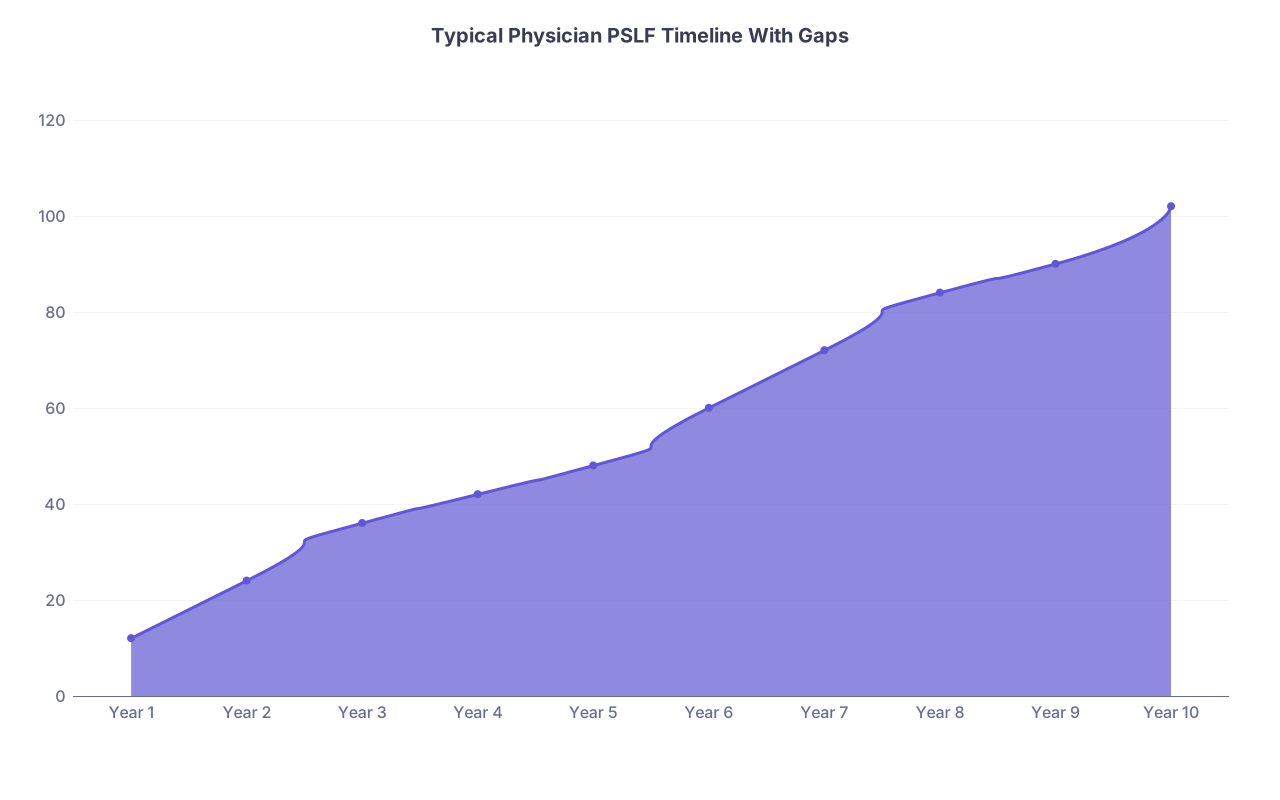
In that example, notice it never reaches 120 because of undocumented forbearances or non-qualifying periods. People are shocked by this gap—until they reconstruct what actually happened.
7. Assuming All Nonprofit or Government Work Automatically Counts
“501(c)(3) hospital” is not a magic phrase. You still have to prove:
- You’re an employee, not an independent contractor.
- You’re working full-time according to PSLF rules (generally 30+ hours/week or your employer’s full-time definition, whichever is greater).
- Your employer actually meets the PSLF definition, not just “feels like public service.”
Common pitfalls for physicians:
- Working for a private group that contracts with a nonprofit hospital (your paycheck comes from the group, not the hospital).
- Being paid as a 1099 independent contractor at a VA or county facility.
- Splitting time between a PSLF-qualifying and non-qualifying employer and not documenting the qualifying portion correctly.
I’ve seen attending physicians say, “But I’ve been at County Hospital for six years,” only to discover:
- The hospital is county-run (fine), but their employer is a physicians’ group organized as a for-profit.
- PSLF looks at who employs you, not where your patients are seen.
Do not guess. Use the PSLF Help Tool on studentaid.gov and plug in your employer by EIN. Then save a PDF of:
- The eligibility result.
- The employer details.
If you change employers or your group reorganizes, re-check it. PSLF eligibility can change with corporate structure. Your feelings about how “public” your work is don’t matter. The documentation does.

| Step | Description |
|---|---|
| Step 1 | Where does your paycheck come from |
| Step 2 | Potentially PSLF eligible |
| Step 3 | Likely not PSLF eligible |
| Step 4 | Submit PSLF form |
| Step 5 | Part time - special rules |
| Step 6 | Government or 501c3 |
| Step 7 | Full time 30+ hours |
8. Letting Servicer Changes Scramble Your Records
Servicers change. Files get moved. Data fields break. And physicians find out after the fact that their PSLF counts were “recalculated” in a way that doesn’t match reality.
Every time there’s a big transition (like PSLF moving to MOHELA):
- PSLF counts can change.
- Payment histories can look different.
- Some periods can be miscoded or lost in translation.
The mistake is trusting that whatever the new statement shows is automatically correct.
Instead, when a servicer change happens:
- Download everything from the old servicer’s site before it shuts down:
- Payment history.
- PSLF qualifying payment counts.
- Messages/letters.
- Save these as PDFs in your PSLF folder.
- Once the new servicer is live, compare:
- Old PSLF count vs new PSLF count.
- Any missing periods in the history.
If there’s a discrepancy, you now have before-and-after evidence. Without that, you’re arguing from memory.
| Category | Value |
|---|---|
| Old Servicer | 68 |
| New Servicer | 52 |
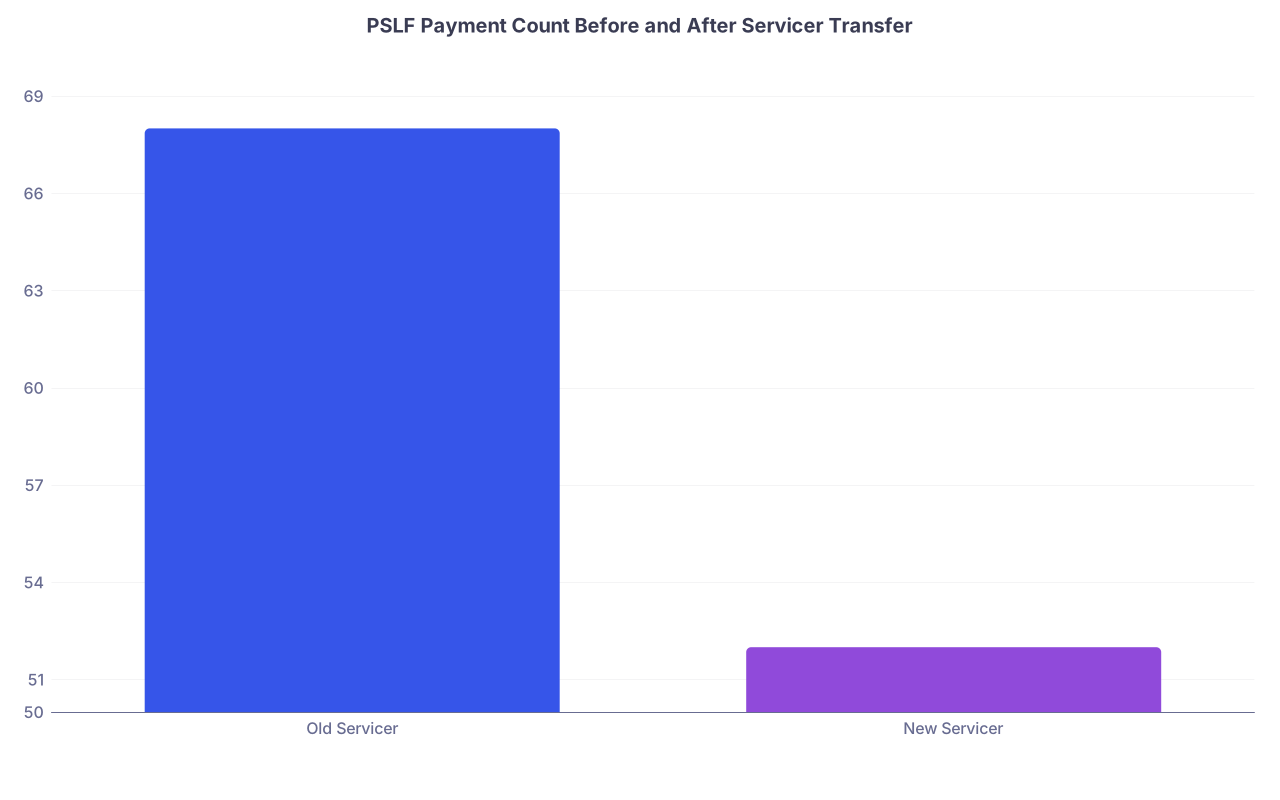
I’ve seen exactly this: a physician drops from 68 to 52 qualifying payments because a specific employer period got lost or misclassified. The ones who had documentation usually got it corrected. The ones who didn’t were stuck fighting uphill.
9. Ignoring Name Changes, NPI Mismatches, and Personal Info Errors
This sounds trivial until it isn’t.
Your PSLF record is tied to:
- Your name.
- Your SSN.
- Your loan records.
If over ten years you:
- Change your name (marriage, divorce).
- Have multiple versions of your name in HR systems.
- Use a nickname on PSLF forms that doesn’t exactly match your loan file.
You’re setting yourself up for small mismatches that cause big headaches.
I’ve seen MOHELA reject or delay processing because:
- The name on the PSLF form didn’t match the loan account (e.g., missing middle initial or different last name).
- The SSN was off by one digit on an older form.
- HR auto-filled old address or personal data that conflicted with what’s on file.
What you should do:
- Make sure your studentaid.gov profile is 100% current: legal name, address, contact info.
- Use the same legal name on PSLF forms that appears on your federal loan record.
- If you change your name, update it everywhere (loan servicer, HR, PSLF forms) and keep documentation of the name change.
You don’t want your file sitting in a manual review pile because the system can’t decide if you and “yourself three years ago” are the same person.
10. Not Getting Legal/Expert Help When Things Get Messy
By the time people ask for help, they’re often already in a mess:
- Ten years of payments.
- Multiple employers.
- Forbearances.
- Consolidations.
- Conflicting PSLF counts.
The mistake isn’t messing up—that’s common. The mistake is continuing to fly blind once things get complicated.
If:
- Your payment count isn’t what you expect.
- An entire employer isn’t showing as qualifying.
- You’re getting contradictory answers from the servicer.
Stop assuming it’ll fix itself.
This is when a student loan–savvy financial planner or a lawyer who lives and breathes PSLF can be worth far more than their fee. You’re dealing with a benefit that can be worth $200k–$400k+ for physicians. Paying a few thousand to avoid denial isn’t extravagant; it’s rational.
Just be careful who you listen to. Red flags:
- Anybody promising to “guarantee” PSLF.
- Companies asking you to pay to “apply for PSLF” (the forms are free).
- Advisors who clearly don’t know the difference between IDR, PSLF, and refinancing.
If you bring in help, bring them in before year ten. Preferably before year five.

11. Not Matching Hours and FTE With PSLF Rules
For PSLF, “full-time” isn’t just whatever your contract says. You must meet:
- Your employer’s full-time definition or
- At least 30 hours/week (some technical nuances apply),
whichever is greater.
Physicians get tripped up when:
- They cut down to 0.6–0.8 FTE for family reasons but assume they’re still PSLF-eligible.
- They pick up shifts at multiple sites and assume the total counts without documenting the qualifying employer piece.
- They go hospitalist-per-diem, keeping their badge, but losing W-2 employee status.
On the PSLF form, your employer checks a box for:
- Full-time.
- Part-time.
You do not want your HR office checking “part-time” on a PSLF form for the three years you were 0.7 FTE unless you’re very sure you can still meet PSLF standards through multiple qualifying employers.
If you’re cutting hours:
- Confirm with HR how they define full-time.
- Confirm exactly what they’d list on your PSLF form for your position.
- If you rely on combining hours from multiple qualifying employers, prepare to document all of it and expect extra scrutiny.

12. Treating PSLF Like a Last-Minute Box to Check at Year Ten
The most fatal mistake is philosophical: viewing PSLF as a sign-up instead of a 10-year process.
I’ve seen this exact script:
- Physician pays for 10 years while working at nonprofits.
- Near the end, they Google PSLF, download a form, send it in, and expect a congratulatory letter.
- The letter comes back instead with: 48 qualifying payments. Eight years of “ineligible” time because of one or more of the mistakes above.
The documentation reality of PSLF is harsh:
- If you haven’t been checking your payment counts,
- If you haven’t been certifying employment,
- If you haven’t been tracking your loan types and plans,
then year ten is not a finish line. It’s when you finally see how badly things went off the rails.
Protect yourself by building your own PSLF “control panel” early:

| Step | Description |
|---|---|
| Step 1 | Start Residency |
| Step 2 | Check Loan Types |
| Step 3 | Consolidate to Direct if needed |
| Step 4 | Enroll in IDR plan |
| Step 5 | Submit PSLF form year 1 |
| Step 6 | Create PSLF document folder |
| Step 7 | Check payment count yearly |
| Step 8 | Submit PSLF form yearly and on job change |
| Step 9 | Review counts at year 5 and 8 |
| Step 10 | Apply for forgiveness at 120+ payments |
That looks like overkill to some people. Those are the same people who end up on Reddit furious that “the system screwed them” at year twelve.
| Category | Value |
|---|---|
| Missed 12 qualifying payments | 30000 |
| Missed 36 qualifying payments | 90000 |
| Never certified residency | 180000 |
| Refinanced instead of PSLF | 300000 |
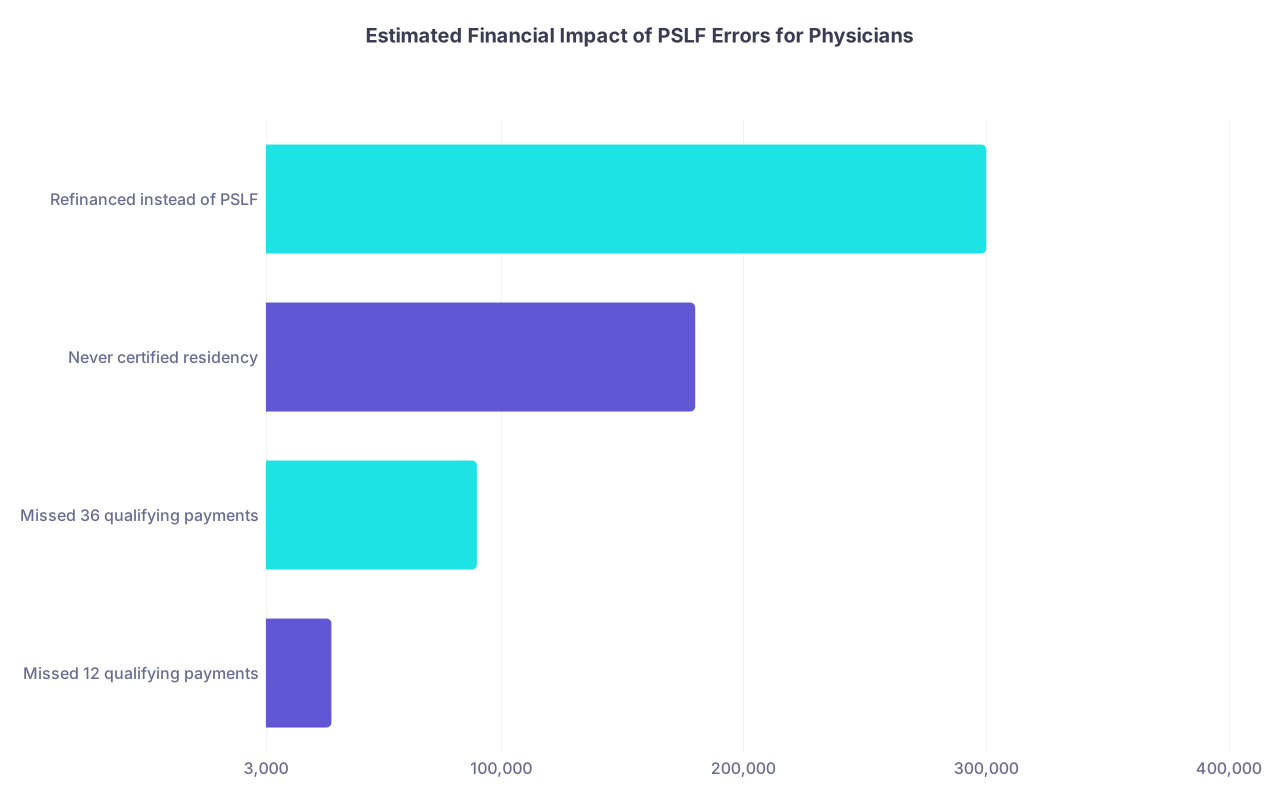
Those are conservative ballpark estimates based on physician debt loads and attending-level payments. You can’t afford to be sloppy.
The Bottom Line: Three Things You Cannot Afford to Screw Up
Verify and document everything, every year. Loan types, repayment plans, employment forms, payment counts. If you can’t prove it on paper, assume PSLF won’t count it.
Don’t outsource responsibility. HR, GME, loan servicers—they’re all fallible. You are the only constant over ten years. Treat PSLF like a long-term project you personally manage.
Catch problems early, not at year ten. Compare your own records vs MOHELA’s counts regularly. If anything looks off, fix it now or bring in an expert. Waiting is how six-figure mistakes become permanent.
You trained too long and work too hard to donate $200k+ to bad paperwork. PSLF can be brutally unforgiving to the inattentive. Do not be one of them.