
Your first attending contract will either accelerate your student loan payoff or quietly lock you into another decade of financial stress. There is no middle ground.
Most new attendings obsess over base salary and sign-on bonuses. That is how you end up with a “high” paycheck and a completely mismatched debt plan, overpaying interest or blowing PSLF eligibility without realizing it until year 3 or 4.
Let me walk you through how to fix that.
This is not a generic “read your contract” lecture. This is a specific, point-by-point checklist to make sure your contract and your student loan strategy are actually working together.
Step 1: Map Your Debt Before You Touch the Contract
If you have not done a full debt inventory, you are negotiating blind. You cannot align income with debt if you do not know:
- What you owe
- To whom
- At what rates
- Under what programs
Spend an evening and get precise.
Make a one-page student loan snapshot:
List every loan with:
- Servicer (MOHELA, Nelnet, Great Lakes, private lender, etc.)
- Type (Direct, FFEL, Perkins, private)
- Balance
- Interest rate
- Current repayment plan
- PSLF-eligible? (Yes / No / Maybe)
- Months of qualifying PSLF credit already earned (if any)
| Loan Type | Balance | Rate | PSLF Eligible | Qualifying Months |
|---|---|---|---|---|
| Direct Unsubsidized | $210,000 | 6.3% | Yes | 54 |
| Direct Grad PLUS | $80,000 | 7.1% | Yes | 54 |
| Private Refi (Residency) | $40,000 | 4.5% | No | 0 |
Now, categorize your situation into one of three tracks. Do not skip this—your track dictates how you should view income in your contract.
Track A – PSLF All-In
You are planning to:
- Stay employed by a qualifying non-profit / academic / government employer for 10 PSLF years, and
- Already have several qualifying years under your belt (residency + fellowship), and
- Expect a large remaining balance at year 10 that you want forgiven
If this is you, your goal is not to maximize gross income at all costs. Your goal is to:
- Keep AGI low to minimize IDR payments
- Maintain PSLF eligibility for the full 10 years
- Avoid refinances or contract structures that break PSLF
Track B – Refinance and Crush the Debt
You are planning to:
- Work in private practice or non-qualifying hospital long term, and/or
- Have relatively “modest” federal balances relative to income
- Want the loans gone in ~3–7 years, no PSLF
Your goal here is aggressive payoff. High income, low fixed expenses, and quick refinancing at lower rates.
Track C – Hybrid / Undecided
You are not sure yet, or you may:
- Start at a PSLF-eligible place but are not certain you will last 10 years
- Have some private loans plus federal loans
- Be weighing early attending income vs academic track
If you are here, your contract needs to preserve optionality. That usually means:
- Keep PSLF eligibility possible
- Avoid long non-competes that trap you in non-qualifying jobs if things change
- Do not rush to refinance federal loans until the path is clearer
Once you know your track, you can evaluate each contract clause like a lever that affects either:
- Your AGI and payment size (Track A)
- Your cash flow and payoff speed (Track B)
- Or your flexibility to change paths (Track C)
Step 2: Translate Contract Terms Into Real Cash Flow
You do not live off “base salary.” You live off after-tax cash, after retirement, after malpractice tail, after loan payments.
Your job is to turn the contract into a realistic monthly net.
Take a sample contract and run this exercise:
Identify core income components:
- Base salary
- RVU or productivity incentives
- Call pay / shift differentials
- Quality bonuses
- Sign-on / relocation bonuses
- Loan repayment assistance
Separate guaranteed vs fantasy.
What is truly guaranteed vs “target if everything goes well”?- Guaranteed: base salary, fixed call pay, minimum stipend
- Variable: RVU bonuses, collections-based compensation, quality incentives
When aligning to your loans, use only the guaranteed number for your baseline. Treat bonuses as debt-accelerators, not necessary cash.
Estimate taxes and deductions.
As a back-of-the-envelope:
- Federal + state + FICA for many new attendings: 30–40% effective rate
- Retirement contributions: you should aim to do at least the employer match
For an example:
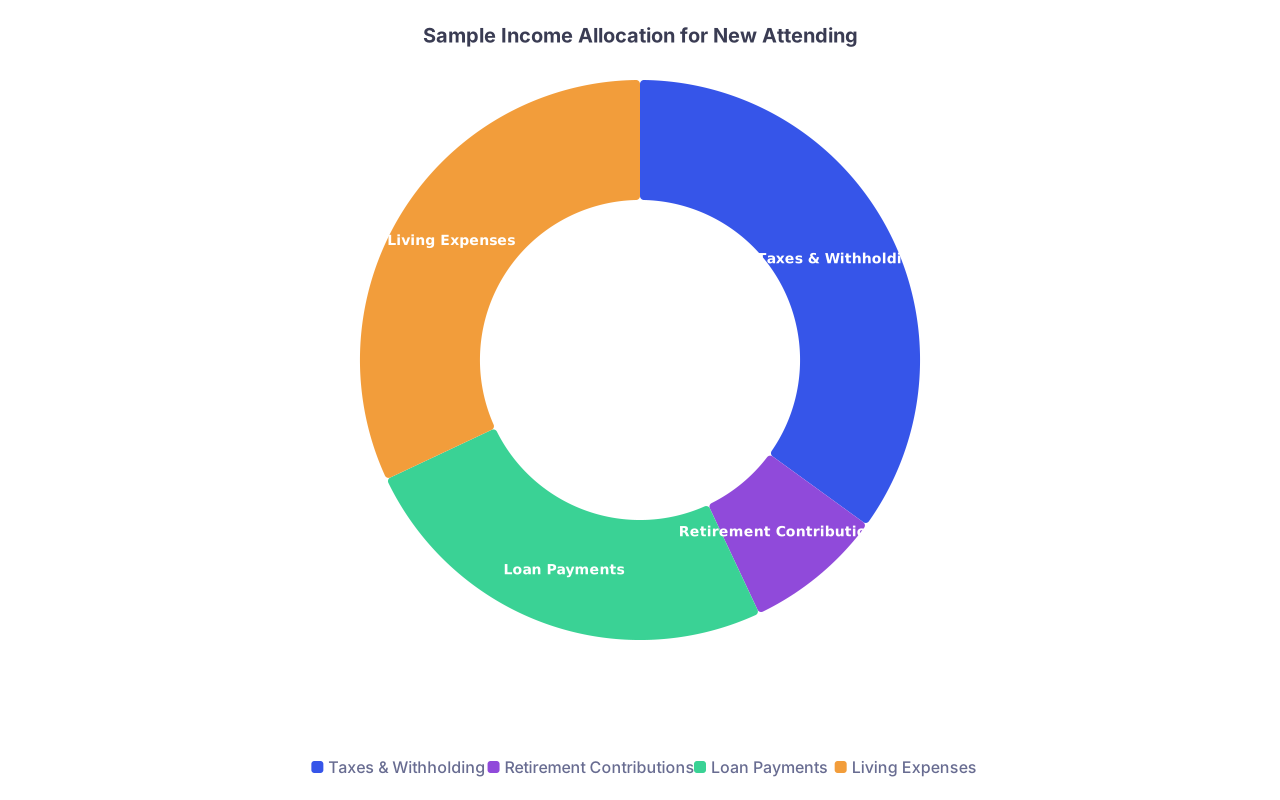
- Base salary: $280,000
- Assume effective tax/withholding: 35%
- After-tax: ~$182,000
- 403(b)/401(k) contribution: $23,000
- New “spendable” annual: ~$159,000
- Monthly net: ~$13,250
That is the pool from which loan payments will actually come.
Drop those numbers into your loan strategy.
| Category | Value |
|---|---|
| Taxes & Withholding | 35 |
| Retirement Contributions | 8 |
| Loan Payments | 25 |
| Living Expenses | 32 |
You should be able to answer, in writing:
- “If I accept this contract, my minimum IDR payment will be about $X per month.”
- “If I go refinance-and-crush mode, I can afford $Y per month without compromising retirement or basic life.”
If you cannot answer those with numbers, you are not ready to sign.
Step 3: Match Contract Type to Loan Strategy
This is where people usually screw it up. They sign an income-maximizing, high-RVU private practice contract while intending to do PSLF. Or they pick an academic job for PSLF but misread the pay structure and can barely cover cost of living plus loans.
If You Are PSLF All-In (Track A)
Your contract must:
Confirm PSLF-eligible employer status.
Ask HR directly. Not the recruiter. HR.You want in writing (email is fine):
- Employer is a 501(c)(3) or qualifying government entity
- You will be a W-2 employee of that entity (or wholly owned subsidiary counted as such)
Check FTE requirement.
PSLF needs full-time. Usually defined as:- Employer’s full-time standard, or
- At least 30 hours per week
Watch for contracts that classify you at 0.8 FTE with weird “per diem” language.
Focus on stability over max RVU upside.
Higher income increases IDR payments and usually reduces the eventual forgiven amount. That might still be fine. But do not trade away:- Benefits
- Job stability
- Reasonable hours
…for an extra $20–50k that just raises your IDR bill and tax pain.
Avoid contract terms that make PSLF impossible if things go sideways:
- Long non-competes that block you from other local non-profits
- Clawback clauses on sign-on/loan repayment that punish you if you need to switch to another PSLF-eligible employer
Key question for PSLF track:
“Does this contract let me safely complete 10 PSLF years with minimal job risk and reasonable payments, or is it putting obstacles between me and year 10?”
If You Are Refinance-and-Crush (Track B)
Very different priorities.
You want:
Maximum realistic income during first 3–7 years.
That usually means:- Higher base or strong RVU upside
- Manageable call that does not burn you out in year 2
Predictable schedule so you can moonlight or add telemedicine if needed.
Look for:- Shift-based models
- Clearly defined call responsibilities
- No “other duties as assigned” black holes
Shorter guaranteed-term or partnership track you believe in.
You want to avoid being stuck below-market for 5–7 years.Reasonable malpractice tail arrangements if you plan to change jobs once the loans are gone.
You will then refinance (if it makes sense) and hammer the principal with a fixed, aggressive payment strategy.
If You Are Hybrid / Undecided (Track C)
Do not lock yourself into a corner.
Your contract should:
- Keep PSLF eligibility possible (non-profit employer, full-time, W-2)
- Avoid long non-competes that block other hospital systems or geographies
- Not rely on extremely high but fragile RVU income to be livable
This gives you a 2–3 year window to decide whether PSLF or refinance makes more sense, based on reality instead of speculation.
Step 4: Go Line-by-Line Through Contract Terms That Impact Debt
Here is the actual checklist. You can literally open your contract and go item by item.
1. Compensation Structure
You want clarity on:
- Base salary (amount, duration, when it is reviewed)
- RVU/production bonuses (conversion factor, thresholds, caps)
- Call pay (per shift / per weekend)
- Quality bonuses (metrics, historically paid out or not)
How this ties to loans:
- For PSLF: high income increases IDR payments. Ok, but know the impact on your projected forgiveness.
- For refinance: more stable income = more confidence committing to fixed high payments.
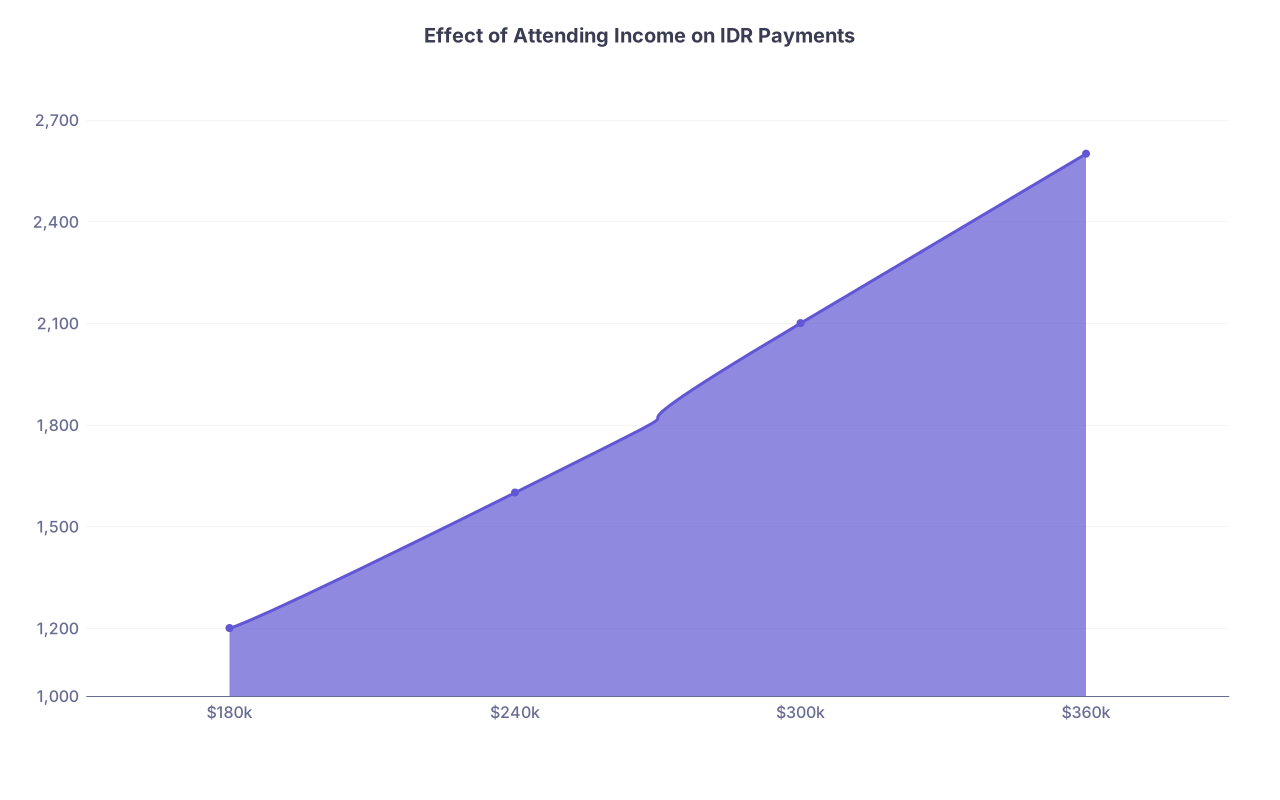
Run an IDR calculator with different income projections and see the swing.
| Category | Value |
|---|---|
| $180k | 1200 |
| $240k | 1600 |
| $300k | 2100 |
| $360k | 2600 |
(Example: single filer, SAVE plan, large federal balance. Your exact numbers will differ, but the shape is similar.)
2. Bonuses, Sign-On, and Loan Repayment Assistance
Do not mentally spend this money on a house upgrade. This is loan fuel.
Look for:
- Sign-on bonus amount and payout timing
- Repayment obligations if you leave early (usually 2–4 years prorated)
- Student loan repayment assistance (structure, cap per year, tax treatment)
Tactics:
Sign-on bonus: Best use is either:
- Immediate payment to highest-interest debt, or
- Build a 3–6 month emergency fund so you can commit to high recurring loan payments confidently
Employer loan repayment:
- Confirm: paid to you or directly to servicer?
- Confirm: taxable or via tax-advantaged program (rare but exists in some state or federal programs)?
- Time your own extra payments so you do not accidentally underuse employer money.
3. Non-Compete and Geography
Most people treat non-competes as an annoyance. For someone with six figures of debt, they can be catastrophic.
- If you need to switch employers to stay PSLF-eligible, a non-compete that blocks every other hospital in a 30-mile radius is a problem.
- If you plan to leave for a higher-paying group to accelerate debt payoff, but you are boxed out of the local market, that can cost you years.
Read:
- Radius (miles)
- Duration (in years)
- Scope (specialty, hospital locations, telemedicine)
4. Term and Termination
You want to know:
- Contract length (1 year with auto-renewal, 3-year locked, etc.)
- Without-cause termination notice (60–180 days is common)
- With-cause termination details
Why you care:
- PSLF track: sudden termination or forced move to non-qualifying employer can derail your count.
- Refinance track: if you have a high fixed private loan payment and lose your job or income dips, you are exposed.
Try to avoid:
- Very long initial terms without an exit
- Crazy short notice periods that give you no time to replace income
Step 5: Build a 3-Year Loan Plan Off the Contract
Once you understand the contract, you do not stop there. You convert it into a plan. Written. With actual numbers.
Step 5A: Project Income and AGI
Take:
- Guaranteed base
- Conservative estimate of production/call if historically reliable
Estimate AGI (roughly gross minus pre-tax retirement and health premiums). This is what your IDR plan uses.
Step 5B: Choose (or Confirm) Your Repayment Plan
Federal loans:
- PSLF track: usually SAVE (or PAYE if grandfathered). You want lowest payment that still moves PSLF forward.
- Refinance track: might use SAVE or a standard plan for 6–12 months while your income stabilizes, then refinance when ready.
Private loans:
- No forgiveness. Focus on best rate with a term you can actually crush (5–10 years) without sabotaging retirement.
Step 5C: Design a Year-by-Year Debt Attack
Here is what a reasonable three-year sequence can look like for a new attending with $300k federal + $40k private:
Year 1: Stabilize and Observe
- Do not refinance federal loans immediately. Get six months of attending paychecks and see how the job feels.
- Enroll or stay on SAVE; make required payments.
- Build 3–6 months of living expenses as emergency fund.
- Make at least minimum on private loans, ideally extra principal.
Year 2: Commit and Accelerate
Based on how stable the job and income are:
PSLF track:
- Confirm HR is reporting employment to servicer correctly.
- Keep AGI as controlled as reasonable (front-load retirement, HSA).
- Use bonuses/sign-on to clean up any private or high-rate debt.
Refinance track:
- Refinance federal (if PSLF off the table) and private together if possible at lower rate.
- Set an aggressive fixed payment: 20–30% of net income going to loans is common for aggressive payoff.
Year 3: Optimize
PSLF:
- Re-check total PSLF qualifying months.
- If life goals change (geography, kids, burnout), reevaluate if PSLF still makes sense.
Refinance:
- If you get a raise or new contract, consider refinancing again to shorter term if cash flow allows.
Step 6: Compare Contracts With a Debt Lens, Not Just a Salary Lens
At some point you will have multiple offers. Here is how to compare them the right way.
| Feature | Job A (Non-profit) | Job B (Private Group) |
|---|---|---|
| Base Salary | $240,000 | $320,000 |
| PSLF Eligible | Yes | No |
| Sign-on Bonus | $20,000 | $40,000 |
| Non-compete Radius | 10 miles | 35 miles |
| Loan Repayment Help | $15k/year x 3 | None |
Now evaluate:
- How each affects:
- IDR payment size
- Remaining forgiven balance (PSLF)
- Time to payoff if refinancing
- Which gives you more options if the first choice is wrong in 2 years.
You may find:
- The lower salary non-profit job, once you account for PSLF and employer loan repayment, effectively beats the “big” private group offer over a 10-year window.
- Or, your loans are small enough that PSLF savings are trivial and the higher income private job lets you be debt-free in 3–4 years, which is massively better for your mental health.
Run actual scenarios. Not vibes.
Step 7: Use the Right Experts, But Ask Targeted Questions
You should not be doing this alone, but you also should not outsource your thinking.
People who can help:
- Student loan–savvy financial planner (fee-only, ideally, no product commissions)
- Contract attorney with physician contract experience
- Senior attendings you trust who know local compensation norms
When you involve them, do not just say “Is this OK?” Be precise:
- “Given I am 6 years into PSLF, does this contract keep me safely PSLF-eligible?”
- “If I take this base + RVU structure and refinance to a 7-year term, what payment range is safe?”
- “Is this non-compete going to trap me in a non-PSLF employer?”
You are after decisions, not vague reassurance.
A Visual of How All This Fits Together

| Step | Description |
|---|---|
| Step 1 | Sign Contract Offer |
| Step 2 | Map Loans and PSLF Status |
| Step 3 | Confirm Employer Eligibility |
| Step 4 | Maximize Income and Stability |
| Step 5 | Preserve Flexibility |
| Step 6 | Select IDR Plan |
| Step 7 | Refinance When Stable |
| Step 8 | Delay Refinance Decision |
| Step 9 | 3 Year Payment Plan |
| Step 10 | Review Annually and Adjust |
| Step 11 | Choose Track |
Do Not Forget Lifestyle Creep
You can wreck a perfectly good contract and smart loan plan with one mistake: escalating your lifestyle as fast as your paycheck.
Your first attending contract should do three things in the first 3–5 years:
- Stabilize your life (reasonable housing, transportation, basic savings).
- Eliminate or neutralize your loans.
- Build an investing habit.
What it should not do in those early years:
- Lock you into a giant mortgage that depends on RVU bonuses.
- Force you to keep a job you hate just because you bought too much house or car.
Keep fixed expenses low until your loans are either gone or clearly headed to PSLF forgiveness.
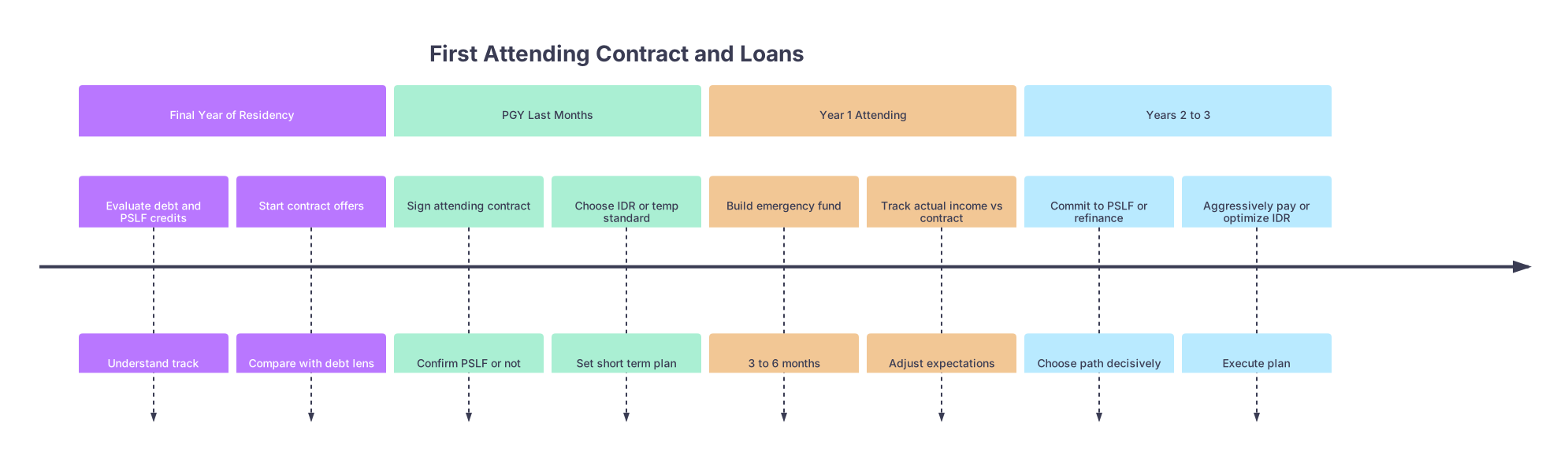
A Quick Reality Check Timeline
Here is a simple, honest expectation for many physicians:
| Period | Event |
|---|---|
| Final Year of Residency - Evaluate debt and PSLF credits | Understand track |
| Final Year of Residency - Start contract offers | Compare with debt lens |
| PGY Last Months - Sign attending contract | Confirm PSLF or not |
| PGY Last Months - Choose IDR or temp standard | Set short term plan |
| Year 1 Attending - Build emergency fund | 3 to 6 months |
| Year 1 Attending - Track actual income vs contract | Adjust expectations |
| Years 2 to 3 - Commit to PSLF or refinance | Choose path decisively |
| Years 2 to 3 - Aggressively pay or optimize IDR | Execute plan |
One More Tool: Side-by-Side Scenario Thinking
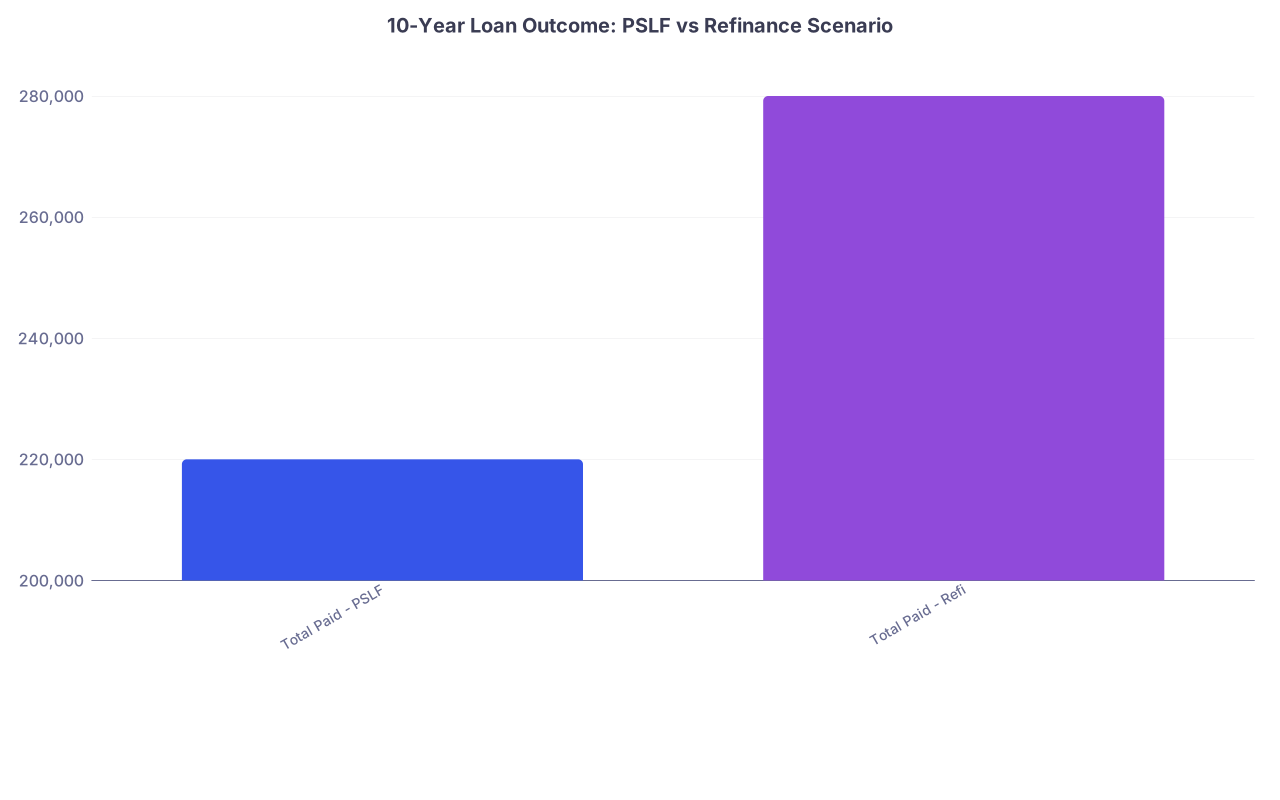
For some people, seeing it side by side clarifies everything. Here is a stripped-down comparison:
| Category | Value |
|---|---|
| Total Paid - PSLF | 220000 |
| Total Paid - Refi | 280000 |
Imagine the non-profit job + PSLF path results in $220k total paid over 10 years, and the private high-income job + refinance results in $280k total paid but you are debt-free in 6 years instead of 10. You might value 4 extra debt-free years more than the $60k difference. Or not.
That is the level of thought you need. Not “this base salary is higher.”
Final Check: Before You Sign
Before your pen hits the page, you should be able to answer, clearly:
- Which track am I on? PSLF, refinance, or hybrid—with a reason.
- What will my monthly loan payments be under this contract, year 1 and year 3?
- How does this contract either support or undermine that plan? (PSLF eligibility, income stability, non-compete, term.)
If you cannot answer those three questions in under two minutes without guessing, you are not done with your homework.
Key Takeaways
- Your first attending contract is not just a job offer; it is the engine that funds your entire loan strategy. Treat it that way.
- Decide your track (PSLF vs refinance vs hybrid) first, then evaluate contract terms as tools to support that path—especially employer type, compensation structure, and non-compete.
- Convert the contract into a 3-year written loan plan with real numbers, then keep lifestyle creep in check so your income advantage actually reaches your debt, not the dealership.