
The usual student loan advice—“just pay extra when you can”—is lazy, expensive, and wrong.
If you have both federal and private loans, you need a system, not vibes. A 3‑tier payment strategy is that system. It tells every single dollar where to go, in what order, and why. No guesswork. No “I’ll figure it out later.”
Here is how you actually build it.
Step 1: Get Violently Clear on Your Loan Inventory
You cannot build any strategy if your “plan” is just screenshots and a vague memory of what you signed in college.
You need a complete loan inventory. One page. Everything on it.
Do this in one sitting. No excuses.
Pull your federal loans
- Go to studentaid.gov → log in.
- Export your loan data or copy it into a spreadsheet.
- Capture each individual loan, not just the total.
Pull your private loans
- Log into each private servicer site (Navient, SoFi, Sallie Mae, Discover, Earnest, etc.).
- Download or view statements.
- Capture each separate loan if they list them (often by disbursement date).
Build a simple table For each loan, you need:
- Lender / servicer
- Loan type (Direct Unsubsidized, Direct PLUS, private fixed, private variable, etc.)
- Balance
- Interest rate
- Fixed or variable
- Monthly payment
- Remaining term (or years left if shown)
Here is what a cleaned‑up summary might look like:
| Loan Group | Balance | Rate | Type |
|---|---|---|---|
| Direct Unsubsidized (3x) | $42,000 | 5.2% | Federal |
| Direct Grad PLUS | $65,000 | 7.0% | Federal |
| Private Loan 1 | $18,000 | 8.5% | Private Fixed |
| Private Loan 2 | $12,000 | 11.9% | Private Variable |
If you do not have something like this, you are driving blind.
Step 2: Decide Your Overall Path First (Not Last)
Before building tiers, you must answer one core question:
Are you aiming to pay off your federal loans or optimize forgiveness (PSLF or IDR forgiveness)?
Everything else hangs on this.
Path A: Forgiveness‑Optimized (PSLF or long‑term IDR)
You are here if:
- You work (or will likely work) full‑time in qualifying public service and can realistically stay 10 years; or
- Your income vs. debt makes full repayment in 10–15 years unrealistic, so IDR forgiveness is the rational plan.
Under this path, your mindset is:
- Federal loans = tax/fee you minimize, not a traditional debt you rush to kill.
- Private loans = the bad guys that must die first.
Path B: Aggressive Payoff (No forgiveness, want them gone)
You are here if:
- You are in (or aiming for) higher‑income private sector jobs; and
- You do not plan on PSLF‑eligible work long term; and
- You realistically can clear your loans in 10–15 years with focused effort.
Under this path, your mindset is:
- Federal and private loans are debt to be eliminated, but you still use federal protections strategically.
- You still prioritize high‑rate and high‑risk loans, but you do not intentionally drag federal loans out on IDR.
Pick one path. If you try to “keep your options open” forever, you end up with the worst of both worlds.
Step 3: Understand the 3‑Tier Framework
A proper 3‑tier payment strategy splits your money like this:
Tier 1 – Mandatory Minimums:
The absolute minimum required to avoid delinquency and default. Non‑negotiable.Tier 2 – Priority Paydown:
The loans you attack with any extra dollars. The ones that are mathematically or strategically worst.Tier 3 – Strategic Optional Payments:
Only used after Tier 2 is fully funded. This includes prepayments on “okay” federal loans, extra contributions toward future goals (retirement, down payment) instead of low‑interest loans, etc.
The trick is choosing which loans live in which tier based on your path (forgiveness vs payoff).
Step 4: Build the 3 Tiers – Forgiveness‑Optimized Version
If you are going for PSLF or long‑term IDR forgiveness, your priority is simple:
Pay the least you reasonably can on federal, crush private loans as fast as possible.
Tier 1 – Mandatory Minimums (Forgiveness Path)
Federal loans on IDR
- Enroll in the best income‑driven plan (often SAVE as of 2024).
- Goal: Lower required payment, not faster payoff.
- Recertify on time every year.
- If PSLF‑eligible job:
- Make sure your employer is qualified.
- Submit PSLF Employment Certification Form annually.
- Your Tier 1 payment here is whatever IDR says your minimum is.
Private loans – Contractual minimums
- You must at least pay what the lender requires.
- If cash flow is tight, call and ask about:
- Temporary interest‑only
- Short‑term reduced payment
- Refinance only if it materially improves rate and you are not likely to need forbearance protections soon.
So Tier 1 (forgiveness path) =
Federal IDR minimum + Private minimums.
You are not adding extra principal to federal loans here. That would be self‑sabotage if forgiveness is the plan.
Tier 2 – Priority Paydown (Forgiveness Path)
This is where real progress happens.
Your rule:
Every extra dollar above Tier 1 goes to the worst private loan first.
Practical method:
- List private loans from highest interest rate to lowest.
- If rates are similar, prioritize variable over fixed (higher risk).
- Attack the top loan with:
- All extra monthly cash flow.
- Windfalls (tax refunds, bonuses, side gig money).
Use a pure debt avalanche within private loans:
- Make minimums on everything else.
- Max extra payment on the single worst loan.
- When that one is zero, roll its entire payment onto the next.
Do not scatter extra money across loans. That feels responsible and is actually inefficient.
Tier 3 – Strategic Optional Payments (Forgiveness Path)
Only after:
- You are stable on IDR.
- Your emergency fund exists (bare minimum 1–3 months expenses).
- Your worst private loans are either gone or very small.
Then you can consider:
Extra payments on higher‑rate federal loans only if:
- You are no longer reasonably expecting forgiveness (job change, law change, etc.), or
- Your projected forgiven balance is small and the psychological benefit of being debt‑free matters more to you than squeezing every last dollar.
Or, prioritizing:
- Retirement contributions (especially if you have an employer match).
- Future down payment savings.
- Professional expenses (licenses, certifications).
In a true forgiveness‑optimized setup, Tier 3 extra payments on federal loans are usually low priority. Often, you are better off building net worth elsewhere.
Step 5: Build the 3 Tiers – Aggressive Payoff Version
If you are not chasing forgiveness and you want everything gone, you tweak the tiers.
Tier 1 – Mandatory Minimums (Payoff Path)
Federal loans
- You can still use IDR for flexibility, but:
- If your IDR payment is higher than the standard 10‑year payment, that tells you your income is high enough that IDR is not helping.
- In that case, consider switching to the standard 10‑year or a shorter term if offered.
- Tier 1 = Required minimums under your chosen plan.
- You can still use IDR for flexibility, but:
Private loans
- Same as before: at least the contractual minimums.
- Refinance if:
- You have steady income.
- Your credit is decent.
- You get a clearly better rate and term.
- But never refinance federal to private just to “simplify” unless you are absolutely sure you will never need federal protections or forgiveness.
Tier 2 – Priority Paydown (Payoff Path)
Now your goal is pure efficiency.
Rule:
Every extra dollar goes to the highest‑interest debt, federal or private.
In most cases:
- High‑interest private (10–12%) will be first.
- Then higher‑rate federal (Grad PLUS at 7–8%).
- Then mid‑rate federal (5–6% Direct Unsub).
- Then any remaining low‑rate loans.
Again, this is a debt avalanche ordering. It minimizes total interest paid.
If you care a lot about quick wins and staying motivated, you can use a modified avalanche:
- Among loans with similar interest (say within 0.5%), pay the smallest balance first.
- You still keep the math mostly intact while getting some faster psychological “paid off” moments.
Tier 3 – Strategic Optional Payments (Payoff Path)
Once your highest‑interest loans are gone and you have only moderate‑rate federal loans (say 4–5%) left, things shift.
You ask: Where does my next dollar do the most good?
Options in Tier 3:
- Continue to aggressively pay down remaining federal loans to be fully debt‑free sooner.
- Or, if rates are low and you have a long term left:
- Fund retirement accounts more heavily (401(k), IRA, etc.).
- Build investment accounts with expected returns possibly higher than your loan rate.
- Save for major goals (home, practice buy‑in, business).
There is no one “correct” answer here. But there is a correct order:
- Do not get fancy in Tier 3 if Tier 2 loans at 8–10% are still alive. Those are financial arson.
Step 6: Turn Strategy into a Monthly Cash‑Flow Plan
Concepts do not pay bills. Automation does.
You need a written monthly cash‑flow plan that explicitly funds Tier 1, Tier 2, and Tier 3.
Step 6A: Define Your Max Loan Budget
Calculate:
- Net monthly income (after tax).
- Essential expenses (rent, utilities, basic food, insurance, transportation).
- Reasonable discretionary (not “monk mode,” but not luxury either).
Whatever is left = potential loan firepower. That is your total for Tiers 1–3.
If the math shows:
- You cannot cover even Tier 1 → you need an immediate damage‑control plan (see below).
- You can cover Tier 1 but little else → you are in maintain + slow extra payments.
- You have solid extra room → Tier 2 becomes very powerful.
Step 6B: Allocate Explicitly
Example (for forgiveness path, early career):
- Net income: $4,200 / month
- Tier 1:
- Federal IDR payment: $280
- Private minimums: $320
- Tier 1 total: $600
- Available for loans overall (after living expenses): $1,000
Allocation:
- Tier 1: $600
- Tier 2 (extra to worst private): $400
- Tier 3: $0 (you are not there yet)
You literally log into the servicer site and set:
- Auto‑pay for Tier 1 minimums.
- Separate manual or automatic extra payment on the specific Tier 2 target loan.
Do not let servicers “spread” extra payments across loans automatically. You almost always need to designate: Apply extra to Loan X, principal only.
Step 7: Use a Simple Timeline to Keep Yourself Honest
You are not just building a plan for this month. You are building a multi‑year attack.
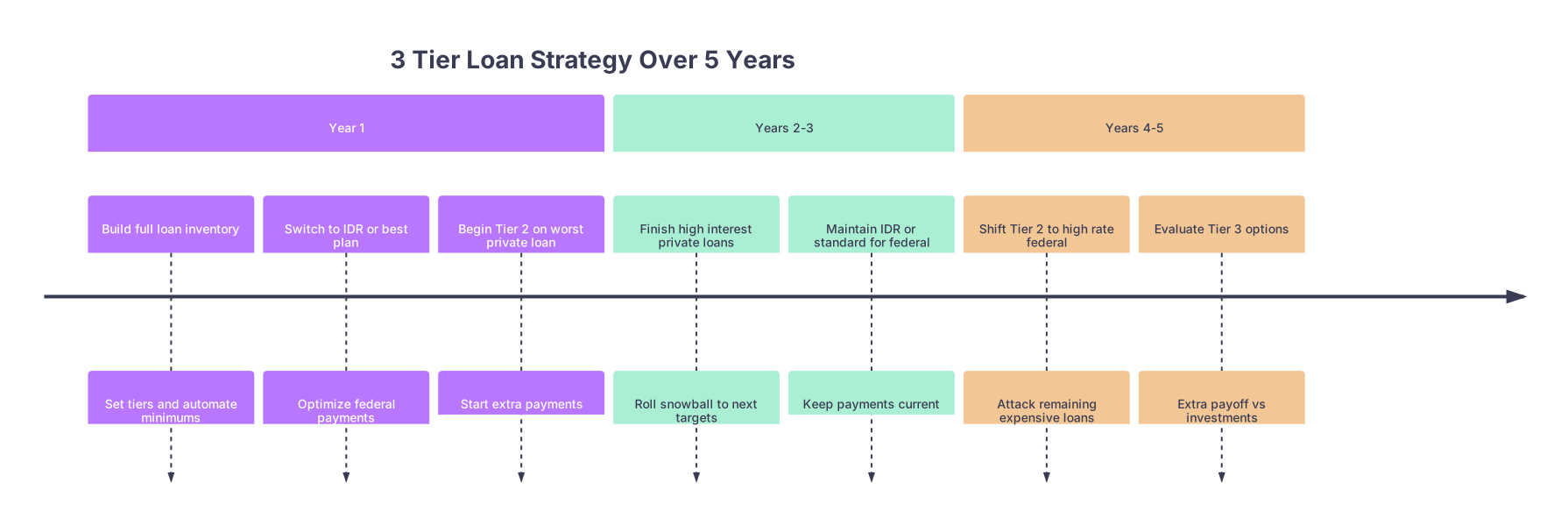
| Period | Event |
|---|---|
| Year 1 - Build full loan inventory | Set tiers and automate minimums |
| Year 1 - Switch to IDR or best plan | Optimize federal payments |
| Year 1 - Begin Tier 2 on worst private loan | Start extra payments |
| Years 2-3 - Finish high interest private loans | Roll snowball to next targets |
| Years 2-3 - Maintain IDR or standard for federal | Keep payments current |
| Years 4-5 - Shift Tier 2 to high rate federal | Attack remaining expensive loans |
| Years 4-5 - Evaluate Tier 3 options | Extra payoff vs investments |
Your strategy should not be rigid for 10 years. But it should be stable for at least 6–12 months at a time. Constantly tinkering is usually just procrastination wearing a productivity costume.
Step 8: Handle Common “Real Life” Problems Without Blowing Up the Plan
You are going to hit turbulence. Job changes, moves, kids, unexpected expenses. This is where most people panic and undo years of smart decisions.
Scenario 1: Income drops or you lose your job
- Federal loans
- Immediately: Request IDR recalculation or put loans in forbearance while you get stabilized.
- If on PSLF, pushing forbearance too long just pushes forgiveness further out. Balance that tradeoff.
- Private loans
- Call the lender before you miss payments.
- Ask clearly for:
- Temporary reduced payment.
- Interest‑only for a few months.
- Formal hardship programs (some lenders have them, they will not advertise them loudly).
For this period:
- Tier 3 = zero.
- Tier 2 may briefly shrink or pause.
- Protect Tier 1 as much as possible to avoid late marks and default.
Scenario 2: You get a big raise or bonus
Do not let lifestyle creep eat all of it.
Protocol:
- Increase Tier 1 auto‑payments if your plan requires higher payments (e.g., IDR recert based on higher income).
- Immediately allocate a fixed portion of the raise/bonus to Tier 2:
- Example: 50% extra to debt, 50% to long‑term savings/fun.
- Apply one‑time bonuses straight to your worst Tier 2 loan.
Scenario 3: Interest rates change (for variable private loans)
If your variable loan jumps from 6% to 10%:
- That loan very likely jumps to the front of Tier 2, even if the balance is large.
- Run quick numbers. A spike to double‑digit interest is a fire that spreads fast.
- Consider:
- Refinancing to fixed if your situation allows.
- Reranking loans by current rate and adjusting your avalanche order.
Step 9: Quick Visual – Where Most People Go Wrong
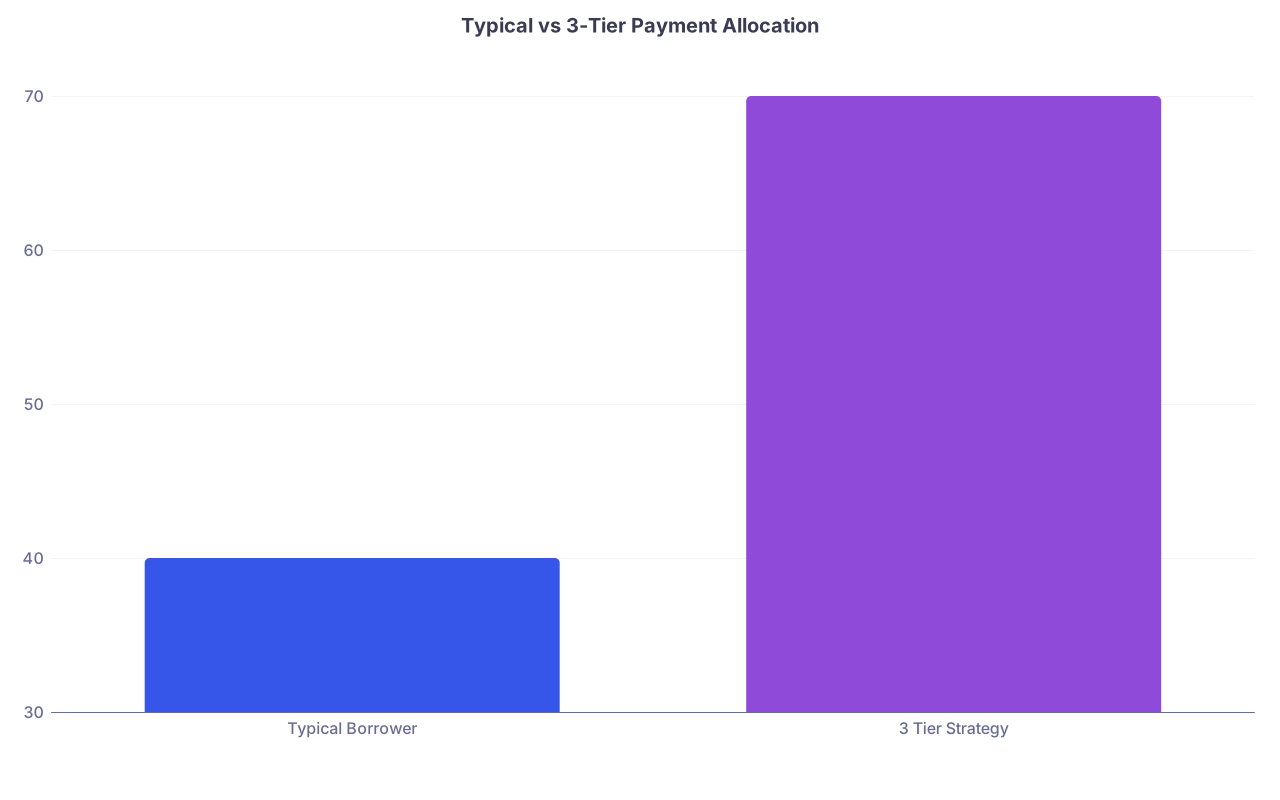
| Category | Value |
|---|---|
| Typical Borrower | 40 |
| 3 Tier Strategy | 70 |
Interpretation (conceptual, not exact math):
- “Typical Borrower” has ~40% of extra payments going to suboptimal targets (random extra principal on federal loans, scattered overpayments, or paying off low‑rate loans early).
- A focused “3 Tier Strategy” channels ~70% or more of extra dollars directly into the highest‑impact loans.
You do not need to be perfect. You just need to stop making the obviously bad moves.
Step 10: Implementation Checklist (Do This in Order)
- Build a full loan inventory with rates, terms, types.
- Decide: Forgiveness path or Aggressive payoff path.
- Assign every loan to a tier:
- Tier 1: Minimum required payments.
- Tier 2: Ordered list of priority loans for extra payments.
- Tier 3: Long‑term, lower‑impact targets.
- Set up automatic payments:
- Auto‑pay for all Tier 1 minimums.
- Auto or scheduled manual extra for the current Tier 2 target.
- Create a simple monthly cash‑flow sheet:
- Net income.
- Non‑negotiable expenses.
- Loan budget (Tier 1, Tier 2, Tier 3).
- Review every 6–12 months:
- New interest rates?
- Income change?
- Job change that affects PSLF eligibility?
- Any loans fully paid off (update Tier 2 order)?
If you do these six steps thoroughly one time, you will be more organized than 90% of borrowers.
FAQs
1. Should I ever refinance my federal loans into private loans as part of this 3‑tier strategy?
Only in a very narrow set of cases. If you are absolutely sure you will never use PSLF, never rely on IDR safety nets, and you have stable, high income with solid emergency savings, then refinancing high‑rate federal loans (like Grad PLUS) into a significantly lower fixed rate can make sense in the aggressive payoff path. But this is permanent. Once you refinance federal to private, there is no going back. If there is any realistic chance you will need federal protections, do not do it.
2. How much should I keep in an emergency fund before I go hard on Tier 2 payments?
For most borrowers with mixed federal and private loans, aim for at least 1–3 months of bare‑bones expenses before going heavy on Tier 2. If your job is unstable, you are self‑employed, or you have dependents, lean closer to 3–6 months. It is better to slightly slow down loan payoff than to end up using credit cards at 25% because you had no cash buffer.
3. What if my federal loan rates are higher than my private loans—do I still pay private first?
No. You follow the rate hierarchy within Tier 2, not some ideological “private bad, federal good” rule. If your federal Grad PLUS is at 7.9% and your private refinance loan is at 4.5%, you attack the 7.9% federal loan first if you are on the aggressive payoff path. The only exception is if you are intentionally pursuing forgiveness; then you minimize federal payments on IDR and focus Tier 2 on private, even if the private rate is slightly lower. Strategy always depends on the path you chose up front.
Bottom line:
- Inventory first. You cannot fix what you will not look at.
- Choose your path—payoff or forgiveness—and build your 3 tiers around that choice.
- Automate Tier 1, relentlessly attack Tier 2, and only touch Tier 3 when the fires are mostly out.