
It’s 11:45 p.m. You’re post‑call, half‑awake on the couch, scrolling through your loan servicer’s website for the first time in months.
Balance: $278,000.
Projected payoff: “2049.”
You close the tab because your brain is fried, you tell yourself you’ll “figure loans out later,” and you crash.
Fast‑forward 10–15 years. You’re an attending in your 40s or early 50s, finally making real money… and still shackled to loans that should’ve been half gone by now. That’s the version of you I’ve heard from in physician lounges, faculty offices, and post‑clinic vent sessions.
Let me tell you what those older attendings say when the residents leave the room.
They don’t regret the specialty. They don’t regret the hours.
They regret how blindly they handled their loans during residency.
Here’s what they wish they’d done differently—and what you still have time to fix.
The Big Picture: What Actually Matters During Residency
Before we get into the weeds, you need the frame older attendings eventually figure out:
During residency and fellowship, three things matter way more than everything else:
- Locking yourself into the right federal system (and not bailing to private refinancing too early).
- Getting every single qualifying month to count for something—PSLF, long‑term IDR forgiveness, or just minimized damage.
- Keeping lifestyle creep and “I’ll pay it down later” lies in check.
Most of the pain older attendings feel now traces back to violating one of those three.
Let’s break down what they wish they’d done.
Regret #1: “I Consolidated and Reset the Clock Without Realizing It”
Older attendings will say this with a very specific frustration: “I lost years of qualifying time because I didn’t know what I was clicking.”
Here’s what actually happens, behind the scenes, at the servicer and government level.
When you graduate, your loans are a mess:
- Direct Unsubsidized Loans from each year
- Maybe a Direct Grad PLUS
- Maybe some old FFEL or Perkins that got dragged along
Back in the day, people either:
- Did nothing during grace period
- Or consolidated everything immediately, with zero strategy
The catch?
If you consolidate the wrong way at the wrong time, you wipe out previous qualifying periods toward PSLF or IDR forgiveness. It’s basically hitting a reset button you didn’t know existed.
Older attendings I’ve watched learn this in real time—usually when they finally talk to a competent advisor or actually read the PSLF rules—look physically ill.
What they wish they’d done:
Figured out their endgame early:
“Am I likely PSLF, non‑PSLF IDR forgiveness, or pure aggressive payoff?”
Not carved in stone, but at least a working hypothesis.-
- If PSLF was even a maybe, they’d have made sure all loans were Direct and started on a qualifying IDR early.
- If they had old FFEL/Perkins loans, they’d have consolidated those into Direct ASAP before making payments that didn’t count.
Respected the countdown clock:
PSLF = 120 qualifying payments.
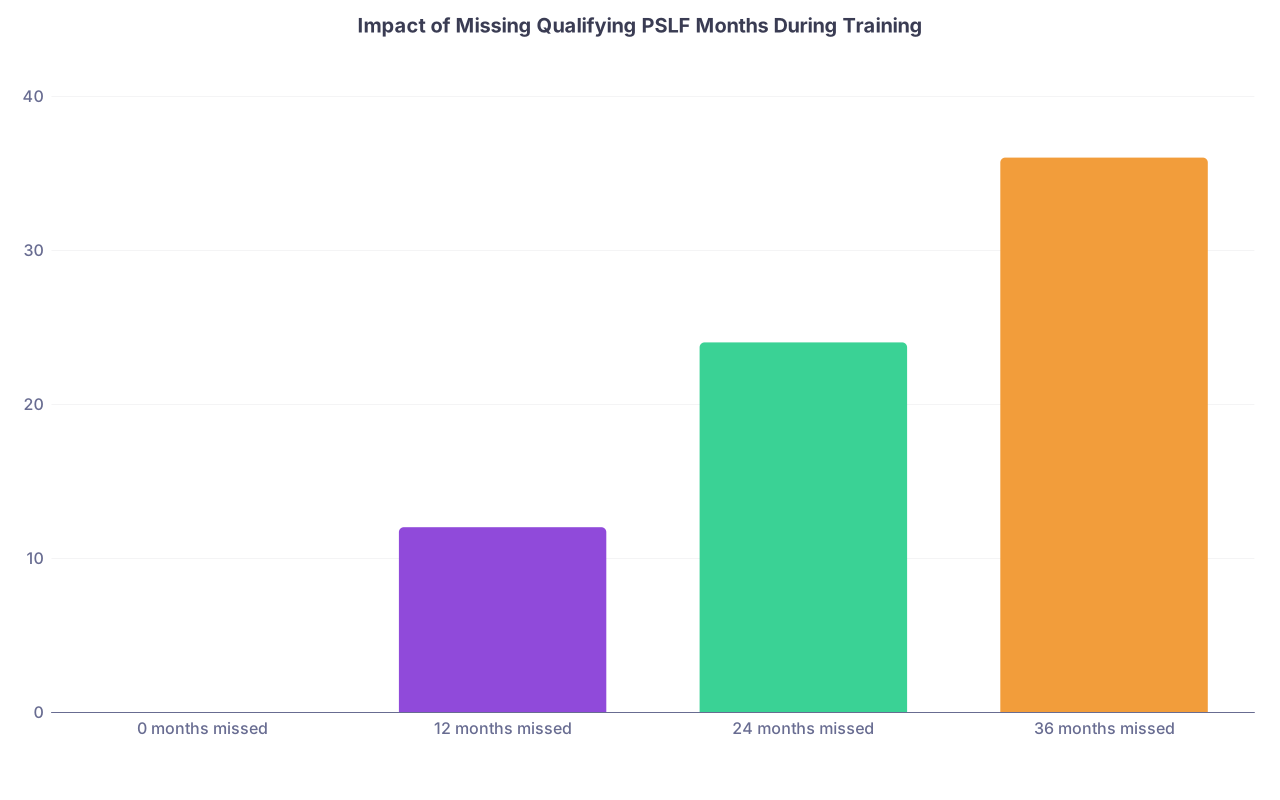
Older attendings routinely threw away 12–36 potential months because “I was in grace,” “I was on forbearance,” or “I never enrolled in an IDR plan.”
Let me be blunt: every month of residency that could qualify and does not qualify is a month you donate to the government for free.
| Category | Value |
|---|---|
| 0 months missed | 0 |
| 12 months missed | 12 |
| 24 months missed | 24 |
| 36 months missed | 36 |
That chart isn’t just bars. It’s literally 1–3 extra years of attending‑level payments because you didn’t click a form in PGY‑1.
Regret #2: “I Forbeared My Way Through Residency”
This is probably the most common regret. I have heard countless versions of:
“My servicer told me I could just do forbearance. So I did that every year of residency.”
Here’s what really happens when you live on forbearance:
- Interest continues accruing on unsubsidized and Grad PLUS like a running tab.
- The unpaid interest capitalizes—gets added to principal—typically when forbearance ends or when you change plans in certain ways.
- Your balance quietly explodes while you’re too busy surviving the ICU.
Older attendings remember checking their balance PGY‑1:
“$220k… painful but manageable.”
And then PGY‑5 or fellowship:
“$310k… how the hell did that happen?”
What they wish they’d done instead:
Got on an income‑driven plan immediately: REPAYE, PAYE, IBR—whatever was best at that time.
- Payment based on income, not balance.
- Residency income = low payments.
- Many months could’ve counted toward PSLF or IDR forgiveness.
Used the subsidized interest features when they existed:
Under old REPAYE, half of unpaid interest was subsidized. The new SAVE plan has an even more generous unpaid interest subsidy. Older docs love these changes… and hate that they missed them.Reserved forbearance for actual emergencies:
Maternity leave, medical issues, disaster. Not “I didn’t feel like doing paperwork.”
Here’s the ugly math older attendings replay in their heads.
| Strategy | End of PGY-4 Balance | PSLF-Qualifying Payments Earned |
|---|---|---|
| Annual Forbearance | ~$320,000 | 0 |
| IDR w/ Low Payments | ~$260,000–$280,000 | 48 months |
| IDR + PSLF-Eligible Job | ~$260,000–$280,000 | 48 months toward PSLF |
Same residency. Same specialty. Same starting balance.
Two very different futures.
Older attendings wish they’d understood this:
Forbearance doesn’t “protect” you. It just stalls you while the meter runs.
Regret #3: “I Refinanced Too Early Because Everyone Said It Was Smart”
This one came in waves—especially in the pre‑PSLF‑crackdown, pre‑COVID era when private lenders were showing up at residency noon conference with free lunch and “resident‑friendly refi” offers.
You know the pitch:
- “Cut your rate from 7% to 3.5%!”
- “Simple, low monthly payment during training!”
- “Fast track to being debt‑free!”
And a lot of smart, well‑intentioned residents jumped. Because lower interest sounds obviously better.
Here’s what older attendings realized—too late:
Once you refinance federal loans to private loans:
- PSLF is dead. Permanently.
- Federal IDR is gone.
- Federal forbearance and hardship protections are gone.
- Any future federal forgiveness, relief, or policy changes? Also gone. You’re out of the club.
Many of those older attendings then:
- Took academic or 501(c)(3) jobs without realizing they would’ve qualified for PSLF.
- Rode out COVID watching federal payments pause to $0 and interest set to 0%, while their private loans kept chugging along.
- Found themselves with private lenders who were… less flexible than the sales pitch had implied.
The quiet part those refi companies don’t shout: their business literally depends on physicians giving up federal protections.
What older attendings wish they’d done:
Waited to refinance until they were absolutely sure PSLF and federal IDR weren’t worth more. That usually means:
- You’re 100% on a private group or non‑qualifying employer long term.
- Your plan is aggressive payoff, not forgiveness.
- You’ve run the real numbers, not vibes.
Kept some or all loans federal during residency even if a refi was attractive.
A lot of them would keep the bulk in federal IDR and, if they really wanted to, maybe refinance a small portion they were sure they’d attack aggressively.
The honest truth: the number of residents who should refinance all their federal loans during training is much smaller than the marketing suggests.
Regret #4: “I Ignored PSLF Because Everyone Said It Was a Scam”
There’s a particular group of attendings—especially from the first PSLF‑eligible cohorts—who got burned by incompetent servicers, terrible communication, and unclear rules.
Their reaction?
They told every med student and resident behind them: “PSLF is fake. Do not count on it.”
So a lot of you tuned it out. Or assumed it wouldn’t be around. Or that you wouldn’t qualify.
But here’s the part you don’t see unless you’re on the inside now:
There are faculty—right now—getting six‑figure tax‑free forgiveness checks approved. Quietly. Because by year 8 or 9 of payments, they finally cleaned up their paperwork and got their act together.
I’ve sat in offices with attendings who said, “I wish I hadn’t spent a decade telling residents PSLF was a lie. I just got $230k forgiven.”
The system was a mess early on. But now, the rules are clearer:
- You need Direct Loans.
- You need a qualifying IDR plan.
- You need a qualifying employer (501(c)(3), government).
- You need 120 qualifying payments.
That’s it. Not simple, but not mystical.
What older attendings wish they’d done in residency:
Kept PSLF alive as an option, even if they weren’t dead‑set on academics.
You can do residency and fellowship at PSLF‑eligible hospitals and bank a big chunk of those 120 payments without locking your entire life into academia forever.Filed the employment certification form every year: Not in year 10 when they’re applying for forgiveness and discovering 40 qualifying payments are missing.
Stopped listening to the loudest cynic in the resident lounge and looked at actual data and current approvals.

The attendings who are happiest now didn’t “trust” PSLF blindly. They structured things so that if PSLF worked, great—huge upside. If it didn’t, their plan still made sense.
Regret #5: “I Never Tracked Anything—Then Spent Months Fixing It Later”
Older attendings will tell you the real tax on bad loan management isn’t just money. It’s time and mental bandwidth when you’re already burned out.
They show up in year 9 or 10 of practice and decide, “Alright, I should probably get PSLF or at least see where I stand.”
What happens next is predictable:
- Hours on the phone with servicers.
- Old HR departments trying to sign 7 years’ worth of employment verification retroactively.
- Payments miscounted, misapplied, or missing.
- Going through paystubs from a decade ago to prove income history.
All of which could’ve been avoided with a simple system during residency.
What they wish they’d done:
Kept a running yearly file (yes, literally a folder—digital or physical) with:
- Annual IDR recertification confirmations
- PSLF employer certification forms
- Copies/screenshots of payment counts
- Offer letters/contract showing employer status if relevant
Checked the servicer’s qualifying payment count once a year, instead of discovering a mess 9 years in.
Written down the names/dates of which servicer said what, when. Because servicers contradict themselves and change staff constantly.
The line I’ve heard more than once:
“I spent more time fixing my PSLF history than I did on some QI projects.”
You can avoid that circus by being boring and organized now.
Regret #6: “I Let Lifestyle Creep Eat My Attending Pay Instead of Killing Loans Strategically”
This one starts in residency but hits full force as an attending.
Here’s the pattern:
- Residency: “I’m too broke to do anything meaningful with loans. I’ll worry about it when I’m an attending.”
- Fellowship or PGY‑5ish: “I deserve a better car / better apartment / nicer vacations. I’ve sacrificed enough.”
- First attending job: Instant upgrade—house, car, daycare, maybe private school, big city costs.
Then what?
The “I’ll hammer the loans later” plan never really shows up. Because “later” keeps moving.
What older attendings wish they’d done:
During residency:
Made at least some payment every month on IDR, even if it was tiny, instead of forbearance. That often created PSLF‑eligible months or minimized interest bloat.
Stopped telling themselves the story that “any payment under $500 is meaningless.” That’s just not how IDR and PSLF math works.
First 1–3 years as attending:
Kept living like a senior resident or cheap fellow for a defined, short period—12 to 36 months—and pushed hard on loans while income jumped dramatically.
Picked a lane clearly:
- Going PSLF? Then don’t throw massive extra principal payments at loans you plan to forgive.
- Not going PSLF? Then crush them aggressively early while your lifestyle is still (relatively) contained.
What they regret isn’t buying a house or upgrading their car.
It’s doing all of that before having any intentional plan for the loans.
What They Wish Every Resident Would Actually Do (Concrete Moves)
Let’s get more tactical. If you corner older attendings who’ve dug themselves out of the hole, this is basically the “do this, not that” they’d give you.

| Step | Description |
|---|---|
| Step 1 | Graduate Medical School |
| Step 2 | Identify Loan Types |
| Step 3 | Consider IDR Plan |
| Step 4 | Consolidate to Direct |
| Step 5 | Enroll in IDR for PSLF |
| Step 6 | Enroll in IDR for Flexibility |
| Step 7 | Submit PSLF Form Yearly |
| Step 8 | Refi Selectively as Attending |
| Step 9 | Stay Federal and Reassess Yearly |
| Step 10 | All Direct Loans? |
| Step 11 | Working at PSLF Eligible Hospital? |
| Step 12 | Ready to Refinance Later? |
Here’s the translation, residency‑level:
Get everything into the Direct Loan system if it isn’t already.
You don’t have to consolidate if all loans are already Direct Loans, but you must make sure you’re in the right federal bucket.Choose an IDR plan that fits your situation.
For current trainees, SAVE is usually a strong baseline. PAYE or IBR might still make sense in certain niches, but the point is: be in something income‑driven, not forbearance by default.If you’re at a 501(c)(3) / academic / VA / county hospital, treat every month as potentially PSLF‑qualifying.
That means correct employer type, correct IDR plan, and filing employer certification annually.Avoid private refinancing during residency unless:
- You’re certain PSLF is off the table.
- Your total debt is modest relative to future attending income.
- You’re committed to rapid payoff with a clear runway.
Once you’re an attending, take 12–24 months to be “strategically boring” with lifestyle and smash loans (or ride PSLF properly) while you have maximum leverage.
| Category | Value |
|---|---|
| IDR + PSLF Path | 40 |
| IDR, No PSLF | 30 |
| Forbearance Heavy | 20 |
| Early Private Refi | 10 |
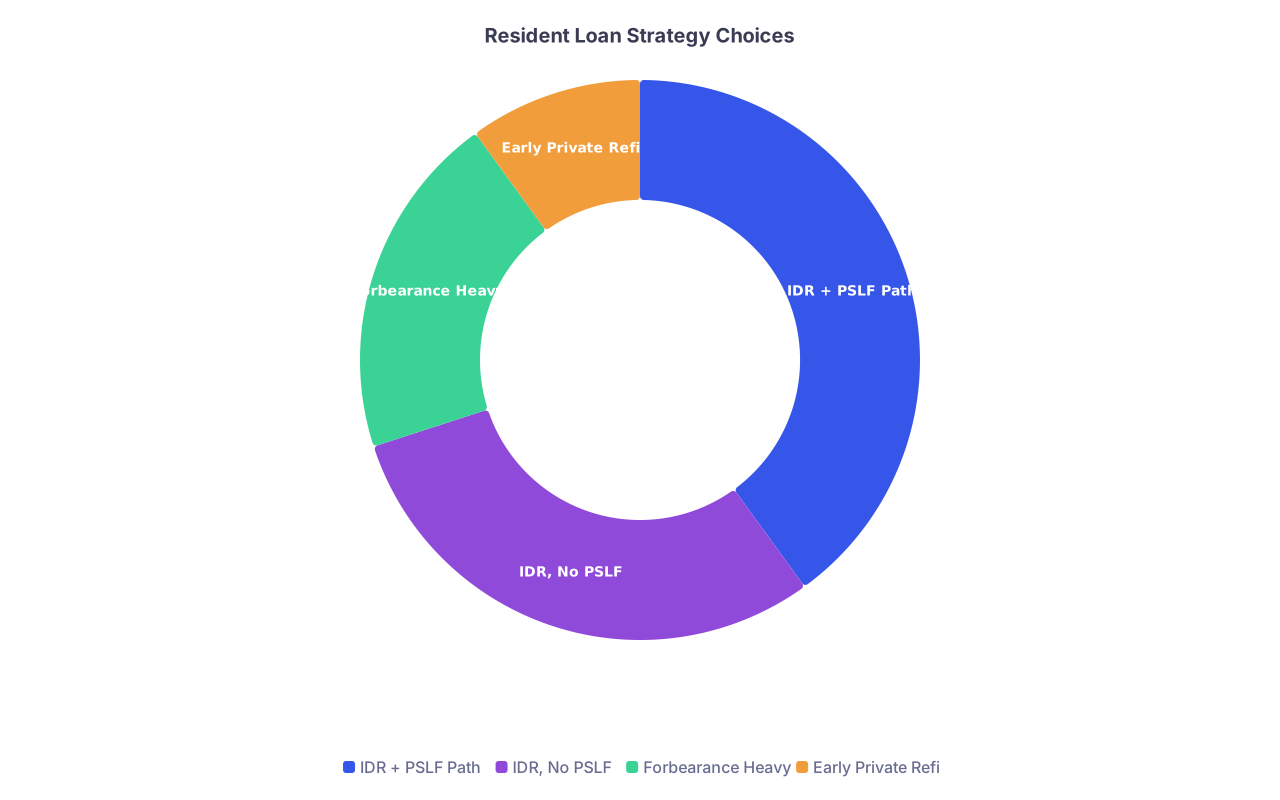
I can tell you from sitting in faculty meetings: the most financially relaxed attendings are either the ones who did PSLF right or the ones who attacked loans early with discipline. Almost nobody is happy with the path of “I’ll just ignore this until later.”
The One Conversation Older Attendings Wish You’d Start Now
There’s one more behind‑the‑scenes truth: most attendings are terrible at bringing this stuff up with you. They assume you’re too overwhelmed. Or they’re embarrassed by their own financial mistakes.
But when you actually ask a mid‑career attending, “What do you wish you’d done with loans in residency?” you’ll see their face change. The guard drops. The rehearsed professional script disappears.
You’ll hear:
- “I wish I hadn’t trusted my servicer’s advice.”
- “I should’ve gotten on IDR immediately.”
- “I lost years of PSLF because I didn’t understand the rules.”
- “I refinanced too early because the rep sounded smart.”
- “I ignored it for a decade and now I’m playing catch‑up with three kids and a mortgage.”
Use that. Ask those questions now. Harvest their regrets before you repeat them.
Because here’s the real insider secret:
You’re not “too early” to think about loans as a PGY‑1.
You are exactly on time.
And every month that passes without a plan quietly hardens into something you’ll be trying to chip away at with a much busier life.
With these foundations in place, you’re not going to become a loan expert overnight. You don’t have to. But you’re now in the small minority of residents who actually understand where the landmines are. Next step is execution: getting on the right plan, filing the right forms, and revisiting the strategy as you move through fellowship and that first attending job.
The attending version of you 10 years from now? They’ll feel the difference. And they’ll have very different stories to tell the residents coming behind you.
FAQ: What Older Attendings Always Ask (Too Late)
1. “I’m already a PGY‑3 and have been forbearance‑heavy. Is it too late to fix this?”
No. You haven’t ruined anything permanently. You may have lost some potential PSLF‑qualifying months and allowed more interest to accrue than ideal, but the next best time to get on an IDR plan and start counting qualifying payments is now. Get your loans in Direct form, choose an IDR (often SAVE), and if you’re at a qualifying employer, start filing PSLF employment certification annually.
2. “What if I’m not sure I’ll stay in academics or a PSLF‑qualifying job long term?”
Then you structure your plan so PSLF is a free option, not the only option. Stay in federal loans, use IDR during training, and accumulate qualifying months while you’re at PSLF‑eligible hospitals. If you later move to private practice permanently, you can reevaluate and potentially refinance as an attending. But if you refinance early, that door is closed forever.
3. “My attending told me PSLF is a scam and I shouldn’t count on it. Who’s right?”
Your attending is reacting to a bad early era of PSLF administration. The rules were poorly communicated, servicers screwed things up, and lots of people were denied for technical reasons. Today, PSLF approvals are happening routinely when people actually meet the criteria. You don’t “trust” it blindly—but you also don’t throw away the option. Build your plan so it works with or without PSLF, and document everything.
4. “Is there ever a good reason to refinance during residency?”
Yes, but it’s narrower than marketed. If your debt is relatively low compared to your expected specialty income, PSLF is clearly off the table, you’re in a stable situation, and you’re comfortable taking on private‑lender risk for a lower rate, partial refinancing can make sense. But the vast majority of residents are better served staying federal during training, reassessing as an attending when their situation is clearer.
5. “What’s the single most high‑value move I can make this month if I’ve been ignoring loans?”
Log in to your servicer, pull a full list of your loans, confirm they’re Direct, and enroll in an appropriate IDR plan now—not after grace, not “when things calm down.” If you’re at a PSLF‑eligible employer, submit your first PSLF employer certification form this month. That one short burst of admin work can literally be worth tens to hundreds of thousands of dollars down the line.