
The biggest financial lie medical students tell themselves is this: “I’ll worry about interest later. Once I am an attending, I will just pay it off.” That mindset quietly destroys hundreds of thousands of dollars of your future income.
You do not feel the damage now. You absolutely will later.
Let me walk you through how ignoring interest in medical school is not a neutral decision. It is an active, expensive mistake that follows you into residency, fellowship, and long after your first attending job.
The silent problem: capitalization you pretend is “not real”
Interest during med school feels fake. You are not making payments. Your servicer sends statements you barely open. The portal shows “$0 due.” So you tell yourself: loans are paused, I am “fine.”
Wrong. Here is what actually happens.
Unsubsidized federal loans (and virtually all grad loans are unsubsidized now) start accruing interest the day they are disbursed. That interest piles up while you are:
- In medical school
- In grace period
- Often in residency, if you are in forbearance or on low payments
If you do nothing, that interest eventually capitalizes. Translation: it gets added to your principal. Then you start paying interest on your interest. Forever.
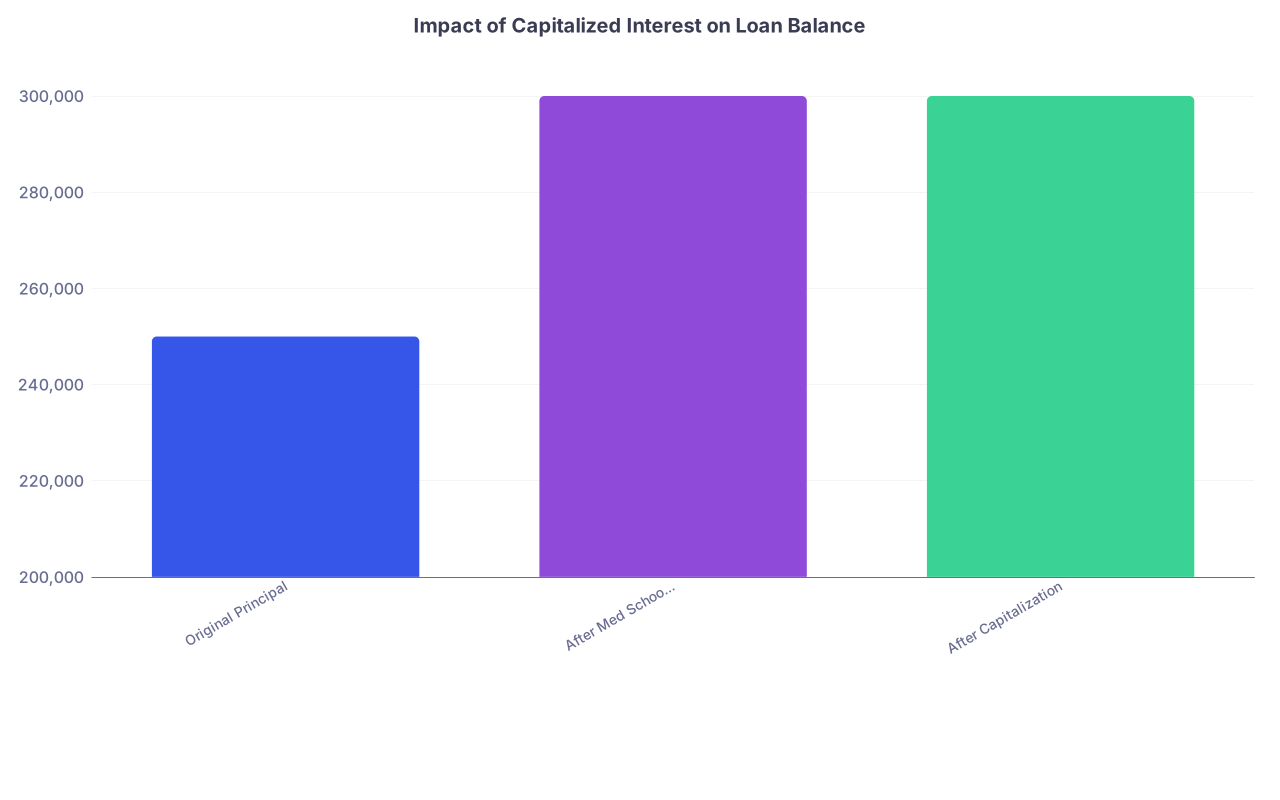
| Category | Value |
|---|---|
| Original Principal | 250000 |
| After Med School Interest | 300000 |
| After Capitalization | 300000 |
Here is the classic trap:
- You borrow $250,000 total during med school.
- Average interest rate: 6.5%.
- You do nothing, pay nothing, and ignore every statement.
- After four years, you easily have ~$50,000+ of unpaid interest.
- That $50,000 gets capitalized and becomes your new principal.
- Now you are paying 6.5% interest on $300,000, not $250,000.
Most students treat that $50,000 like it “just happened.” It did not. It happened because you chose to ignore interest. Because you decided “future me will deal with it.”
Future you is going to be furious.
Mistake #1: Confusing “no payment due” with “no cost”
I have watched this play out in real time. MS3s and MS4s sitting in a call room at 2 a.m. complaining that their future loans will be “like $250K or something.” Then they pull up their actual NSLDS or studentaid.gov file and see $290K… $310K… sometimes $350K.
Why the shock? Because they made the classic error:
They equated “I am not required to pay” with “I am not being charged.”
During med school, you are usually in an in‑school deferment. Deferment sounds safe. It is not. Deferment just means you are not required to pay. Interest still accrues on unsubsidized and Grad PLUS loans. Every month.
Ignoring this in school causes three predictable problems:
- You wildly underestimate your final balance.
- You make bad specialty and job decisions because you think your loans are smaller than they are.
- You box yourself into more expensive repayment paths later (or unnecessary forbearances) because the numbers are worse than you expected.
This is not about being perfect and paying everything off in school. It is about not lying to yourself about what is happening in the background.
Mistake #2: Letting interest derail your repayment strategy options
Another late realization I see all the time: students do not understand that how much interest you accumulate in school locks in or eliminates repayment paths later.
Your future choices depend heavily on what your balance looks like the day you:
- Enter residency
- Choose an income‑driven repayment plan
- Decide whether Public Service Loan Forgiveness (PSLF) is realistic
Example: The PSLF “oops”
You match into internal medicine at a nonprofit hospital. Perfect PSLF candidate. But during med school, you ignored everything, let interest balloon, and took out a bunch of Grad PLUS on top of unsubsidized loans.
Now your Day 1 residency balance is $350K at ~7%. You enter a new IDR plan, start making small payments, but the interest bill every month is much larger than your payment. The unpaid interest keeps climbing.
If you are on a PSLF track, the unpaid interest itself might be forgiven at the end. But here is the catch: PSLF only works if you stay in qualifying employment for 10 years and do all the paperwork flawlessly.
Most people are not that perfect. They switch jobs, go to a for‑profit practice, miss recertification, consolidate at the wrong time, or decide they want geographic flexibility. When PSLF falls apart, that huge capitalized balance is now very, very real.
Had you kept the balance smaller in school, your non‑PSLF options in your 30s and 40s would be far less painful. Instead, you built yourself a debt mountain that assumes a best‑case scenario career path to avoid disaster. That is not a smart bet.
Mistake #3: Blindly tolerating high interest rates because “I am a future doctor”
There is a weird arrogance that shows up with med students and interest rates. You will hear things like:
- “I mean, what is the difference between 6.5% and 8% when I am going to be a surgeon?”
- “I will refinance later, not worth thinking about now.”
- “Everyone graduates with debt; it is just part of the process.”
This is how lenders win.
Every extra percentage point on six‑figure debt is real money. Very real.
| Interest Rate | Annual Interest | 10-Year Total (No PSLF, Simple View) |
|---|---|---|
| 5.0% | $15,000 | $150,000 |
| 6.5% | $19,500 | $195,000 |
| 7.5% | $22,500 | $225,000 |
| 8.0% | $24,000 | $240,000 |
The difference between 5.0% and 7.5% on $300,000 is $7,500 per year. Keep that for 10 years, you just gave away $75,000 of interest alone, not counting compounding and capitalization.
You do not have to be perfect. But you should not be indifferent.
Options med students routinely ignore:
- Minimizing Grad PLUS borrowing (which has higher rates and fees) when other cheaper sources exist
- Using school‑based or state‑based low‑interest programs when available
- Considering modest family loans at lower rates in very specific, well‑documented situations
- Understanding that current federal interest subsidies in some IDR plans apply only if you are actually in those plans, not in forbearance
If you treat every loan as the same, you will accidentally prioritize the worst ones.
Mistake #4: Misusing forbearance in residency and turbo‑charging prior interest
Most of the damage from ignoring interest in med school shows up during early residency, when that interest finally capitalizes and you start compounding on a larger principal.
Here is how the dominoes usually fall:
- Med school: you ignore interest, never look at balances.
- Graduation: grace period hits, you still do nothing because you are “too busy with Step 2, moving, onboarding.”
- Residency starts: you panic when you see the payment, slap everything into forbearance because “I cannot afford this as a PGY‑1.”
- Interest continues to accrue on the already‑inflated balance.
- When the forbearance ends, all that unpaid interest capitalizes. Again.
Now you are paying interest on interest on interest. Now you are trapped.

| Step | Description |
|---|---|
| Step 1 | Med school loans accrue interest |
| Step 2 | No payments made |
| Step 3 | Interest grows quietly |
| Step 4 | Graduation and grace period |
| Step 5 | Residency starts |
| Step 6 | Resident chooses forbearance |
| Step 7 | More unpaid interest accrues |
| Step 8 | Capitalization event |
| Step 9 | Much higher principal |
| Step 10 | Higher lifetime cost |
If you think you might use PSLF or any IDR forgiveness, forbearance is almost always the wrong move. Every month in forbearance is:
- A month of lost qualifying payments
- A month of unnecessary interest buildup
You think forbearance gives you breathing room. What it actually does is lock in the damage done by ignoring interest in med school and then add another layer.
A resident who used IDR with $0–$150 payments starting PGY‑1 is usually in a far better position—even though they “paid something”—than the resident who paid nothing and sat in forbearance.
Mistake #5: Not understanding interest subsidies and IDR quirks
There is a fairly cruel irony here. Many med students ignore interest and skip IDR because they believe, incorrectly, that any unpaid interest will just make things worse.
Then the government actually offers partial interest subsidies in some plans for low‑income borrowers. The help exists. They just never bothered to learn how it works.
For example (this is the pattern, details evolve as rules change):
- Certain IDR plans cover a portion of unpaid interest each month if your payment does not fully cover the interest.
- Sometimes the government pays 100% of unpaid interest on subsidized loans for a set number of years, and 50% on unsubsidized loans.
- On some newer plans, there can be targeted interest benefits that keep your balance from ballooning under specific income thresholds.
If you sit in deferment or forbearance, you often miss these subsidies entirely. You think you are “avoiding payments,” but what you are really doing is rejecting free interest coverage.
Again: ignoring interest does not keep you neutral. It actively blocks you from available protections.
Mistake #6: Treating unpaid interest as emotionally distant instead of as a concrete dollar figure
The psychological trick your brain plays: $300K vs $350K feels roughly the same. Both are “massive.” So you stop caring about the extra $50K of interest that built up.
But that extra $50K is not abstract. It is:
- A down payment on a house in a cheaper market
- The cost of 12–18 months of daycare for two kids in many cities
- The difference between working an extra 5 years vs hitting financial independence sooner
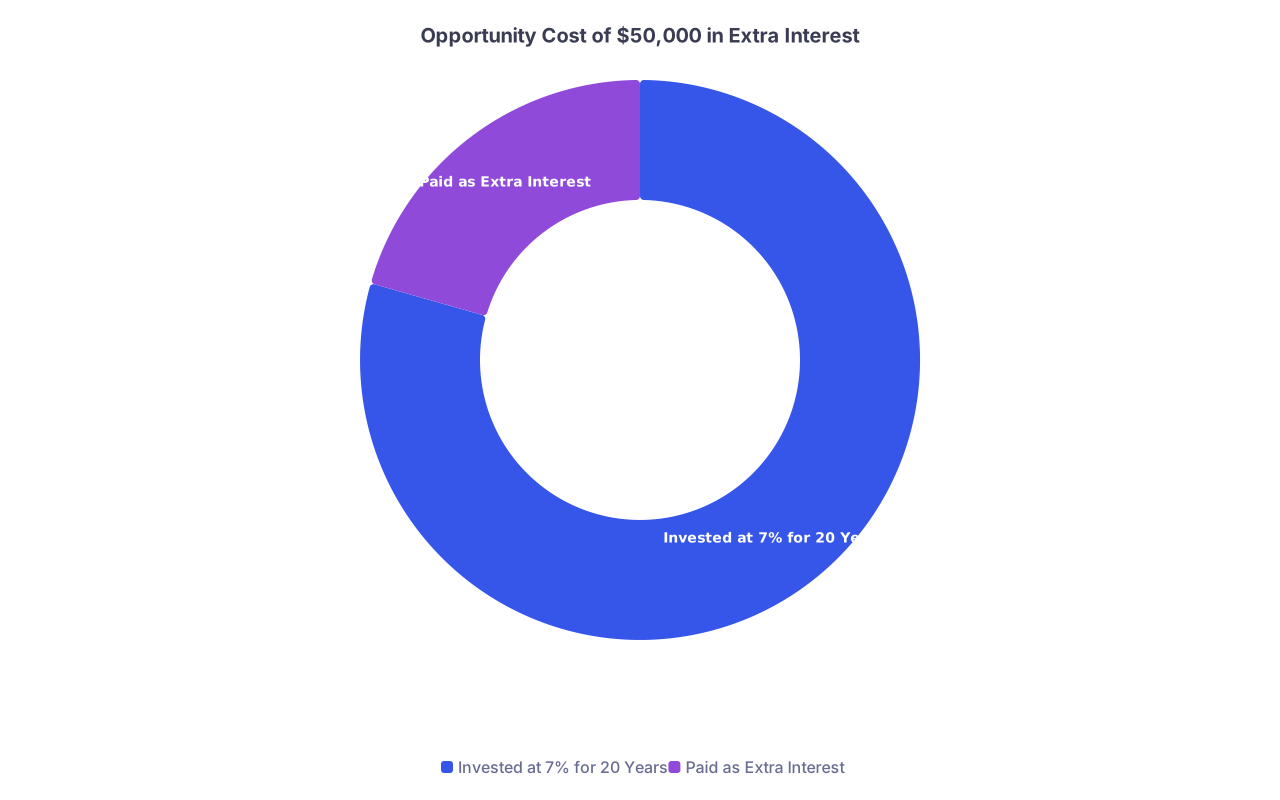
| Category | Value |
|---|---|
| Invested at 7% for 20 Years | 193000 |
| Paid as Extra Interest | 50000 |
If you invested $50,000 at a modest 7% return for 20 years, you end up with around $193,000. When you let that same $50,000 quietly accrue and capitalize instead, you are not just paying $50,000. You are giving up the six‑figure future value of that money.
That is what “ignoring interest” really costs. You are not avoiding stress. You are converting it into a massive invisible tax on your future.
So what should you do differently in med school?
I am not going to tell you to live like a monk and pay everything off before residency. That is fantasy for most students. But there are specific mistakes you must avoid and a few realistic steps that make a huge difference.
1. Stop pretending you do not have a number
Log in. Today. To your actual loan accounts. Not the vague memory of some PDF from MS1.
- Check each loan: principal, interest rate, and accrued interest.
- Add it up. Write the total down somewhere you cannot ignore.
No, this will not feel good. Yes, you need to do it anyway.

2. Understand when capitalization will hit
Ask directly:
- When does unpaid interest capitalize on my loans?
- At graduation? End of grace period? When I consolidate? When I change plans?
Then avoid unnecessary capitalization events. Sometimes consolidating early into an IDR plan as a resident makes sense. Sometimes waiting does. The point is: do not trigger capitalization blindly.
3. Make even small, targeted payments in med school if you can
You do not have to pay everything. But the med student who:
- Covers at least part of the accruing interest each year, or
- Throws a few hundred dollars per semester at the highest‑rate loans
ends up in a much cleaner position than the one who pays literally nothing.
If your loans accrue about $10,000 of interest per year, and you can scrounge up even $1,500 toward that, you just cut your eventual capitalized interest by 15%. That is not trivial.
Focus any extra money on:
- The highest‑interest loans first (often Grad PLUS)
- Loans that are most likely to capitalize soon
Do not spread tiny payments evenly across everything without thinking.
4. During residency, default to IDR over forbearance unless a specialist tells you otherwise
If your goal is PSLF, this is nearly non‑negotiable: you should be in an income‑driven plan and making qualifying payments as early as possible.
Even if your IDR payment is $0, you are at least:
- Getting qualifying months for PSLF
- Potentially receiving interest subsidies
If you are not going for PSLF, you still probably want to avoid forbearance unless:
- You are in a short, temporary crunch, and
- You have a plan to resume payments soon
For most residents, a lower IDR payment is better than a total pause with full, unsubsidized interest growth.
How this plays out in real life: two residents, same specialty, very different futures
Let me sketch a simplified comparison. I have seen variations of this more times than I can count.
| Resident A – Ignored Interest | Resident B – Managed Interest | |
|---|---|---|
| Med school behavior | Never checked balances; no payments | Checked yearly; small interest payments |
| Balance at graduation | $300,000 | $270,000 |
| Residency choice | 3 years forbearance | 3 years on IDR, $100/mo avg |
| Balance before attending | ~$360,000 (after capitalization) | ~$280,000–$290,000 |
| Time to payoff as attending (no PSLF) | 15–20 years, high payments | 10–15 years, more flexibility |
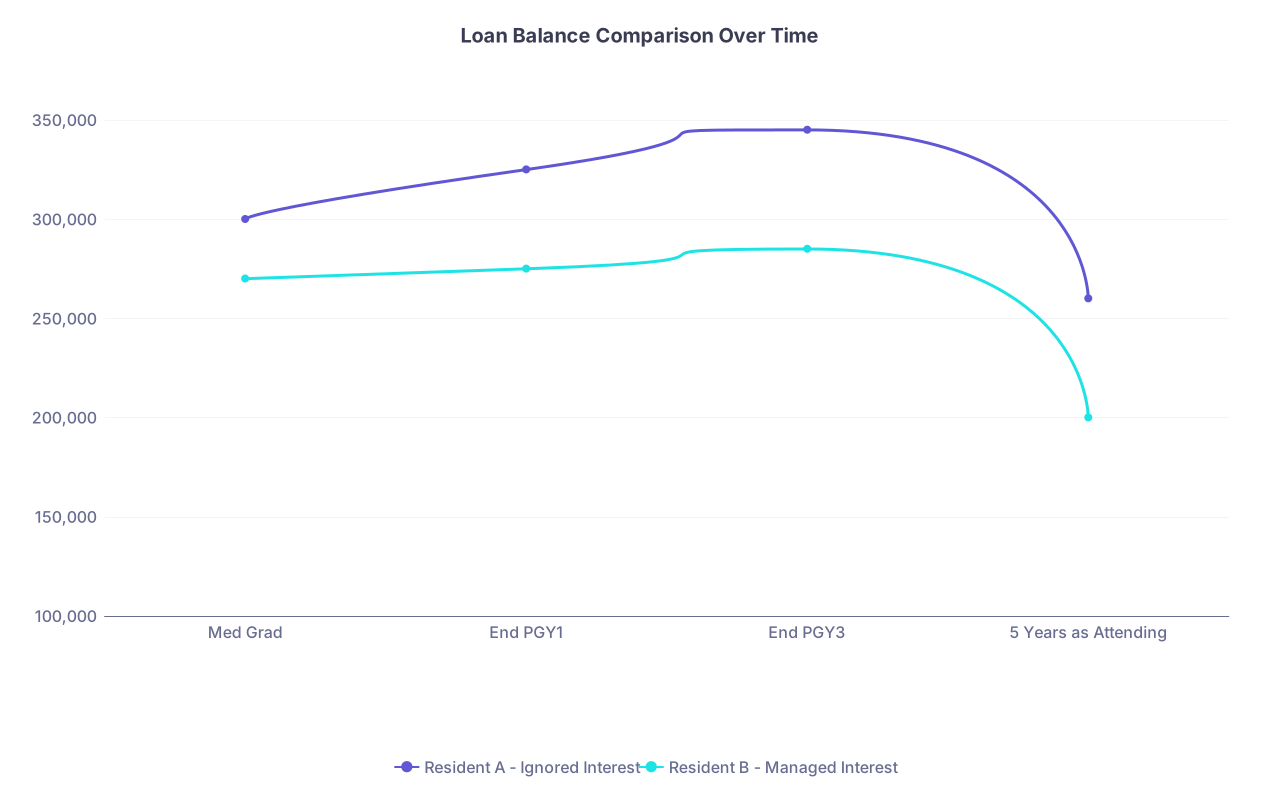
| Category | Resident A - Ignored Interest | Resident B - Managed Interest |
|---|---|---|
| Med Grad | 300000 | 270000 |
| End PGY1 | 325000 | 275000 |
| End PGY3 | 345000 | 285000 |
| 5 Years as Attending | 260000 | 200000 |
Same degree. Same specialty. Same salary as attendings.
Resident A gave away an extra $60K–$100K (or more) over their career because they could not be bothered to understand or address interest during med school and residency.
That is the sabotage I am talking about. Completely avoidable. Brutally common.
Do not let “future you” pay for present denial
The core problem is not that loans exist. Medical training is expensive, and debt is often unavoidable.
The core problem is denial.
- Denying that interest is accumulating while you sleep.
- Denying that capitalization is a huge, one‑way ratchet that makes everything worse.
- Denying that small, early actions matter more than heroic efforts later.
You cannot fix every aspect of the system. You can stop making it harder on yourself.

If you remember nothing else, remember this:
- Interest is not hypothetical. It is real money you will either pay or give up forever.
- Forbearance and inaction are not neutral; they are often the most expensive choices you can make.
- Small, informed steps in med school and residency—checking balances, avoiding unnecessary capitalization, using IDR intelligently—save you tens to hundreds of thousands of dollars in future paychecks.
Ignore interest now, and your future self will work extra nights and weekends paying for that decision. Literally.