
Tactics for Handling Med School Loans During a Research or Chief Year
It is July 1. You just slid out of your last intern rotation, and instead of signing out to nights, you are staring at your first “non-standard” year: a funded research year, or stepping into a chief role with a weird mix of admin time, call, and maybe less moonlighting than your co-residents. Your friends are talking about PSLF years “counting.” Your servicer just emailed you a bill that looks like rent in a major city. And you are realizing: this in-between year can either help your long-term loan strategy or quietly screw it up.
I am going to walk straight at that problem: how to handle med school loans specifically during a research year or chief year. Not generic “loan advice.” Concrete levers, traps, and moves that affect whether that one year costs you tens of thousands of dollars over your career.
Let me break this down.
Step 1: Get brutally clear on your status this year
Everything flows from how the system labels you. Not how you feel (“I’m basically still a resident”), but what your pay stubs and contracts actually say.
There are three core realities I see in research/chief years:
- You are still an employee of a 501(c)(3) or government hospital (W-2), just with different duties.
- You are paid via a grant/fellowship/stipend that may or may not be routed through payroll.
- Your income is low enough or irregular enough that your loan payment can drop significantly.
Each of those matters for PSLF and for IDR payments.
Here is the diagnostic checklist I would want on your desk:
- Are you getting a W-2 from a hospital, medical school, or affiliated 501(c)(3) this year?
- Is your title still “resident physician,” “fellow,” “chief resident,” “clinical instructor,” or similar?
- Is your FTE (full-time equivalent) at least 0.75–1.0 with that employer?
- Are you doing at least some clinical work (even if part-time) under that paycheck?
If you answer “yes” to those, you are probably still accumulating qualifying PSLF months. If you cannot answer those cleanly, you need to assume nothing and verify everything.
Step 2: PSLF – are you building credit or taking a gap year?
For anyone even remotely considering PSLF, your research or chief year is either:
- A cheap PSLF year (low income → low IDR payment, still earning credit), or
- A lost year (no qualifying employment, or you accidentally forbear).
The difference is not subtle. It is tens of thousands of dollars.
When a research/chief year does count toward PSLF
You are usually fine for PSLF credit if:
- Employer is a 501(c)(3) or government entity.
- You are paid as an employee (W-2), not just as a contractor (1099) or “scholar.”
- You are working an average of at least 30 hours per week (PSLF full-time definition) or meeting your employer’s definition of full-time if higher.
Common concrete examples where the year counts:
- Chief resident at a university hospital, paid via GME, same benefits as residency.
- Funded research year where your stipend comes on the same payroll system as residents, with benefits and W-2.
- “Research fellow” position at the same teaching hospital, with 0.8–1.0 FTE and employee benefits.
Those months should count toward PSLF as long as you are on a qualifying repayment plan (IDR) and making payments.
When a research/chief year does not count – or is at risk
Red flags that I see too often:
- Your “funding” is a training grant paid as a stipend, not employee wages. No W-2, but maybe a 1099 or even no tax slip at all.
- You are technically a “visiting scholar” or “postdoc” with a non-employee status.
- You take an unfunded research year, live off savings or family support, and do not have a qualifying employer at all.
- You casually throw your loans into forbearance or deferment because “my income is low; I will pay later.”
If your year falls into that bucket, you either:
- Accept that it is a non-PSLF year and plan accordingly, or
- Aggressively adjust the structure (take paid clinical shifts through the hospital, change your appointment title, etc.) to make it count.
This is where one phone call to GME or HR is not optional. You want the exact language:
“Will I be a W-2 employee of [Hospital Name] this year at at least 0.75 FTE, with benefits, and does my position qualify as full-time under hospital policy?”
If the answer is vague, keep digging until it is not.
Step 3: IDR strategy – this is where research/chief years can be leveraged
Here is the quiet advantage of a research or chief year: your income is often the lowest it will be for the rest of your life, but those payments can still count toward PSLF or IDR forgiveness. That combination is lethal (in a good way) if you use it correctly.
Understand which IDR plan you are actually on
Right now, most trainees should be on SAVE (the new REPAYE) or occasionally PAYE/IBR if there is some edge case. The mechanics:
- Payments are based on prior-year AGI (unless you update with pay stubs).
- Family size matters.
- SAVE structure is very favorable for low-income trainees: much of the unpaid interest is subsidized.
During a research or chief year, you can:
- Keep payments artificially low by not updating income if your AGI was low last year.
- Or, if your income dropped this year compared to last, submit new income documentation (pay stubs) to force your payment lower.
You need to choose intentionally, not accidentally.
The research-year / chief-year payment play
Here is how to weaponize that year if PSLF is likely in your future:
- Stay on a qualifying IDR plan (SAVE, PAYE, or IBR if you are stuck there).
- Keep your payments as low as legally allowed:
- If last year’s AGI was low → ride that for another 12 months.
- If last year’s AGI was high but this year is low → recertify early using current pay stubs.
- Make every month count toward PSLF if your employment qualifies.
During a low-income year, the “cost” of those PSLF credits is often a few hundred dollars a month. Cheap years are the ones to hoard.
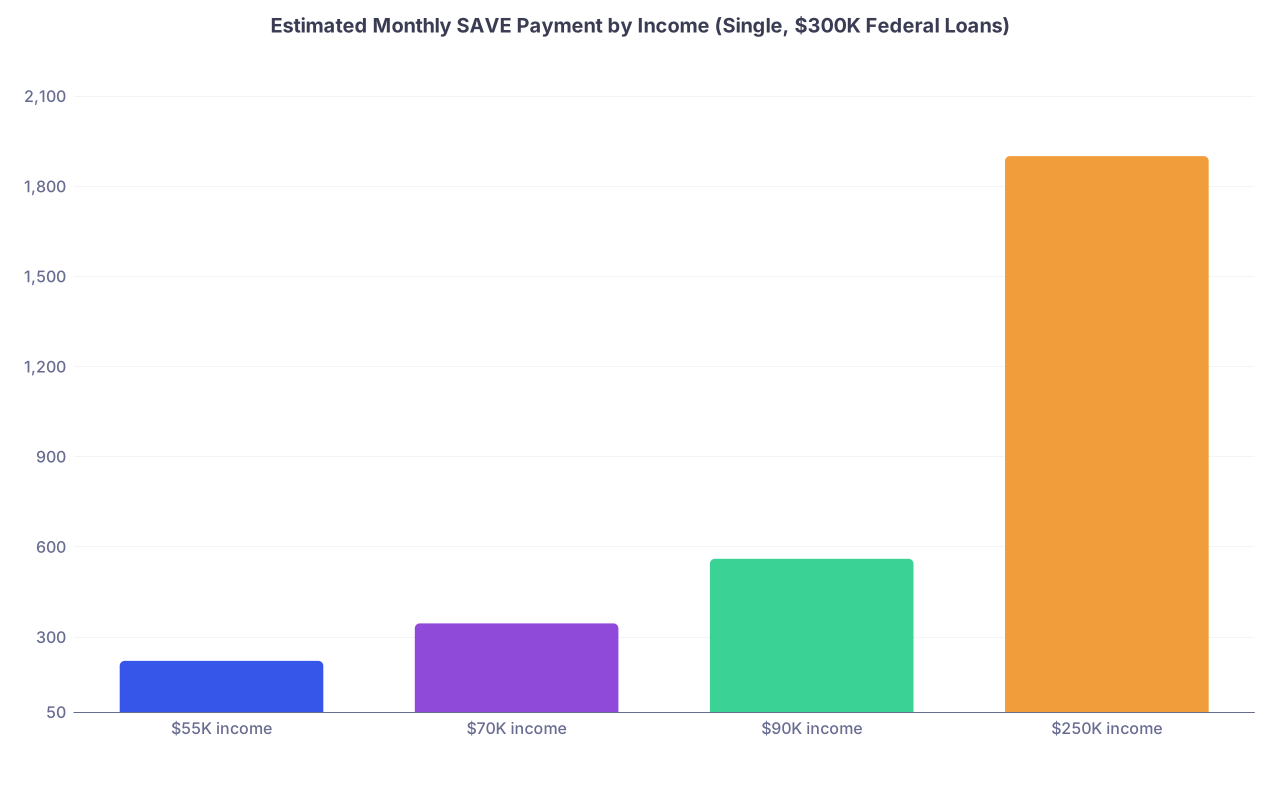
| Category | Value |
|---|---|
| $55K income | 220 |
| $70K income | 345 |
| $90K income | 560 |
| $250K income | 1900 |
You can see the pattern. That research or chief year where you make $60–75K is the last time in your career your IDR payment will be that low. It is the wrong year to drift into forbearance.
Step 4: Avoid the “free” forbearance trap
I see this one constantly: GME or your servicer offers an easy path to forbearance or deferment because “your income is low” or “you are in training.” Residents hear “you can pause payments” and think it is a perk.
For almost everyone with federal loans, especially if PSLF is anywhere on the horizon, this is a bad move.
What forbearance does in this context:
- It stops required payments.
- It does not stop interest.
- It does not earn PSLF credit.
- It often leads to large capitalization events down the road that inflate your balance.
During a research or chief year, skipping payments can cost you:
- 12 lost PSLF-eligible months
- Thousands of dollars of interest that could have been subsidized or “forgiven” indirectly via PSLF.
You need a very specific, defensible reason to use forbearance in this year:
- Catastrophic cash flow (medical crisis, supporting family, etc.).
- You are already fully committed to a non-PSLF path, plan to refinance later, and are simply buying time.
Even then, I would run the numbers before clicking “forbear.”
Step 5: If PSLF is uncertain, build two parallel plans
A lot of people in research or chief years are not sure if they will:
- End up at a 501(c)(3) long term.
- Go private practice.
- Subspecialize in a way that changes the whole equation.
That is fine. You do not need to know with certainty. You do need a framework that keeps options open.
Split scenarios: what are you optimizing for?
Two main endgames:
PSLF path:
- Likely academic or large nonprofit hospital work for at least 10 total years.
- Goal: maximize PSLF-eligible months, pay the least allowable under IDR.
Non-PSLF / private practice path:
- Likely higher attending income in non-qualifying environments.
- Goal: minimize total interest and time in debt; may refinance aggressively after training.
During a research/chief year, you should act as if both are still on the table, unless you are absolutely sure.
That means:
- Stay on IDR (do not default to forbearance).
- Keep PSLF eligibility active if your employer qualifies.
- Do not refinance to a private lender during training (huge mistake if you later land at a PSLF-eligible job).
| Factor | PSLF-Likely Strategy | Non-PSLF / Private Strategy |
|---|---|---|
| Repayment plan | SAVE / other IDR | SAVE or standard while in training |
| Refinancing | Avoid until stable attending job | Consider only after training |
| Goal this year | Max PSLF months, minimal payment | Control balance, preserve options |
| Forbearance use | Avoid unless absolutely necessary | Rare; only for extreme hardship |
Notice what both columns share: you do not torpedo options during this year.
Step 6: How chief year specifically changes things
A chief year looks simple on paper, but there are a few quirks that matter for loans.
Income jump (or not)
Some programs pay chiefs:
- A modest bump ($5–10K over senior resident pay).
- A significant bump if classified as “junior faculty.”
- Or nothing meaningful at all, just a title and misery.
This matters because your IDR recertification may capture that higher income.
Key tactic: time your recertification.
- If last year’s AGI is still based on your PGY-3/PGY-4 income (lower) and your chief year pay is slightly higher, do not voluntarily recertify early. Let the low AGI ride as long as possible.
- If you had an unusually high income the previous year (moonlighting heavy) but are now in a lower-paid chief role, do submit current pay stubs to drop your IDR payment.
I have watched residents accidentally spike their IDR payment for 12 months by recertifying on July 1 with their fresh, higher chief pay stub, when they could have ridden their old AGI for another year.
PSLF certs during chief year
You want your PSLF Employment Certification Form updated for this role. Do not wait three years and then try to retroactively prove:
- That your “chief” role met full-time criteria.
- That your employer was 501(c)(3).
- That you were in fact paid as an employee.
Get it signed during the year by whoever handles HR/benefits or GME. Throw a reminder into your calendar now.
Step 7: How a research year specifically complicates things
Research years are messier. The variety of structures is the whole problem.
Here are the common flavors I see:
Fully funded, employee status, still in GME system.
- Easiest case. Treat it like another resident year.
Funded by a grant but paid as a stipend, not as an employee.
- You might lose PSLF credit unless you add separate qualifying employment.
Unfunded or externally funded where you have no formal employer relationship.
- PSLF is off the table for that year unless you attach yourself to a qualifying employer some other way.
Tactical fixes for a non-employee research year
If you find out your research year is non-employee, ask:
- Can this funding be routed through the hospital’s payroll so you are classified as a research fellow or similar?
- Can you pick up paid clinical shifts directly through the hospital as a W-2 employee at sufficient FTE to qualify as full-time?
- Can you combine a 0.5–0.75 FTE clinical appointment with research, so that your employment relationship exists and your time totals at least 30 hours/week?
If you can restructure it, do it before the year starts. Trying to fix it retroactively is a mess.
If it truly cannot be structured as qualifying PSLF employment, then you pivot:
- Accept that PSLF will have one less year.
- Still stay on IDR to keep payments manageable and limit capitalization.
- Treat this as a cash-flow year: keep payments low, interest manageable, and be ready to recalibrate once you are back in clinical training.
Step 8: Moonlighting and side income – use it, but understand the tax and IDR implications
A research or chief year is often when you can finally moonlight. This feels like free money. It is not.
Two separate issues:
Short-term cash management
- Moonlighting income can be perfect for making your IDR payments painless, padding an emergency fund, or reducing high-interest credit card or personal debt.
Next-year IDR payments
- If you moonlight heavily and report a much higher AGI, next year’s IDR payment will jump.
So the move is not “do not moonlight.” The move is:
- Use moonlighting to shore up your financial position now.
- Understand that a huge spike in AGI this year means higher IDR next year. Factor that into your attending-year budget or fellowship planning.
If you are near the end of your PSLF timeline (e.g., PGY-5, planning academic attending), a higher IDR payment near the end simply means more paid before forgiveness. That might be fine. Just do not act surprised when the servicer recalculates.
Step 9: Federal vs private – do not refinance too early
A common mistake: a confident PGY-3 going into a “guaranteed” private practice fellowship or job decides to refinance during chief or research year to get a lower rate.
Then:
- They match into or pivot to an academic job.
- Or the private group folds.
- Or life changes and PSLF/IDR flexibility becomes useful again.
Once you refinance federal loans to a private lender:
- PSLF is gone forever.
- SAVE and other IDR plans are gone.
- Economic hardship forbearance rules change.
For almost everyone, the correct sequence is:
- Keep loans federal through all training years (including research and chief).
- Make IDR payments, collect PSLF months if available.
- Decide on attending job structure.
- Only then consider refinancing – and only if PSLF is clearly off the table and you are comfortable losing federal protections.
Your research or chief year is still “training.” Not the time to burn bridges.
Step 10: Legal and paperwork hygiene – boring but critical
Two administrative pieces will save you headache later:
1. PSLF Employment Certification Forms (ECFs)
During a multi-stop path (intern year → research year → residency continuation → chief year → fellowship), your PSLF audit trail can get ugly. I have seen people spend months trying to track down old GME coordinators who retired.
So:
- Submit an ECF for each distinct role:
- Core residency at Hospital A.
- Research fellow at Hospital A/B (if employee).
- Chief resident at Hospital A.
- Keep copies of:
- Signed forms.
- Offer letters/contracts describing FTE and job title.
- Pay stubs showing employer name and hours if there is any gray area.
This is boring. It is also the difference between “forgiven at 120 months” and “we only count 84 of these.”
2. Income documentation
Each year, servicers will:
- Ask for recertification of income (AGI or alternative documentation).
- Adjust your IDR payment for the next 12 months.
You want:
- A stable system for saving your tax returns (PDF), pay stubs, and any letters showing job transitions.
- Awareness of timing – if you are planning a transition (e.g., chief year → fellowship with lower pay), you can sometimes time your recert so they use the lower income.

| Step | Description |
|---|---|
| Step 1 | Start Year |
| Step 2 | Confirm employer is 501c3 |
| Step 3 | Keep IDR, avoid refinance |
| Step 4 | Check W2 employee status |
| Step 5 | Stay on SAVE or other IDR |
| Step 6 | Try to add qualifying employment |
| Step 7 | Submit PSLF cert for role |
| Step 8 | Time IDR recert with income changes |
| Step 9 | Avoid forbearance unless crisis |
| Step 10 | Reassess at year end |
| Step 11 | PSLF Likely? |
A concrete example – two paths, same person
Just to crystallize this, let me give you a typical scenario.
You:
- $300,000 federal loans at ~6.5%.
- PGY-3 internal medicine, planning chief year, then maybe cards.
Path 1 – Clean PSLF-minded strategy
- You stay on SAVE all through PGY-3 and chief year.
- Your employer is a large academic 501(c)(3).
- You do not recert early in July; you let last year’s lower AGI hold your payment around $250–300/month.
- You moonlight a bit, but keep that money for emergency fund and Roth IRA, not to prepay loans (because you expect PSLF).
- You file PSLF employment certifications for:
- PGY-1–3 years.
- Chief year.
Result: by end of chief year, you have 4–5 years of PSLF-eligible credit at very low payments. You are positioned to hit 10 years relatively painlessly if you stay academic.
Path 2 – Sloppy, “I will figure it out later”
- You defer your loans PGY-3 because payments feel stressful.
- For chief year, you put loans in forbearance because GME told you it was easy.
- You never submit employment certifications.
- You moonlight heavily, push your AGI to $90K, but then switch back to IDR at the end of chief year and get hit with a big payment based on that AGI.
Result: you have 0–2 PSLF-eligible years instead of 4–5, thousands of dollars of capitalized interest, and fewer options when deciding between academic vs private jobs.
Same salary. Same loans. Different discipline.
Summary: The three things that actually matter
Keep this short and sharp:
Do not waste cheap years. A research or chief year is usually low-income. That is exactly when you want to be on IDR, avoiding forbearance, and banking PSLF-eligible months if your job qualifies.
Get your classification right. For research or chief roles, verify: W-2 employee, 501(c)(3) or government employer, full-time by policy. If any of those are ambiguous, fix them early or adjust your expectations.
Preserve flexibility. Do not refinance during training. Do not casually pause loans. Stay on federal IDR, certify PSLF employment, and time income recerts intelligently. That one “weird” year can either quietly help you or quietly cost you. Use it.