
Only 24% of physicians carry enough disability insurance to replace even 60% of their income if they are unable to work.
Now layer $200,000–$400,000 of student loans on top of that and you start to see the problem.
You do not manage student loans in a vacuum. You manage them in the context of “what happens if something goes very wrong?” Disability, early death, or needing to leave your field entirely. Most people ignore this until they get burned or watch a colleague get burned. You are trying to be smarter than that.
Let me break this down specifically: how disability insurance and student loans intersect, where you are actually vulnerable, and what you can do now so a worst‑case medical or career scenario does not also become a financial catastrophe.
1. The Core Problem: Income Risk + Long-Term Debt
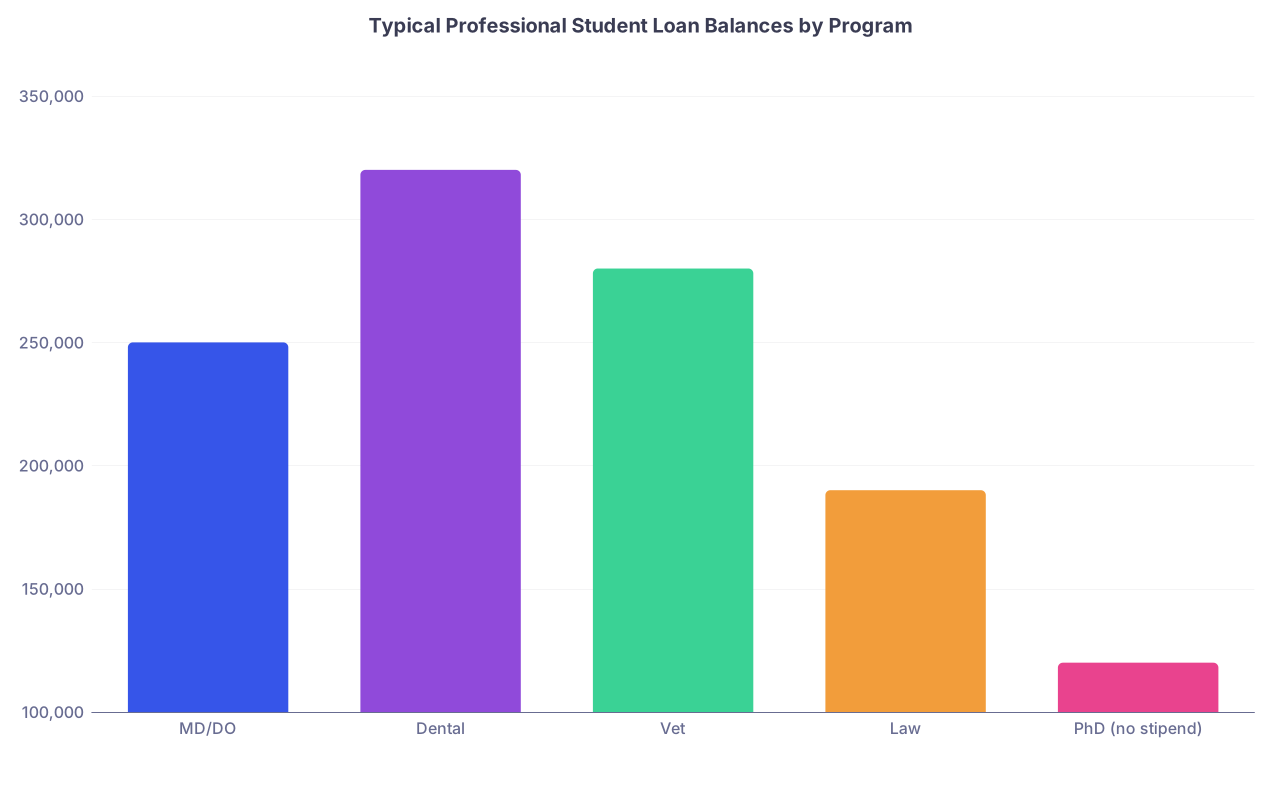
| Category | Value |
|---|---|
| MD/DO | 250000 |
| Dental | 320000 |
| Vet | 280000 |
| Law | 190000 |
| PhD (no stipend) | 120000 |
Let’s start bluntly: federal student loans are unsecured, long‑term, and usually not dischargeable in bankruptcy. They are designed with one assumption: you will be able to work.
The risk profile for someone with high loans looks like this:
- Large, fixed monthly obligation (often $1,500–$3,000+ on a standard plan).
- Income that is very much not guaranteed: illness, injury, mental health, burnout, career change.
- A legal structure (especially with federal loans) that heavily favors the lender, not you.
Disability is the bridge between “this seems manageable on a spreadsheet” and “I have no idea how to pay anything.”
The big three “disaster” questions you should be able to answer:
- If I became totally disabled tomorrow, what would happen to my loan payments for the next 30+ years?
- If I could work only part‑time or in a lower‑paying job, how would that affect my repayment plan, forgiveness strategy, and retirement savings?
- If I died, what would happen to my loans, and who would be left holding the bag (spouse, parents, cosigner)?
If you cannot answer those clearly, you do not yet have a real protection strategy. You just have loans and vibes.
2. How Federal and Private Loans Behave in Disability and Death
This is where details matter. The rules are not intuitive, and they differ sharply between federal and private loans.
Federal Loans: What Actually Happens
For federal Direct Loans, Grad PLUS, and some older FFEL loans, the key concepts are:
- Total and Permanent Disability (TPD) Discharge
You may qualify for TPD discharge of federal loans if:
- You are a veteran with a VA determination of unemployability, or
- You receive SSDI/SSI and your next review is 5–7 years out, or
- A physician certifies that you are unable to engage in substantial gainful activity due to a physical or mental impairment expected to last at least 60 months or result in death.
This sounds generous, but in practice:
- It is a high bar. Partial disability, limited capacity, or inability to work in your specialty alone usually will not qualify.
- The process is paperwork-heavy and slow.
- For three years after discharge, your status is monitored. If your income goes above a threshold or you fail to return required forms, your loans can be reinstated.
- Death Discharge
- Federal student loans are discharged upon your death.
- Parent PLUS loans are discharged upon the death of either the parent borrower or the student.
- Historically, there could be tax complications (COD income), but currently federal TPD and death discharges are not treated as taxable income through at least 2025. Tax law can change; you cannot assume this forever.
- Partial Disability or “Can Work in Some Capacity”
This is where most people actually end up:
- You cannot keep doing full‑time surgery, dentistry, heavy clinical work, or consulting hours.
- But you can do something: part‑time telemedicine, admin work, non‑clinical role, or a lower‑paying specialty/industry.
In this middle ground:
- No TPD discharge.
- You still have the loans.
- Your income may drop 30–60% or more.
Here is where income-driven repayment (IDR) becomes your pressure valve. With plans like SAVE (formerly REPAYE), PAYE, or IBR:
- Your payment is a percentage of “discretionary income.”
- If your income falls sharply, your required payment falls. Sometimes dramatically.
- After 20–25 years of qualifying payments, the remaining balance can be forgiven (tax‑free under current rules for federal IDR through 2035; again, law can change).
So for federal loans, the rough picture:
- Totally, permanently disabled or dead → loans may be discharged.
- Partially disabled, reduced earning capacity → no discharge, but IDR may keep payments technically “affordable,” while retirement savings and lifestyle get crushed.
Private Loans: Less Friendly, More Dangerous
Private student loans are a different animal:
- Many do not offer robust TPD discharge.
- Some offer only very narrow disability or death protections (or none).
- Some will discharge upon death; others still hold cosigners liable.
- Some have temporary forbearance for short‑term disability, but that does not solve long‑term problems.
If you or a cosigner signed private loans, you need to know, in black and white:
- Does this loan discharge on borrower death?
- Does this loan discharge on TPD? How is TPD defined?
- What happens to cosigners?
I have reviewed enough promissory notes to say this plainly: many borrowers are shocked by how little protection is built in.
3. Disability Insurance: What It Actually Needs To Do For You

Disability insurance is not one monolithic thing. The details determine whether it truly protects you or just checks a box on an HR form.
The main purpose, in the context of student loans, is simple:
Replace enough of your income, for long enough, that you can
(a) keep your loan strategy intact or adjust it rationally, and
(b) still have some shot at saving for retirement and living like a human.
Let’s drill actual features that matter.
Own-Occupation vs Any-Occupation
This is the first battlefield.
- Any-occupation: You are disabled only if you cannot work in any reasonable job you are suited for by education, training, or experience.
- Own-occupation (true own-occ): You are disabled if you cannot perform the material duties of your own occupation, even if you could do something else.
For a high-debt professional:
- A neurosurgeon who can no longer operate but can work part-time in clinic or admin would rarely qualify as disabled under “any‑occ.”
- Under a strong “own‑occ” policy, that same surgeon could collect full disability benefits while earning in another role.
If your career track depends on a specific technical/specialized skill (procedures, physical capacity, long shifts), you want true own-occupation, often specialty-specific in medicine and dentistry.
Group policies through employers are often:
- Any‑occ or modified own‑occ.
- Limited duration own‑occ then revert to any‑occ.
- Capped at relatively low benefit limits.
That is not enough protection for someone with $250k+ of loans.
Benefit Amount and Duration
Two numbers that matter more than all the marketing fluff:
- Monthly benefit – How much it pays.
- Benefit period – How long it pays.
A common mistake: buying just enough to cover current living expenses, ignoring loans and long-term saving.
As a rule of thumb, many people aim for 60–70% of gross income as a target benefit number. I find that too simplistic. You actually want to run a rough budget:
- Post-disability monthly income from insurance.
- IDR-adjusted or private loan payment.
- Baseline living costs (housing, food, insurance, kids, etc.).
- Some retirement savings (because you will still age, even if you are disabled).
If that math does not work with your proposed benefit, the policy is underpowered. Period.
Duration: A policy that pays only 5 or 10 years might be acceptable only if you have a realistic backup plan, small loans, and can pivot fairly easily. With heavy loans and a specialized career, to age 65 or 67 is usually more appropriate.
Elimination Period (Waiting Period)
This is the time from disability onset to when benefits start, usually 90 days, sometimes 180.
You bridge that gap with:
- Emergency fund.
- Short-term disability coverage (often employer provided).
If you have no cash buffer, a 180‑day elimination period is a bad bargain just to save a few dollars in premium.
Riders That Matter for Student Loan Management
Riders are where you “aim” the insurance at the student loan problem.
The big ones:
- Student Loan Repayment Rider
Some private policies offer a specific rider that:
- Pays an additional amount per month dedicated to loan repayment,
- For a fixed period (often 10–15 years) after disability starts.
Pros:
- Directly covers or offsets your student loan payments.
- Lets your main benefit focus on living expenses and retirement.
Cons:
- Extra cost.
- Usually time‑limited; may not cover the whole life of the loan or all forgiveness waiting periods.
- Residual / Partial Disability Rider
This is crucial and frequently overlooked.
If you are partially disabled, working less or in a worse-paying role, a residual rider:
- Pays a partial benefit proportional to your loss of income,
- Even if you are still working part‑time or in a different role.
Without it, you may get nothing unless you are totally out of work. That scenario (partial capacity, lower income) is exactly where student loans become a slow bleed.
- Cost-of-Living Adjustment (COLA) Rider
For long-term disabilities, inflation will erode a flat benefit badly over 20–30 years.
A COLA rider increases your benefit annually (e.g., 3% compounded).
Relevance to loans:
- If you are on IDR, your payments may rise with inflation or income.
- A COLA helps ensure the benefit keeps pace with rising living costs and payments.
- Future Increase Option / Benefit Update Rider
This lets you increase your benefit later as your income rises, without new medical underwriting.
The time when you are most insurable is usually early in your career, ironically when you are poorest. Lock the insurability in now; grow the coverage later.
4. Matching Disability Insurance to Your Student Loan Strategy
Now the part almost no one actually does: coordinating your disability coverage decisions with how you plan to handle the loans.

| Step | Description |
|---|---|
| Step 1 | Assess Loans |
| Step 2 | Choose IDR Plan |
| Step 3 | Review Discharge Terms |
| Step 4 | Estimate IDR Payment if Income Drops |
| Step 5 | Calculate Fixed Payment Risk |
| Step 6 | Set Disability Benefit Target |
| Step 7 | Select Riders and Benefit Period |
| Step 8 | Federal or Private |
Scenario 1: Massive Federal Loans, IDR + PSLF Plan
Example: Internal medicine resident with $300k federal loans, planning PSLF.
Normal career path:
- Income: $65k–$300k+ over time.
- Loan strategy: PAYE/SAVE → PSLF after 10 years of qualifying payments.
- Actual dollars paid: maybe $100k–$150k before forgiveness. Balance at forgiveness much higher.
Now inject disability:
If totally disabled early and forced to stop working:
- Short-term: IDR payment may drop to close to $0 as income falls.
- If TPD criteria are met: potential federal TPD discharge.
- If no TPD approval but long‑term low income: IDR keeps payments small, but PSLF clock may stop if you are not working full-time for a qualifying employer.
If partially disabled or forced into a much lower-paying role (e.g., non-clinical):
- Income: maybe $60k–$90k instead of $250k+.
- PSLF may still be possible if you work for a 501(c)(3) or government.
- IDR payments may stay relatively manageable, but retirement savings get destroyed without additional support.
Here is how disability coverage fits:
- Benefit amount: enough to maintain modest living expenses and allow at least minimal retirement saving. IDR will adjust loan payments down, so the benefit does not need to fully cover the original standard payment.
- Partial disability rider: essential for the “non-clinical lower-pay” scenario.
- Student loan rider: nice but not mandatory if IDR dramatically drops payments in disability.
Scenario 2: Heavy Private Loans, No TPD Protections, High Fixed Payments
Example: Dental grad with $450k loans, mix of federal and private, private portion $200k, standard 10–15 year amortization, no strong TPD provisions.
Here the risk is sharper:
- Federal portion can use IDR.
- Private portion has rigid payments of, say, $1,500–$2,000 per month, non‑dischargeable absent specific provisions.
Disability impact:
- Federal side: payments may fall with income.
- Private side: lender expects full payment. No automatic forgiveness.
Disability insurance needs to:
- Explicitly incorporate those private loan payments into the benefit calculation.
- Make a student loan repayment rider much more attractive.
- Strongly push for to‑age‑65 benefit period, because the private lender does not care that you cannot work.
Scenario 3: Spouse or Parent Cosigned Private Loans
This is the nightmare scenario that nobody flags up front.
If you are disabled and cannot work:
- Your cosigner may still be liable.
- Lender may pursue them aggressively.
In this case, disability coverage is not just protecting your lifestyle. It is protecting your family from your loans.
You want:
- Enough monthly benefit to cover your realistic living expenses plus those private payments, even if your own income is zero.
- To verify in writing whether the lender has any disability-related relief on cosigner liability. Many do not.
5. Concrete Steps: What You Should Actually Do
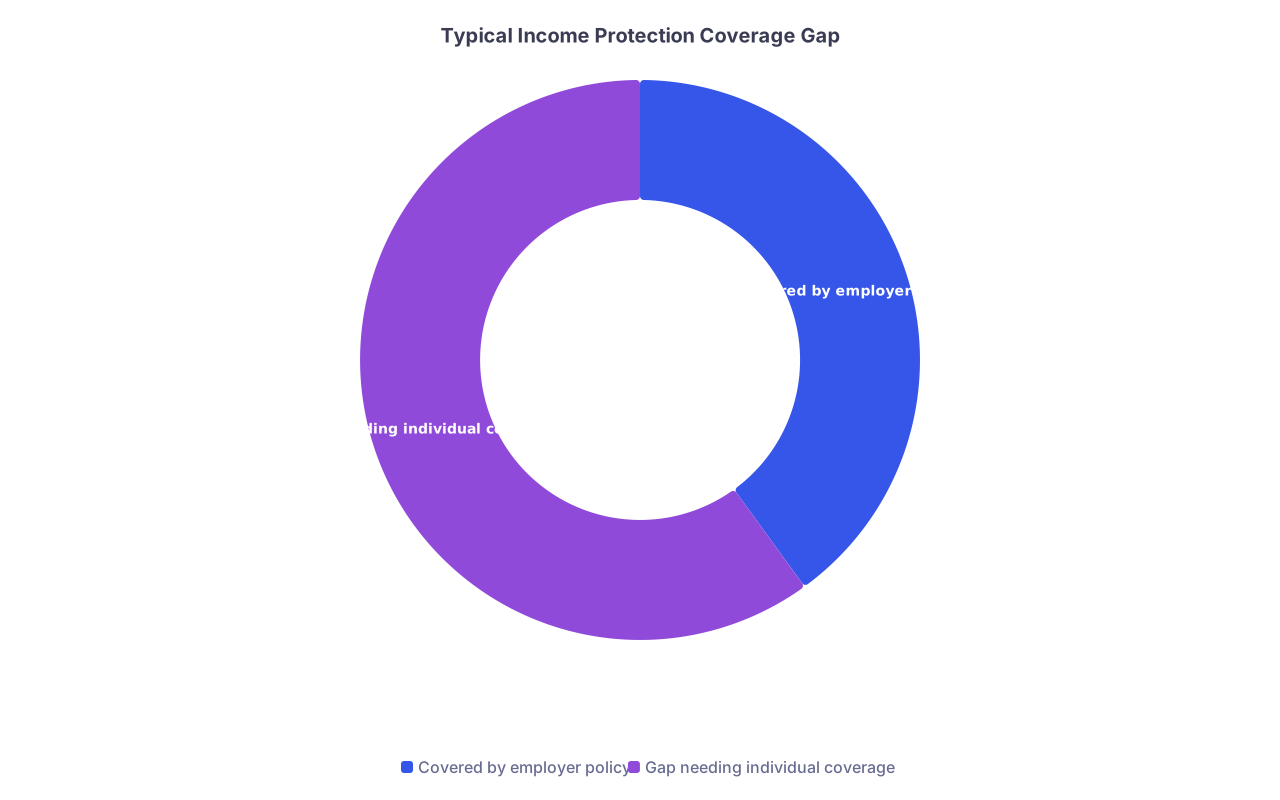
| Category | Value |
|---|---|
| Covered by employer policy | 40 |
| Gap needing individual coverage | 60 |
Let me walk through a practical checklist. No fluff.
Step 1: Inventory Your Loans Precisely
You need one clean page (or spreadsheet) that lists:
- Loan type: Federal Direct, Grad PLUS, FFEL, Perkins, private (by lender).
- Balance and interest rate.
- Cosigner? Yes/No and who.
- TPD and death discharge terms (federal: known; private: read the promissory note or call).
- Current repayment plan (for federal) and required monthly payment.
Until you have this in front of you, you are just guessing.
Step 2: Model a “Bad-Year Income” and a “Worst-Case Income”
Two separate numbers:
- Bad year: Reduced but nonzero income (e.g., 50–70% of your current or expected attending income).
- Worst case: Cannot work in your main field at all; maybe minimal or zero income.
Look at what your:
- Federal loan payments would be under IDR in those scenarios.
- Private loan obligations would be (likely unchanged).
Step 3: Set a Disability Benefit Target
For each scenario, rough math:
Monthly need =
Living expenses (lean but realistic)
- Loan payments (post‑IDR for federal; fixed for private)
- Minimal retirement savings (yes, even disabled you should try to save something)
– Any other guaranteed income (spouse income only if you are willing to depend on it; group disability, etc.)
That is your benefit target range. It may be less than the classic 60–70% of income, or more, depending on your loans and lifestyle.
Step 4: Evaluate Group Coverage Honestly
Most employers offer a group LTD (long-term disability) benefit. Before depending on it:
- Confirm definition of disability (own-occ vs any-occ, and for how long).
- Check the benefit cap: often 50–60% of base salary, up to some fixed max (e.g., $8,000/month), and bonuses/OT may be excluded.
- Understand taxation: If employer pays the premium, the benefit is typically taxable, which reduces your take‑home.
Many high-income professionals discover that group LTD replaces far less of their actual spendable income than they assumed.
Step 5: Design or Upgrade Individual Coverage
Here is the prioritized list, given a significant student loan burden:
- True own-occupation definition, ideally specialty-specific.
- Benefit period to age 65 or 67.
- Residual/partial disability rider.
- Benefit amount targeted to your calculated needs.
- Student loan rider if you have large private loans or low flexibility.
- COLA rider, especially if you are early career.
- Future increase option.
Yes, it costs money. So does a lifetime of debt service on a reduced income.
6. Legal and Tax Angles You Should Not Ignore

This is the less glamorous side, but it matters.
TPD and Death Discharge – Tax Treatment
Historically, forgiven or discharged debt could be treated as taxable income (Cancellation of Debt, or COD income).
For now:
- Federal TPD and death discharges are not taxable at the federal level under current law (at least through 2025).
- State tax treatment may vary.
If that sunset expires without renewal, future discharges might again be taxable. That could create a bizarre scenario: you lose the loans but get a large one‑time tax bill. Disability coverage would then need to consider the possibility of a lump‑sum tax liability.
Private Loan Discharge Clauses
If your private loan promises TPD discharge:
- Read the exact definition of disability.
- See who decides (lender? SSDI standard?).
- Confirm whether cosigner liability is also discharged.
If discharge is narrow or unhelpful, you cannot rely on it. You must design your insurance around the assumption that the loan will stay.
Estate Planning and Beneficiaries
If you die:
- Federal loans die with you.
- Some private loans die with you. Others do not, especially if there is a cosigner.
Your disability policy may also have a death benefit or be separate from life insurance. At minimum:
- Ensure beneficiaries are updated.
- Consider carrying enough term life insurance to protect your spouse/parents from any lingering private or cosigned obligations if discharge is not guaranteed.
7. Common Mistakes I See Over and Over
| Mistake | Why It Is Dangerous |
|---|---|
| Relying only on employer LTD | Often any-occupation, taxable, capped low |
| Ignoring private loan TPD terms | Assumes forgiveness that may not exist |
| No partial disability rider | Leaves you exposed in the most common scenario |
| Underestimating benefit needed | Does not cover both living costs and loans |
| Not coordinating with IDR strategy | You may overpay or underprotect |
A few patterns you should actively avoid:
“I will just refinance everything privately to get a lower rate; that solves it.”
No, it trades flexibility and legal protections (IDR, TPD, IDR forgiveness) for a lower interest rate. That can be smart if you have strong disability coverage and solid income stability. It is reckless if you do not.“My spouse makes good money; we will be fine.”
I have seen relationships implode under the stress of disability and money. Planning based on someone else’s future generosity is not a strategy.“I am young and healthy; disability is unlikely.”
You are insuring low‑probability, high‑impact events. That is the whole point. For physicians and dentists, musculoskeletal issues, hand injuries, mental health conditions, or even long COVID have derailed careers.“I will get disability later when I am an attending.”
By then you may already have a health condition that makes coverage more expensive or impossible, or you may have wasted years unprotected at the highest leverage point: early career, no savings, big loans.
8. Putting It All Together: A Realistic Protection Blueprint
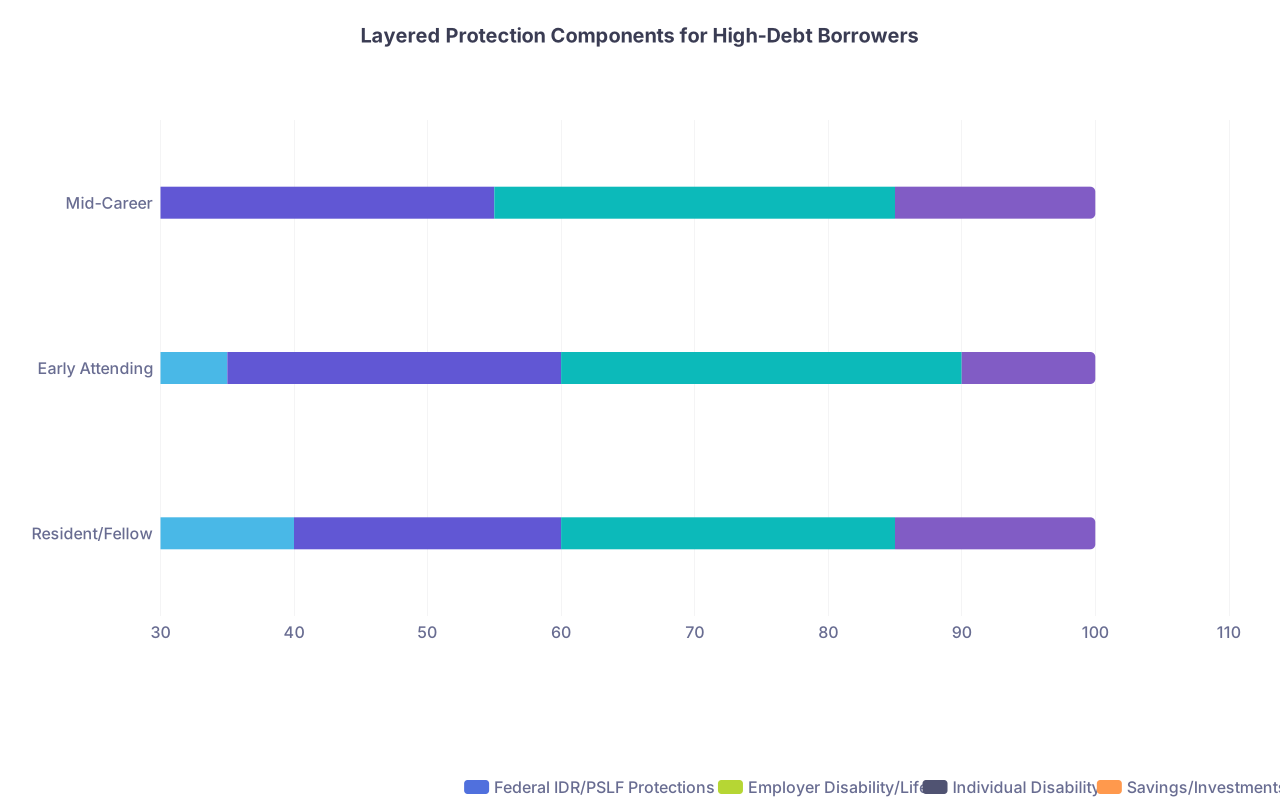
| Category | Federal IDR/PSLF Protections | Employer Disability/Life | Individual Disability | Savings/Investments |
|---|---|---|---|---|
| Resident/Fellow | 40 | 20 | 25 | 15 |
| Early Attending | 35 | 25 | 30 | 10 |
| Mid-Career | 30 | 25 | 30 | 15 |
The goal is not perfection. It is to avoid ruin.
A solid structure for someone with substantial loans looks like this:
Federal loans:
Stay in federal system until you fully understand IDR, PSLF, and TPD implications. Use IDR as a backstop in low-income or disabled years.Private loans:
Minimize them when possible. Where you cannot, treat them as “hard” liabilities that your disability coverage must explicitly address.Disability insurance:
Anchor protection on a strong individual own‑occupation policy, with adequate benefit, long benefit period, and a residual rider. Add student loan rider when the loan profile justifies it.Legal/tax awareness:
Know your TPD and death discharge rules and keep an eye on changes in tax law related to forgiveness and discharge.Ongoing review (every 2–3 years):
As your income, specialty, and loan balances change, adjust coverage. Many residents buy a small policy then never update it. That makes no sense once income quadruples.
FAQ (exactly 6 questions)
1. If I am on an income-driven repayment plan, do I still need as much disability insurance?
Generally yes, but the focus shifts from “cover the full standard payment” to “cover realistic living costs plus a reduced IDR payment plus some retirement saving.” IDR will drop your required federal payment if your income falls, but it will not pay your rent, food, or private loans. Disability coverage is what keeps your overall financial life viable, not just the loans.
2. Is a student loan disability rider always worth buying?
No. It is most valuable when you have large private loans with poor or no TPD relief and relatively inflexible payments. If your loans are mostly federal and you expect to use IDR and possibly PSLF, the rider is more optional. You might be better off with a higher core benefit and a residual rider instead of paying for a narrowly targeted loan rider you may not need.
3. How does partial disability actually work on most policies?
With a residual or partial disability rider, if a covered illness or injury reduces your income (usually by a specified percentage, such as 15–20%) but you are still working, the insurer pays a proportional benefit. For instance, a 50% loss of income might trigger roughly 50% of the full disability benefit. Without that rider, you might receive nothing unless you stop working entirely, which is exactly what you are trying to avoid.
4. Can I rely on my employer’s long-term disability policy instead of buying my own?
For a high-debt borrower, that is rarely smart. Employer policies often have weaker definitions of disability (any‑occupation), caps that do not keep up with attending‑level or partner‑level income, and taxable benefits. If you lose or change jobs, you may lose the coverage. An individual policy that you own, with true own‑occupation and tailored benefit levels, gives much more control and portability.
5. What if my health history makes individual disability insurance very expensive or I am declined?
Then your strategy shifts. You maximize whatever group coverage you can access (through employers, unions, or professional associations), you lean heavily on federal loan protections (IDR and staying federal rather than refinancing to private), you build an emergency fund aggressively, and you may prioritize accelerated payoff of private loans. You also become very conservative about taking on additional unsecured debt.
6. If my federal loans are discharged due to total and permanent disability, will my disability insurance payments stop?
Not automatically. Disability insurers do not care whether your loans are discharged; they care whether you still meet their policy definition of disability. If you remain disabled under that definition, benefits continue. The TPD discharge simply reduces your monthly obligations, which is good news for your budget. In fact, one reason I like strong private disability coverage is precisely so that, if TPD discharge occurs, you are not just “not in debt,” but actually able to live and save with dignity.
Key points to walk away with:
- Student loans plus uncertain health and career trajectories demand a real plan, not hope.
- Federal protections (IDR, TPD, PSLF) help, but they do not replace the need for solid own‑occupation disability insurance—especially if you hold private loans.
- The best setup is coordinated: your loan strategy and your disability coverage are designed together, so that even in a worst‑case scenario, your finances bend but do not break.