
Married Filing Separately vs Joint: Deep Dive for IDR and PSLF Optimization
It is late January. Your W‑2s just hit your inbox. You and your spouse are both staring at a tax preparer’s screen, and the preparer just said the line every high‑debt professional hears at some point:
“If you file Married Filing Separately, your tax bill goes up about $6,000. But it might lower your student loan payments.”
You ask, “How much lower?”
They shrug. “You’ll have to ask your loan servicer.”
That is the exact moment people make five‑figure mistakes.
Let me fix that. We are going to walk through, in detail, when Married Filing Separately (MFS) actually makes sense for income‑driven repayment (IDR) and Public Service Loan Forgiveness (PSLF), and when it is just an expensive illusion.
1. Core Framework: What Filing Status Really Does to Your Loans
Forget the slogans. The real question is:
How does filing jointly vs separately change:
- whose income counts for IDR, and
- how much tax you pay to get that IDR benefit?
You care about after‑tax, after‑payment cash flow over many years, not just “lower monthly payment.”
A. Which IDR plans care about your spouse’s income?
Here is the key rule set, as it stands now (post‑SAVE and current regulations):
| IDR Plan | Spouse Income Counted if Married Filing Joint? | Spouse Income Counted if Married Filing Separately? |
|---|---|---|
| SAVE | Yes | No (if you indicate separate household) |
| PAYE | Yes | No (if MFS and no joint return) |
| IBR | Yes | No (if MFS and no joint return) |
| ICR | Yes | Yes (spousal income factored regardless) |
| REPAYE* | Yes (spouse always counted) | Yes |
*REPAYE is effectively being replaced by SAVE; some borrowers are still on REPAYE.
The short version:
- On SAVE, PAYE, and IBR, you can usually exclude your spouse’s income by filing MFS and certifying separate household / not using a joint return.
- On ICR and REPAYE, your spouse’s income basically always counts, regardless of filing status.
So the MFS vs MFJ decision matters most if:
- You are on (or planning) SAVE, PAYE, or IBR, and
- Your spouse has higher income and/or no federal loans (or much lower balance).
If your spouse also has large federal loans and is also using IDR/PSLF, folding their income in may actually be a net positive, because you are getting two sets of loans covered by the same household income. Different game.
2. The IDR Math: How Filing Status Changes Your Payment
Let me walk through the mechanics, because otherwise you are just guessing.
A. The IDR payment formula (for SAVE and PAYE)
Very simplified:
- Take Adjusted Gross Income (AGI) (from your tax return).
- Subtract a poverty‑based deduction.
- Multiply the remainder (“discretionary income”) by a percentage.
- Divide by 12 = monthly payment.
For a single borrower:
- Discretionary income = AGI − (225% of poverty line on SAVE; 150% on PAYE/IBR)
- Payment = 10% (SAVE/PAYE) or 15% (IBR) of discretionary income / 12
Now, what changes with filing status?
Married Filing Joint (MFJ)
- AGI is combined income.
- Family size includes both of you (and kids).
- Poverty deduction is higher (bigger family), but income increases more than the deduction in most two‑income households.
Married Filing Separately (MFS)
- Your IDR payment is based on your AGI only, if your plan allows spouse exclusion.
- Family size still includes spouse + kids for most IDR plans if you claim them, so you keep the larger poverty deduction.
- This is the core arbitrage: large household deduction with only your income counted.
That is why MFS is so powerful for a dual‑income couple where:
- One spouse has very high income and little/no federal debt.
- The other spouse has large federal loans and PSLF eligibility.
B. Quick numerical example: why this can be huge
Say:
- You (the borrower) earn: $80,000
- Spouse earns: $140,000
- You have: $250,000 in federal loans, all PSLF‑eligible.
- Spouse has: no federal loans.
- You are on SAVE.
Assume 2024 poverty line for a family of 2 (ballpark): $20,440
SAVE uses 225%: ~$46,000 deduction.
If you file MFJ
- Joint AGI ≈ $220,000.
- Discretionary income ≈ $220,000 − $46,000 = $174,000.
- SAVE: 10% of $174,000 = $17,400/year, or $1,450/month.
If you file MFS
- Your AGI ≈ $80,000.
- You still claim family size of 2 (you + spouse).
- Discretionary income ≈ $80,000 − $46,000 = $34,000.
- SAVE: 10% of $34,000 = $3,400/year, or ~$285/month.
That is $1,450 vs $285 per month.
Difference: ~$1,165/month or ~$14,000/year in lower payments.
Most of that $14,000/year reduction is effectively “extra” PSLF forgiveness if you are going all 120 payments.
Now the real question:
How much extra tax are you paying to get that $14,000/year benefit?
That is the only way this decision is rational.
3. The Other Side: Tax Penalties of Married Filing Separately
I see people fixate on the lower loan payment and completely ignore all the tax landmines that appear when you switch to MFS. That is sloppy.
A. Concrete tax hits when you file MFS
Here are the big ones that commonly hurt high‑income couples:
- You often lose education‑related credits (AOTC, LLC).
- You are ineligible for student loan interest deduction (though honestly that is small once your income is high).
- You can lose child and dependent care credits or they are severely limited.
- You are shut out of Earned Income Tax Credit (usually irrelevant at high incomes).
- Phaseouts/limits change for certain itemized deductions and credits.
- Capital loss deduction is smaller.
- Contribution limits and deductibility rules for traditional IRAs and Roth IRAs can become worse or more complicated.
- Your tax brackets are not just “half of joint.” The structure is less favorable.
And if you live in a community property state (CA, TX, AZ, WA, ID, LA, NV, NM, WI), it gets even more complex: by default, each spouse may have to report half of combined community income on their separate returns unless you use specific workarounds. That can partially destroy the IDR benefit unless planned correctly.
B. How big is the tax cost really?
Let’s anchor this with rough numbers instead of vague worrying.
Take our previous couple:
- Spouse A (borrower): $80,000
- Spouse B: $140,000
- Location: non‑community property state, standard deductions, W‑2 only, no kids for now.
I am not doing full tax software here, but here is the general pattern:
MFJ:
- Taxable income after standard deduction (2024 numbers)
Joint AGI: 220k − 29,200 ≈ 190,800.
This falls partly in 24% and 32% brackets. - Combined federal tax bill: somewhere in the low‑40s thousands.
- Taxable income after standard deduction (2024 numbers)
MFS:
- Each spouse gets half the standard deduction (~$14,600).
- Their brackets and phaseouts are less favorable.
- Combined federal tax usually increases by several thousand dollars, often $4,000–$8,000 for this kind of profile. Sometimes more if credits are lost.
So you may pay:
- ~$6,000 extra tax per year to file MFS,
- In exchange for ~$14,000/year reduction in IDR payments (which are mostly forgiven under PSLF).
That trade (pay $6k more tax to get $14k more effectively forgiven each year for 10 years) is phenomenal. You are buying ~$140k of additional forgiveness over 10 years for ~$60k cumulative tax cost. Net ahead: about $80,000, ignoring discounting.
That is the correct mental model: compare cumulative after‑tax PSLF benefit, not just monthly payment.
4. When MFS is Clearly the Right Call (and When It Isn’t)
Let me be blunt. There are patterns where MFS is almost a no‑brainer, and patterns where it is usually dumb.
A. Strong candidates for MFS for IDR/PSLF
These are the profiles where I would be shocked if MFS did not at least deserve a serious, modeled analysis:
High‑debt, moderate‑income borrower + high‑income, low/no‑debt spouse
- Example:
- You: pediatrician at a 501(c)(3) hospital, $260k balance, $90k income.
- Spouse: software engineer, $220k income, no loans.
- You are on SAVE, aiming for PSLF.
- MFJ forces your payment to reflect $310k of income.
- MFS lets you pay on $90k of income, with a family‑size deduction of 2 or 3.
- Tax penalty is real, but the PSLF benefit often dwarfs it.
- Example:
Your spouse is in private practice / corporate and you are 100% PSLF‑bound
- You are a hospitalist at a non‑profit, clearly staying long enough to hit 120 payments.
- Spouse is a dentist, lawyer, or in private equity with no PSLF path.
- There is no reason for their high income to inflate a payment that buys you nothing (you are not trying to pay off the loans early, you are trying to get them forgiven).
Very early in career, loan balance is a multiple of your income
- If your debt‑to‑income ratio is > 2:1 (e.g., $300k loans, $120k income), and you are PSLF eligible, your strategy is almost always: minimize IDR payments, maximize forgiveness.
- In that situation, suppressing household income from the calculation via MFS is usually the lever that matters.
B. Situations where MFS is often not worth it
Both spouses have substantial federal loans and are using PSLF
- Example:
- You: $220k loans, $120k income, PSLF.
- Spouse: $180k loans, $130k income, PSLF.
- Filing MFJ, your SAVE payment is higher, but it effectively serves both of your loans.
- Splitting income with MFS often yields two separate IDR payments that sum close to or even above the joint payment, plus a tax penalty.
- Here, optimizing within MFJ (choice of plan, recert dates, etc.) matters more than switching filing status.
- Example:
You are planning to aggressively pay off loans, not use PSLF
- If your strategy is: “I want these gone in 5–7 years,” you care less about minimizing IDR and more about minimizing your total lifetime tax bill and maximizing retirement contributions.
- The extra tax cost of MFS is rarely justified if you are not planning to harvest PSLF or long‑term IDR forgiveness.
Your spouse’s income is similar to yours, and loan burden is modest
- Example:
- You: $90k income, $80k loans.
- Spouse: $95k income, no loans.
- Combined income is not astronomical, your loan balance is not huge, and the IDR reduction from MFS is often modest while the tax costs remain.
- A careful computation might still show a small benefit, but often not enough to justify complexity.
- Example:
You are on ICR or locked into REPAYE with no practical path to SAVE/PAYE/IBR
- On ICR/REPAYE, MFS does not rescue you from your spouse’s income.
- You are paying extra tax for almost no loan benefit. That is just burning money.
5. PSLF + MFS: Long‑Game Strategy (Years 1–10)
The whole game with PSLF is ten years of qualifying payments. Filing status needs to be viewed in that 10‑year frame, not year‑to‑year panic.
A. Core PSLF + MFS playbook
If you are committed to PSLF and married to a higher‑income or no‑debt spouse, the clean strategy looks like this:
Get on SAVE (or PAYE/IBR if legacy reasons) ASAP
- SAVE is now the primary plan for most new PSLF‑bound borrowers.
- It has the most generous poverty deduction and strong unpaid interest protections.
File MFS during the years when your payment is most sensitive
- Early career, when your income is relatively low and your balance is huge, the payment delta between MFS and MFJ is usually largest.
- Those early years dictate much of your total cash outlay over 10 years.
Reassess annually with actual numbers
- As your income climbs, kids arrive, your spouse’s income shifts, and your balance shrinks, the MFS benefit may shrink or grow.
- There are years where MFS is clearly worth it, and years where switching back to MFJ makes sense, even before PSLF is complete.
Make sure you are actually accruing PSLF credit
- Government or 501(c)(3) employer, full‑time work, direct loans, correct plan.
- I have seen couples pay thousands in extra tax for five years with MFS, only to discover their employer was a private contractor hospital that does not qualify. That is painful.
B. Example: 10‑year PSLF arc
Let’s sketch a realistic trajectory.
- Year 1: PGY1, $65k income, spouse at $180k.
- Year 4: Attending, $220k, spouse at $230k.
- Loan balance: $300k at graduation, mostly unsubsidized.
If:
- You file MFJ the entire time, your payments ramp aggressively as your income rises. You may end up paying $200k+ over 10 years before PSLF wipes the rest.
If:
- You file MFS for years 1–7 (resident + early attending) to keep payments closer to your solo income, then maybe MFJ for the last 3 years when your own income is high enough that spouse inclusion adds less incremental payment,
you might end up around $120k–$150k total paid for the same PSLF outcome.
The difference—often $50k–$100k—is driven mainly by the filing status decision plus choice of IDR plan.
6. The Community Property State Headache
If you are in a community property state and thinking, “I will file MFS and magically only my $80k income will show up,” not so fast.
A. The default rule
In community property states:
- Each spouse typically reports half of community income on their separate return.
- If all income is “community,” then:
- You each may show AGI ≈ (your income + spouse income) / 2.
That means:
- You are trying to use MFS to exclude your spouse’s income from IDR, but the AGI itself still reflects half of their salary.
- Your IDR application pulls that inflated AGI directly from the separate return.
- MFS benefit is partially or fully sabotaged.
B. Workarounds and planning
There are ways to improve this, but they are more technical and should be done with a tax professional who actually understands student loans (most do not):
- Properly separating community vs separate income when applicable (rental income, pre‑marital assets, etc.).
- Sometimes using separate property agreements or different ownership structures for new income streams, where legally appropriate.
- In some years, it may actually be cleaner to accept MFJ and plan around it rather than contorting your entire financial life just to save on IDR.
The big point:
If you are in CA, TX, or any community property jurisdiction and you are banking on MFS for PSLF, you absolutely need pro‑level modeling. DIY back‑of‑the‑envelope is how people get burned.
7. Modeling It Correctly: Practical Step‑by‑Step
Here is how I’d tell a smart resident or young attending to actually decide, not just guess.
Step 1: Get real tax projections (MFJ vs MFS)
Use:
- A CPA or EA who is comfortable running both scenarios; or
- Good tax software and a couple hours of focus if you are comfortable with it.
You want:
- Federal tax under MFJ
- Federal tax under MFS (sum of both returns)
- Changes in credits, deductions, retirement contribution opportunities.
Compute:
Tax Penalty = (MFS_total_tax − MFJ_tax)
Step 2: Compute IDR payments both ways
For the same tax year:
- Under MFJ:
- Joint AGI, family size, plan (SAVE/PAYE/IBR) → annual IDR payment.
- Under MFS:
- Borrower’s AGI, family size, same plan → annual IDR payment.
Compute:
- IDR Savings = (MFJ_IDR_payment − MFS_IDR_payment)
If you are going for PSLF, those savings are effectively increased forgiveness, not lost progress.
Step 3: Compare on an after‑tax, long‑term basis
For a given year:
Net benefit of MFS for that year ≈
IDR Savings − Tax Penalty
If that number is strongly positive (e.g., +$8,000), MFS is likely worth it that year.
If it is marginal (e.g., +$500), you may decide the hassle and risk are not worth the small edge.
Now, do not stop there. Repeat this projected out for multiple years, using reasonable salary growth, kid additions, and loan balance projections.
You want a cumulative picture over, say, the 10 PSLF years.
Step 4: Revisit annually
The biggest mistake I see:
Couples pick MFS once, never revisit, and stick with it for a decade even after the math flips against them.
Things that change the equation:
- You become the higher earner instead of your spouse.
- Your loan balance shrinks to the point that minimizing payments is no longer critical.
- Kids arrive, and the value of certain credits under MFJ explodes.
- Your spouse develops their own big federal loan balance and enters PSLF.
The correct mindset: Filing status is a strategic lever you can toggle year‑to‑year, not a one‑time religious commitment.
8. How This Interacts with SAVE vs PAYE vs IBR
I am going deeper here because a lot of “advice” in this space is outdated by SAVE.
A. Why SAVE + MFS is usually the dominant play now
SAVE has:
- 225% poverty line deduction (bigger zero‑payment zone).
- Better unpaid interest protections (no ballooning balance if payment is below accruing interest).
- Future enhancements (like 5% payments for undergrad‑only loans).
Paired with MFS, you get:
- Low or very low required payment on just your income.
- Interest subsidy preventing runaway negative amortization.
- Maximized PSLF forgiveness.
For the classic “high debt, PSLF‑bound” borrower, SAVE + MFS is typically the first scenario to analyze.
B. Legacy PAYE/IBR considerations
Some borrowers are better off staying on PAYE or IBR, often because:
- They have older loans with grandfathered terms.
- They are planning for 20‑ or 25‑year taxable forgiveness, not PSLF.
- Their specific interest and amortization pattern is awkward under SAVE.
PAYE and IBR still allow the same MFS protection (spouse income excluded if you actually file MFS). But their:
- Lower poverty deduction (150% vs 225%), and
- Higher percentage (10% PAYE, 15% IBR)
can make them worse than SAVE in many PSLF scenarios.
So, unless you have a very specific reason to stay off SAVE, you usually analyze:
- SAVE + MFS vs SAVE + MFJ
first, then compare to - PAYE/IBR options if your servicer or situation is legacy.
9. A Quick Visual: Payment Impact vs Tax Cost
Let me give you a conceptual visual. Imagine we look at three example couples and compare how much filing MFS lowers their annual IDR payment vs how much extra tax they pay.
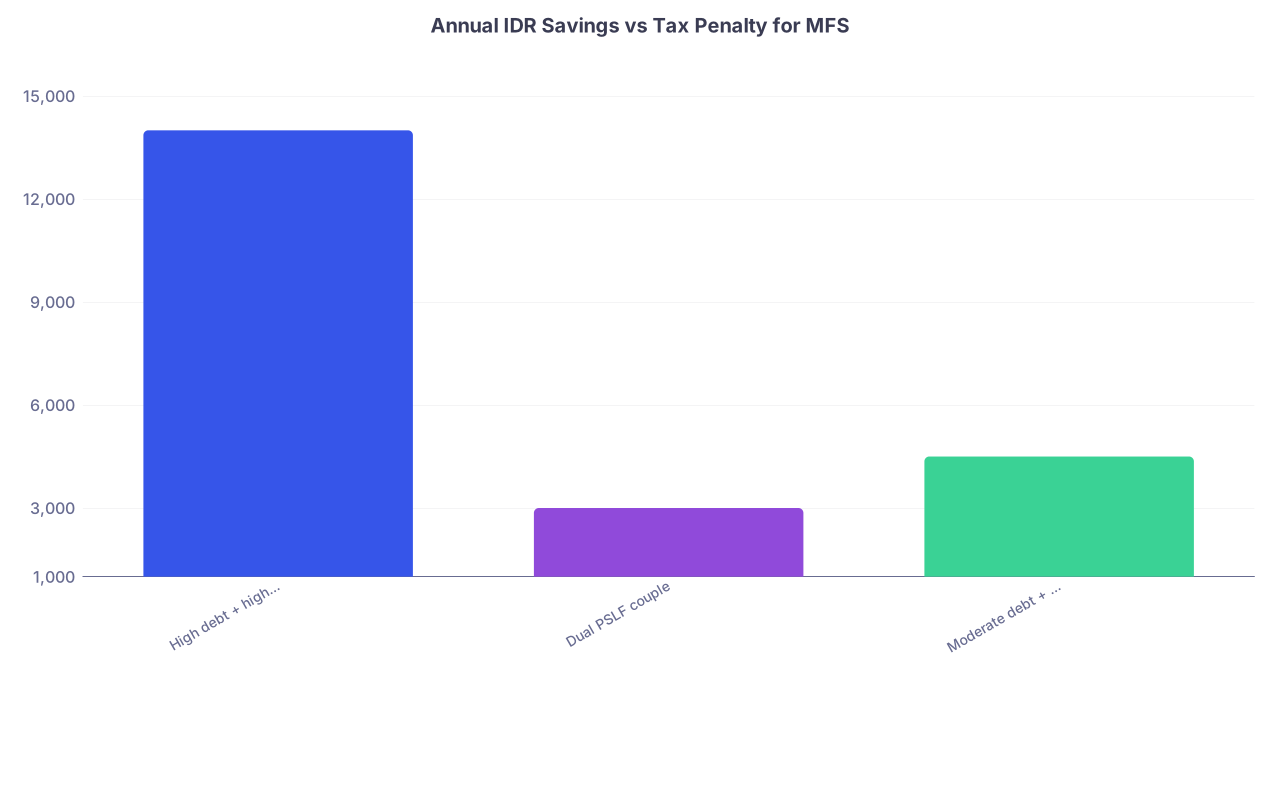
| Category | Value |
|---|---|
| High debt + high-income spouse | 14000 |
| Dual PSLF couple | 3000 |
| Moderate debt + similar incomes | 4500 |
(Think of these bar heights as “IDR savings” in dollars.)
Now overlay rough tax penalties:
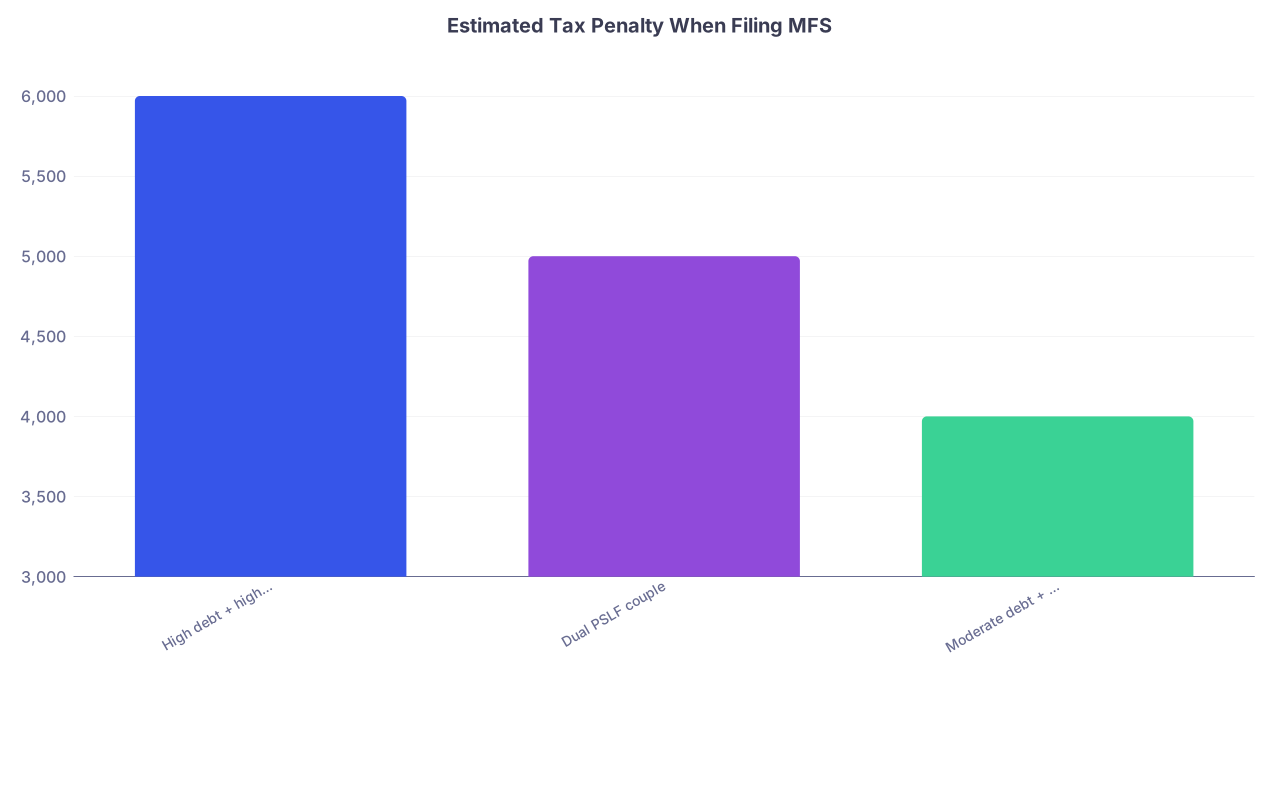
| Category | Value |
|---|---|
| High debt + high-income spouse | 6000 |
| Dual PSLF couple | 5000 |
| Moderate debt + similar incomes | 4000 |
Interpretation:
- First couple: $14k IDR savings vs $6k tax penalty → net +$8k. Clear MFS candidate.
- Second couple: $3k IDR savings vs $5k tax penalty → net −$2k. Likely MFJ.
- Third couple: $4.5k vs $4k → marginal. Worth careful analysis but not automatic.
The exact numbers will differ, but this is how you should be thinking: compare bars, not just stare at one.
10. Implementation Details People Screw Up
A few recurrent, painful mistakes I see in practice.
A. Forgetting to update household info on IDR recert
You file MFS, but then, during IDR recertification, you:
- Check that you are married,
- Do not clearly indicate that you file separate and want payment based on your income only, or
- Allow the servicer to pull a joint tax return from an earlier year.
Result:
Your spouse’s income is still baked into the calculation, even though you ate the MFS tax penalty. That is just lighting money on fire.
B. Timing recert correctly around big income jumps
Residents going to attending salary:
- If you can recertify based on your last low‑income tax return right before income jumps, you lock in a lower payment for up to 12 months.
- Combine that with MFS in that transition year, and you can save a very significant chunk.

| Step | Description |
|---|---|
| Step 1 | Resident Year |
| Step 2 | Low AGI Tax Return Filed |
| Step 3 | Recertify IDR Early Using Low AGI |
| Step 4 | Start Attending Job Higher Income |
| Step 5 | Low Payment Continues Until Next Recert |
If you get the order wrong (recert after your big income shows up on a return), you lose that arbitrage year.
C. Not aligning with your tax pro
I have seen this more than once:
- Couple tells loan consultant, “We will file MFS.”
- Tells tax preparer, “Make our taxes as low as possible.”
- Preparer files MFJ, saves them $7k in tax, unaware that it raises IDR payments by $15k and destroys PSLF optimization.
Solution is simple: you need one person (you, ideally) driving the combined loan‑tax picture, and you need your CPA/preparer to understand the why behind MFS.
D. Not documenting the rationale
Two reasons to document:
- For yourselves, so future‑you remembers why you are paying more tax.
- For any advisor/CPA change, so you do not have to re‑explain the entire logic three years in.
I tell people to keep a one‑page summary:
- IDR plan
- PSLF timeline
- Why MFS is being used
- Annual estimate of IDR savings vs tax penalty
Keeps everyone honest.
11. Putting It All Together: A Brief Decision Flow
Here is a high‑level logic chain to sanity‑check your thinking.

| Step | Description |
|---|---|
| Step 1 | Married Borrower with Federal Loans |
| Step 2 | Prioritize lowest lifetime tax - usually MFJ |
| Step 3 | Run numbers MFJ vs MFS - benefit may be small |
| Step 4 | MFS usually not helpful |
| Step 5 | Model Tax Penalty vs IDR Savings |
| Step 6 | Use MFS and recert IDR correctly |
| Step 7 | Consider staying MFJ and recheck yearly |
| Step 8 | Using PSLF or Long IDR Forgiveness? |
| Step 9 | Spouse Income Much Higher or No Loans? |
| Step 10 | On SAVE, PAYE, or IBR? |
| Step 11 | IDR Savings > Tax Penalty by Wide Margin? |
12. Two Case Snapshots to Cement This
Case 1: The clear MFS win
- Borrower: Family medicine attending at FQHC, $210k income, $280k loans, PSLF path.
- Spouse: Tech sales, $260k income, no federal loans.
- State: Illinois (non‑community).
- Plan: SAVE.
Modeled results (approximate):
- MFJ:
- Tax: $75k
- SAVE payment: $2,800/month
- MFS:
- Combined tax: $82k (penalty = $7k)
- SAVE payment: $1,000/month
Annual impact:
- IDR saving = ($2,800 − $1,000) × 12 = $21,600
- Tax penalty = $7,000
- Net yearly gain ≈ $14,600
Over 8 more PSLF years: ~$116,800 net benefit, ignoring growth. Obvious MFS candidate.
Case 2: The MFJ makes more sense
- Borrower: Hospital pharmacist at 501(c)(3), $140k income, $90k loans, PSLF.
- Spouse: Teacher at public school, $75k income, $40k loans, PSLF.
- State: Ohio.
- Plan: SAVE.
Modeled (ballpark):
- MFJ:
- Tax: $29k
- SAVE payment (covers both): $700/month
- MFS:
- Combined tax: $33k (penalty = $4k)
- SAVE payments:
- Borrower: $450/month
- Spouse: $250/month
- Total: $700/month
Result:
Same IDR outlay, $4k more in tax. MFS is just a leak. MFJ and done.
13. Key Takeaways
Married Filing Separately is a tool, not a religion. It can unlock enormous PSLF value when one spouse has big federal loans and the other does not, especially on SAVE, but it can be pointless or harmful in dual‑PSLF or low‑debt situations.
Run the math like an adult. For each year, compare the extra tax from MFS to the IDR savings it creates. Over 10 PSLF years, the net effect is easily five or six figures either way.
This is a yearly strategic decision. Your incomes, employers, family size, and loan balances change. Recheck MFJ vs MFS annually, especially around big income jumps or job changes.