
39% of physicians in their first three years of practice do not know their exact interest rates across federal and private loans.
That is not a minor detail. With $250–400k of mixed med school debt, not knowing your rate is like not knowing the dose on a vasopressor drip. You might get away with it for a while. But it will cost you.
Let me break this down the way I do when a PGY-2 shows me their loan spreadsheet during a slow night shift: federal vs private is not the real problem. The real problem is sequencing, timing, and tax traps when you combine them.
We will stay out of the fluff. This is about high‑level, concrete strategies for people with both federal and private med school loans who want to optimize, not just “get by.”
1. First, classify your loans like a clinician, not a consumer
Most people do a shallow classification: “I have federal and I have private.” That is useless for strategy.
You need a three‑layer classification:
- Legal type
- Repayment options
- Strategic role in your plan
1.1 Legal type: what you are actually dealing with
You should be able to put every loan you have into one of these bins from NSLDS (for federal) and your private statements:
| Category | Examples |
|---|---|
| Direct federal | Direct Unsub, Grad PLUS |
| Legacy federal (FFEL)* | FFEL Stafford, FFEL Grad PLUS |
| Perkins / institutional | Perkins, med school loans |
| Pure private | Sallie Mae, SoFi, Laurel Road |
| Refi private | DRB, Earnest, CommonBond |
*FFEL sometimes still held commercially and not eligible for all federal programs unless consolidated into Direct.
If you cannot put each loan into one of those buckets with principal, rate, and servicer, you are not ready for any advanced strategy. You are still in triage.
1.2 Repayment option: what each loan is actually allowed to do
Federal Direct loans (and FFEL once properly consolidated) can access:
- Income‑Driven Repayment (IDR) like SAVE, IBR, PAYE (grandfathered), ICR
- Deferment/forbearance with interest rules that differ by plan and subsidy
- Public Service Loan Forgiveness (PSLF)
- 20–25 year taxable forgiveness (non‑PSLF)
Private loans can usually access:
- Standard amortization (5–20 years)
- Limited forbearance (often interest‑only or full‑payment pause, but interest accrues)
- No forgiveness, no IDR in any real sense
The mixing problem: federal gives you flexibility and potential forgiveness; private generally does not. So your whole strategy revolves around where to apply flexibility and where to apply aggression.
1.3 Strategic role: nurse, resident, attending, not all equal
Each debt line has a strategic role:
- “PSLF‑bound” loans (federal, working in a qualifying nonprofit/government job)
- “IDR‑to‑tax‑bomb” loans (federal, not PSLF, lower income, long horizon)
- “Refi‑to‑kill” loans (high‑rate private or federal once you give up federal benefits)
- “Ignore until decision point” loans (legacy FFEL or Perkins not yet consolidated, small balances, sometimes 0–3% interest institutional loans)
The mistake I see constantly: residents paying extra on federal loans that will eventually be forgiven, while letting 9–12% private loans silently balloon. That is exactly backwards.
2. The decision tree: PSLF vs non‑PSLF vs mixed path
You cannot design a rational mixed federal/private strategy until you answer one question with brutal honesty:
Will you likely qualify for PSLF?
Not “PSLF sounds nice.” I mean:
- You are in (or likely to be in) a 501(c)(3) or government employed role
- You expect to stay there for most of 10 years of qualifying payments
- You will maintain qualifying IDR during that time

| Step | Description |
|---|---|
| Step 1 | Assess Employment Path |
| Step 2 | PSLF-Focused Strategy |
| Step 3 | Private Sector Strategy |
| Step 4 | Minimize Federal Payments |
| Step 5 | Hybrid or Wait and See |
| Step 6 | Optimize Refinance and Payoff |
| Step 7 | Reassess Yearly |
| Step 8 | Nonprofit or Government? |
| Step 9 | Comfort With Long Commitment? |
2.1 If you are clearly PSLF‑bound
Example: Internal medicine resident at a university hospital, planning academic hospitalist or subspecialty in a 501(c)(3) system. You are the PSLF poster child.
Strategy:
- Put all eligible federal loans into Direct form (consolidate if needed)
- Enroll in the best IDR for PSLF (currently SAVE for most, unless you are grandfathered into a better PAYE scenario)
- Pay the minimum required on federal loans, maximize PSLF‑qualifying payments
- Attack private loans with every extra dollar
In this setting, your federal loan interest rate becomes almost irrelevant. If your total federal balance will likely be forgiven after 10 years, overpaying federal is throwing dollars into a fire.
I have seen faculty with $300k forgiven at year 10 while still carrying a $90k private refi at 8% that they only “paid as billed.” That is a design failure, not bad luck.
2.2 If you are clearly NOT PSLF‑bound
Example: Planning private practice ortho, derm, anesthesia, EM in a for‑profit chain, or you already signed with a non‑qualifying group.
Here the logic flips:
- PSLF is off the table, so federal vs private is mostly about interest rate and flexibility
- Shorter payoff horizon (5–10 years) is usually optimal given high attending incomes
- Early‑career IDR may still be useful during residency/fellowship, but your endgame is payoff, not forgiveness
In that world, keeping high‑rate federal loans at 7–8% for 20+ years on SAVE to chase taxable forgiveness at year 25 is almost always a bad deal at attending incomes. The math is ugly once you factor in compounding and eventual tax.
So you generally:
- Use IDR during training to stay afloat and preserve cash
- Reassess right before (or early in) attendinghood
- Aggressively refinance federal and private loans into a shorter‑term private product once you accept you do not need federal protections
2.3 The messy middle: “maybe PSLF, maybe not”
This is where advanced strategy lives. IM resident not sure whether to stay academic. Pediatrics thinking about community vs children’s hospital. EM in the current unstable market. Many of you are in this bucket.
In the messy middle, you need a reversible strategy. That means:
- Keep federal loans in the system and pay minimums on IDR
- Do not refinance federal loans yet (you can always refinance later, you cannot un‑refinance)
- Direct any extra savings to:
- A high‑yield savings account or short‑term Treasuries earmarked as a “loan payoff fund”
- Private loans with clearly worse terms than your federal ones
You are buying an option: the ability to later choose PSLF or accelerated payoff once your job path is clear. The “cost” is slightly more interest than if you had refinanced federal aggressively on day one. That is often a very fair price for flexibility in your 20s and early 30s.
3. Tactical ordering: which loans to hit, in what sequence
Once you are clear on PSLF vs non‑PSLF, the next move is surgical: ordering.
3.1 The resident/fellow stage: survival + optionality
Residents almost always benefit from:
- Federal loans on IDR (often SAVE) with payments tied to a low income
- Private loans refinanced only if:
- The refi offers a materially lower rate
- You are not counting on flexibility or long forbearances from that private lender
I tend to see three archetypes.
Archetype A: High federal, minimal private
Example: $320k federal at 6.8–7.5%; $20k private at 9%.
Move:
- Put federal on SAVE, minimize payments, count PSLF time if eligible
- Refinance or just aggressively pay off the $20k private as fast as reasonably possible
- Do not send extra money to federal unless PSLF is impossible and the federal rate is horrible vs what you could refinance to
Archetype B: High private, moderate federal
Example: $180k federal at 6.8%; $220k private at 8.5–10%.
Move:
- Federal on SAVE or other IDR to keep payments tolerable, preserve PSLF option
- Refinance private to the lowest fixed rate you can get without wrecking your cash flow
- Any extra moonlighting money or partner income → straight to private principal
The mental shift: your private loans are essentially a bad business loan attached to your medical degree. You pay that off aggressively, while you keep your federal loans in the background as a flexible tool.
Archetype C: Balanced, both large
Example: $230k federal, $200k private, both 6.5–8%.
This is the group that tends to freeze.
When rates are similar, the tiebreakers become:
- Federal flexibility and forgiveness potential
- Your risk tolerance and specialty income trajectory
During training, I would still lean:
- Federal on IDR, minimal payments
- Private: refinance if beneficial and allowed by cash flow; then target them first for extra payments
You want to keep your “option‑rich” debt (federal) around longer and kill your “no‑option” debt (private) sooner.
4. Advanced IDR and PSLF tactics when you also have private loans
The interaction between low IDR payments and high private debt can be exploited in your favor if you do it intentionally.
4.1 The SAVE “subsidy” is effectively an arbitrage opportunity
Under SAVE, unpaid interest on subsidized loans and half of unpaid interest on unsubsidized loans does not capitalize or accrue beyond the required payment. That makes SAVE extremely favorable for long‑term PSLF or forgiveness strategies.
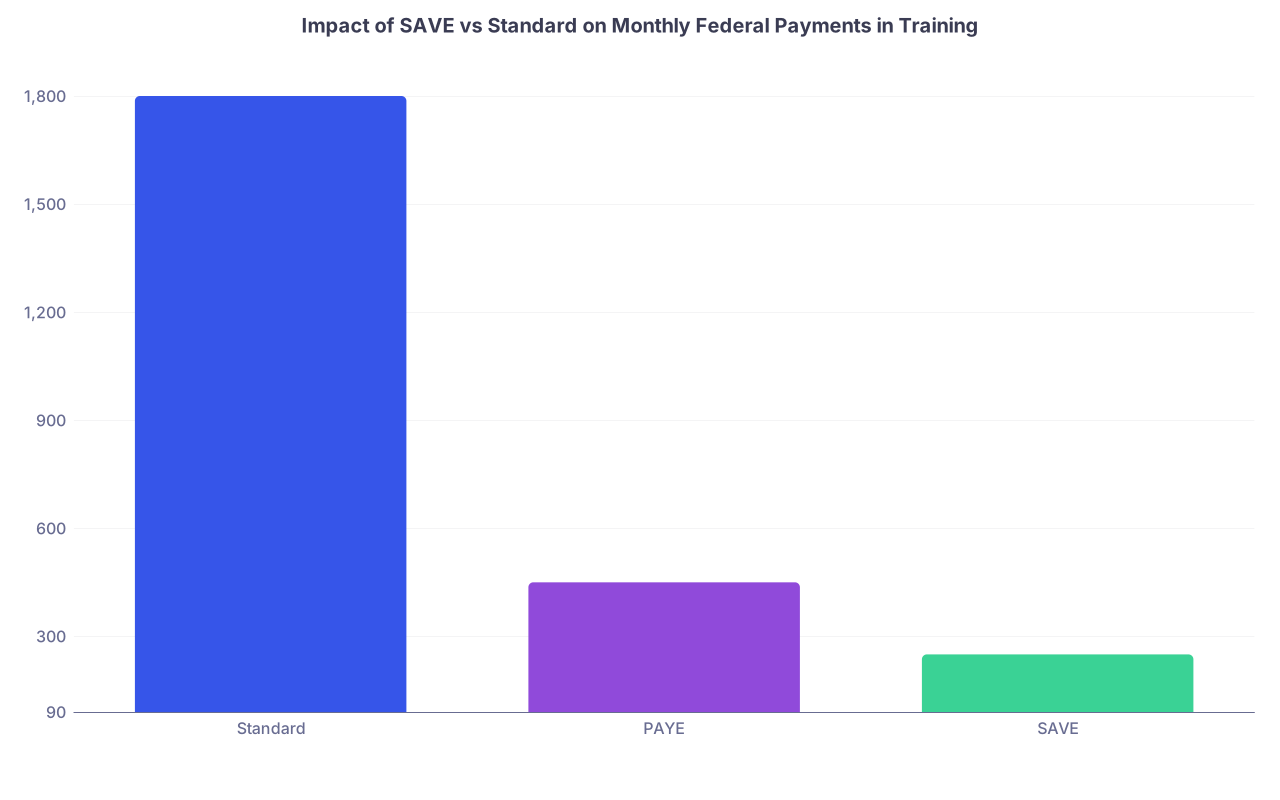
| Category | Value |
|---|---|
| Standard | 1800 |
| PAYE | 450 |
| SAVE | 250 |
In a PSLF path:
- Low SAVE payments free up cash
- That cash can be used to aggressively pay private loans
- Meanwhile, your forgiven federal balance at 10 years may actually be larger, which is good for PSLF (forgiveness amount is tax‑free)
So the combined play is:
- Minimize federal payments
- Maximize PSLF‑qualifying years
- Simultaneously minimize or completely eliminate private loans before attending lifestyle inflation kicks in
If you are not PSLF‑bound but using SAVE temporarily during training:
- The subsidy still helps you keep federal manageable
- But you should not mentally anchor to 20–25‑year forgiveness; it is usually inferior to faster payoff once you are earning attending money
4.2 Married, mixed loans, and tax filing status
Here is where it gets messy and where most online calculators oversimplify.
If one partner has huge federal loans (possibly PSLF‑bound) and the other has:
- No loans, or
- Only private loans
Then:
- Filing Married Filing Separately (MFS) may sharply reduce the IDR payment for the federal borrower, because only their income is counted on some IDR plans
- But MFS usually raises total tax due as a couple
The key is to model:
- Extra tax cost of MFS
- Federal payment savings from MFS
- Effect on PSLF or long‑term forgiveness value
I have seen couples where:
- Paying an extra $4,000 in taxes by filing separately saved $12,000 in federal loan payments and increased projected PSLF forgiveness by tens of thousands. That is a clear yes.
- In other cases, the spread is more like $4,000 higher taxes for $5,000 in payment savings. That margin is thin and depends on risk preferences.
Meanwhile, private loans do not care about your tax status. They just want the contracted payment. So your MFS decision is almost entirely about the federal side.
This is a classic point where spending money on a real student loan specialist or tax pro actually makes sense. The math is not intuitive.
5. Refinance timing: when to sacrifice federal protections
Too many people refinance federal loans too early because they like the “clean” feeling of one big private loan at 4–5%. Clean is not always smart.
You give up:
- IDR flexibility
- PSLF eligibility
- Broad federal forbearance (yes, pandemic‑style pauses are unlikely to repeat at that scale, but you are giving up a set of safety valves)
You gain:
- Lower interest rate
- Possibly clearer payoff horizon
So when does it actually make sense?
5.1 You are out of training, PSLF is clearly off the table
Once you are:
- In a stable private sector job with no realistic move to qualifying PSLF employment
- Comfortable that you have emergency reserves (three to six months of expenses, minimum)
- Not planning major income disruptions (long unpaid leave, starting a risky practice with volatile cash flow, etc.)
Then refinancing federal loans to a shorter term (5–10 years) can be rational.
But do it in tiers:
- Start with the highest‑rate private loans first. Refi those aggressively.
- Then look at highest‑rate federal loans that are not meaningfully benefiting from IDR or any PSLF prospects.
- Consider keeping a small slice of federal loans in the system if you are at all nervous about disability, burnout, or career change. They become your built‑in shock absorber.
5.2 Variable vs fixed: not a cosmetic decision
Variable rates can look seductive: 3.5% vs 4.5% fixed, for instance.
For a resident with limited cash buffer and uncertain attending timeline, variable is usually a trap. For an attending with a planned 3‑year payoff horizon and high savings rate, the calculation changes.
My usual stance:
- Residents/fellows: favor fixed rate unless you have a very short payoff plan and strong savings buffer
- Attendings with high savings rate and payoff goal ≤ 5 years: variable can be considered, but only if the starting discount vs fixed is meaningful and you are willing to rapidly pay it down
6. Planning for taxable forgiveness when private loans are in the mix
Not everyone will do PSLF. Some will go the 20–25‑year IDR forgiveness route. That often happens when:
- Income is relatively modest vs debt (peds, psych, some primary care, or part‑time work) in non‑PSLF settings
- Family priorities or geographic constraints make high‑pay private practice unlikely
If that is you, and you still have private loans, the strategy is very different from the high‑income, fast‑payoff archetype.
6.1 The “tax bomb” is real, but predictable
Non‑PSLF forgiveness is currently taxable under federal law (this is subject to change in future policy, but you do not plan on wishful thinking). That means:
- At 20–25 years, the remaining federal balance counts as taxable income
- You owe a lump‑sum tax in that year (unless the law changes)
This is not a surprise bill if you prepare properly.
You should:
- Use conservative projections of your forgiven balance
- Assume a plausible marginal tax rate in the year of forgiveness (often 25–35% when combining federal + state for many physicians)
- Start a parallel “tax bomb” savings or investment fund in taxable accounts
Meanwhile, private loans do not get forgiven. They need to be paid off fully, much earlier.
So your play:
- Keep federal loans on IDR with the expectation of eventual forgiveness
- Pay only the required IDR amount on federal
- Aggressively pay down private loans as early as possible
- Build a separate, growing “tax bomb” fund for the eventual forgiveness event
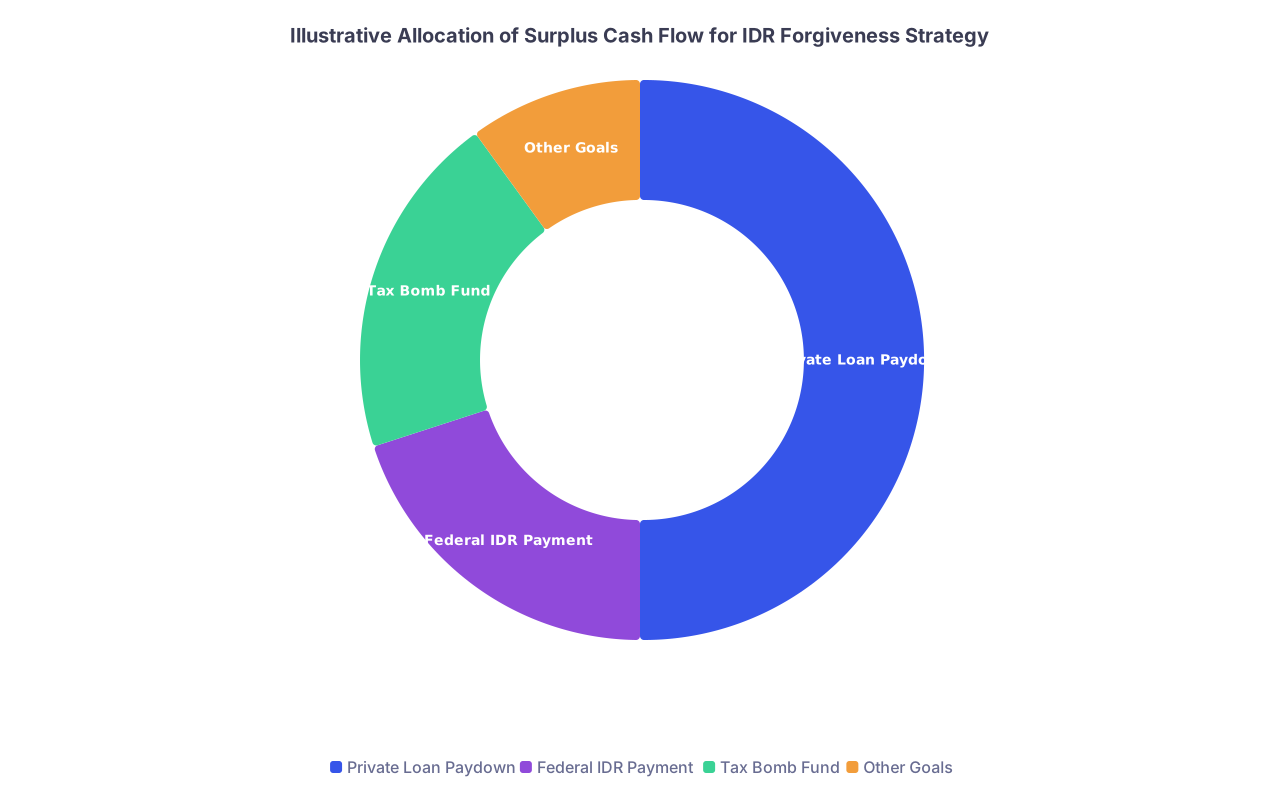
| Category | Value |
|---|---|
| Private Loan Paydown | 50 |
| Federal IDR Payment | 20 |
| Tax Bomb Fund | 20 |
| Other Goals | 10 |
Is this psychologically messy? Yes. You are living with a big federal balance for decades. But strictly mathematically, in certain income/loan scenarios, it is rational.
7. Integrating loans with your real life: housing, retirement, and burnout risk
Student loan planning in a vacuum is fantasy. You are going to want a house, children, retirement savings, maybe part‑time work at some point.
7.1 Housing decisions with big mixed debt
Here is the blunt truth: if you are carrying $400k of mixed federal and private loans, a physician mortgage with 0% down and a $900k house straight out of fellowship is usually financial malpractice.
Private debt + giant mortgage + delayed retirement savings = vulnerability.
Better pattern:
During training and early attending years:
- Keep housing modest. Rent or buy below your “approval limit.”
- Attack private loans, stabilize federal strategy.
Once:
- Private loans are gone or on a clear <5‑year payoff path, and
- You are consistently hitting at least baseline retirement savings (15–20% of gross),
then you can ratchet up housing.
You do not get extra credit for being a doctor who is “house poor” and loan heavy at the same time.
7.2 Retirement vs paying down loans
This is the other big emotional battlefield.
For someone with both federal and private loans, the sequencing is:
- Capture employer retirement match. Always. That is a 50–100% immediate return.
- Keep federal loans in their chosen track (PSLF/IDR vs refinance/payoff) with minimum required payments.
- Direct additional dollars to:
- Private loans (especially >6–7% rates),
- Or, if private loans are already on a fast track, to tax‑advantaged retirement accounts (401(k), 403(b), 457(b), Roth or backdoor Roth),
depending on your risk tolerance and timeline.
People obsess over “should I invest or pay loans” in a vacuum. With mixed debt, the more precise question is: “Should I pay off my 9% private loans faster, or invest in a 401(k) with expected long‑term 6–8% returns and tax benefit?”
In that matchup, the 9% guaranteed saved usually wins early in your career. Later, as private debt shrinks and your rates drop, investing gains ground.
8. Implementation checklist: what you should actually do this month
Let me bring this from strategy to ground level. This is what I would tell you to do over the next 30 days if you showed up in my office with mixed med school debt.
Build a real inventory
- Download your NSLDS file (studentaid.gov)
- List every loan: type, servicer, balance, rate, federal vs private, PSLF eligibility
Sort into strategic buckets
- PSLF‑candidate federal vs non‑PSLF federal
- Private that could be refinanced vs already‑refi private vs ultra‑low institutional loans
Decide your PSLF likelihood
- Based on actual career path probabilities, not vague hope
Pick a federal strategy
- PSLF path → consolidate as needed, enroll in SAVE or best IDR, minimize payments
- Non‑PSLF high‑income path → IDR during training, plan refinance near or soon after attending start
- “Maybe PSLF” path → preserve options, keep federal unrefinanced, IDR with minimal payments
Attack private loans intentionally
- Refinance where the rate cut is meaningful and terms are acceptable
- Target highest rate private loans with every extra dollar, while federal payments sit at IDR minimums
If long‑term IDR forgiveness is your path
- Compute a rough tax bomb
- Open a separate “forgiveness fund” and automate monthly contributions
Reassess annually
- New job? New attending income? Marriage? Divorce? Kids?
- Each event is a trigger to re‑model PSLF vs refinance vs payoff options

9. Two real‑world style scenarios (and how I’d handle them)
Sometimes abstraction hides the point. Let me walk you through two stylized but very realistic mixes.
Scenario 1: Academic hospitalist, heavy federal, some private
- PGY‑3 IM, accepted academic hospitalist job at a 501(c)(3)
- Federal: $310k at weighted 6.7%, all Direct after consolidation
- Private: $60k at 9.2%
- Married to non‑physician with $0 debt, income $60k
My approach:
- Federal: On SAVE, file MFS if modeling shows big payment reduction and significantly higher PSLF forgiveness vs tax cost
- Private: Refinance to lowest fixed rate allowed by PGY‑3 income and contract (some lenders will pre‑approve based on signed attending contract), maybe to a 10‑year then aggressively prepay
- Attending year 1: Live like a senior resident + small raise. Use surplus cash to crush private loans within 3–4 years
- Do not pay extra to federal. Count PSLF months, keep meticulous employer certification forms up to date
- At year 10 of PSLF, federal disappears tax‑free. At that point, most or all private debt is already gone.
Scenario 2: EM private group, high mixed debt, PSLF off table
- EM attending in a for‑profit chain, no realistic 501(c)(3) shift
- Federal: $220k at 6.8%
- Private: $210k at 8.7%
- Single, $380k income, located in a high tax state
My approach:
First, six months emergency fund. You are in a volatile specialty.
Federal and private: Shop multiple refi lenders; likely outcome is combining both into one or more private loans with blended ~4–5% fixed, possibly shorter terms (5–10 years)
Keep some flexibility:
- Maybe refinance private now into a 10‑year, attack them;
- Keep federal on IDR for 1–2 years while you stabilize, then refinance the federal later once you are sure PSLF is permanently off the table.
Allocate aggressive monthly surplus to loan payoff, but still:
- Max out 401(k)/403(b) and backdoor Roth
- If your refi rate is very low (<4%) and you have a 10‑year horizon, you might shift earlier into more investment vs prepayment; but with 8–9% original private rates, I would prioritize payoff for at least the first few years.

10. Common mistakes I see that you should avoid
Let me be blunt about the biggest errors, because I have seen them destroy otherwise solid plans.
Refinancing federal loans during intern year “to feel better”
- You destroy PSLF eligibility and IDR flexibility before you even know your career path. Premature and usually irreversible.
Paying extra on PSLF‑bound loans while ignoring high‑rate private debt
- This is emotionally satisfying (“I’m getting rid of debt!”) and mathematically terrible.
Completely ignoring tax planning when married with mismatched debt
- Filing status and IDR interactions can cost or save you tens of thousands over a decade. People just default to MFJ because TurboTax says so.
Maxing out lifestyle the moment attending checks start with large private loans still at 8–10%
- New house, new car, daycare, and suddenly there is “no room” to pay down the worst debt you will probably ever have.
Failing to track PSLF qualifying payments and employment
- Relying on servicers to count correctly is optimistic. You need your own records.

Key Takeaways
- Treat federal and private loans as different tools, not one big blob of “debt.” Keep flexible, forgivable federal loans on IDR; attack rigid, high‑rate private loans first.
- Do not refinance federal loans until you are decisively off any PSLF path and have modeled the tradeoffs; you can always refinance later, you can never “un‑refinance.”
- Your best strategy is dynamic: re‑evaluate yearly as your job, income, family, and tax situation change, instead of locking yourself into a plan you made as an intern who had never seen an attending paycheck.