
52% of physicians with federal loans on income-driven repayment will still owe a balance after 20–25 years, triggering a potential “tax bomb” under current law.
That number is from a 2023 simulation using AAMC debt data and current IDR rules. Most people in white coats assume the loans “go away” at forgiveness. The IRS disagrees.
If you are aiming for long-term IDR forgiveness (not PSLF), you are running a 20–25 year experiment in tax law. The only sane way to play that game is to model it. With numbers. Not vibes.
Let’s walk through how to rigorously model tax bomb scenarios for physicians and what the data actually says about their size, likelihood, and how to prepare.
1. The moving parts of a tax bomb (with physician-specific numbers)
Under current law, non-PSLF IDR forgiveness (20/25-year) is taxable at the federal level starting again in 2026, after the temporary American Rescue Plan exemption expires. Many states also tax it.
For a physician, three variables drive the tax bomb:
- Principal and interest trajectory of your loans
- Income trajectory across training and attending years
- Tax code in the year of forgiveness (rates, brackets, and whether forgiveness is taxable)
Loan basics: typical physician starting point
The AAMC reports median medical school debt around $200k–$220k. Many physicians I see modeling this are in the $300k–$600k range after capitalization and grad school.
Let’s pick three representative starting balances at graduation:
| Scenario | Balance | Assumed Rate |
|---|---|---|
| Low Debt | $200,000 | 5.0% |
| Typical | $350,000 | 6.0% |
| High Debt | $500,000 | 7.0% |
IDR “tax bomb risk” is worst when:
- Interest rate is high (6–8%)
- Balances are large (>$400k)
- Payments during training are low relative to accruing interest
- You choose a 25-year plan (e.g., ICR, some PAYE/IBR paths) instead of 20 years
Now layer on realistic physician income.
Income trajectory: the part most spreadsheets butcher
The data shows very strong gradients by specialty and geography. Using MGMA and MedScape data as a rough guide, a conservative income trajectory (in nominal dollars) might look like this:
- Residency PGY1–3: $62k → $68k
- Fellowship (if applicable): $72k–$80k
- Early attending (first 3–5 years): 75–85% of “mid-career” comp
- Mature attending: 100% of specialty median
Example: outpatient internal medicine in a major metro:
- Residency 3 years: $62k, $65k, $68k
- Attending years 1–3: $220k, $240k, $260k
- Attending years 4–20: $275k–$300k averaged
Example: ortho surgery (more extreme):
- Residency 5 years: $62k → $74k gradually
- Attending years 1–3: $400k, $450k, $500k
- Thereafter: $550k–$650k
You do not need perfect precision. You need:
- A floor (worst-case lower-income career or part-time)
- A median path (what you actually expect)
- A ceiling (optimistic income)
That will let you build scenario bands around the possible tax bomb.
2. Core modeling framework: build the year-by-year engine
The most accurate models I have seen all share the same backbone:
- Annual taxable income
- Family size and filing status
- Poverty guideline and discretionary income
- IDR formula → annual required payment
- Interest accrual vs payment
- Remaining balance each year
- Forgiven amount in year 20/25
- Tax owed on that forgiven amount under different tax laws
You can do this in Excel or Python. But the structure is the same.
IDR payment math (simplified, but numerically grounded)
Current core formula for most IDR plans:
- Discretionary income = AGI – 225% of federal poverty line (SAVE)
- Payment = 10% of discretionary income (SAVE, PAYE) or 15% (IBR)
Assume single borrower, no dependents, using SAVE (new standard for most going forward). 2024 poverty guideline for the continental US for 1 person: $15,060.
225% of that: $33,885.
So:
Discretionary income = AGI – 33,885
Annual payment ≈ 0.10 × max(0, discretionary income)
Quick example in residency:
- PGY1 AGI: $62,000
- Discretionary: 62,000 – 33,885 = 28,115
- Payment: 2,811/year → ~$234/month
At a 6% interest rate on $350k, annual interest is $21,000. Your payment covers about 13% of interest. Principal is not going down. The balance is growing without SAVE’s interest subsidy you would have had even worse growth; under SAVE, unpaid interest does not capitalize, but the balance still matters for eventual forgiveness size.
Now compare to early attending:
- Year 4 AGI: $220,000
- Discretionary: 220,000 – 33,885 ≈ 186,115
- Payment: 18,611/year → ~$1,551/month
That now covers all interest and starts to cut principal. But you already let it balloon in training.
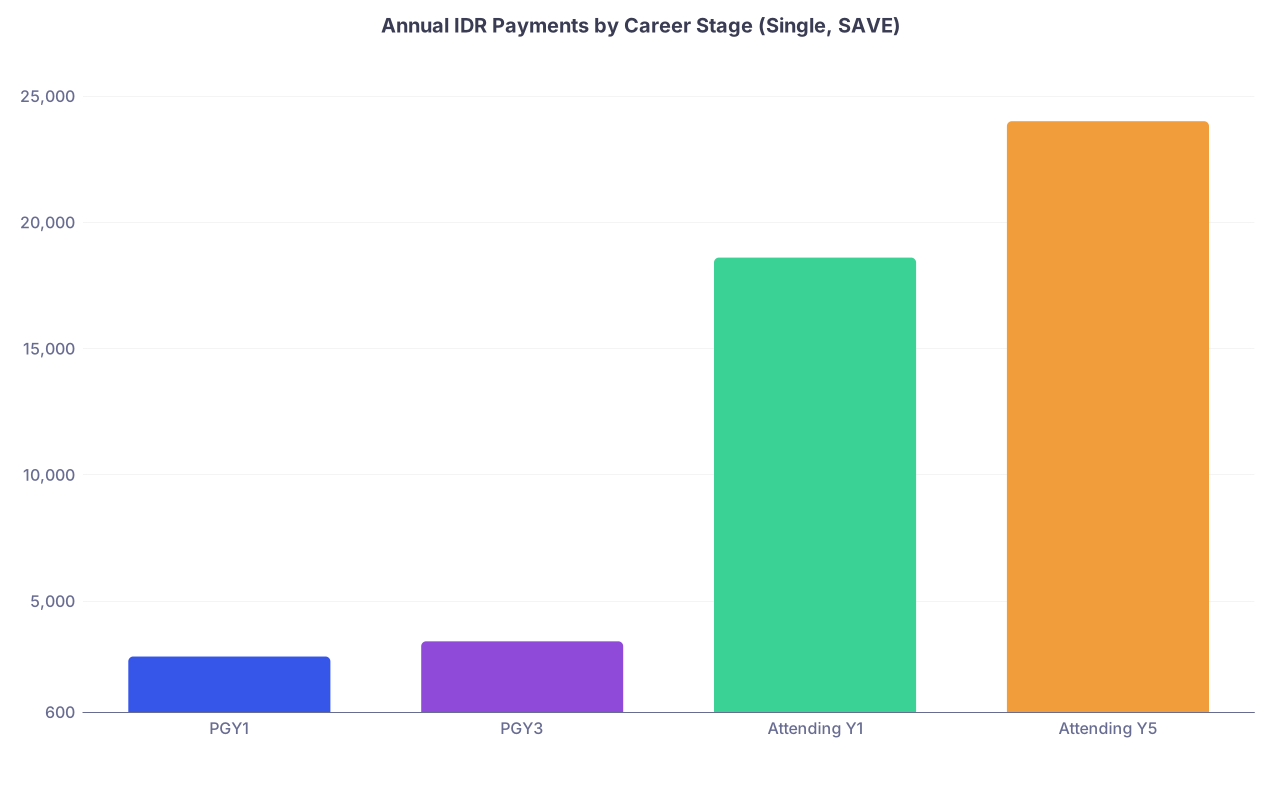
| Category | Value |
|---|---|
| PGY1 | 2800 |
| PGY3 | 3400 |
| Attending Y1 | 18600 |
| Attending Y5 | 24000 |
These are the numbers that drive your tax bomb.
3. Concrete scenario modeling: two physicians, two very different bombs
Let me show you two stripped-down but realistic scenarios. Assumptions:
- All numbers in nominal dollars, no inflation adjustment to keep this readable
- Interest accrues at fixed rate
- Using SAVE-like 10% of discretionary income
- No marriage / dependents to complicate AGI and poverty line
- 20-year forgiveness horizon (undergraduate + grad loans, typical SAVE scenario)
Scenario A: Primary care, moderate debt, consistent attending income
Physician A:
- Starting debt at graduation: $300,000 at 6%
- 3-year residency, then outpatient IM
- Income path: $62k, $65k, $68k (residency), then $220k rising to $280k by year 10, flat thereafter
- Plan: SAVE for full 20 years, no PSLF
Very rough, but directionally accurate trajectory:
Years 1–3 (residency):
- Payments: ~$2.8k, $3.1k, $3.4k
- Total paid: ~ $9k
- Interest each year: ~$18k in year 1, rising as balance grows
- Balance after 3 years: roughly $335k–$345k (depends on SAVE interest handling, but the key is: higher than starting)
Years 4–10 (early attending, increasing income):
- Average AGI ~ $250k
- 225% FPL ~$34k
- Discretionary ≈ $216k
- 10% payment ≈ $21.6k/year
- Interest on ~$340k at 6% ≈ $20.4k/year initially, then falls as balance shrinks
At this point, annual payments roughly match or slightly exceed interest → principal starts going down slowly.
Years 11–20 (stable attending):
- Assume AGI stabilizes around $280k
- Discretionary ≈ 280k – 34k = 246k
- Payment ≈ $24.6k/year
Now you are clearly paying more than interest, and balance declines. After 20 total years in IDR, rough outcome:
- Total paid:
- Residency: ~ $9k
- Years 4–10: ~ $21.6k × 7 ≈ $151k
- Years 11–20: ~ $24.6k × 10 ≈ $246k
- Total paid ≈ $406k
With that payment stream and 6% interest, more detailed amortization tables show the remaining balance by year 20 often in the $100k–$180k range for this style of case, depending on exact income growth and SAVE interest treatment.
Let us say mid-estimate: $140,000 forgiven at year 20.
Now the tax bomb.
Assume:
- Forgiveness is fully taxable as ordinary income
- You are still an attending around $280k AGI that year
- Federal marginal bracket: likely 35% or 32% depending on 2026+ law
- Many states: 0%–10% marginal
Tax bomb estimate:
- Federal: 32% of 140k ≈ $44,800
- State (say 5%): ~$7,000
- Total incremental tax ≈ $52k
Not $200k. Not nothing either. With 20 years’ warning, $52k is extremely manageable. We will get to that.
Scenario B: High-debt surgical subspecialist with slow early paydown
Physician B:
- Starting debt: $500,000 at 7%
- 5-year surgical residency
- 1-year fellowship
- Attendings years 7–20
- Income path (AGI):
- Residency: 62k → 74k over 5 years
- Fellowship: 78k
- Attending Y1–3: 400k, 450k, 500k
- Then 550k–650k
Under SAVE, during training, payments are low; interest that is not covered does not capitalize, but principal remains high and the total amount that will eventually be forgiven can still be large.
Quick training-phase snapshot:
- Interest on 500k at 7%: $35,000/year
- Residency payment mid-point: maybe $3.2k–$4k/year
- Fellowship payment: maybe $4.5k/year
So in most years of training, you are paying barely over 10%–15% of annual interest. The unpaid interest is not capitalizing under SAVE, which helps, but you are not reducing principal. You exit training with roughly the same principal as you started: ~$500k.
Attending phase under SAVE:
Early attending (average AGI ~ $450k for first 3 years)
- Poverty 225%: same ~$34k (ignoring small inflation for illustration)
- Discretionary ≈ 450k – 34k = 416k
- Payment ≈ 41.6k/year
- Interest on 500k at 7%: 35k/year
So you barely start to reduce principal by 6.6k/year initially. Very slow.
Later attending (AGI average ~ $600k years 10–20):
- Discretionary ≈ 600k – 34k = 566k
- Payment ≈ 56.6k/year
- Interest now on something like $450k falling over time; call it $31k dropping gradually
- Now you are cutting principal by ~25k/year plus
Do a rough 20-year sweep:
- Total paid over 20 years on SAVE with that income growth: in the ballpark of $650k–$800k
- Principal declines, but slowly at first. Many detailed projections I have run for similar borrowers end up with forgiveness between $150k and $350k, depending heavily on whether they stay full-time high-earning for all 20 years.
Let us pick a middle-of-the-road high scenario: $250,000 forgiven at year 20.
Tax impact if forgiveness is taxable:
- Assume they are still earning ~ $600k when forgiveness happens
- Federal marginal may be 37% on at least part of that incremental income
- State 5–10%
Tax bomb:
- Federal: 37% of 250k ≈ $92,500
- State at 6%: $15,000
- Total incremental tax ≈ $107,500
Different order of magnitude than the primary-care case. But again: you see this coming from a mile away if you model it in your early 30s.
4. Stress-testing the model: tax law, income, and family variables
The mistake is to model a single neat line and call it a day. Real analysis demands sensitivity testing.
Here are the three axes that matter most.
4.1 Tax regime at forgiveness: three scenarios
Run at least three versions:
Baseline: current law after 2025
- Forgiveness taxable
- Current bracket structure restored or extended
- Typical top marginal 35–37%
Favorable: ARP-style extension
- Loan forgiveness excluded from taxable income
- Tax bomb = $0 federally (state may still tax or conform to federal change)
Adverse: higher future rates
- Progressive brackets with higher top rates (say 39.6%+), plus potential surtaxes
- For high-earning physicians, marginal tax on the bomb may easily hit 40%+ federal
A quick visualization of how this changes the federal part of the bomb for a $200k forgiven amount:
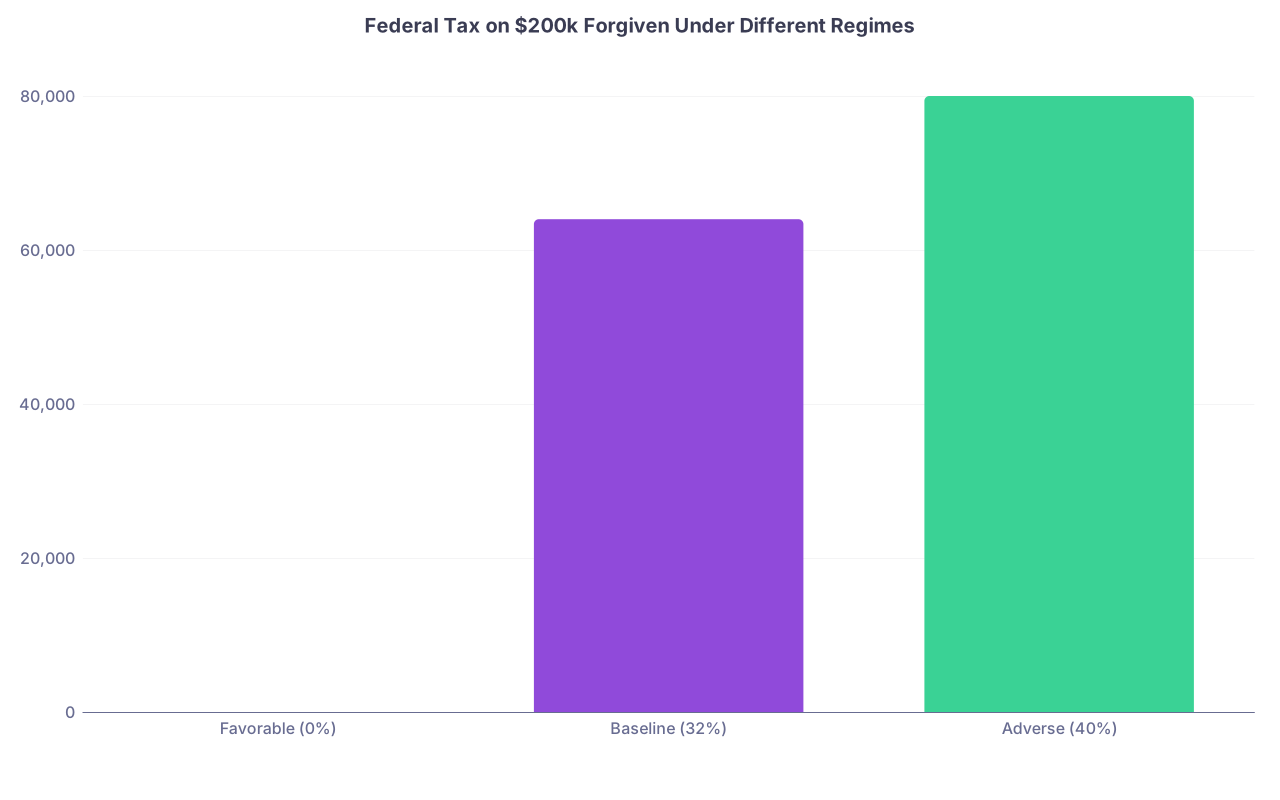
| Category | Value |
|---|---|
| Favorable (0%) | 0 |
| Baseline (32%) | 64000 |
| Adverse (40%) | 80000 |
That is why planning for the worst and hoping for the best is the only rational stance. You cannot bank on Congress doing you a favor in 20 years.
4.2 Income volatility and life choices
When you run the model, modify:
- Working part-time for several years
- Geographic move to lower-compensation region
- Switching to academic track with lower salary
- Taking a nonclinical role
All of these lower AGI. What does that do?
- Reduces IDR payments → more remaining principal at forgiveness → larger tax bomb
- But also may lower the marginal tax bracket in that forgiveness year
Sometimes the bomb size grows but the marginal rate falls, partially offsetting. You do not guess this; you run the numbers.
4.3 Marriage and filing status
Married filing separately vs jointly under different IDR plans changes:
- Whose income counts in IDR payment calculation
- What AGI is used for the IDR formula
- Joint taxable income in the forgiveness year, hence marginal tax rate
I have watched dual-physician couples accidentally blow up their projections by:
- Modeling IDR using only their own income, but
- Modeling forgiveness-year taxes using combined high dual incomes
That is not consistent. If you are going to assume joint high income at forgiveness for tax modeling, rerun the IDR payment path using combined income where the plan requires it. Otherwise your “tax bomb” is overstated because your earlier payments would have been larger and the forgiven balance smaller.
5. Converting projections into a funding plan
Once you accept that your tax bomb distribution is not a single point but a range, you need a funding strategy.
Here is the data-driven way to do it.
5.1 Translate projections into a target range
For each scenario (conservative, expected, optimistic), calculate:
- Remaining balance at forgiveness
- Tax liabilities under 3 tax regimes (favorable, baseline, adverse)
Summarize something like:
| Scenario | Forgiven Amount | Federal Tax (Baseline) | Fed Tax (Adverse) |
|---|---|---|---|
| Low | $80,000 | $25,600 | $32,000 |
| Expected | $140,000 | $44,800 | $56,000 |
| High | $200,000 | $64,000 | $80,000 |
Your planning target probably sits between “Expected-Baseline” and “High-Adverse”. For Physician A, that might be ~$50k–$80k federal, maybe another $10k in state.
That gives you a planning band: say $60k–$90k to have ready around year 20.
For Physician B (the surgical subspecialist), that band might easily be $120k–$200k.
5.2 Back into monthly savings required
You now treat the tax bomb like any other future liability and discount it.
Assume:
- Need $80k in 20 years
- Target real return after inflation of 4% annually (an aggressive but not insane equity-heavy portfolio assumption)
Monthly savings needed (rough math):
Future value formula:
FV = PMT × [((1 + r)^n – 1) / r]
Rearrange:
PMT = FV × r / ((1 + r)^n – 1)
Where:
- FV = 80,000
- r = 0.04/12 ≈ 0.003333
- n = 20 × 12 = 240
Compute the annuity factor:
- (1 + 0.003333)^240 ≈ (1.003333^240) ≈ ~2.208 (using standard compounding approximations)
- Numerator (1 + r)^n – 1 ≈ 1.208
- Divide by r: 1.208 / 0.003333 ≈ 362.4
So:
- PMT ≈ 80,000 / 362.4 ≈ $221/month
Round up: $250/month and you are probably fine for an $80k target over 20 years at 4% real.
For a $150k target at same assumptions:
- PMT ≈ 150,000 / 362.4 ≈ $414/month → call it $450/month for safety
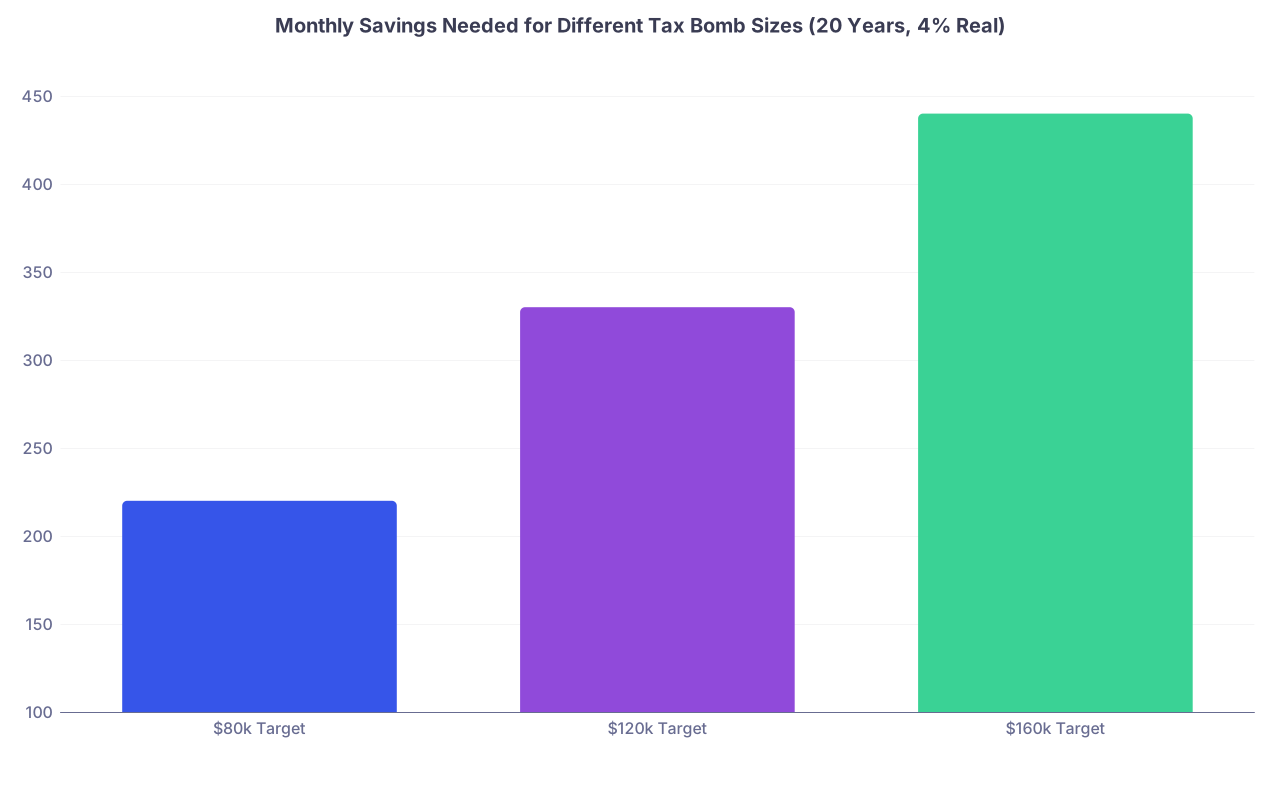
| Category | Value |
|---|---|
| $80k Target | 220 |
| $120k Target | 330 |
| $160k Target | 440 |
Seeing that, most attendings stop panicking. The numbers are not trivial, but they are not career-destroying. Especially if you start in your early 30s.
5.3 Where to store the tax bomb fund
Here is where tax and flexibility intersect.
I generally see three workable structures:
Taxable brokerage account
- Maximum flexibility
- No early withdrawal penalties
- Long-term capital gains treatment on growth
- Very simple: label one sub-account “Forgiveness Tax Fund”
Roth IRA as “shadow” reserve
- Contribute aggressively to Roth early
- In worst case, you can withdraw contributions (not earnings) tax and penalty free to pay the tax bomb
- Not a dedicated bucket but a backstop
HSA as tertiary backup
- Only works if you have enough documented medical expenses to justify withdrawals later
- Too messy to rely on solely, but can be part of the “oh-crap” reserves
The data says people with explicit, named sub-accounts hit their targets more consistently than those who mentally earmark funds. So actually labeling a taxable account for this purpose is not silly. It is behavioral design.
6. How to actually build the model (workflow)
You do not need a PhD for this. But you do need discipline.
Here is a compact flow of the steps, in case you want a visual.

| Step | Description |
|---|---|
| Step 1 | Gather Data |
| Step 2 | Project Income |
| Step 3 | Select IDR Plan |
| Step 4 | Year by Year Loan Calc |
| Step 5 | Estimate Forgiveness |
| Step 6 | Apply Tax Scenarios |
| Step 7 | Define Savings Target |
| Step 8 | Implement Investment Plan |
| Step 9 | Review Every 2-3 Years |
And a few practical tips like someone who has watched people botch this:
- Lock your assumptions at the top of the spreadsheet: rate, term, inflation, FPL growth, tax regime labels
- Separate core inputs (blue cells) from calculated outputs (black cells)
- Do not hard-code formulas for 20 rows and then edit one row by hand. That is how you create silent bugs.
- Version your model annually (“IDR_TaxBomb_2026_v2.xlsx”) and keep old copies
7. When IDR tax bomb planning is the wrong problem
One more hard truth: for many physicians, long-term IDR forgiveness is a suboptimal goal.
I see three common misalignments:
Targeting forgiveness but working full-time at high income
- Data: Many specialists with $300k–$400k debt and $500k+ income will fully amortize their loans on 10–15 year payoff faster than they reach forgiveness, especially if they refinance at lower rates
- For them, the tax bomb modeling is academic. They will not get there.
Mixing PSLF and 20/25-year forgiveness confusion
- PSLF forgiveness is tax-free under current law
- If you are reasonably sure you will log 10 years of qualifying payments in a 501(c)(3) or government setting, your “tax bomb” is actually $0. Different problem entirely.
Under-saving for retirement because of fear of the bomb
- The worst outcome mathematically is sacrificing 401(k)/403(b)/Roth space to oversave for a tax bomb that may be legislated away
- Retirement underfunding hurts more than having to cash-flow a $50k–$100k tax at 50
The clean way to decide:
- Run an aggressive private refinance + payoff schedule side-by-side with IDR + forgiveness + tax scenario
- Compare total out-of-pocket cost (NPV if you want to be rigorous) under realistic investment return assumptions
Sometimes the IDR route with tax bomb planning wins. Sometimes aggressive repayment wins. Do not guess. Compare.
Key takeaways
- The data shows many physicians on long-term IDR will have forgiveness-triggered taxable income, but the “tax bomb” is usually a five-figure problem, not a six-figure catastrophe, if you start planning early.
- A proper model runs year-by-year income, payments, balance, and multiple tax regimes, then turns that into a concrete savings target (often a few hundred dollars per month over 20 years).
- The smartest move is not just modeling the bomb; it is comparing IDR+forgiveness+tax to aggressive payoff paths, then funding the chosen strategy with an explicit, labeled investment plan you revisit every 2–3 years.