
The most financially dangerous specialties are not always the lowest paid. The real risk sits where long training, high debt, and modest compensation intersect. That is where debt-to-income ratios quietly explode.
You are not choosing between “rich specialties” and “poor specialties.” You are choosing between a 0.7× debt-to-income ratio and a 2.5× ratio that can trap you in 20+ years of repayment. The data is very clear about which paths create that trap.
Below, I will walk through the numbers that actually matter: average student loan balances, training length, starting and peak incomes by specialty cluster, and how those combine into realistic debt-to-income (DTI) ratios.
1. The Baseline: Typical Physician Debt vs Income
Let’s anchor this with national data before slicing by specialty.
From recent AAMC and Medscape data (rounded to realistic ranges used in financial planning):
- Median educational debt at graduation (MD/DO, with debt): about $250,000–$230,000, but a sizable chunk of grads sit closer to $300,000–$350,000, especially at private and Caribbean schools.
- New attending salaries (first few years out, not peak):
- Primary care: roughly $210k–$260k
- Hospital-based non-surgical (e.g., anesthesia, EM): $330k–$420k
- Surgical subspecialties (e.g., ortho, neurosurg): $450k–$650k+
If we take a realistic “high-debt” new attending with $350,000 in loans:
- A primary care doc at $230,000: DTI ≈ 1.5×
- A general surgeon at $450,000: DTI ≈ 0.8×
- A neurologist at $260,000: DTI ≈ 1.3–1.4×
And that is just the snapshot at the start of attending life. Add 3–7 years of fellowship, interest accrual during residency, and lifestyle inflation, and some specialties become dramatically more leveraged than others.
To make this concrete, let us group specialties logically and put rough numbers on the DTI.
| Metric | Low-Debt Scenario | High-Debt Scenario |
|---|---|---|
| Loan principal at graduation | $200,000 | $350,000 |
| Interest rate (average) | 6.0% | 6.5% |
| Primary care starting pay | $220,000 | $230,000 |
| Hospital-based starting pay | $350,000 | $370,000 |
| Surgical starting pay | $450,000 | $500,000 |
Those are the inputs. Debt-to-income ratios are just arithmetic on top of them.
2. Specialties with the Highest Debt-to-Income Ratios
The worst DTI offenders share a few traits:
- Long training (residency + one or more fellowships)
- Below-average or only slightly-above-average attending pay
- Limited moonlighting opportunities during training
- High proportion of academic or hospital-employed positions with rigid salary scales
Here is how the data shakes out.
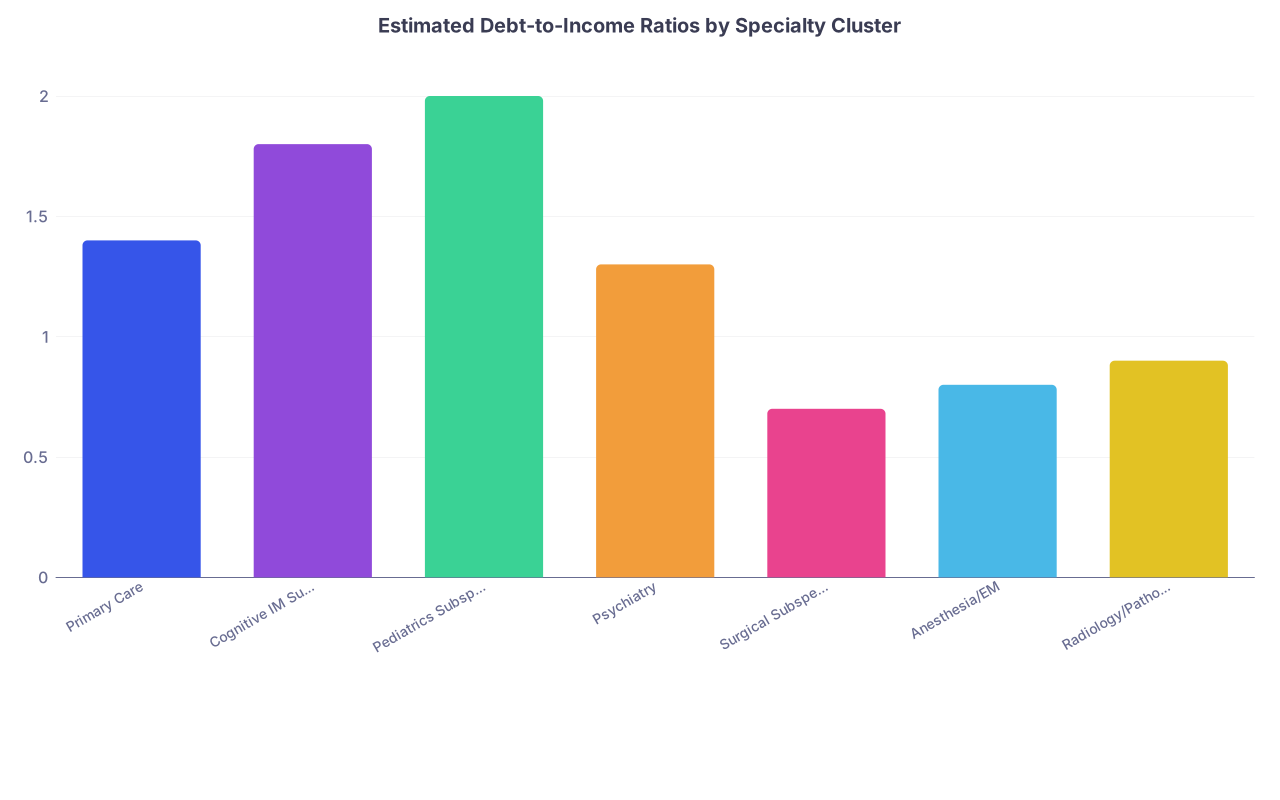
| Category | Value |
|---|---|
| Primary Care | 1.4 |
| Cognitive IM Subspecialties | 1.8 |
| Pediatrics Subspecialties | 2 |
| Psychiatry | 1.3 |
| Surgical Subspecialties | 0.7 |
| Anesthesia/EM | 0.8 |
| Radiology/Pathology | 0.9 |
2.1 Cognitive Internal Medicine Subspecialties
Think: endocrinology, rheumatology, infectious disease, geriatric medicine.
Patterns I keep seeing in actual borrower spreadsheets:
- MD at private med school: $320k–$380k at graduation.
- IM residency: 3 years
- Fellowship: +2–3 years (endocrine, rheum, ID)
- In-training income: $65k–$75k starting PGY-1, rising slowly.
- Interest capitalization by attendinghood: often total debt $380k–$450k.
Typical early attending salaries:
- Endocrinology: $220k–$260k
- Rheumatology: $250k–$300k
- Infectious Disease: $220k–$260k
Let us be numeric and a bit ruthless.
Scenario: Endocrinology, high-debt profile.
- Starting attending salary: $240,000
- Debt at that point: $400,000
DTI = 400,000 / 240,000 ≈ 1.67×
That is already high. Now factor:
- Location skew: many endocrine/ID jobs are in academic centers or high COL cities.
- PSLF-heavy employment: federal/academic hospitals, which often means you are on income-driven repayment for 10 years.
If that same doctor goes for standard 10-year repayment:
- Monthly payment on $400k @ 6.5% over 10 years ≈ $4,540
- That is roughly 23% of gross income, and closer to 35–40% of take-home after taxes and retirement contributions.
By any consumer finance standard, that is a stretched DTI.
This is why, if you love endocrinology or ID, you almost have to assume income-driven repayment plus PSLF or a long 20–25 year IDR horizon. On pure DTI, these specialties are near the top of the risk heap.
2.2 Pediatric Subspecialties
This is where the numbers are frankly awful.
Peds subspecialties include pediatric endocrinology, nephrology, infectious disease, heme/onc, and others. The pay bump over general pediatrics is often modest, sometimes negligible, despite extra training.
Typical path:
- Med school debt at graduation: $260k–$350k
- Peds residency: 3 years
- Fellowship: another 3 years (common)
- Total training: 6 years post-MD before attending
- Accrued interest pushes total debt: $320k–$400k+
Starting attending salaries:
- General pediatrics: $190k–$230k
- Pediatric endocrinology/ID/nephrology: often $200k–$240k
- Pediatric cardiology/critical care: somewhat higher, $260k–$320k, but still below many adult subspecialties.
Let us hit a representative scenario: pediatric endocrinology.
- Debt at attending start: $350,000
- Salary: $220,000
DTI = 350,000 / 220,000 ≈ 1.59×
High-debt case:
- Debt: $420,000
- Salary: $220,000
DTI = 420,000 / 220,000 ≈ 1.91×
That is nearly 2×. Translation: even aggressive repayment (without PSLF) will eat an enormous share of your income for 15–20 years.
Among all specialties, pediatric cognitive subspecialties consistently land in the worst DTI quadrant. The qualitative story (“low paid, heavily academic, long training”) aligns with the quantitative data.
3. “Moderate Pay, High-Leverage” Specialties You Should Not Ignore
Not all high DTI ratios come from the lowest paying fields. Some mid-range specialties look fine on salary tables but become dangerous once you account for high starting debt and long fellowships.
3.1 Neurology
Neurology looks middle-of-the-road on a salary list but becomes tricky under real debt loads.
- Training: 4 years residency, +1–2 year fellowship (epilepsy, stroke, movement disorders, etc.) is common.
- Attending salaries:
- General neurology: $260k–$320k
- Subspecialty neuro (epilepsy, movement, MS): $280k–$350k range, higher in some private settings, but not dramatically.
Take a realistic early-attending scenario:
- Debt: $375,000
- Salary: $290,000
DTI ≈ 1.29×
Looks better than pediatric endo, but still high. And neurology often clusters in urban or academic centers where COL and state taxes are high. After tax, retirement, and loan payments, net discretionary cash can feel far tighter than a raw $290k suggests.
3.2 Psychiatry
Psychiatry is an odd one. The base salary is not stellar, but:
- Training length: 4 years, usually no mandatory extra fellowship (except child psych, addiction, etc.).
- Attending salaries:
- Employed psych: $260k–$320k
- High-productivity outpatient or telepsych: $300k–$400k+ is increasingly common.
DTI for a high-debt psych doc:
- Debt: $350,000
- Salary: $280,000
DTI ≈ 1.25×
Not catastrophic. Where psychiatry can go sideways: academic tracks in big cities at $230k–$260k, with $350k–$400k debt. Now you are creeping to 1.5× DTI and above. But there is a release valve: part-time telepsych, locums, and flexible private practice options. Those options are weaker in something like pediatric endocrinology or ID.
So I would not put psychiatry in the “worst DTI” bucket, but it is firmly in “be deliberate or you will drift into a long IDR/forgiveness plan.”
4. Where Debt-to-Income Ratios Are Safest
Now the contrast. Which specialties usually carry the most favorable DTI ratios, even for highly indebted graduates?
Think three factors: short(er) training, strong income, broad mix of community jobs.
4.1 Surgical Subspecialties
Orthopedic surgery, neurosurgery, vascular surgery, some ENT and urology jobs.
Even with long training, the income levels overpower the debt in DTI terms.
Typical paths:
- Total educational debt: $350k–$450k
- Training: 5–7+ years
- Attending salaries:
- Orthopedics: $550k–$700k+
- Neurosurgery: $650k–$900k+
- Vascular: $450k–$600k
- ENT/Urology: $450k–$600k
Let us do the math with a heavy-debt ortho surgeon:
- Debt at attending start (after interest): $450,000
- Salary: $600,000
DTI = 450,000 / 600,000 = 0.75×
That is lower than many primary care and IM subspecialty ratios, despite higher absolute debt. The income is just that strong.
If an ortho surgeon lives on $250k–$300k for the first 5–7 years and attacks loans aggressively, full payoff in under 10 years is very plausible, even without PSLF.
4.2 Anesthesiology and Emergency Medicine
Yes, EM is in flux with job market concerns and corporate consolidation. But purely on DTI, both anesthesia and EM still average favorably.
- Training: 3–4 years, typically no extra fellowship required (except for some niches).
- Attending salaries:
- Anesthesiology: $400k–$500k+
- Emergency medicine: historically $350k–$450k, now more variable but still strong in many markets.
High-debt anesthesiologist scenario:
- Debt: $350,000
- Salary: $420,000
DTI ≈ 0.83×
This is why, even for a doctor who “overpaid” for med school, anesthesia or EM can still be financially forgiving. The pay comes early relative to some long-fellowship tracks, and the absolute income levels are high enough to keep DTI under 1× for most graduates.
4.3 Radiology and Pathology
Less glamorous in conversation, very relevant in spreadsheets.
- Diagnostic radiology: 4-year residency after prelim, some do extra fellowships.
- Pathology: 3–4 years, sometimes plus fellowship.
Average early attending:
- Radiology: $420k–$500k
- Pathology: $280k–$350k (more variable)
DTI with $350k debt:
- Radiology @ $450k: DTI ≈ 0.78×
- Pathology @ $300k: DTI ≈ 1.17× (still better than many IM/peds subspecialties)
So radiology usually lands in the safest DTI tier. Pathology can be middle-of-the-pack, but not disastrous, unless combined with extreme debt and low-paying academic posts.
5. Comparing Specialties Side by Side: Debt, Income, and DTI
Let me put some representative numbers into a table. These are illustrative, not exact for any single doc, but they reflect stacked real-world data I have seen again and again.
| Specialty Cluster | Debt at Attending Start | Starting Salary | Approx. DTI |
|---|---|---|---|
| Family Med/Internal Med | $320,000 | $230,000 | 1.39× |
| Pediatrics (general) | $320,000 | $210,000 | 1.52× |
| Peds Endo/Nephro/ID | $360,000 | $220,000 | 1.64× |
| Endocrine/Rheum/ID (Adult) | $380,000 | $240,000 | 1.58× |
| Neurology | $375,000 | $290,000 | 1.29× |
| Psychiatry | $350,000 | $280,000 | 1.25× |
| General Surgery | $380,000 | $400,000 | 0.95× |
| Ortho/Neurosurg | $450,000 | $600,000 | 0.75× |
| Anesthesia | $350,000 | $420,000 | 0.83× |
| EM | $320,000 | $380,000 | 0.84× |
| Radiology | $350,000 | $450,000 | 0.78× |
The key takeaway is brutally simple:
- Highest DTI zones: general pediatrics, pediatric subspecialties, adult cognitive IM subspecialties.
- Moderate DTI zones: primary care, neurology, psychiatry, pathology.
- Lowest DTI zones: surgical subspecialties, anesthesia, EM, radiology.
The specialty you choose changes your long-term leverage by a factor of two or more.
6. Training Length and Interest Accrual: The Hidden Multiplier
Debt-to-income is not just about the endpoint numbers. The path matters.
Someone in orthopedic surgery might finish with $450k in debt, but they hit a $600k+ salary at age 33–35. A pediatric endocrinologist may start at $220k at roughly the same age with $360k of debt.
To visualize how training length inflates total debt, picture two simplified paths starting from the same initial principal: $300,000 at graduation.
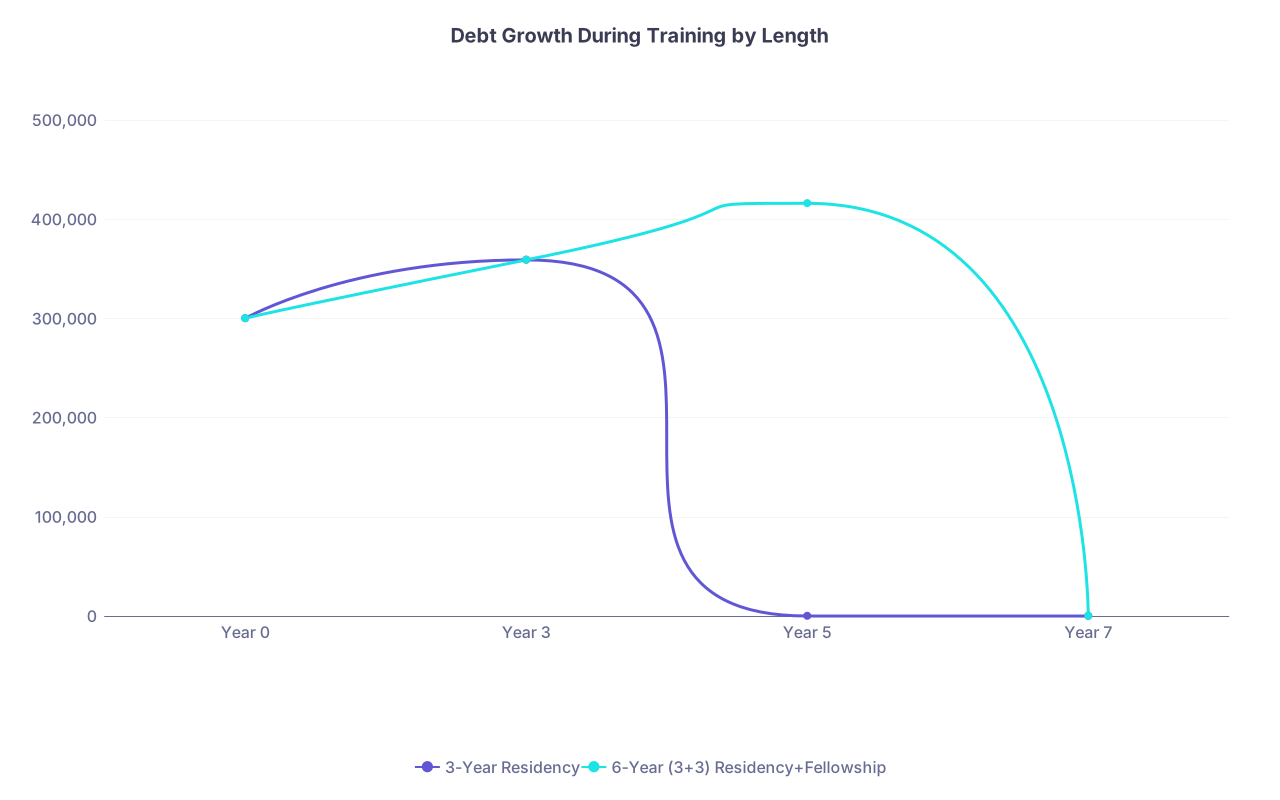
| Category | 3-Year Residency | 6-Year (3+3) Residency+Fellowship |
|---|---|---|
| Year 0 | 300000 | 300000 |
| Year 3 | 359000 | 359000 |
| Year 5 | 0 | 416000 |
| Year 7 | 0 | 0 |
Assuming:
- 6.5% average interest rate
- No in-training payments (common before IDR awareness spread)
- No capitalization until repayment (simplified; in practice, capitalization timing can vary)
Approximate balances:
3-year path:
Year 0: $300,000
Year 3: $300,000 × (1.065)^3 ≈ $359,0006-year path:
Year 0: $300,000
Year 3: ≈ $359,000
Year 6: $300,000 × (1.065)^6 ≈ $430,000
That is a $70,000 difference from training length alone.
Now marry that to income:
- 3-year path (FM/IM): $359k debt vs $230k salary → DTI ≈ 1.56×
- 6-year path (peds subspecialty): $430k debt vs $220k salary → DTI ≈ 1.95×
This is why every extra year of training in a low-paid field is financially expensive, even if your gross debt at graduation is identical.
7. Where Loan Programs and PSLF Actually Change the Story
At this point you might be thinking: “So anyone in peds or endocrine is doomed?” No. But the data is loud about this: if you choose a high-DTI specialty, you must play the loan programs strategically.
A quick, numbers-driven map:
- Income-Driven Repayment (IDR) plans (SAVE, PAYE legacy, etc.) cap your payment around 5–10% of discretionary income.
- Public Service Loan Forgiveness (PSLF) wipes remaining federal debt after 120 qualifying payments (10 years) in qualified employment.
Who actually benefits the most from PSLF, mathematically?
Not the orthopod making $700k.
The pediatric heme/onc attending making $230k in a children’s hospital with $380k of loans.
Let me model it roughly.
Example: Pediatric Subspecialist on PSLF
- Starting debt at attending: $380,000
- Salary progression (academic center): start $220k, grow to $260k over 10 years
- Filing status: single, using SAVE-like plan with 10% of discretionary
Rough IDR payments (very simplified, no COLA nuance):
- Year 1–3: payments around $1,000–$1,200/month
- Year 4–10: perhaps $1,200–$1,600/month as income creeps up
Total paid over 10 years: on the order of $150,000–$180,000
Remaining balance after 10 years: still substantial, maybe $250,000–$300,000 forgiven tax-free under PSLF.
Effective “cost” of the debt over a decade: closer to $15k–$18k per year, not the eye-watering $4–5k per month of standard repayment.
That transforms a 1.8–2.0× DTI specialty into something manageable. But only if you structure your career around PSLF-eligible employment and never “accidentally” break eligibility.
Example: Orthopedic Surgeon on Standard Repayment
- Starting debt: $450,000
- Salary: $600,000+, private practice, non-PSLF.
10-year standard repayment:
- Monthly: ≈ $5,110
- Total over 10 years: ≈ $613,000
- DTI is still under 1×, and the loans are gone in 7–10 years if they push.
The data pattern:
- High-earning proceduralists rarely get the maximum relative benefit from PSLF. They can simply kill the loans.
- High-DTI, low-to-moderate income specialties practically require IDR + PSLF or extended IDR with forgiveness to keep lifestyle reasonable.
8. How to Use These Numbers in Real Decisions
Here is where I tend to be blunt with residents and MS3/4s.
The numbers say:
- If you are choosing pediatric endocrine, rheumatology, ID, or similar with $350k–$450k of debt and no interest in PSLF, you are signing up for 20–25 years of income-driven repayment with a very real chance of large taxable forgiveness at the end (under current rules).
- If you are choosing orthopedics, radiology, anesthesia, or EM with $350k–$450k of debt, you have the ability to be debt-free in 10 years or less without totally wrecking your lifestyle, if you behave like a rational high earner early on.
This is not about loving or hating certain specialties. It is about leverage.
To make intelligent moves, you should:
- Quantify your likely total debt by graduation, not just current balance.
- Overlay training length and realistic fellowship plans.
- Use actual starting salary ranges from credible sources (Medscape, MGMA ranges, specialty society data).
- Compute a rough DTI ratio for your intended field.
If your projected DTI is >1.5×, you must:
- Plan for IDR from the start of residency.
- Treat PSLF eligibility as a central design parameter, not an afterthought.
- Avoid stacking extra consumer debt (cars, credit cards, personal loans) on top.
If your projected DTI is <1×, you have far more flexibility. You can choose aggressive standard repayment, refinance privately when stable, and still hit normal financial milestones (home, kids, retirement) without constantly juggling forgiveness strategies.

9. A Visual Snapshot: Competitiveness vs DTI Risk
One last angle. Students often obsess over “competitiveness” (Step scores, match odds) but ignore financial competitiveness: how much income you actually get for the time and debt you invest.
Let us plot specialties by relative competitiveness and relative DTI risk:
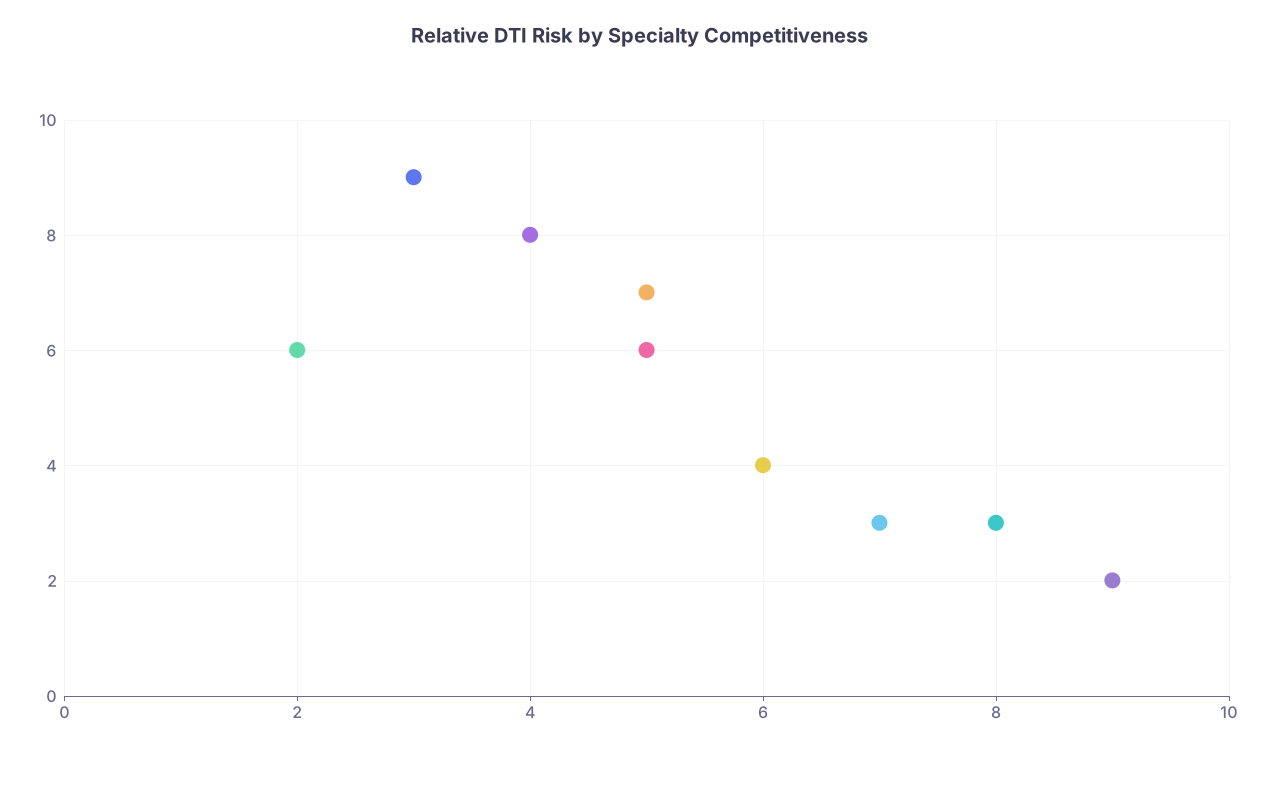
| Category | Value |
|---|---|
| Peds Subspecialty | 3,9 |
| Adult Endo/Rheum/ID | 4,8 |
| FM/IM | 2,6 |
| Neurology | 5,7 |
| Psychiatry | 5,6 |
| Anesthesia | 7,3 |
| EM | 6,4 |
| Radiology | 8,3 |
| Ortho/Neurosurg | 9,2 |
Scale (arbitrary but informative):
- X-axis (1–10): Match competitiveness (1 = easiest, 10 = hardest)
- Y-axis (1–10): DTI risk (1 = lowest risk, 10 = highest risk)
Patterns:
- Some of the most competitive specialties (ortho, neurosurg, rads, anesthesia) actually have low DTI risk.
- Some of the less competitive specialties (peds subspecialties, ID, endocrine) have the highest DTI risk.
So the market already “prices in” income potential somewhat in competitiveness, but not perfectly. From a cold financial perspective, matching into pediatric ID is harder on your future net worth than missing ortho and landing in anesthesia.

| Step | Description |
|---|---|
| Step 1 | Estimate Total Debt at Graduation |
| Step 2 | DTI usually manageable |
| Step 3 | Estimate Target Specialty Income |
| Step 4 | High DTI Risk |
| Step 5 | Moderate to Low DTI Risk |
| Step 6 | Prioritize IDR and PSLF |
| Step 7 | Avoid extra fellowships without pay boost |
| Step 8 | Consider aggressive repayment or refinance |
| Step 9 | Projected Debt > 300k |
| Step 10 | Starting Income < 260k |
Key Takeaways
- The highest debt-to-income ratios cluster in pediatric subspecialties and adult cognitive IM subspecialties (endo, rheum, ID), where long training and modest pay collide with high educational debt.
- Surgical subspecialties, anesthesia, EM, and radiology generally produce the lowest DTIs, even with large nominal debt, because income levels overwhelm the leverage.
- If your projected DTI is above 1.5×, you are in a high-risk leverage zone and should treat income-driven repayment and PSLF as core to your career planning, not optional afterthoughts.