
What if the “smart” financial move you rush into during intern year quietly costs you six figures and destroys your safety net—right before life gets expensive?
I’m talking about refinancing federal student loans too early. During residency. Often during intern year. It’s the mistake that looks responsible. Feels proactive. Sounds smart on Reddit.
And then five years later, people are sitting in my office or my inbox saying the same thing:
“I had no idea what I was giving up.”
Let’s make sure you’re not one of them.
The Core Problem: You’re Trading Flexibility for a Slightly Lower Payment
Refinancing during training usually happens for one reason:
“I wanted a lower interest rate and better monthly payment.”
Reasonable motivation. Terrible timing.
When you refinance federal loans to a private lender as an intern or resident, you’re doing more than changing who you pay each month. You are permanently giving up:
- Federal protections
- Federal repayment options
- Access to loan forgiveness (including PSLF)
- Built-in safety valves in case life blows up
In exchange for what?
- Maybe a 1–2% lower interest rate
- A cleaner-looking balance on a fancy dashboard
- A sense of “taking control” that is mostly emotional, not financial
Let me be blunt:
The earlier you refinance during training, the more likely you are to regret it.
Not always. But often enough that you should assume it’s a bad idea until proven otherwise.
The Biggest Mistake: Killing PSLF Before You Even Understand It
Here’s the most expensive mistake I see:
Refinancing away PSLF eligibility before you actually know where your career will land.
If you’re even remotely likely to:
- Work at a 501(c)(3) hospital
- Work at an academic center
- Take a hospital-employed job at a nonprofit system
- Stay in training a long time (fellowships, sub-fellowships)
…then throwing away federal loan status during residency can be catastrophic.
Why PSLF is secretly training-friendly
Public Service Loan Forgiveness (PSLF) requires:
- 120 qualifying monthly payments
- On an income-driven repayment (IDR) plan
- While working full-time at a qualifying employer (nonprofit/government)
- With Direct federal loans
Here’s what people get wrong:
- Those 120 payments do not need to be made as an attending.
- They don’t need to be large.
- Residency and fellowship years can count, as long as you’re:
- Employed full-time by a qualifying institution (most teaching hospitals qualify), and
- On a qualifying IDR plan, paying something each month.
So that $200/month payment on SAVE or PAYE as a PGY-2?
Counts the same toward PSLF as a $2,500 attending payment.
I’ve seen this scenario more than once:
- Intern refinances $300k to a private lender at 4.5%
- PGY-4: Falls in love with academic medicine at a big nonprofit center
- Attending: Easily qualifies for PSLF job for 10+ years
- Realizes too late: Training years no longer count; PSLF is gone forever
On the other side, I’ve seen co-residents who:
- Stayed in federal loans
- Made token IDR payments during training
- Took nonprofit attending jobs
- Ended up with $150k–$300k forgiven tax-free after 10 total years
Same specialty. Same hospital. One saved six figures. One “refinanced too early.”
You do not get PSLF back once you privatize your loans. There is no undo button.
Hidden Protections You Lose When You Go Private
Everyone focuses on the interest rate. That’s amateur-level analysis.
The real value of federal loans for interns and residents is risk management.
Once you refinance to private, you lose:
1. Income-Driven Repayment (IDR) Flexibility
With federal loans, you can use plans like:
- SAVE (the new big one)
- PAYE (for some existing borrowers)
- IBR (less ideal, but still there)
These do things private lenders will not:
- Cap your payments based on your actual income, not your balance
- Automatically adjust with your income each year
- In some cases prevent unpaid interest from growing without limit
- Drop payments way down if you have a bad year, reduce hours, or take unpaid leave
Private lenders?
They want a fixed payment based on:
- Loan amount
- Interest rate
- Chosen term (5, 10, 15, 20 years, etc.)
If you take a pay cut, go part-time, go on maternity leave, or have a medical issue?
Too bad. The payment doesn’t care. The lender doesn’t either.
2. True Safety Nets: Forbearance and Deferment
Federal loans offer:
- Economic hardship deferment
- Unemployment deferment
- Forbearance options (not perfect, but there when you need them)
- Disaster forbearance (we all saw this during COVID)
Are these ideal long-term solutions? No. But they stop a crisis from becoming a default.
Private lenders offer:
- Maybe short-term forbearance
- Maybe temporary reduced payments
Heavily “maybe.”
And always on their terms, not yours. With interest compounding happily in the background.
When you’re an intern pulling 28-hour calls, you do not have time or leverage to negotiate with a private lender during a crisis.
3. Death and Disability Protections (Real Ones)
Federal loans:
- Discharged at death
- Discharged with total and permanent disability (TPD)
- Some protections for certain health-related service members and public health emergencies
Private loans:
- Often have death discharge, sometimes.
- Disability discharge? Not always. Definitions can be narrow and ugly. Requires jumping through hoops at your worst moments.
I’ve watched families discover that their loved one’s private refinance loan was not forgiven at death the way they assumed. Do not assume.
The Psychological Trap: Feeling “Behind” Before You’ve Even Started
There’s another subtle trap here: ego.
Medicine naturally attracts people who hate the idea of “being behind.”
So a lot of interns think like this:
“I’m $300k in debt. I can’t just sit here. I need to be doing something big to attack this.”
Then a refinance ad hits:
- “Slash your interest rate!”
- “Save thousands over the life of your loan!”
- “Residents qualify for special terms!”
And it plays directly into your anxiety.
You think: Real grown-ups refinance. Sloppy people stay in federal IDR.
That’s wrong.
Sometimes the most mature move is to wait. To preserve options while your life stabilizes. To admit that future-you has more information than current-you.
Let me be very clear:
You are not “falling behind” because you:
- Stay in federal loans during training
- Use SAVE or PAYE with low payments
- Let PSLF remain an option
- Prioritize cash cushion over “attacking” your balance
You are falling behind if you:
- Trap yourself in an inflexible private loan
- Lose PSLF when you might actually qualify
- Have no safety margin when you need time off, get sick, or life explodes
When Early Refinancing is Especially Dangerous
Here are the situations where I’ve seen early refinancing blow up the worst.
1. You Aren’t 100% Sure About Future Employer Type
If you can’t say this sentence honestly:
“I am 100% certain I will work for a private, for-profit employer long-term”
…then you have no business killing PSLF during training.
Nonprofit jobs pop up constantly:
- Academic attending position you did not expect to like
- Hospital-employed job in your partner’s hometown
- A “dream” job you discover in fellowship that happens to be 501(c)(3)
If you’re even 30–40% likely to end up at a nonprofit, PSLF stays on the table.
2. You Might Do Fellowship
The more years you spend in training at qualifying institutions, the more PSLF becomes a monster benefit.
Example:
- 3-year IM residency at a nonprofit hospital
- 3-year cardiology fellowship, same system
- 4 years as attending at same nonprofit
That’s 10 years. Done.
If you made qualifying IDR payments the whole time, your remaining balance is forgiven. Tax-free.
Refinancing as an intern wipes all of that potential off the map.
3. You Have High Debt Relative to Income
If your total federal debt is:
- More than 1.5x your expected starting attending salary
- Or especially >2x
PSLF becomes very attractive.
Refinancing early when you’re sitting on:
- $350k+ debt
- Planning on pediatrics, family med, psych, EM, or lower-paid subspecialties
…is like throwing away the one card in the deck that could save the game.
4. Your Life Situation Is Uncertain
If any of this is true:
- You’re not sure where you’ll live after residency
- You might have kids during training
- You or your partner have health issues
- You rely heavily on one income
- You have no significant family financial backstop
You need maximum flexibility, not a rigid private loan contract.
When Refinancing Can Make Sense (Later, and Carefully)
Refinancing is not evil. It’s just often premature for interns.
There are situations where it can be smart:
- You’re near the end of training
- You’re certain PSLF is off the table (for-profit future employer)
- Your debt is moderate relative to your attending salary
- You’ve already built a cash cushion (3–6 months expenses)
- You’ve run the math: IDR vs aggressive payoff vs refinance
You also don’t need to refinance all your loans. Another nuance people miss.
Maybe:
- Keep some federal loans to preserve IDR and safety net
- Refinance a portion you plan to aggressively pay as an attending
Nuance. Options. That’s what you want.
Quick Comparison: What You Lose by Refinancing Too Early
| Feature | Federal Loans | Early Private Refinance |
|---|---|---|
| PSLF eligible | Yes | No |
| Income-based payments | Yes | No (usually fixed) |
| Payment drops if income drops | Yes | Rarely, and not automatic |
| COVID-style mass forbearance | Yes (past example) | No |
| Death discharge | Yes | Sometimes |
| Disability discharge | Yes (TPD) | Limited/varies |
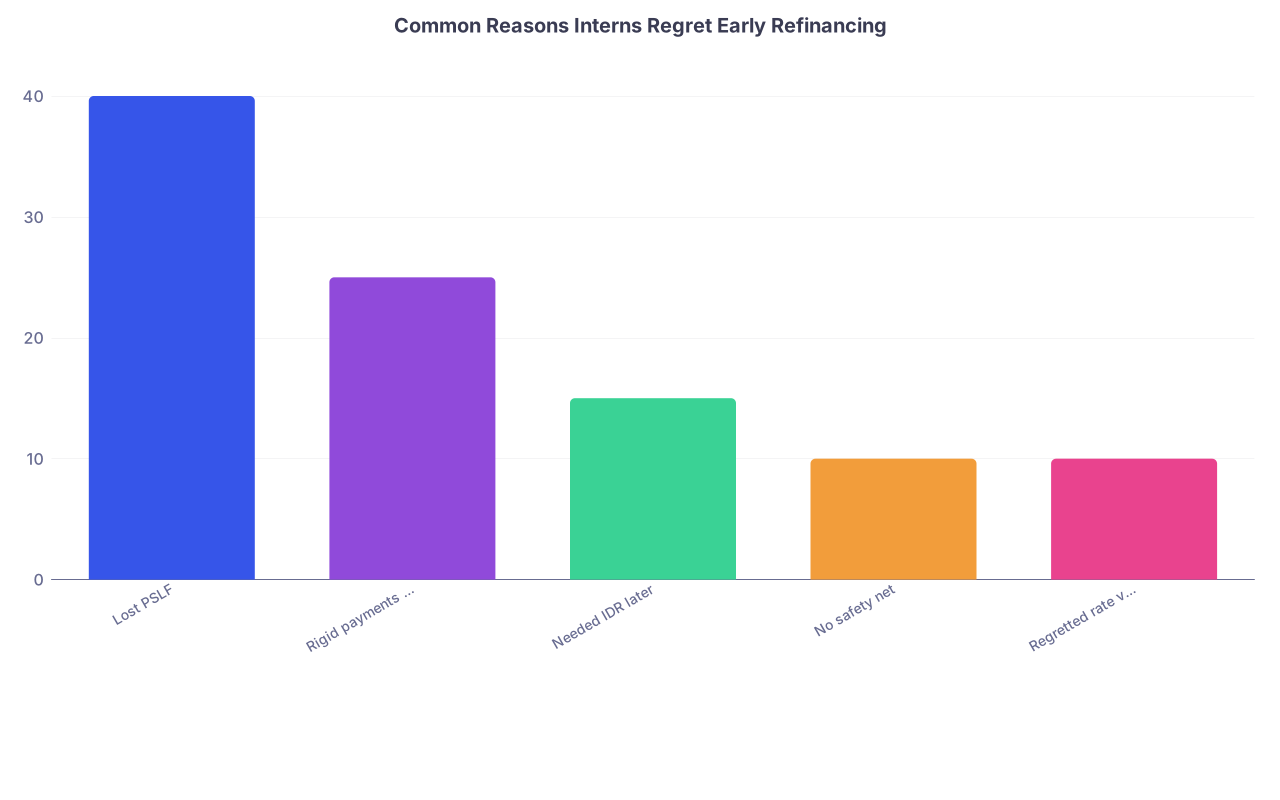
| Category | Value |
|---|---|
| Lost PSLF | 40 |
| Rigid payments during hardship | 25 |
| Needed IDR later | 15 |
| No safety net | 10 |
| Regretted rate vs protections trade | 10 |
The point of this table and chart isn’t to scare you with numbers. It’s to make one thing unavoidable:
The downside risk of early refinancing is massive.
The upside reward (a bit less interest during low-income years) is modest.
Terrible trade.
Subtle Traps and Red Flags You Should Not Ignore
Let me call out the marketing nonsense that trips people up.
Red Flag #1: “Resident-Specific Refinance Programs”
Some lenders now push “resident-friendly” refinance products:
- Very low payments during training
- Interest-only or token flat payments
- Maybe ability to extend term after training
Sounds nice. But remember:
- They’re still private loans
- You still lose PSLF, IDR, and federal safety nets
- The low resident payment sometimes tricks you into not running PSLF math
The fact that they’ve slapped “resident” on the program does not make it safe.
Red Flag #2: “Lower Interest Rate = Always Better”
This one is stubborn.
Yes, paying 4.5% instead of 7% is better if:
- You’re definitely paying the loan to $0
- You’re not eligible for forgiveness
- You don’t need those federal protections
But during training:
- You’re making tiny payments anyway
- In SAVE, unpaid interest may not even be growing the way you think
- PSLF might erase the entire remaining principal and interest before you ever “feel” that 7%
People obsess over interest rate while ignoring forgivable principal. That’s backwards.
Red Flag #3: “I’ll Never Work for a Nonprofit”
I’ve heard this one:
“I’m going private practice derm/ortho/ophtho, no way I’ll be at a 501(c)(3).”
Maybe you’re right. But I’ve seen:
- Private practice plans derailed by:
- Partnership that falls through
- Buyouts by hospital systems
- Burnout leading to job changes
- People switch specialties or subspecialties
- Market shifts that push jobs into large nonprofit systems
If your career path is 80% private-for-profit and 20% “who knows,” I wouldn’t nuke federal protections during intern year. Wait until you’re closer and know more.
A Simple Decision Framework: Should You Refinance During Training?
Use this like a pre-procedure checklist. If any of these are true, do not refinance yet:
- You are not crystal clear on PSLF rules
- You have any chance of working at a nonprofit long-term
- Your total debt is ≥1.5x your expected attending salary
- You might pursue fellowship
- You don’t have 3–6 months of expenses saved
- You haven’t run side-by-side projections:
- IDR with possible PSLF vs
- Aggressive payoff vs
- Refinance as attending

| Step | Description |
|---|---|
| Step 1 | Intern with Federal Loans |
| Step 2 | Learn PSLF rules |
| Step 3 | Stay Federal and use IDR |
| Step 4 | Compare IDR vs refinance as attending |
| Step 5 | Understand PSLF fully |
| Step 6 | Any chance of nonprofit job |
| Step 7 | Debt <= 1.5x expected salary |
| Step 8 | At or near end of training |
If you end up at “Stay Federal and use IDR,” that’s not you being lazy.
That’s you avoiding the mistake everyone thinks is “smart” until the bill comes due.
The One Thing You Should Actually Do This Year
You don’t need to have your entire 10-year student loan strategy locked as an intern.
But you do need a temporary plan that doesn’t close doors.
Here’s what I’d tell any PGY-1 who’s tempted to refinance:
Consolidate to Direct loans if needed
Make sure all your federal loans are Direct, so they’re PSLF eligible and can use the newest IDR (like SAVE).Get on an IDR plan (usually SAVE)
Low payment, PSLF-eligible, best flexibility.Document your employer and payments
Submit the PSLF Employer Certification Form annually if you’re at a qualifying institution. Let time work in your favor while you figure out your long-term path.Build a cash cushion before you think about refinancing
Emergency fund first. Fancy interest rate later.
Then revisit everything near the end of residency or fellowship—when you actually know:
- Where you’re going
- What you’ll earn
- Nonprofit vs for-profit
- Whether PSLF is truly off the table
That’s when a refinance conversation becomes adult-level, not impulsive.
FAQs
1. What if interest is piling up on my federal loans during residency—isn’t that a huge mistake?
Interest piling up feels terrible, but feelings aren’t math. Under plans like SAVE, unpaid interest may be subsidized or not capitalized the way you expect. And if you eventually qualify for PSLF, that accumulated interest might be completely forgiven anyway. The bigger mistake is shortening your time horizon and ignoring possible forgiveness just to feel better about “doing something” immediately.
2. I’m 99% sure I’ll work in private practice—should I still avoid refinancing now?
If you’re truly 99% sure, your future employer type is for-profit, and your debt is not extreme relative to your expected salary, then early refinance might work out. But residency is exactly when that 1% surprises people. My rule: wait until at least the last year of training, confirm your job type and location, compare numbers side by side, then decide. You lose nothing by waiting; you lose a lot by jumping early and being wrong.
3. My co-resident refinanced and seems thrilled—am I missing out?
Probably not. You’re just not seeing their opportunity cost. They may be:
- Ignoring PSLF eligibility they threw away
- Underestimating how valuable flexibility is
- Taking on risk that hasn’t bitten them yet
Remember, early refinancing is like driving uninsured. It feels fine—until the crash. You don’t judge that decision by the days nothing goes wrong. You judge it by the day everything does.
Open your loan servicer account today and answer one question in writing: “If I refinanced all of this to private tomorrow, exactly what protections and options would I be giving up?” If you cannot list them clearly, you are nowhere near ready to refinance.