
The verbal promises you get from HR about loan forgiveness are not benefits. They’re rumors until they exist in writing.
If you’re counting on someone in HR “assuring” you that your loans will be forgiven, you’re setting yourself up for a brutal financial surprise.
Let me walk you through the mistakes I see over and over from smart people who should know better—residents, NPs, nurses, hospitalists, public employees—who thought, “HR said I’m covered,” and then learned they very much were not.
The Core Mistake: Treating HR’s Words Like a Contract
Here’s the blunt truth:
HR’s job is to explain company policies as they exist. They are not your attorney. They do not control federal loan programs. And they are not on the hook when you discover that the “forgiveness” you were promised is actually…nothing.
The most dangerous behaviors I see:
- Accepting a job based on a verbal promise of loan forgiveness without a written clause in the offer letter or contract.
- Assuming “eligible for PSLF” means “your loans will be forgiven.”
- Trusting that because “other people here got forgiveness,” you will too—even if your situation is different.
- Not independently confirming federal loan forgiveness rules, counting on HR to “handle it.”
Here’s the financial landmine:
You can easily make 5–10 years of life and career decisions based on loan forgiveness that never happens. That’s not a small mistake. That’s a “$100,000+ and a decade of planning” mistake.
How Verbal HR Promises Go Wrong (Real Scenarios)
I’ve seen these exact chains of events play out.
Scenario 1: “Our hospital qualifies for PSLF”
You’re a new hospitalist or nurse practitioner. HR says in orientation:
“Don’t worry, we’re a nonprofit 501(c)(3), so your work here qualifies for PSLF. After 10 years, your loans will be forgiven.”
You mentally breathe out: “Okay, I just have to survive 10 years.”
Then the traps:
- You never confirm your loan type. Turns out you have FFEL or Perkins loans that were never consolidated into a Direct Consolidation Loan.
- You don’t submit the Employment Certification Form (ECF) annually, because HR “knows you’re here.”
- The hospital merges with another system or outsources you to a third-party staffing group that isn’t a qualifying employer.
- Ten years later, FedLoan/MOHELA (or whoever is servicing PSLF at the time) tells you:
“You have 32 qualifying payments, not 120.”
HR isn’t writing you a check for the difference. You eat it.
Scenario 2: “We’ll forgive $50,000 of your loans”
A rural hospital, FQHC, or state agency says in the interview:
- “We offer up to $50,000 in loan forgiveness if you commit for three years.”
- “We can usually get people approved, it’s not a problem.”
- “Our doctors and NPs always get this – it’s a great perk.”
You hear: “I will get $50,000.”
What they actually mean is often:
- You may be eligible for a state or federal loan repayment program (NHSC, state LRAP, etc.).
- You still have to apply.
- It’s competitive.
- You must meet specific discipline, site, and service requirements.
- Funding availability changes year to year.
And the killer detail:
If it’s not explicitly in your contract as a guaranteed employer-paid benefit (with a dollar amount and timeline), it’s not guaranteed.
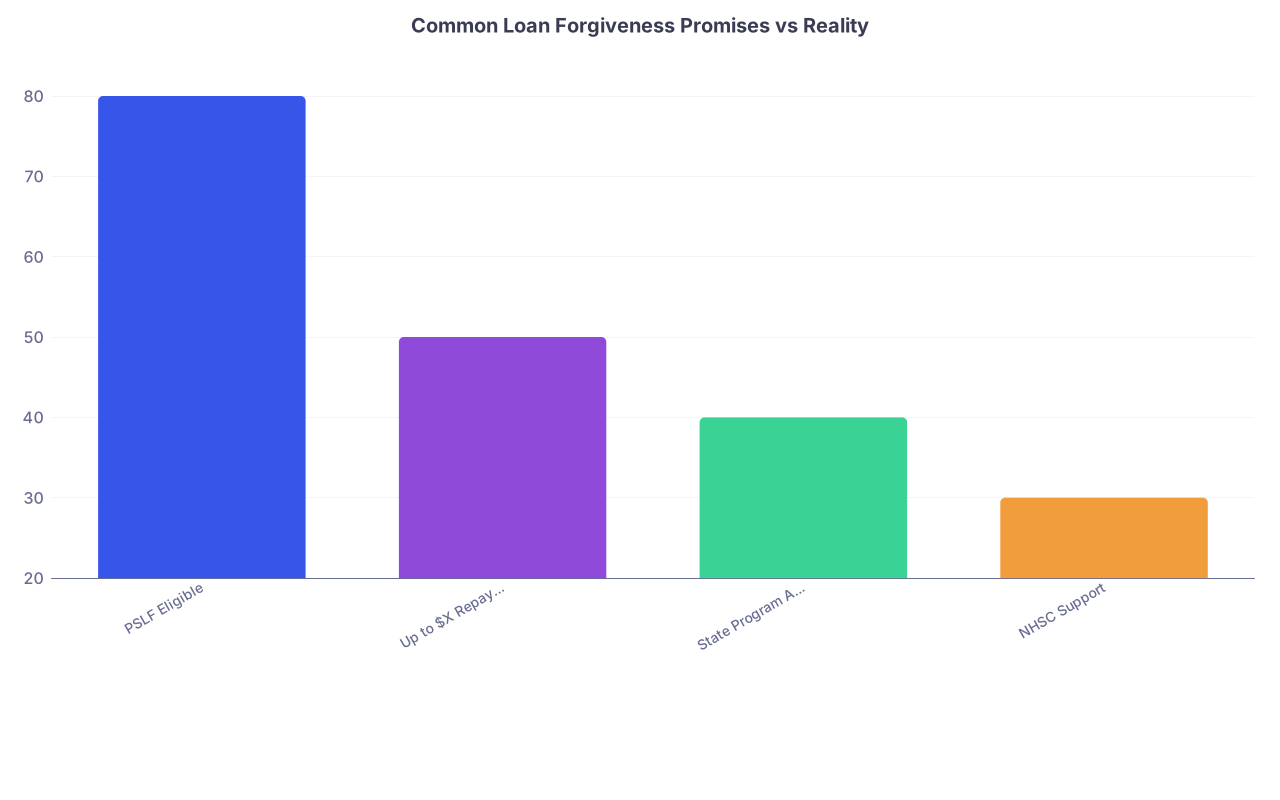
| Category | Value |
|---|---|
| PSLF Eligible | 80 |
| Up to $X Repayment | 50 |
| State Program Access | 40 |
| NHSC Support | 30 |
(Values = rough percentage of times I’ve seen candidates assume something was guaranteed when it absolutely wasn’t.)
Scenario 3: “We’ll cover your loans if you stay”
A small practice or community hospital says:
- “If you stay with us, we’ll help pay your loans down.”
- “We’re working on a loan forgiveness program.”
- “Our board is planning to roll out a benefit soon, you’ll be included.”
You accept the job, lowball your salary expectations (because, hey, “loan forgiveness”) and 3–4 years later:
- The board “decided not to implement” the program.
- The CFO says the budget is tight now.
- Or they offer a token $5,000/year taxable stipend that barely dents interest.
Verbal promises, zero contractual teeth.
HR’s Limits: What They Can’t Control (Even If They Talk Like They Can)
You make a critical mistake when you assume HR controls any of these:
- Federal loan rules (PSLF, IDR forgiveness, TEPSLF)
- State-funded loan repayment program approvals
- National Health Service Corps (NHSC) awards
- Consolidation requirements
- What counts as a “qualifying payment”
- Government policy changes
They don’t.
They can:
- Verify your employer’s tax status (e.g., 501(c)(3))
- Confirm whether your position is full-time and W-2
- Tell you if the organization has its own loan repayment benefit program
- Sign the employment certification form
They cannot:
- Guarantee you will receive federal forgiveness.
- Promise you’ll be approved for a competitive grant-based repayment program.
- Make loan servicers count payments that don’t meet technical criteria.
HR people are often well-meaning but misinformed. I’ve heard wild stuff like:
- “Any payment you make while you work here counts toward PSLF.” (Not if your loans and plan don’t qualify.)
- “You don’t have to be full-time for PSLF.” (Wrong under standard rules.)
- “Your forbearance time still counts because you work in public service.” (Absolutely false.)
- “We’re a government contractor; it’s basically the same as PSLF.” (No. It’s not.)
When you rely on that as the foundation of your financial life plan? That’s the mistake.
The Technical Traps People Ignore (Until It’s Too Late)
Here’s where people blow it: tiny PSLF and forgiveness rules they never personally check.
1. Wrong loan type
You can work 10 years at a qualifying employer and still not qualify if:
- Your loans are FFEL or Perkins and you never consolidated into a Direct Consolidation Loan.
- You have private loans (no forgiveness there, no matter who you work for).
2. Wrong repayment plan
People assume: “As long as I’m paying, it counts.”
Not true.
Under standard PSLF rules, qualifying payments must be made on:
- An income-driven repayment plan (IBR, PAYE, REPAYE/SAVE, ICR)
- Or the 10-year Standard plan
If you’re in:
- Graduated
- Extended
- Or using forbearance/deferment
You might be racking up non-qualifying months.
3. Employer status shifts
This one burns people badly:
- Hospital merges and your paycheck now comes from a for-profit affiliate.
- You’re technically employed by a physician group or staffing company, not the nonprofit hospital.
- You shift to PRN/part-time and fall below qualifying hours.
HR might say “nothing changes” or “we’re still the same hospital.” For benefits, maybe. For PSLF? Totally different question.
4. Documentation gaps
If you don’t:
- Submit PSLF Employment Certification Forms regularly
- Keep copies of W-2s, contracts, and offer letters
- Download records of payment history
You’re trusting that 8–10 years later, a loan servicer’s database will be perfect and your employer’s HR records will still exist.
That’s naive. And expensive.
How to Verify Forgiveness Claims Without Getting Burned
Here’s how to avoid being the person saying “HR told me…” while staring at a six-figure bill.
Step 1: Separate employer benefits from federal programs
Two different beasts:
Employer-based loan repayment/forgiveness
- Written in your contract or HR handbook
- Paid for by your employer
- Might be taxable income
- Example: “$20,000 per year for 3 years toward federal loans”
Federal or state forgiveness programs (like PSLF, NHSC, state LRAP)
- Controlled by government agencies
- Require applications and eligibility review
- Not guaranteed just because you work somewhere
Never let someone blur these together into “we have great forgiveness here.”
| Aspect | Employer Repayment Benefit | PSLF (Federal Program) |
|---|---|---|
| Who pays | Employer | Federal government |
| Where it's defined | Contract/HR policy | Federal law/regulation |
| Guaranteed if in writing? | Yes, if contractual | No, must meet all rules |
| Tax treatment | Often taxable | Forgiven balance tax-free |
| Who enforces it | Contract law | Department of Education |
Step 2: Demand written proof for employer promises
If HR says: “We offer $X of loan forgiveness,” your response should not be:
“Okay, great.”
It should be:
- “Can you please send me the written policy or benefit summary?”
- “Will this be written explicitly in my offer letter or contract?”
- “Is there any clawback requirement if I leave early?”
If they:
- Won’t put it in writing
- Say “we don’t usually formalize it like that”
- Or vaguely promise “we’ll see what we can do later”
That is your red flag. You cannot build a financial plan on that.
Step 3: Independently confirm PSLF or other federal program rules
You should personally:
- Check your loan types and status on studentaid.gov
- Confirm that your employer shows up as qualifying on PSLF resources or via Employment Certification
- Enroll in a qualifying repayment plan
- Use the official PSLF Help Tool (not an HR pamphlet)
- Submit Employment Certification at least annually
If anything HR says conflicts with government documentation? Believe the government site. Not the benefits coordinator who “thinks it still works that way.”
Psychological Traps: Why Smart People Fall for HR Promises
You’re not dumb. This stuff preys on entirely human biases.
1. Hope > details
You hear “loan forgiveness” and your brain stops asking hard questions. You want it to be true, so you gloss over the fine print, conditions, and legal reality.
2. Authority bias
HR speaks with confidence. They have badges, branded slides, polished benefits presentations. So they must be right. Except… they’re often just repeating outdated or incomplete information.
3. Social proof
You hear:
- “Oh, my coworker said theirs will be forgiven too.”
- “Our last resident class was told the same thing.”
So you assume it’s legit. But no one you talk to has actually completed forgiveness and seen a $0 balance letter. They’re all just repeating the same promise down the line.
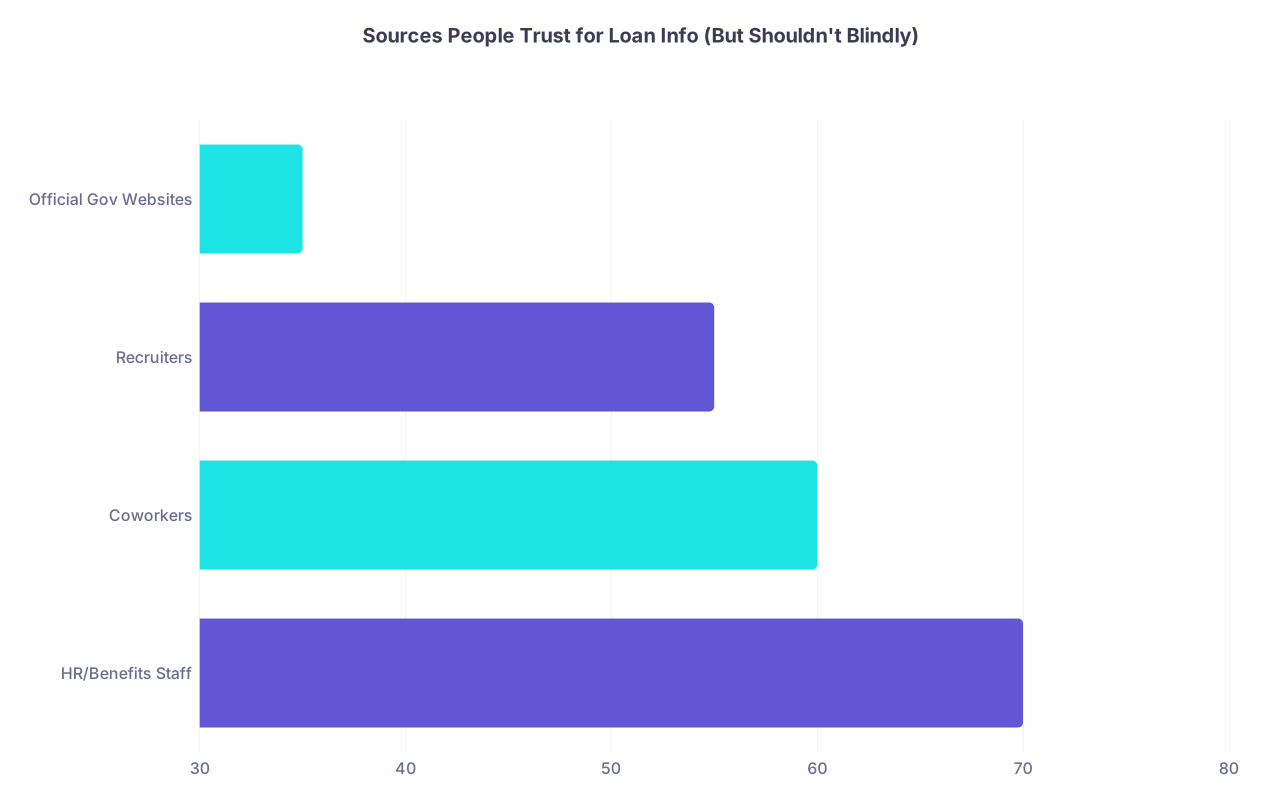
| Category | Value |
|---|---|
| HR/Benefits Staff | 70 |
| Coworkers | 60 |
| Recruiters | 55 |
| Official Gov Websites | 35 |
(The problem isn’t using HR or coworkers as a starting point. It’s treating them as final authority.)
Red Flags You’re Being Sold a Story, Not a Guarantee
Learn to spot the language that should make you stop and demand proof.
Phrases like:
- “We typically see people get…”
- “You should qualify for…”
- “We’re a nonprofit, so everyone gets PSLF.”
- “We’re working on a program you’ll be eligible for.”
- “We buddy up with [state program] to get people forgiveness.”
- “It’s never been a problem for anyone here.”
None of those are commitments. They’re vibes.
If they won’t:
- Name the exact program.
- Show you written eligibility criteria.
- Put concrete numbers and timelines in your contract.
…you treat it as nice-to-have, not guaranteed.
How to Protect Yourself Before You Sign Anything
Here’s the protection playbook you actually need.
1. For employer repayment programs
Before you sign, you should have:
- A written clause in your offer or contract with:
- Exact dollar amount or formula
- Payment schedule (e.g., $10k/year for 3 years)
- Any minimum employment period
- What happens if you leave early (clawback?)
- A copy of any HR policy document describing the benefit
If it’s not in writing, it does not exist.
2. For PSLF hopes
Your checklist should look like this:
- Loans are Direct Loans (or you’ve consolidated into Direct Loans)
- You’ve enrolled in a qualifying IDR plan
- Your employer is a qualifying PSLF employer (nonprofit 501(c)(3) or eligible government)
- Your employment is full-time per PSLF definition
- You’ve submitted an Employment Certification Form and received confirmation of qualifying months
You do not rely on HR’s word that “we’re PSLF-eligible.” You verify.
3. For state or NHSC-type programs
Do not assume “we’re an NHSC/State site” means “you will get funded.”
You must:
- Look up the exact program (NHSC LRP, SLRP, state LRAP, etc.)
- Read the latest eligibility rules and funding caps
- Understand it’s competitive and subject to funding cycles
- Recognize you often apply after working some time at the site
Employer designation ≠ your personal award.

| Step | Description |
|---|---|
| Step 1 | Hear HR Loan Promise |
| Step 2 | Request written policy and contract clause |
| Step 3 | Identify federal or state program name |
| Step 4 | Benefit is real |
| Step 5 | Assume not guaranteed |
| Step 6 | Verify rules on official website |
| Step 7 | Check your loans and status |
| Step 8 | Reasonable to plan for |
| Step 9 | Do not rely on forgiveness |
| Step 10 | Is it employer paid? |
| Step 11 | Is it in contract? |
| Step 12 | All criteria met in writing? |
The Ugly “I Trusted HR” Outcomes
To be absolutely clear on what you’re trying to avoid:
- Residents reaching year 10 and realizing they have half the PSLF-qualifying payments they thought.
- NPs who took a lower-paying “public service” job and find out their loans weren’t even the right type.
- Hospitalists who were promised $30k/year in repayment, only to see it cut after year one due to “budget constraints” because it was never contractually guaranteed.
- Nurses told their “hardship forbearance” months would still count toward PSLF. They don’t.
All because they treated verbal HR assurances as if they were binding commitments.
They aren’t.
Your Next Move: What To Do Today
Do not wait until “later” to clean this up. Every month you’re operating under false assumptions is a month you might be losing real money.
Here’s what you can do today:
Pull your federal loan info from studentaid.gov and see:
- Loan types
- Servicer
- Repayment plan
If you’re already employed and counting on forgiveness:
- Request your HR department’s written policy on any loan repayment benefit.
- Ask them to confirm employer type (501(c)(3), government, for-profit, contractor).
If you’re in the middle of a job search:
- Go back to any employer who mentioned “loan forgiveness” and ask for:
- Written documentation
- Exact program names
- Clear contract language
- Go back to any employer who mentioned “loan forgiveness” and ask for:
Submit (or resubmit) your PSLF Employment Certification Form and get your qualifying payments count in writing.
Then open your current or pending job offer and highlight every line that mentions loans. If the “forgiveness” you’re relying on isn’t there in black and white, treat it as marketing fluff, not money in the bank.
FAQ (Exactly 4 Questions)
1. HR told me we’re a PSLF-eligible employer. Isn’t that enough?
No. “PSLF-eligible employer” is only one piece. You still need the right loan type (Direct Loans), a qualifying repayment plan, full-time qualifying employment, and 120 qualifying payments documented through the PSLF process. HR can be wrong about their own eligibility, and they have zero authority over your loan structure or payment plan. Use the PSLF Help Tool and Employment Certification Form to verify everything officially.
2. My offer letter mentions “eligibility for loan forgiveness programs.” Am I safe?
That phrase is basically legal wallpaper. It usually means “our organization participates in or qualifies for certain programs” – not that you are guaranteed any specific amount. Safe is: “Employer will pay $X per year toward employee’s qualifying student loans, for Y years, subject to Z conditions,” in your signed contract. Anything vaguer than that is not something you should bank on.
3. The recruiter said other employees have had their loans forgiven. Should I trust that?
You can believe it as an anecdote, not as a guarantee for you. Did those employees have the same loan type? Same hours? Same repayment plan? Same years of service? Same program rules at that time? Policies change. Laws change. Their situation is not your contract. You only trust what’s written and applicable to your exact circumstances.
4. What’s the single biggest sign I shouldn’t rely on a loan forgiveness promise?
Simple: they won’t put it in writing with clear numbers and conditions, or they can’t show you an official program description from a government site. If all you’re getting are phrases like “up to,” “typically,” “you should be fine,” or “we’re working on it,” that’s your warning siren. Until it’s in a contract or on an official government page that you’ve matched to your own loans and status, it’s just talk.
Go pull your latest offer letter or contract right now. Circle every reference to loan forgiveness or repayment. If the details you’ve been telling yourself are “guaranteed” aren’t actually there, you just found your first mistake to fix.