
Last December, during a contract review meeting, a CFO slid a folder across the table to a freshly graduated fellow. On top: a neat little spreadsheet labeled “Debt-to-Income Risk.” The fellow laughed and said, “You guys check my loans too?” The CFO didn’t laugh back.
If you think hospitals are blind to your student loan burden, you’re living in 2005. Behind closed doors, your debt load is getting modeled, stress-tested, and occasionally used as quiet leverage—especially once you’re past residency and stepping into attending territory.
Let’s pull the curtain back.
What Hospitals Actually Know About Your Loans
First myth to kill: “They have no way of knowing my loan situation.” That’s not true once you move from trainee to employee-physician.
As a med student or resident, most hospitals honestly don’t care about your loans beyond wellness and retention. But when they’re hiring attendings or long‑term faculty? Very different game.
Here’s what they can see or infer, even if you never hand them a loan statement:
Your credit profile (with consent).
For many attending offers, especially with a signing bonus, relocation package, or loan “repayment,” HR will run a background check that often includes a credit pull. That doesn’t give them every detail of your repayment plan, but it tells them:- Total student loan balance ballpark
- Payment status (current, delinquent, in default)
- Other debts (credit cards, car loans, mortgage)
Your likely debt range based on your training path.
Program and department leadership know exactly what typical debt loads look like by:- Med school type: private vs public, DO vs MD, Caribbean vs US
- Graduation year: debt trends are well‑known; they’ve been climbing for years
- Your CV: extra degrees (MBA, MPH, PhD), gap years, military scholarships, NHSC, etc.
Your earning potential versus specialty‑typical debt.
They’re not just thinking “this person has $380k in loans.” They’re thinking: “$380k on a hospitalist salary vs $380k on ortho pay.” One makes them nervous. The other, not so much.Your risk markers:
- Late payments or collections
- Prior bankruptcies (yes, they know)
- High total revolving debt compared to income
All of this colors how leadership views you as a risk—financially and professionally.
They don’t need to see your servicer login to “assess” your student loans. They triangulate from what they already see.
Why Hospitals Care About Your Student Debt (Even If They Never Say It)
Let me be blunt: hospitals are not worried about your financial wellness out of pure altruism. They care because your loan burden affects:
- Retention risk: Are you going to bolt in 2 years for a higher-paying job in Texas or a corporate telemed gig?
- Burnout risk: Crushing debt plus modest salary equals higher burnout, higher turnover.
- Malpractice risk: Financial stress can correlate with cutting corners, overwork, distraction. They know it, even if they won’t put it in writing.
- Negotiation leverage: Your debt anxiety is a powerful motivator—and they do use it.
Some systems, especially large academic and nonprofit employers, quietly model all this. They don’t publish it, but the conversations absolutely happen in C-suite rooms and physician comp committee meetings.
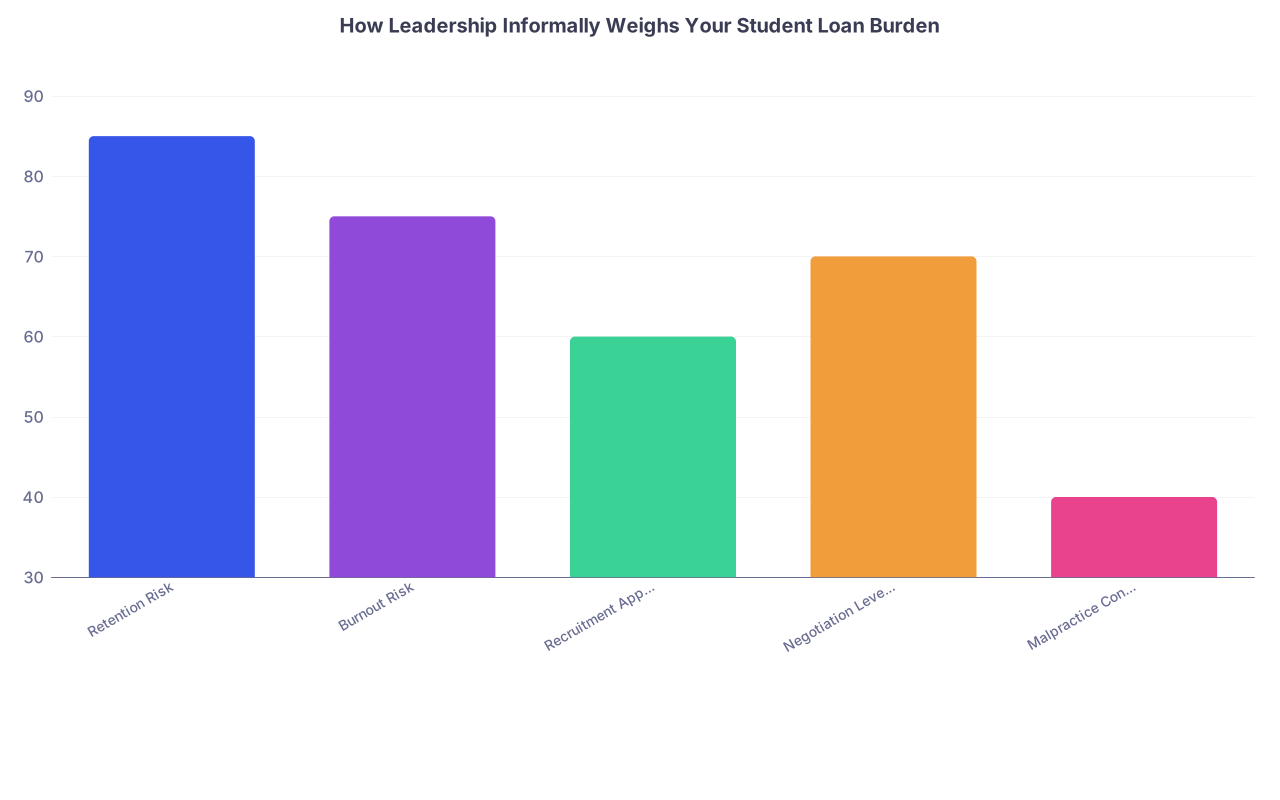
| Category | Value |
|---|---|
| Retention Risk | 85 |
| Burnout Risk | 75 |
| Recruitment Appeal | 60 |
| Negotiation Leverage | 70 |
| Malpractice Concerns | 40 |
That bar chart is basically the unspoken priority list in admin meetings. Retention and burnout always dominate.
The Quiet Metrics: Debt-to-Income, Stability, and “Flight Risk”
Nobody sits you down and says, “We’re concerned your debt-to-income is too high.” But internally? Some finance departments absolutely talk like that.
The usual internal metrics they kick around:
Debt-to-Income Ratio (DTI)
They’re not calculating it line by line, but they’re mentally mapping: “This person makes $260k, probably has ~$350k in loans, probably not on track to be debt-free before 45 without pain.”In low-paying specialties (peds, FM, psych, academic IM), high DTI is a red flag for:
- Higher likelihood of leaving for private practice or locums
- Pressure for more moonlighting, which can hurt availability and performance
Payment Behavior = Responsibility Signal
If a credit pull shows:- Consistently current student loans → tends to be interpreted as “responsible, stable”
- Multiple late payments or default → “potential chaos, possible distraction, maybe trouble”
It’s not fair. But those snap judgments happen.
Geographic Stability vs Debt Obligation
For rural or underserved sites, admin will quietly ask:- “This doc has massive debt and two kids in private school. Do we really think they’ll stay in this town of 40,000 for more than a contract cycle?”
- “We’re offering $250k. With that debt, this job might just be a stepping stone.”
PSLF and 501(c)(3) Status
At nonprofit hospitals, your PSLF eligibility becomes retention gold. If you’re:- 3–5 years into PSLF when you join
- Fully documenting qualifying payments
They know you’re handcuffed for at least a few years, maybe the full 10. They like that. A lot.
So yes, your loans are silently part of the risk assessment of you as a long-term hire.
Loan Repayment “Benefits”: What They’re Really Calculating
Those shiny recruitment flyers bragging about “Up to $200,000 in Student Loan Repayment”? You are not the only one doing math. They are too.
Behind closed doors, the conversation goes more like this:
“Okay, if we stack $40k/year of loan repayment on top of a $230k base for 5 years, is that enough golden handcuff for this specialty in this region?”
They’re not being generous. They’re buying your inertia.
| Scenario | Internal Thought Process |
|---|---|
| No repayment | "We will lose them in 2–3 years unless salary is high." |
| $20k/year for 3 years | "Decent, but they can still walk after paydown bump." |
| $50k/year for 5 years | "Strong handcuff, likely stay through at least one renewal." |
| PSLF-eligible + moderate salary | "Built-in retention for 6–8 years if they understand PSLF." |
| One-time $100k bonus | "Looks big, but low long-term effect unless clawbacks." |
Three insider truths most applicants never realize:
They prefer structured annual loan payments over pure salary.
Why? Because:- They can tie it to staying year after year.
- It looks good on recruitment ads.
- It’s easier to cut or “pause for budget reasons” than base pay.
They often structure repayment with clawbacks.
Leave early, and:- You owe back all or part of the “loan repayment.”
- Or it vests over time, so you lose unvested installments.
This is not accidental. It’s retention engineering.
They model how desperate your debt makes you.
A candidate with low or no debt is more likely to walk from a bad offer.
A candidate drowning in loans is more likely to accept a slightly abusive schedule, under-market salary, or vague promises of future raises.
Executives know this dynamic. Some exploit it more than others.
How This Changes From Med Student → Resident → Attending
Different phase, different lens. Let me walk you through how conversations actually sound behind the scenes.
As a Medical Student
Most hospitals don’t individually assess your debt yet. GME offices are thinking:
- “Our students are stressed about loans; we should have a lunch talk on REPAYE and PSLF.”
- “Can we advertise ‘PSLF-eligible’ to help recruitment from private schools?”
They’re using your debt collectively as a marketing tool, not as a risk metric on you personally.
But I’ve sat in dean’s meetings where someone flat-out said, “If we add $10k to annual tuition, will we still match enough students into our affiliated residency because PSLF will bail them out eventually?”
So your future hospital may have already exploited your willingness to tolerate debt before you even step on the ward.
As a Resident
GME programs care less about your absolute debt and more about one thing: will debt push you to leave?
Example conversations I’ve heard almost word-for-word:
- “He’s talking a lot about moonlighting and his $500k in loans. I’d be surprised if he stays academic; he’s gone to private practice the second he can.”
- “She’s very focused on PSLF and working here long term. Might be a good candidate for a chief role or junior faculty path.”
Debt shows up in resident evaluations indirectly as “maturity,” “stability,” or “distracted and financially overwhelmed.”
If you’re behind on payments or talking constantly about default, that gets around. PDs, APDs, chiefs—people talk. Quietly, but they talk.
As an Attending Candidate
Now the gloves come off. Finance and HR do a much colder analysis.
They look at:
- Your specialty market value locally and nationally
- Their need (desperate vs optional hire)
- Your likely debt (based on age, degree, med school, training path)
- How badly you “need” them vs how badly they need you

| Step | Description |
|---|---|
| Step 1 | Review CV |
| Step 2 | Estimate Debt Level |
| Step 3 | Higher Retention if Paid Fairly |
| Step 4 | May Have More Mobility |
| Step 5 | Low Flight Risk |
| Step 6 | Watch for Early Departure |
| Step 7 | High or Low Debt |
| Step 8 | Market Value vs Offer |
Nobody says, “We like that you’re financially trapped.” But when you’re:
- High debt
- Limited geographic flexibility (spouse/job/kids)
- PSLF-dependent
…you are, from their standpoint, an excellent long-term bet—as long as they’re not absurdly underpaying you.
PSLF, Nonprofits, and the Retention Game
Here’s one of the biggest unspoken truths: some nonprofit hospitals know exactly how to weaponize PSLF to keep you put.
If your loans are:
- Federal
- Substantial (let’s say >$200k)
- On an income-driven repayment plan
…then a 501(c)(3) hospital with a modest-but-stable salary has a huge advantage. Administrators know:
- After 5 years of PSLF-qualifying payments, you’re very unlikely to walk away from that progress.
- They don’t need to compete dollar-for-dollar with private groups. PSLF closes the gap for you.
- If you don’t understand PSLF, they can “educate” you in a way that aligns you with staying long term.
I’ve watched leadership do back-of-the-envelope math in meetings:
“Okay, this candidate has $400k in federal loans. If we bring them in at $240k salary and they stay here 7–8 years, PSLF will wipe out what they can’t pay. That’s worth more to them than a $290k private practice job with no PSLF. We don’t need to match private salaries.”
They are not wrong. But they will rarely say all that out loud.
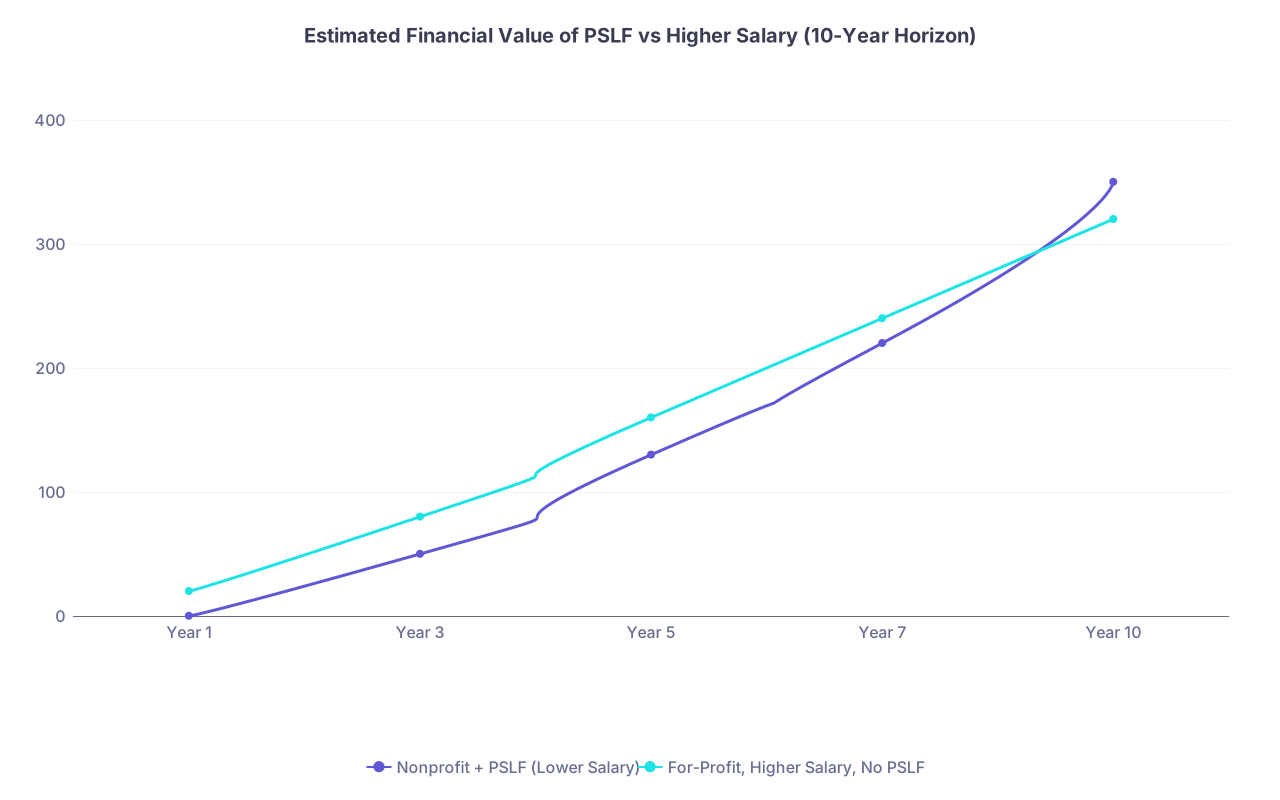
| Category | Nonprofit + PSLF (Lower Salary) | For-Profit, Higher Salary, No PSLF |
|---|---|---|
| Year 1 | 0 | 20 |
| Year 3 | 50 | 80 |
| Year 5 | 130 | 160 |
| Year 7 | 220 | 240 |
| Year 10 | 350 | 320 |
That kind of mental comparison is exactly what they’re doing. The X-axis is time; the Y-axis is total “economic value” to you. They know PSLF can outcompete raw salary over a decade.
How Your Loan Burden Affects Negotiations (If You Let It)
Let me say this clearly: the more emotionally you negotiate from fear of your loans, the worse deal you will sign.
This is where insider knowledge helps.
Here’s what happens behind closed doors when you reveal too much desperation:
You say in the interview:
“I’ve got like $450,000 in loans. Honestly I just need stability and loan help.”
Admin hears:
“We can offer a slightly below-market base, slap on a 3-year $25k/year loan repayment, call it a ‘$75k loan forgiveness package’ on the brochure, and they’ll probably sign.”
Better approach:
- Speak from value, not desperation.
- Treat loan repayment as icing, not the cake.
- Negotiate base first, then loan repayment as an additional lever.
Because once they smell panic? The leverage flips.
What You Should Actually Do With This Knowledge
You’re not going to change how hospitals think. But you can change how you present and protect yourself.
Clean up your credit before major job searches.
Late payments on student loans look bad. If you’re in residency:- Get onto an IDR plan that gives you predictable, affordable payments.
- Don’t play games with forbearance roulette if you can avoid it.
Stop oversharing your exact loan numbers in early interviews.
Saying you “have the usual med school debt” is enough. You don’t need to announce, “$517k and counting.”
Save specifics (if useful) for late-stage negotiation when you’re asking for targeted loan benefits.Use PSLF strategically, not passively.
If you’re in a PSLF-eligible environment:- Certify employment every year.
- Keep meticulous records.
- Recognize the retention shackle—and decide if you’re comfortable wearing it for 8–10 years in exchange for forgiveness.
Evaluate offers with both salary and loan context—but don’t tell them your internal math.
You can privately calculate:- Take-home after federal loans on IDR
- Time to forgiveness vs time to payoff
Without turning your negotiation into, “Please save me, I’m drowning.”
Watch the fine print on “loan repayment” clauses.
Look for:- Clawback language
- Vesting schedules
- Whether they pay directly to servicers or to you (tax implications)
- Whether it stops if budgets tighten
You’re not just a workforce unit with a debt profile, even though some admin treat you that way. But ignoring how they’re thinking is naive.
FAQs
1. Do hospitals actually run my credit before hiring me as an attending?
Often, yes—especially if there’s a significant signing bonus, relocation assistance, or loan repayment. It’s usually part of a broader background check you consent to. They’re looking at overall financial responsibility and stability, not just your student loans, but your loans are part of that picture.
2. Can my residency program see my specific loan balances or payment history?
Not directly. They don’t have automatic access to your servicer data. But if you volunteer details, apply for institutional hardship funds, or ask for documentation for forbearance/IDR recertification, pieces of your situation can become known. And residents talk; PDs often hear who’s financially drowning.
3. Will high student loan debt hurt my chances of getting hired?
High debt by itself rarely blocks hiring—medicine is full of high-debt physicians. What hurts you is visible mismanagement: defaults, repeated delinquencies, chaotic credit history. That raises concerns about reliability and stress, which absolutely can factor into final decisions when it’s a close call between candidates.
4. Should I tell employers I’m counting on PSLF when I choose a job?
You can mention you “value nonprofit, PSLF-eligible institutions,” but I wouldn’t frame yourself as PSLF-dependent. If they know you’re locked in for 10 years no matter what, they feel less pressure to improve compensation or conditions. Use PSLF as a personal strategic tool, not as a bargaining crutch.
5. Is hospital-provided loan repayment usually worth it, or is it a trap?
It can be very worth it—but only if you understand the strings. Multi-year commitments, clawbacks, and below-market base pay can turn “$150k loan repayment” into a retention cage that’s hard to leave. Compare total compensation (base + benefits + loan help) against what you could get elsewhere, and factor in the value of PSLF if applicable. Sometimes their “miracle loan repayment” is just a cheaper way for them to underpay you for years.
Key points: hospitals absolutely think about your student loan burden, even if they never say it out loud; your debt can be both a vulnerability and a form of leverage, depending on how you handle it; and the smartest move is to manage your loans tightly, control how much you reveal, and treat loan repayment offers as tools—not lifelines.