
Last winter, a new hospitalist pulled me aside after sign-out, eyes still half in night float mode. “My chair told me not to worry, ‘the PSLF fairy will handle it,’” she said, “but the private group across town is dangling 450k plus a so-called ‘loan bonus.’ I’m drowning in 380k of debt. Who’s lying to me?”
Let me ruin the magic trick for you: both sides are spinning you. Not maliciously. But very much in their own financial interest.
You’re told to think about “mission,” “fit,” “autonomy,” “academic reputation.” Meanwhile, the people actually building the budgets—department chairs, CFOs, private group partners—are thinking about a different equation: how your loan fear drives you to accept less money, more work, or longer commitments than you should.
You want to know how they actually think about your loan stress? Pull up a chair.
The Quiet Math Behind Your Panic
Before we talk academic vs private, understand the lens they’re looking through.
You see $300–600k of debt and 7–8% interest. They see:
- A lever to make you accept lower starting salaries.
- A reason you’ll stay put even when the job is mediocre.
- A way to package “benefits” that are cheaper to them than actual cash.
In internal comp meetings, this sounds like:
- “We can keep starting salary flat; they’re all chasing PSLF anyway.”
- “They’re debt-heavy; they’ll value stability and forgiveness over a higher but variable comp.”
- “Offer a $25k sign-on, call it a loan bonus, and cap base pay lower.”
No one says this in front of you. They say, “We really value work–life balance.” The spreadsheet says something else.
Now, let’s split the world in two: academic systems and private groups. They look at your loan stress very differently.
How Academic Centers Really View Your Debt
In academic medicine, the official narrative is: “We know you’re drowning in debt. Come here, do good, and PSLF will rescue you.”
Here’s the uncomfortable truth: PSLF is the single strongest physician retention tool academic centers have ever been handed—by the federal government, for free.
PSLF: Their Golden Handcuffs, Not Your Safety Net
Inside academic budget meetings, PSLF is not just a perk. It’s a strategy.
I’ve sat in meetings where chairs or finance people say versions of:
- “Our comp is 80–90% of community, but PSLF makes up the gap.”
- “If we keep them seven to ten years, they’ll be hooked on forgiveness and won’t go to private practice.”
- “We don’t need to beat private salaries; we just have to be ‘PSLF competitive.’”
You’re told PSLF is a gift. They’re using it as discounted payroll.
Because look at their math:
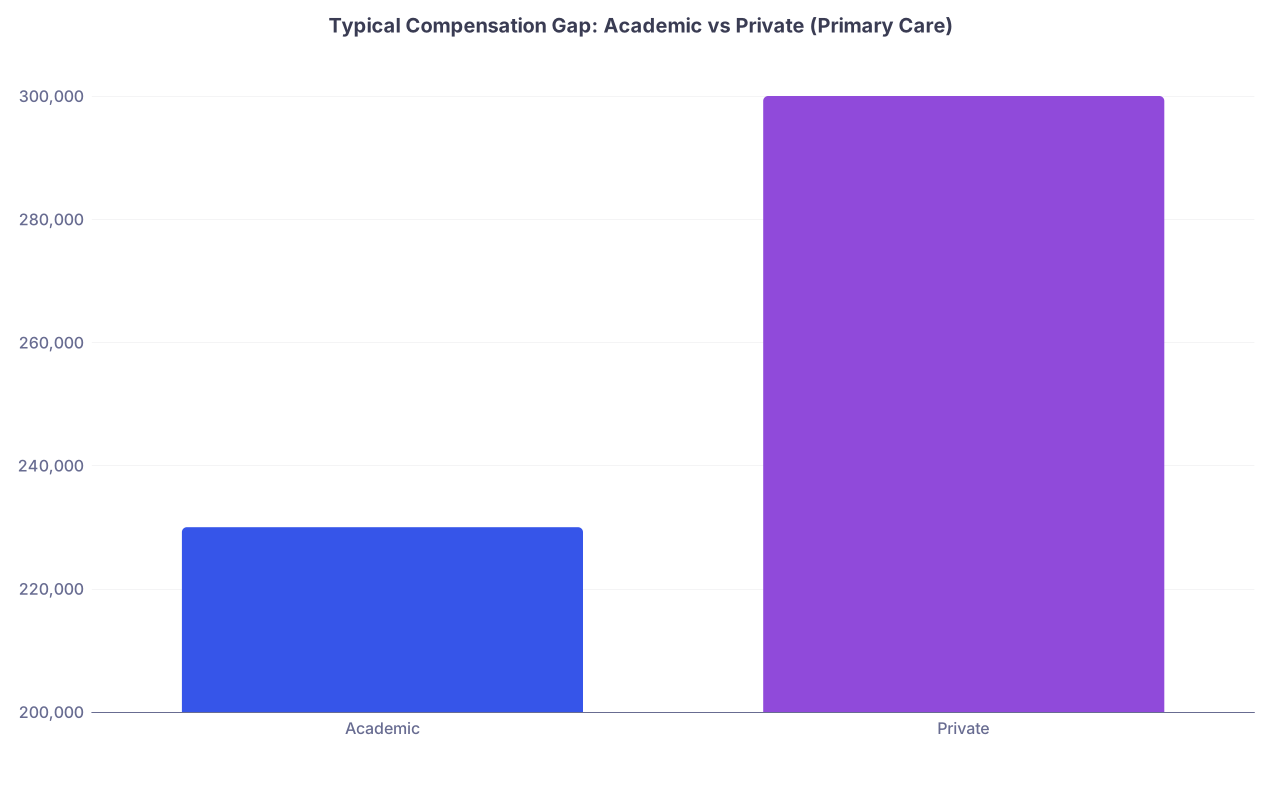
They can pay you $40–80k less per year than a comparable private job, and PSLF + “public service mission” is supposed to cover the gap. Over 10 years, that’s hundreds of thousands in lower salary… subsidized by your patience and federal rules.
| Category | Value |
|---|---|
| Academic | 230000 |
| Private | 300000 |
Now add your debt. If you owe $400k and are on IDR with PSLF, your anxiety effectively ties you to them for a decade. They know it.
They’re not evil. They’re rational.
What They Actually Track About Your Loans
Academic systems usually don’t see your actual loan file. They do track debt-related behavior in aggregate. Here’s what administrators quietly ask advisors and GME leadership:
- “What percentage of our residents are planning PSLF?”
- “How many are switching to REPAYE/ SAVE and using the faculty plan?”
- “Do we need to hold PSLF info sessions to improve retention?”
That last one’s big. Many institutions will host “student loan experts” to talk about forgiveness and IDR. Altruistic? Partially. But those sessions are also subtle retention campaigns: “Don’t leave. PSLF is here. Stay in our system.”
The script goes like this:
- You show up at an academic job with $350k in loans.
- HR arranges a PSLF webinar.
- You consolidate, choose SAVE/IBR, certify employment, and emotionally commit to the 10-year finish line.
- Year 4 or 5, a private group offers you 150k more. You think, “If I leave, I lose PSLF progress.” You stay.
The chair never had to match the offer. Your sunk cost mindset did the work for them.
Misleading Comfort: “Don’t Worry, PSLF Will Fix It”
Another quiet pattern: leadership casually hand-waving your anxiety.
I’ve heard department heads say, “You’re all going for PSLF anyway, right?” during faculty meetings. That’s not support. That’s assumption—and strategic.
They:
- Underpay relative to RVU production.
- Offer “loan counseling” instead of actual loan repayment money.
- Emphasize PSLF security to justify lower raises and promotions that move at a glacial pace.
And some of them don’t actually understand the details of PSLF, yet they sell it confidently. That’s dangerous. For you.
Because PSLF only works cleanly if:
- Your employer is a qualifying 501(c)(3) or government entity.
- Your loans are Direct or properly consolidated.
- You’re on a qualifying IDR plan.
- You keep up with paperwork and don’t screw up during transitions.
Notice how none of that is the institution’s legal responsibility. But they’ll happily market it as if it’s guaranteed.
How Private Groups Really View Your Debt
Now flip to private groups. They don’t get PSLF as a retention tool. So they do something else: they weaponize your fear of missing out on PSLF and your desperation for higher pay.
In private meetings, physician-owners will say things like:
- “They’re PSLF-wired; we need to overcome that anchor with a signing bonus.”
- “They have 500k in debt, they’ll chase high comp—even if the workload’s nasty.”
- “Talk to them about after-tax income; PSLF doesn’t look as magical when the actual net is compared.”
Private groups understand incentives. And they know your loans are both a vulnerability and a motivator.
The “Loan Repayment” Sleight of Hand
A lot of private groups and hospitals attached to them will advertise “loan repayment” without explaining the structure.
Behind the scenes, it typically looks like this:
- A bonus paid annually, contingent on you staying.
- Taxable like normal income.
- Often offset by lower base or RVU rates than they could have offered.
So you’ll see an offer letter that says:
- Base: $280k
- Loan repayment: $25k/year for 4 years
- Actual capacity if they skipped the “loan” language? Often something closer to $310–320k base or richer RVU rates.
They frame it as generosity. In partner meetings, it’s more like, “Let’s lock them in with a forgivable loan or clawback bonus.”
You’ll hear phrases like:
- “Structure it as a forgivable loan so if they leave at 18 months, we’re protected.”
- “Don’t just raise base; we want hooks.”
That’s what “loan repayment” is to them: a hook, not a gift.

Buy-In and Your Debt: A Calculated Delay
Private groups eye your debt when they think about partnership track.
If you come in with $400–600k in loans, they assume:
- You’ll tolerate a rough early workload to get to partner money.
- You probably can’t pony up a huge buy-in quickly, which buys them time to evaluate you.
- You’re less likely to walk away if there’s a big buy-in carrot dangling in year 3–5.
The internal talk:
- “She’s got big loans; she’ll stick it out for partnership.”
- “We can make the buy-in mostly sweat equity; that keeps early guarantees lower.”
- “Don’t need to overpay; let the promise of 700k down the road work for us.”
Your debt, again, is a behavioral prediction model for them.
Academic vs Private: How They Really Compare on Loan Stress
Strip away the glossy brochures and “mission statements.” When it comes to your loan stress, each side plays a very different game.
| Dimension | Academic Centers (501c3) | Private Groups |
|---|---|---|
| Primary leverage | PSLF + job stability | Higher pay + bonuses/buy-in |
| Typical narrative | “Stay for forgiveness & mission” | “Make real money, pay it off fast” |
| Common tactic | Underpay vs market, oversell PSLF | Loan bonuses with strings, heavy workload |
| Retention mechanism | PSLF years accrued, tenure/promotion | Forgivable loans, partnership track |
| Hidden risk to you | Overcommitting to PSLF, ignoring salary gap | Burnout risk, fragile income, PSLF ineligible |
Here’s how they actually think and talk about you in each setting.
Academic Leadership Mindset
They look at you and see:
- A potential long-term faculty member they can keep “loyal” with PSLF.
- Someone who’ll accept weaker raises and slower salary progression because of loan forgiveness.
- A person who fears making a PSLF-breaking move, especially after year 3–5 of payments.
Behind closed doors:
- They plan salary grids that deliberately lag private market data by 10–30%.
- They rationalize it with “but we have PSLF, pension, 403b match.”
- They use your PSLF status as justification not to chase private offers you bring them.
When you say, “Private group X offered me 80k more,” the reply is often: “Sure, but you’d lose PSLF progress.” Translation: “We are not planning to match that. We assume PSLF will keep you here.”
Private Group Leadership Mindset
They look at you and see:
- A revenue generator with output they can model precisely by RVUs or collections.
- Someone whose loan anxiety makes them willing to grind for high compensation.
- A candidate they need to pry away from the mental comfort of PSLF.
In partner meetings:
- They debate how much extra base or bonus is needed to overcome PSLF anchoring.
- They discuss structuring sign-on and “loan repayment” to maximize retention and minimize risk.
- They calculate how quickly a high-debt doc will ramp up volume under productivity comp.
They won’t say, “We like hiring physicians drowning in debt because they want the big checks.” But they behave like it.
The Traps Both Sides Hope You Don’t See
Loan stress makes people easy to manipulate. Here’s how each side quietly benefits from your fear and confusion.
Academic Trap: The PSLF Mirage
The academic trap goes like this:
- You accept a lower salary for PSLF. Reasonable.
- You stay on IDR, intentionally paying less than you could afford, because that’s what forgiveness optimization looks like.
- Meanwhile, you’re underpaid vs peers in private practice and not building much outside wealth.
- Ten years later, you get forgiveness. Great. But you also lost ~$500k–$1M in potential extra earnings and investment growth.
That’s the part nobody in HR says out loud. They talk about “public service” and “debt relief.” They don’t show you the 15-year net worth curves next to a private practice doc who aggressively paid down debt and invested.

| Category | Academic PSLF | Private High-Earner |
|---|---|---|
| Year 1 | 0 | 0 |
| Year 5 | 150000 | 250000 |
| Year 10 | 500000 | 900000 |
| Year 15 | 1100000 | 2000000 |
Are these numbers exact? No. But the pattern is real: PSLF can relieve debt, while lower income slows wealth.
Private Trap: The Golden Handcuffs of Lifestyle and Buy-In
Private practice has its own traps:
- You go from 65k resident income to 400k+ overnight.
- You inflate lifestyle because “I deserve it” after training.
- You plan to attack loans but end up with car payments, house, kids, travel, etc.
- Buy-in shows up. You take on more leverage or stay in a high-stress job you hate to “get your share.”
The partners know this. They’ve watched it for years.
You’ll hear them half-joking:
- “Give them a Tesla and a mortgage, they’ll never leave.”
- “Once they’re locked in with kids in private school, partnership pressure isn’t an issue—they’ll make it work.”
Again: they’re not villains. They’re just pragmatic. But you need to recognize when you’re being predictably maneuvered.
How To Think Like They Do Without Getting Used
You wanted insider truth, not generic “make a budget” nonsense. So here’s how you counter the games on both sides.
Step 1: Stop Leading with PSLF or “Highest Salary”
When you talk to recruiters or leadership and say, “I really need PSLF” or “I just need the highest salary possible to crush my loans,” you’re basically handing them your playbook.
On their side of the table, that translates to:
- “Anchor them to PSLF; no need to bump salary.”
- Or, “Dangle big top-line numbers with harsh call and no structural stability.”
Instead, you present like this:
- “I want a compensation model that reflects my expected productivity and long-term sustainability.”
- “PSLF is a consideration, but I’m weighing total financial trajectory and career flexibility.”
- “I’m comparing effective after-tax income and long-term earning potential between offers.”
Now they know you’re not the easy mark who’ll trade anything for PSLF or the vanity of “highest offer.”
Step 2: Run Your 10–15 Year Scenario, Not Theirs
You must model your own life, not live inside their talking points.
Sketch three realistic scenarios:
- Academic + PSLF, IDR for 10 years, moderate lifestyle, solid retirement contributions.
- Private high-earner, aggressive payoff in 3–7 years, no PSLF, leaner lifestyle for a few years, then expand.
- Hybrid: Start academic for PSLF years, then switch; or start private, crush loans, then transition to academia if you want.
Look at:
- Total income over 10–15 years.
- Loan payoff or forgiveness timing.
- Tax impacts.
- How much invested wealth you’d likely build in each path, not just debt status.
You’ll quickly see something program directors never discuss: PSLF doesn’t automatically beat private practice. Sometimes private + discipline destroys PSLF in terms of net worth. Sometimes PSLF wins if you’re in a specialty underpaid in private or you actually value academics long-term.
But you won’t know until you run the math.

| Step | Description |
|---|---|
| Step 1 | Finish Residency |
| Step 2 | Evaluate PSLF path |
| Step 3 | Evaluate private offers |
| Step 4 | Commit to PSLF 10 yrs |
| Step 5 | Short academic stint 3-5 yrs |
| Step 6 | Private with aggressive payoff |
| Step 7 | Reassess move to private |
| Step 8 | Focus on investing and balance |
| Step 9 | Academic PSLF Eligible? |
| Step 10 | Value Academic Career Long Term? |
Step 3: Translate Their “Loan Benefits” Into Plain Cash
When a job advertises:
- “Up to $30k/year loan repayment for 3 years”
- “$100k sign-on bonus”
- “Generous PSLF-eligible employment”
You convert that to a single number: effective annual cash comp and net worth impact.
Ask:
- Is this loan repayment just taxable income with a label?
- Is the base/RVU lower because of this repayment?
- What’s the after-tax value?
- Would I be better off with a higher base and zero “loan repayment” program?
Once you see everything as “cash now vs cash later vs retention hook,” you stop getting hypnotized by the labels.
What I’d Tell You If We Were Sitting in the Call Room
You’re not crazy for feeling trapped by your loans. You’re also not obligated to play the role academic centers or private groups have written for you.
Here’s how I’d condense the insider take:
- Academic centers use PSLF and your loan fear to justify lower salaries and keep you put. They frame it as altruism, but in internal meetings it’s payroll strategy.
- Private groups use your debt as both bait (“you can earn huge money”) and a retention tool (sign-on loans, buy-in, lifestyle creep), without the PSLF safety net.
- Your job is to step outside both narratives, run your own long-term numbers, and treat every “loan benefit” as a financial instrument—not a favor.
Once you see how they think, the power shifts a little. You stop negotiating like a scared debtor and start acting like the one person in the room whose financial future actually depends on the decision.