
You’re post-call, it’s 7:45 pm, and you’re sitting in the cramped resident lounge. A “financial wellness night” just ended. Pizza boxes, half-drunk sodas, and one very polished guy in a suit who just finished his slide deck on “physician-specific loan strategies.”
He handed you a glossy brochure. You nodded, signed up for a “complimentary consultation,” and wrote “federal loans: $310k” on his intake form. He said things like “customized solutions,” “special resident program,” and “your colleagues love this.”
You’re exhausted. You’re not going to read the fine print tonight. Or tomorrow. Or this month.
That’s exactly what his firm is counting on.
Let me walk you through what actually happens behind the scenes with the loan products reps push on residents — and what they do not tell you unless you corner them with very specific questions.
The Setup: Why Residents Are Prime Targets
Here’s the unvarnished truth: you, the resident, are a ridiculous business opportunity.
You have three features salespeople drool over:
- High predictable future income
- Very little time or bandwidth
- Huge balance sheet in the red (your loans) that can be “restructured” into products that pay them
There’s a reason reps sponsor noon conferences, “financial wellness lectures,” resident retreats, and even step score celebrations.
They’re not doing philanthropy. They’re doing customer acquisition.
Most of these reps fall into a few categories:

- Commission-based brokers tied to specific lenders or insurance companies
- “Advisors” with fee-based accounts who still earn commissions on certain products
- Bank reps with quotas for resident refinancing or “physician mortgages”
They’re judged internally on: how many refinances, how many disability policies, how many “assets under management” (when you finally start making money).
Your loans are the bait. Once you refinance, they have a reason to “stay in touch” and sell you the rest.
They know three more things about you:
- You vaguely know about PSLF but not the rules
- You’re scared of your balance and want it to go away emotionally, not just mathematically
- You associate “confident guy in suit who’s at our hospital” with “must be vetted and safe”
The hospital, by the way, often has no idea what’s being sold. The GME office thinks they’re doing you a favor providing “resources.” No one in that office reads the product contracts.
The Biggest Omission: How Refinancing Can Quietly Kill PSLF
This is the one that still makes attendings furious years later.
Reps will talk about:
- “Lower interest rate”
- “Saving tens of thousands over the life of the loan”
- “Physician-specific underwriting”
What they do not emphasize — or bury in one sentence on slide 27 — is:
The second you refinance a federal loan into a private loan, your eligibility for PSLF is dead. Permanently. No undo button.
And here’s the catch: the most profitable customers for them are exactly the people who probably should not refinance during residency:
- Residents at academic or nonprofit hospitals (which are PSLF-qualifying)
- People in lower-paying specialties where forgiveness is more realistically valuable
- Anyone with six-figure debt who is considering income-driven repayment plus PSLF
Many reps will casually say things like:
“Well, PSLF might not be around in 10 years, right? Can you really count on the government?”
Translation: Our product is threatened by PSLF, so we’re going to cast doubt on it.
They won’t show you this math clearly:
| Scenario | Total Paid Over 10 Years | Balance Forgiven | PSLF Eligible? |
|---|---|---|---|
| Stay Federal + PSLF | ~$180k | ~$200k+ | Yes |
| Refinance in PGY1 | ~$280–320k | $0 | No |
| Refinance as Attending (after PSLF failed plan) | $300k+ | $0 | No |
That first row is the one they don’t want you thinking too hard about.
Will PSLF exist exactly as written forever? Who knows. But here’s what I’ve actually seen in meetings:
- Reps using outdated or misleading PSLF “denial rate” stats without explaining that early denials were mostly due to people being in the wrong plan or wrong employer
- Reps saying “my clients don’t want to count on PSLF” while never once clearly modeling PSLF vs refinance side by side for your numbers
- Residents being nudged emotionally: “You don’t want this hanging over you,” rather than analytically: “Here’s the projected total payout in three scenarios”
The omission isn’t just about PSLF existing or not. It’s about optionalities. Once you refinance, options disappear. That asymmetry is almost never emphasized.
The Fine Print on “Lower Interest Rates”
Now let’s talk about the sacred cow: “lower rate = obviously better.”
In a vacuum, sure. In the real world of resident cash flow and repayment plans? Not so simple.
Here’s what reps gloss over when they slap a 3.9% vs 6.8% comparison on a slide.
1. You’re comparing apples to oranges on payment structure
Federal IDR (SAVE, PAYE, etc.) ties payments to income. During residency, that means:
- Very low required payments
- Interest subsidies on some plans
- Payments that grow as your actual income grows
Private refinance during residency:
- Fixed payment schedule, even if they say “resident-friendly reduced payments”
- Any unpaid interest generally capitalizes at some point (ballooning the principal)
- No forgiveness safety net if life blows up
They love showing you “total interest saved if you refinance now,” but those dummy calculations assume:
- A standard 10-year federal repayment
- No PSLF
- Full required payments in residency you probably would never actually make
2. Lower rate can still mean higher total paid
This one stings when people realize it five years too late.
If you stick with IDR + PSLF at a higher “sticker” interest rate, your total paid may be dramatically lower than aggressively paying a lower-rate private loan over 10–15 years.
I’ve looked at real numbers like:
- $320k federal loans, SAVE + PSLF at academic center
- Resident pays ~$250–300/month for several years, then $2–3k/month as attending, forgiven at year 10
- Total paid around $180–200k before forgiveness, vs $280–320k under private refinance plans
The rep’s “you’re saving $60k in interest!” slide is built on an alternate universe where you never use PSLF, never use IDR, and just white-knuckle standard repayment at a higher federal rate.
They don’t explicitly say that. They just quietly pick the comparison that makes their product look good.
Variable vs Fixed Rates: The Half-Truth Pitch
Another classic move: the variable rate tease.
Reps say:
“Given your timeline, a variable rate could save you a lot if you’re planning to pay this off aggressively once you’re an attending.”
What they do not stress:
- Variable rates can and do rise
- You are accepting interest rate risk so the lender (and by extension, the rep) can sell you a more profitable product
- Very few new attendings actually pay off their refinanced loans as fast as they brag about in PGY3
You think: “I’ll be an attending, I’ll just kill this loan.”
Reality: You’re moving, buying furniture, maybe having a baby, maybe paying childcare, starting 403(b)/401(k), maybe helping family. That “slam the loan in 3 years” fantasy? It often becomes 7–10.
The variable rate pitch is timed for maximum overconfidence and minimal life experience.
And no, they don’t often walk through:
“If rates rise by X%, here’s your worst-case monthly payment and total paid over the full term.”
If you ask that on a call, you’ll hear a little pause. That’s them pulling up the calculator they didn’t plan to show you.
The “Resident-Friendly” Payments That Aren’t Really Friendly
You’ll see ads and slides with phrases like “$100/month during residency” or “low resident payments.”
That sounds similar to IDR. It is not.
With true federal IDR:
- Payments are formula-based and lawful, not promotional
- There are built-in interest subsidies (especially on SAVE)
- Your poorly paid residency years are still counting toward PSLF if you’re at a qualifying employer
With private “resident payment” plans:
- The tiny payment is not usually keeping pace with accruing interest
- Unpaid interest often capitalizes later
- You’re stretching out the loan with artificially low payments that look kind but are actually just front-loading relief and back-loading cost
- Zero months of PSLF credit, because it is not a federal loan anymore
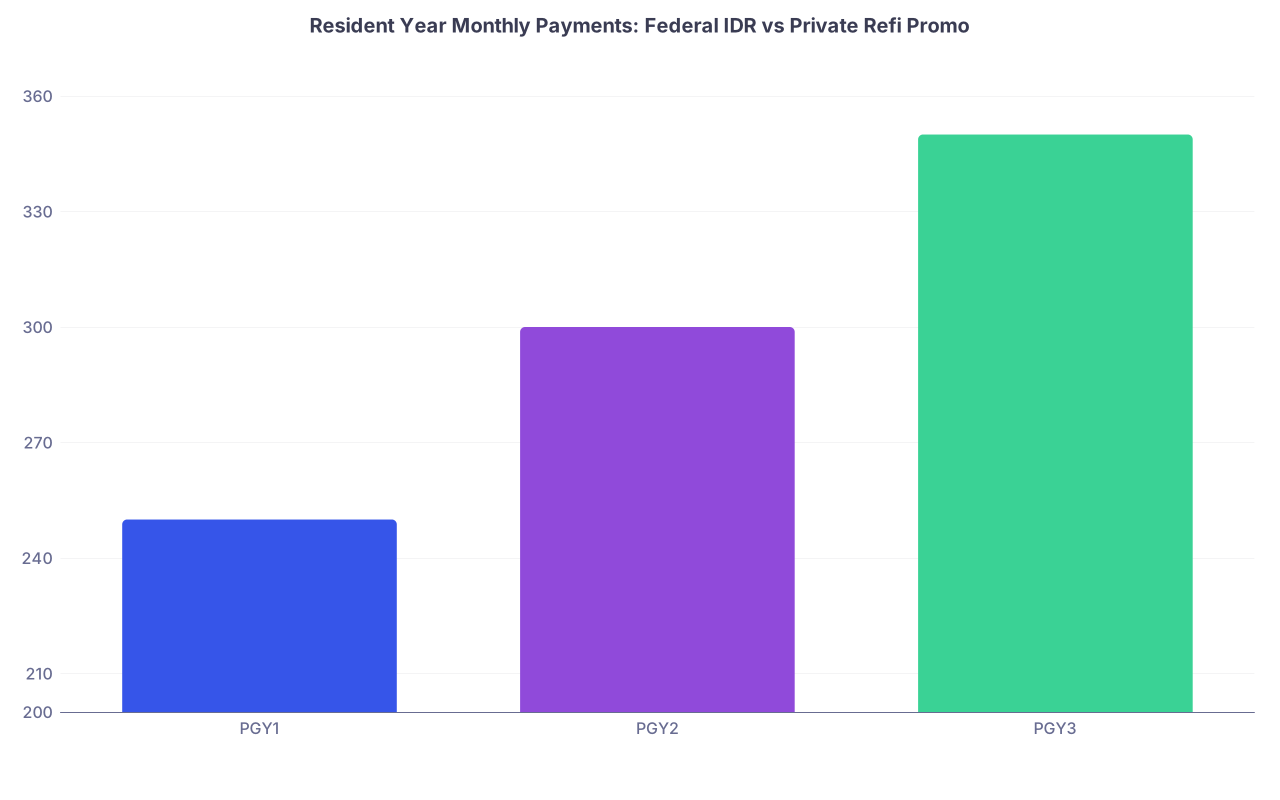
| Category | Value |
|---|---|
| PGY1 | 250 |
| PGY2 | 300 |
| PGY3 | 350 |
That bar chart above is roughly what I’ve seen for IDR payments with realistic resident incomes. The “$100/month promo” plans feel good short term, but you’re quietly signing into a path that may have no forgiveness and potentially more total out-of-pocket in the end.
Incentives They Don’t Talk About (But Live By)
Let’s be blunt. The rep’s “recommendations” are not neutral.
Their paycheck is tied to:
- Loan volume they originate
- Products with better spreads for the lender
- Long-term relationship potential (to later sell investments, insurance, etc.)
You’ll almost never hear:
“Honestly, given your situation, I’d stick with federal loans and PSLF. I don’t make anything on that, but it’s probably best for you.”
I have heard maybe two people say something like that in a decade. They were borderline unicorns and not coincidentally, they had partially fee-only structures.
More common behaviors you don’t see:
- Internal trainings where refinances are highlighted as “key growth area in physician market”
- Leaderboards for top refi originators
- Coaching on how to “address PSLF objections” — translation: how to push you away from federal options without explicitly lying
Even if a rep is personally well-intentioned, the system they sit in tilts the board.
They’re not evil. But they are not your fiduciary, in most cases. They are sales.
Unless they clearly tell you: “I am a fiduciary, legally required to act in your best interest, and I’m compensated this way…” assume they are not.
What They Don’t Say About Losing Federal Protections
When you move from federal to private loans, you are not just changing an interest rate. You are trading a Swiss Army knife for a chef’s knife.
A chef’s knife might be sharper for one task (lower rate, clean amortization). But you’re giving up all the other tools in the handle:
- Income-driven repayment options (multiple flavors)
- Future access to new federal programs (Congress loves tweaking these)
- Forbearance and deferment options during major life events
- Disability discharge options that are fairly generous compared to private contracts
- The ability to adjust payments if you switch to a lower-paying job, fellowship, or part-time work
The rep might say, “Private lenders also have hardship options,” which is technically true. But those are discretionary, policy-based, and written to protect the lender first.
Federal options are statute-based. That matters in a crisis.
You’re not expecting to get disabled in your 30s. Everyone in residency feels invincible. But I’ve seen neurosurgery residents leave medicine for health reasons. I’ve seen psych residents get crushed by depression and step away.
When that happens, many people wish they’d kept their loans under the federal umbrella.
The rep’s slides rarely show:
“Here’s what happens to this loan if you go part-time for a few years, or switch to public-sector work, or stop practicing altogether.”
Because those scenarios make their product look less shiny.
The Cross-Sell Game: Loans as the Trojan Horse
Remember: loans are not the end game. They’re the beginning.
Once they’ve got your refinance on the books, here’s what starts:
- Annual “review” meetings where suddenly you’re talking about disability insurance
- Follow-ups once you’re an attending: “Now that your income has grown, let’s talk investing and protection”
- Proposals for whole life or indexed universal life policies wrapped in phrases like “tax-free retirement” and “asset protection”
You’re thinking, “I came here to talk about my loans.”
They’re thinking, “We have a high-earning client with a 30-year runway and minimal financial literacy.”
Loans are the easiest hook because you’re in pain about them. Then the real money gets made on recurring revenue products: insurance policies, AUM fees on investments, etc.
This is the part no one explains at those hospital lunches:
You are not a one-time transaction to these firms. You are a lifetime revenue stream if they can keep you from wandering off to low-fee, low-commission alternatives.
How To Actually Evaluate a Loan Pitch Like an Attending, Not a PGY1
Let me lay out how the sharpest residents I’ve seen handled this. They didn’t memorise the tax code. They asked the right questions and refused to be rushed.
Next time you’re on a call or in a meeting, you say, calmly:
“Show me three scenarios with my exact numbers:
- Stay federal on IDR + PSLF if I stay academic
- Stay federal on IDR without PSLF if I go private
- Refinance now with your product options”
And then you ask: “What’s my estimated total paid, year by year, in each?”
“If I switch jobs, go part-time, do a non-PSLF fellowship, or take parental leave, how does each option flex or not flex?”
“Are you a fiduciary for me in this relationship, and in what scope? How are you compensated on this refinance?”
“What protections or flexibilities will I lose by leaving federal? Not just PSLF — walk me through repayment options, disability, hardship, and future program eligibility.”
Watch how transparent or evasive the rep becomes. It’s very revealing.

| Step | Description |
|---|---|
| Step 1 | Resident With Federal Loans |
| Step 2 | Run IDR + PSLF Projections |
| Step 3 | Run IDR Without PSLF |
| Step 4 | Stay Federal For Now |
| Step 5 | Compare Refi As Attending |
| Step 6 | Careful Residency Refi |
| Step 7 | Delay Refi Decision |
| Step 8 | PSLF Eligible Employer |
| Step 9 | Total Paid Lower With PSLF? |
| Step 10 | Need To Refi In Residency? |
That little decision tree is how programs that actually care about residents’ finances talk through this informally. Slow, conditional, protecting options. Reps hate that pace.
Red Flags That You’re Being Sold, Not Advised
You want to see the subtle tells? Here are the ones that, when I hear them in a hospital conference room, I mentally walk out.
- Any version of “PSLF might not be there, so…” without also modeling the risk-adjusted math of staying federal
- Pressure language tied to time: “This rate environment won’t last,” “Resident-only offers,” “You want to lock this in before you finish”
- Heavy focus on rate without showing total dollars paid over realistic timeframes
- Dismissive comments about “government programs” instead of nuanced comparisons
- Unwillingness to put all assumptions in writing or in a spreadsheet you can keep and review
Contrast that with the rare good advisor who says something like:
“Honestly, you’re at a 501(c)(3) academic center with $280k in loans. You’re leaning cards-on-the-table toward academic IM or peds. I’d stay federal and use SAVE/PSLF. We can revisit a partial refinance as an attending if your plans change. I don’t make money on that, but it’s probably the right call.”
That’s what alignment sounds like.
When Refinancing Does Make Sense — And Why Reps Push It Earlier
There are scenarios where I’ve told residents and fellows: yes, a targeted refinance can be smart.
For example:
- You’re absolutely certain you’re going into a high-paying private specialty (ortho, derm, some surgical subs)
- You’re at a non-PSLF-qualifying hospital and plan to stay in private practice
- Your debt-to-income ratio as an attending will be manageable
- You have no intention of doing public service work long-term
Even then, I often prefer:
- Stay federal during residency on IDR
- Refinance as an attending once job, location, and income are nailed down
- Possibly refinance part of the debt, not all, depending on your mix of undergrad vs med loans and your risk tolerance
Why don’t most reps lean into that plan?
Because:
- They might not still have access to you in 3–5 years
- Everyone chases “resident capture” because doctors tend to stick with whoever helped them first
- Their firm’s projections and quotas are built on you refinancing now, not later
So they stretch to make today’s refinance seem optimal.
The Perspective You Actually Need
Here’s the part people only realize in hindsight:
Your residency years are not about “becoming debt-free as fast as possible.”
They’re about preserving your options, minimizing irreversible mistakes, and setting up your attending self to have choices.
The worst stories I’ve seen:
- Pediatric or psych residents who refinanced away PSLF, later went into academic or community nonprofit jobs, and paid six figures more than they needed to
- Residents who took variable-rate refis, then moved, had kids, dropped to 0.8 FTE, and got squeezed by rising payments
- People who felt too embarrassed to admit they didn’t understand what they signed and kept overpaying or under-utilizing federal protections
Years from now, you won’t remember the exact interest rate you locked in during PGY2. You’ll remember whether you gave yourself room to change your mind about your career, your specialty, your life.
Loan reps are playing a short game: convert the resident, close the deal, move on to the next program.
You have to play the long game for yourself.
Slow down. Ask the hard questions. Make them show the numbers all the way out, not just the shiny rate on slide three.
You’ve seen enough bad consults on the wards to recognize one when you see it. Treat your loans like a complex patient. Get the second opinion. Read the chart yourself.
Because the attending you become is going to have to live with the orders you write on your debt today.