
Only 27% of physicians who refinance their student loans actually pick the rate structure (variable vs fixed) that ends up being optimal over the life of the loan.
Let me be blunt: most doctors choose based on vibe. “Variable sounds scary, I’ll go fixed.” Or, “Lowest rate on the page? Done.” That is how you overpay five figures without even noticing.
You want the real answer to when variable wins and when fixed wins. Not generic “it depends” fluff. So let’s break this down the way I would with a surgery fellow in my office with $420k of loans and a half-signed refinancing contract on their phone.
The Core Difference: What You’re Actually Betting On
Variable vs fixed is not a “personality” decision. It is a bet on:
- How long you will actually keep this loan.
- What short-term interest rate policy will do during that time.
- Whether you value payment stability more than absolute dollar savings.
Here’s the technical core:
- Fixed rate: Lender takes the interest rate risk. You pay a premium for that certainty.
- Variable rate: You take the interest rate risk. You get rewarded with a discount on day one, but that discount can vanish (or grow) depending on the benchmark rate.
Most physician lenders use something like:
Variable Rate = Index (usually SOFR or Prime) + Margin
Example: 1‑month SOFR at 5.3% + margin 1.5% = 6.8% current variable rate. That will move every 1–3 months.
Fixed is just that same math baked in and locked for the term. The lender looks at the curve, adds a premium for risk and capital, and says “10‑year fixed at 6.4%.”
To see where the “win” lies, you always compare:
- Short payoff horizon + large rate gap → variable usually wins.
- Long payoff horizon + small rate gap → fixed usually wins.
That is the skeleton. Now let’s add muscle.
Physician-Specific Realities That Actually Matter
Most online advice pretends you are a random borrower. You are not. You are a physician, which changes the decision in three big ways.
1. Your Income Trajectory Is Not Flat
Residents and fellows are temporarily poor. Attending salaries are not.
Typical path:
- PGY‑1–6: $60k–80k
- Early attending: $220k–400k (primary care vs subspecialty)
- Peak attending: $300k–700k+
What that means: you are not going to carry a 15‑year refinance to the bitter end if you actually care about getting rid of debt. You will accelerate payments dramatically after training or once you stabilize your life (house, kids, practice setup).
So a “15‑year” term is often actually a 5–9 year payoff in real life. This is why variable rates often win for aggressive payers, even though the term says 15.
2. PSLF/IPLF vs Private Refinancing
If you are eligible for PSLF or state/federal forgiveness and considering leaving it to refinance, fixed vs variable is not your main problem. PSLF is an all‑or‑nothing decision. Once you refinance, it is gone. Forever.
The only time variable vs fixed really matters is:
- You are already in full private territory (no PSLF path).
- Or you are refinancing after PSLF (e.g., you have a leftover chunk you want to clean up).
- Or your loans are private from the start (Caribbean, older private loans, refinanced before).
If your plan is public service + PSLF, your “rate” problem is minimal. Your monthly payments are an income tax. You do not optimize variable vs fixed there; you optimize your tax and forgiveness strategy.
3. Refinancing Is Not One‑and‑Done
Most physicians who do this correctly refinance more than once:
- Once as a senior resident or fellow (training‑friendly product, maybe longer term, lower payment).
- Again as a new attending (much shorter term, much lower rate).
- Sometimes again when rates move or their income jumps.
This “serial refinance” reality changes the math. You are not marrying a 10‑year rate. You are signing up for what is effectively a 2–5 year instrument that you may refinance away once your financial life upgrades.
Variable rates often look far better when you accept that you are likely to refi again if the environment changes.
Where Each Structure Truly Wins (With Real Scenarios)
Let me be concrete. You want to see specific profiles and which side wins. Here we go.
| Scenario Type | Likely Winner | Key Reason |
|---|---|---|
| Resident/Fellow, PSLF-eligible | Neither | Should usually avoid private refi |
| Senior Fellow, plans PSLF exit soon | Fixed | Short horizon but cannot screw up |
| New Attending, plans 3–5 yr payoff | Variable | Big rate gap, quick amortization |
| Attending, uncertain timeline 8–15y | Fixed | Risk of higher rates over long term |
| Highly risk‑averse personality | Fixed | Sleep > marginal savings |
| Very rate‑sensitive, flexible | Variable | Will refinance and adapt as needed |
Scenario 1: New Attending, Aggressive Payoff
Facts:
- $400k refinanced balance
- Lender offers:
- 5‑year variable: 4.4% (index + margin)
- 5‑year fixed: 5.2%
- You know you will live like a resident and knock this out in 4–5 years.
In this situation, unless you believe short‑term rates are about to spike dramatically and stay there, the 0.8% discount is huge. Over 4–5 years, that is often a five‑figure savings.
Quick ballpark:
- 5‑year fixed at 5.2% on $400k → payment ≈ $7,580 / month.
- 5‑year variable at 4.4% (assuming flat) → payment ≈ $7,450 / month and about $9,000–$11,000 less interest over the period.
Even if rates climb 0.5–1% over those 5 years, you probably still come out ahead or at least similar, especially if you prepay.
This is the classic use case where variable “truly wins” for physicians.
Scenario 2: Attending With Long, Sloppy Payoff
Facts:
- $300k balance.
- You are in a non‑PSLF employed position.
- You are maxing retirement, want to buy into a practice, not feeling aggressive about extra payments.
- Realistically, 10–15 year payoff.
Offer:
- 10‑year variable: 5.8%
- 10‑year fixed: 6.1%
Now the rate gap is only 0.3%.
Over 10–15 years, a 0.3% discount on a variable that can move every quarter is not generous. You are accepting years of unknown rates in exchange for saving maybe a few thousand dollars if rates stay flat or fall.
Long time horizon + small rate gap = fixed wins.
If you told me you genuinely intend to ride this loan out for a decade, I would tell you to pay the small premium for a rate you can write into your long‑term financial plan. And then work on all the other levers—retirement savings, disability coverage, practice equity—where the upside is far larger.
Scenario 3: Senior Fellow About to Become Attending
Facts:
- $250k balance.
- Final year of fellowship.
- Planning to go PRIVATE, not PSLF.
- Refinancing now to get better than federal 6.8–7% rate, but payments need to be manageable on fellowship salary.
- Plan to refinance again as attending.
Offer:
- 15‑year variable: 5.0%
- 15‑year fixed: 5.4%
- Training‑friendly: lower monthly required payment with both.
You are likely to refinance again in 12–24 months once you have attending income. So your “true” rate horizon is more like 1–2 years.
Here, a meaningful variable discount (0.4%) over such a short real horizon is again attractive. The risk window is narrow. Even if rates drift up modestly, you will probably exit this refinance into a different product once your income jumps.
This is a spot where variable often wins in practice for physicians, especially when they are disciplined enough to refi again quickly.
The Real Risk in Variable: How Bad Can It Get?
You are not trying to perfectly predict macroeconomics. You are just trying to avoid obvious landmines.
Variable loans have three main risk levers:
- Index volatility. If the benchmark (SOFR, Prime, etc.) spikes 2–3% in a short time, your rate follows. We literally watched this happen 2022–2024.
- Term length. The longer your actual payoff horizon, the more years you are exposed to that craziness.
- Your flexibility. If your budget is already stretched to the limit, a rate spike can push you into real distress.
Lenders usually cap variable rate increases (lifetime caps like “not to exceed 9–10%”), but those caps are still painful on large physician balances.
Think like a risk manager:
- 5‑year payoff or less, with a >0.5–0.75% rate gap → variable is a reasonable risk.
- 10–20 year payoff, <0.5% rate gap → fixed is safer and usually smarter.
- Anything where a 2–3% rate increase would cause real financial strain → fixed, unless you can aggressively shorten the payoff window.
How Market Rate Cycles Tie Into Your Decision
You cannot ignore the rate environment. You also should not overfit to it.
Right now (post‑2022 world), we have:
- Short‑term rates elevated compared with the last decade.
- Possibility of future cuts, but nobody sane will guarantee the path or timing.
What this means practically:
- In a high‑rate environment with some expectation of eventual easing, variable can look more attractive for short‑term loans if you are willing to ride the possible volatility and refi again.
- When rates are historically low (think 2020–2021), fixed rates at the floor are usually the obvious choice, because your upside from going variable is limited and your downside is asymmetrically bad.
So, yes, the calendar year matters. But the main questions remain:
- How long will you keep this loan?
- How big is the variable discount today?
- How much volatility can your life absorb?
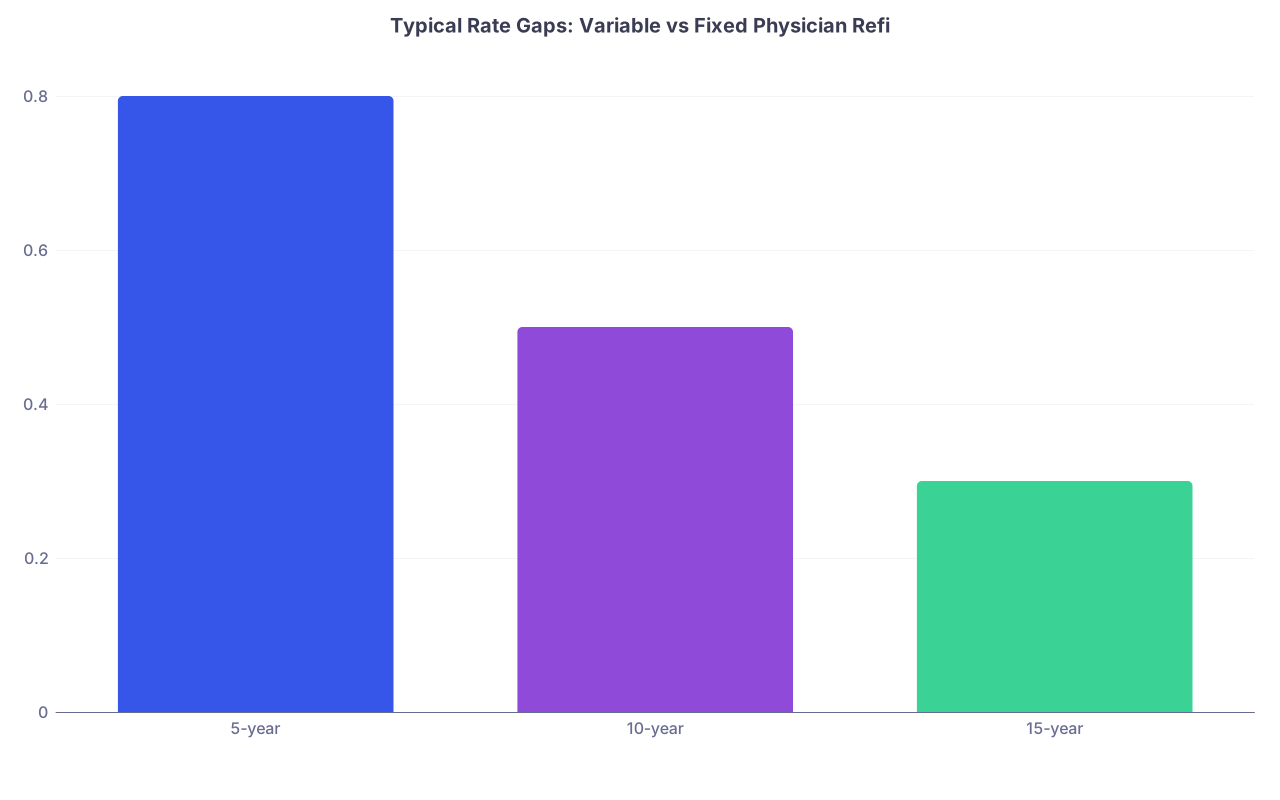
| Category | Value |
|---|---|
| 5-year | 0.8 |
| 10-year | 0.5 |
| 15-year | 0.3 |
Those numbers are representative of what I see across common physician‑focused lenders (Laurel Road, SoFi, Earnest, etc.). Shorter terms usually show a bigger variable‑fixed gap. That is why high‑income, aggressive payers often benefit from variable.
A Concrete Decision Framework (Not Vibes)
Let me give you a direct decision tree. No hand‑waving.

| Step | Description |
|---|---|
| Step 1 | Considering Refinance |
| Step 2 | Usually stay federal |
| Step 3 | Private refinance appropriate |
| Step 4 | Leaning fixed |
| Step 5 | Leaning fixed |
| Step 6 | Fixed safer |
| Step 7 | Variable likely optimal |
| Step 8 | PSLF or forgiveness path? |
| Step 9 | Expected payoff under 7 years? |
| Step 10 | Variable discount at least 0.5 percent? |
| Step 11 | Can budget handle 2 percent spike? |
If you want a formula—this is about as close as it gets.
Payment Behavior: The Silent Tie‑Breaker
Here is where I see many physicians shoot themselves in the foot:
They choose a cheap variable rate. Then they make the minimum payment for the full term.
If you carry a variable loan at minimum payments for 10–15 years, you are not using the product correctly. You are gambling with a large notional balance over a long rate horizon with no hedge (the “hedge” is supposed to be your ability to pay it down faster).
For variable to truly win, two things nearly always need to be true:
- You intend to pay aggressively (extra principal payments, shortest term you can tolerate).
- You are willing to refinance again if the rate environment shifts against you.
Fixed, on the other hand, is very forgiving of lazy behavior. If you pick a 10‑year fixed and just autopay the scheduled bill, you will still have a predictable, acceptable outcome. The main risk is opportunity cost, not blow‑up risk.
I have seen attendings who chose variable purely for the headline rate and then got upset when their payment crept up over time because they were not attacking principal. That is not a rate problem. That is a behavior problem.
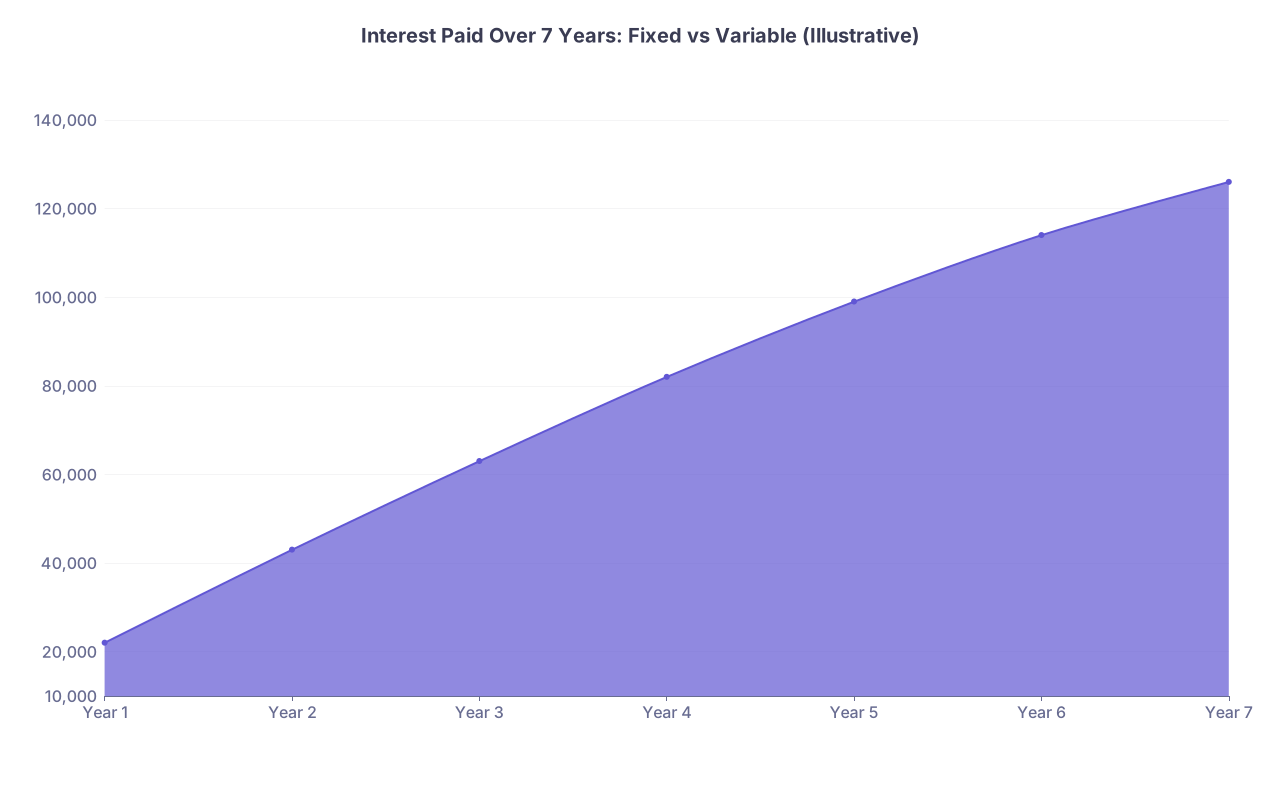
| Category | Value |
|---|---|
| Year 1 | 22000 |
| Year 2 | 43000 |
| Year 3 | 63000 |
| Year 4 | 82000 |
| Year 5 | 99000 |
| Year 6 | 114000 |
| Year 7 | 126000 |
Interpretation: with aggressive prepayments on a lower variable rate, the cumulative interest curve often flattens earlier versus a higher fixed rate with minimum payments.
Legal and Contract Details You Cannot Skip
Since you asked under “Financial and Legal Aspects,” let me focus on the boring fine print you really do need to read. Yes, actually read.
Key clauses in a variable‑rate physician refinance:
Index and reset frequency.
- What is the index? SOFR? Prime? Something obscure?
- How often does it reset—monthly, quarterly?
Faster reset = quicker response to rate spikes.
Margins and caps.
- Exactly what spread over the index are you paying?
- Is there a lifetime cap on the variable rate (e.g., “not to exceed 9.99%”)?
That cap is your worst‑case scenario. See if you can tolerate it.
Prepayment penalty.
You want none. Most modern physician lenders have zero prepayment penalty, but confirm. Without this, your plan to refinance again collapses.Cosigner release and death/disability provisions.
If you are using a spouse or parent cosigner, highlight the release requirements. Also look at what happens if you die or become permanently disabled. Federal loans have robust discharge rules. Private contracts vary. Some are generous, others less so.Forbearance/deferral flexibility.
Residency, fellowship, maternity/paternity leave, practice startup—life happens. Fixed vs variable is meaningless if one temporary rough patch puts your loan into default because the lender refuses reasonable forbearance. Physician‑specific lenders are generally better here, but you still want the language in black and white.
This is where a lot of “online calculators” ignore reality. Your effective risk is not just the rate. It is the combo of rate + contract + your specific career trajectory.
A Few Misconceptions I Hear Constantly
Let me just swat down some nonsense I hear from attendings in lounges and residents in hallways.
“Variable is always dangerous.”
Wrong. Variable is dangerous for long, lazy payoff plans and for people who cannot tolerate volatility. For disciplined, high‑income borrowers with short payoff horizons, it is often the mathematically correct choice.“Fixed is always more expensive long term.”
Also wrong. If the rate gap is tiny and you carry the loan a long time, fixed can easily be cheaper on a risk‑adjusted basis because you are not paying to refinance 3 different times or dealing with spikes.“I will just refinance again if things get bad.”
Maybe. Unless your income drops. Or you change jobs. Or your credit takes a hit. Or credit markets freeze for a season. The ability to refinance is not guaranteed. It is just highly likely for most physicians in typical times.“I don’t have time to worry about this; I’ll just pick whatever my co‑resident did.”
Fine, then expect co‑resident level outcomes: haphazard, occasionally good, frequently suboptimal. This decision is a one‑hour deep dive that can easily be worth $10–50k over the life of the loan.
Practical Playbook: How I’d Walk You Through This in 20 Minutes
If you were sitting in front of me with your loan summary, here is exactly what we would do.
Confirm PSLF/forgiveness status.
- Any federal loans with PSLF potential and getting close to 120 payments? We stop here. No private refi unless you are intentionally abandoning PSLF.
Clarify real payoff horizon.
Not the lender term. Your plan.- “If you keep your lifestyle modest, how many years till you want this debt gone?”
If you say anything under 7, I flag you as a good variable candidate if the discount is meaningful.
- “If you keep your lifestyle modest, how many years till you want this debt gone?”
Get actual term sheets from at least 3 physician lenders.
Not banner ads. Real pre‑approved offers with both variable and fixed quotes for the same term lengths.Compare apples to apples on the targeted payoff term.
If you want to be debt‑free in 5 years, I compare 5‑year variable vs 5‑year fixed across lenders. I do NOT let you justify a cheaper 10‑year because of the monthly payment if your stated goal is 5.Decide the “tolerance band” for payment swings.
- “If your payment went up $400–600 per month, is that survivable or would that blow up your budget?”
If that would blow you up, I push hard toward fixed unless your payoff horizon is extremely short.
- “If your payment went up $400–600 per month, is that survivable or would that blow up your budget?”
Choose structure, then automate aggression.
- Variable: shortest practical term, auto extra principal payments, calendar reminder every 6 months to re‑shop rates.
- Fixed: term that balances comfort and speed; still encourage extra principal, but the urgency is lower.
This is not mysterious. It is just work that most physicians are too exhausted to do. So they default to whatever seems “safer” or has the lowest bolded APR and then hope it all works out.
Helpful Comparison Snapshot
To make this more concrete, here’s a quick side‑by‑side of when each rate type tends to win for physicians.
| Feature / Situation | Variable Rate Wins When | Fixed Rate Wins When |
|---|---|---|
| Payoff horizon | You will pay off in <7 years | You will likely carry debt 10+ years |
| Rate gap vs fixed | Discount ≥ 0.5–0.75% | Discount < 0.5% |
| Income stability | Stable/high income, flexible budget | Income uncertain, tight budget |
| Refi likelihood | You are willing to refinance again | You want one‑and‑done simplicity |
| Risk tolerance | Comfortable with some payment volatility | Highly averse to changing monthly payments |
| Market rate outlook (near term) | You think cuts / stability are plausible | You worry more about further rate increases |
FAQs
1. If I refinance to a variable rate now, can I switch to fixed later with the same lender?
Sometimes, but do not count on it as a contractual right. Many lenders treat a switch from variable to fixed as a brand‑new refinance, which means a new application, new underwriting, and potentially different rate offers. If you must have the option to lock later, ask explicitly and get the answer in writing.
2. I’m in fellowship and plan PSLF but might switch to private practice. Should I refinance to a lower rate now?
Usually no. If PSLF is even a live option, private refinancing is dangerous, because once you refinance federal loans into private, PSLF is dead. In that situation, the correct move is often to stay in an income‑driven plan, minimize payments while you are undecided, and only refinance after you have clearly chosen a non‑PSLF path.
3. How much of a rate difference makes variable “worth it” for a physician?
As a rough, opinionated rule: for payoff horizons under 7 years, I start seriously considering variable when the discount versus fixed is at least 0.5–0.75%. Under 0.5%, the savings are usually not worth taking on rate risk unless your payoff is extremely short and your budget is very flexible.
4. Are there any situations where a long‑term variable (10–15 years) actually makes sense?
Rarely. A long‑term variable loan for a physician only makes sense if: 1) you are confident you will pay it off far earlier than the stated term, and 2) the variable discount is substantial, and 3) you are willing to refinance again if rates move against you. If you expect to make minimum payments for a decade, I would almost always favor fixed.
5. How often should I re‑shop my refinance options after choosing a variable rate?
If you go variable, I like a 6–12 month schedule. Every 6–12 months, pull soft‑pull quotes from 2–3 major physician lenders and see whether you can: 1) shorten your term, and/or 2) improve your rate, especially into a fixed product if rates fall. You do not need to refinance every time—just keep the market checked.
6. Is there any benefit to splitting my balance into part‑fixed, part‑variable?
Most individual lenders will not structure a single loan that way, but you can effectively do it by taking two separate refinance loans (e.g., $200k fixed, $100k variable). This can make sense if you want some payment stability but are willing to push aggressively on a portion of the balance with a lower variable rate. The complexity increases, but for high earners comfortable with financial nuance, it can be a reasonable hybrid strategy.
Key points to walk away with:
- Variable wins for physicians who will pay fast, accept some volatility, and get a real rate discount; fixed wins for those with longer or uncertain payoff timelines and low risk tolerance.
- Your actual payoff plan and behavior matter more than the nominal term—short, aggressive payoff tilts the balance toward variable; long, lazy payoff tilts hard toward fixed.
- Do not even touch this debate until you are certain about PSLF / forgiveness status and have read the specific legal terms of the refinance contract you are signing.