
The worst student loan mistakes happen after you get married and file the wrong tax return once.
This is where couples quietly burn tens of thousands of dollars—by guessing on “Married Filing Jointly vs Separately,” picking the wrong repayment plan, or trusting an accountant who has never actually modeled an income-driven repayment (IDR) payment in their life.
Let’s fix that.
You are not trying to “get the lowest tax bill.”
You are trying to optimize the combined tax + student loan cost of your marriage over years.
Two different games.
Below is a step‑by‑step playbook to coordinate your tax filing status and student loan payments so you stop leaving money on the table.
1. Get Oriented: What Actually Changes When You Get Married
Forget the vague advice you have heard. Here is what actually changes with marriage when you have student loans:
Your AGI (Adjusted Gross Income) can change
- If you file Married Filing Jointly (MFJ), IDR plans usually use household AGI.
- If you file Married Filing Separately (MFS), some IDR plans use only the borrower’s AGI, some still use household income.
Your family size usually increases by 1
That changes your “discretionary income” because the poverty guideline threshold is higher for a family of 2 vs a single person, which can lower IDR payments.Certain tax credits/deductions disappear if you file separately
You may lose things like:- Student loan interest deduction
- Child Tax Credit or partial value of it
- Education tax credits
- Some itemized deduction efficiencies
Your spouse’s loans and income start to matter
This is where most people get stuck:- If both spouses have loans, income-driven plans often split the required payment between you based on your share of total household debt.
- If one spouse has no loans, that spouse’s income often pushes the payment way up unless you deliberately wall it off with MFS (where allowed).
The Core Equation You Must Respect
Every decision you make comes down to this:
Total annual cost = (your total federal tax bill as a couple) + (your annual student loan payment)
Compare that number for:
- Scenario A: Married Filing Jointly + chosen repayment plan
- Scenario B: Married Filing Separately + chosen repayment plan
Whichever combo gives the lower total cost and fits your long‑term plan (forgiveness vs rapid payoff) wins.
2. Know the Rules of Each Major Repayment Plan When Married
If you do not understand how each repayment plan treats spousal income, you are basically gambling.
Here is the cheat sheet for current federal IDR plans (post-SAVE rollout).
| Plan | Uses Spouse Income if MFJ? | Can Avoid Using Spouse Income with MFS? | Status for New Borrowers |
|---|---|---|---|
| SAVE | Yes | Yes | Open |
| PAYE | Yes | Yes | Closed to new |
| IBR | Yes | Yes | Open (limited use) |
| ICR | Yes | Yes | Open |
Key idea:
If you file Jointly, IDR plans treat you as one financial blob.
If you file Separately, most current plans can be calculated using only the borrower’s income.
Now, a bit more detail where it matters.
SAVE (the new dominant plan)
- Payment = 10% of discretionary income (with a lower rate on undergrad starting in 2024), using 225% of poverty line.
- If you file MFJ:
- Uses combined household AGI and combined federal poverty line for family size.
- If you file MFS:
- SAVE can base payments on your income only.
- Interest subsidy: if your payment does not cover monthly interest, 100% of unpaid interest is forgiven (no interest growth). Huge.
Conclusion: SAVE is often the plan to start with in analysis.
PAYE / IBR / ICR
- PAYE: 10% of discretionary income, 20-year forgiveness (closed to most new borrowers now).
- Old IBR: 15%, New IBR: 10% for newer borrowers.
- ICR: 20% (usually worse unless for certain PSLF strategies tied to consolidation/Parent PLUS).
They all share the same married vs separate dynamic:
- MFJ: spouse’s income included.
- MFS: can usually exclude spouse income.
Unless you are grandfathered into a great PAYE or IBR scenario, SAVE usually wins or at least needs to be modeled first.
3. Build a Simple, Correct Model Before You Touch Your Tax Return
Do not start by asking your CPA what to do. Most accountants are not modeling IDR. They are optimizing tax only, which is the wrong game for you.
You and your spouse need a simple 2–3 tab spreadsheet. No more.
Step 1 – Gather the data (no guessing)
You need, in writing:
Your federal loans:
- Loan type (Direct, FFEL, Perkins, Parent PLUS, etc.)
- Total balances
- Interest rates
- Whether already consolidated, and if yes, when
Your spouse’s loans (same items)
Income:
- Your last year’s AGI (from 1040)
- Your spouse’s AGI
- Current gross income for both, plus pretax deductions (401k, 403b, 457, HSA, etc.)
Current repayment plan and payment amounts
Step 2 – Compute your discretionary income
Use the formula each IDR plan uses. For SAVE:
- Determine family size: usually you + spouse (and kids if applicable).
- Look up the federal poverty guideline for your state and family size.
- Discretionary income = AGI – 225% of poverty line (for SAVE).
You will do this twice:
- Once for MFJ with combined AGI and combined family size
- Once for MFS with borrower’s AGI and family size typically still includes spouse (yes, even when filing separately).
Step 3 – Estimate monthly IDR payments under each configuration
For each scenario, estimate:
- Plan: SAVE (and maybe IBR or PAYE if relevant)
- Filing status: MFJ vs MFS
- Whose income is included
Then the formula for SAVE today for most graduate borrowers:
- Monthly payment ≈ 10% of discretionary income / 12.
Do this:
- MFJ + SAVE
- MFS + SAVE (using borrower-only income)
If both of you have loans:
- Compute the household payment, then split in proportion to each person’s share of the total loan balance.
Example (quick mental model):
- You: $200k loans
- Spouse: $100k loans
- Household SAVE payment (MFJ) = $900/month
Your share = 2/3 → $600
Spouse share = 1/3 → $300
Do not skip this proportional split. Servicers use it.
4. The Three Most Common Marriage Loan Scenarios (and What Usually Works)
Here is where theory meets reality. I see the same three patterns over and over.
Scenario 1 – One spouse has loans, one has none
- You: $250k federal loans, income $80k.
- Spouse: $0 loans, income $220k.
- Planning horizon: You may seek PSLF or long-term SAVE forgiveness.
If you file MFJ + SAVE:
- Household AGI = $300k.
- Payment becomes massive. You might be accidentally pushed out of forgiveness benefit into de facto full repayment.
If you file MFS + SAVE:
- Payment can be based on your $80k income only, still with family size of 2.
- Payment much lower, with interest subsidy preserving balance.
Tradeoff:
- You likely pay more tax filing separately.
- But if the IDR payment drops by say $1,000/month and the extra tax costs $3–6k per year, that can still be a big net win over many years.
Usual winner:
- MFS + SAVE when:
- Income gap between spouses is large
- Only one spouse has loans
- You are pursuing PSLF or long-horizon forgiveness
- MFJ + aggressive payoff when:
- You plan to kill the debt quickly (5 years or less)
- Extra MFJ tax benefits are large
- Spouse’s high income is helpful to crush the debt
Scenario 2 – Both spouses have large loans, similar incomes
- You: $220k loans, $150k income.
- Spouse: $200k loans, $160k income.
- Both pursuing PSLF at nonprofit hospitals.
Here, combined IDR payments might already be high no matter what you do.
Filing MFJ + SAVE:
- Saves on taxes.
- Uses combined income and family size of 2 for both.
- Household payment is big, but split proportionally.
Filing MFS + SAVE:
- Each uses own AGI but same family size.
- Slight reduction in payments maybe, but you may lose key credits and deductions.
Usual winner:
- MFJ + SAVE, especially if:
- Both are on PSLF tracks
- Income and debt are similar
- You want simpler taxes and maximum tax-credit efficiency
The exception is if one of you has unusual income volatility, 1099 income, or an ability to drive reported AGI very low via retirement/benefits. Then MFS modeling can be worth another look.
Scenario 3 – High-income household, debt manageable, no forgiveness goal
- You: $120k loans, $200k income.
- Spouse: $0 loans, $180k income.
- Total household income $380k, both in private practice, no PSLF.
If you are not pursuing forgiveness and can realistically pay this off in 5–7 years:
- IDR may not even be your main tool.
- A fixed 10-year standard or even private refinance might be better.
Filing MFS just to drag down an IDR payment is usually pointless if your plan is to pay the loans off aggressively anyway.
Usual winner:
- MFJ + standard or refinance, with a clear payoff plan:
- Large, automatic monthly payments
- High retirement contributions for tax efficiency
- No games with MFS unless a rare edge case
5. Tactical Levers: How to Legally Shrink Payments by Shrinking AGI
Here is where you move from “victim of the system” to “using the system.”
IDR plans key off AGI. So you attack AGI with legal strategies that do not wreck your actual cash flow.
High-yield AGI reducers
Traditional 401(k)/403(b)/457 contributions
- Every pre-tax dollar you contribute lowers AGI.
- For each $1 reduction in AGI, your annual SAVE payment typically drops by about 10 cents (because 10% of discretionary income).
- Example: Reduce AGI by $20,000 → cut annual IDR payments ≈ $2,000. Real money.
HSA contributions (if eligible)
- Triple tax benefit and AGI reduction.
- Family HSA contributions can trim tax and loan payments simultaneously.
Pre-tax premiums and FSA contributions
- Health, dental, vision, dependent care FSA all reduce taxable income.
Business retirement plans for 1099 spouses
- SEP IRA or solo 401(k) can dramatically cut AGI, especially if only the borrower needs lower AGI and you file MFJ.
Where people screw this up
- Switching to Roth 401(k) to “grow tax-free” while on SAVE, not realizing they just raised their IDR payments for no good reason.
- Leaving employer matches on the table while overpaying loans at 6–7%.
- Not timing contributions properly in big income years before recertification.
If you are on an IDR plan and still in the forgiveness game, traditional pre-tax retirement contributions are usually superior to Roth, today. You can revisit Roth later when loans are gone.
6. Designing Your Annual “Married Loan + Tax” Checkup
You need a repeatable process. Not heroics every April.
Here is a yearly protocol that works.

| Step | Description |
|---|---|
| Step 1 | Start of Year |
| Step 2 | Estimate Household Income |
| Step 3 | Update Loan Balances and Plans |
| Step 4 | Model MFJ vs MFS Scenarios |
| Step 5 | Choose Target Plan and Filing Status |
| Step 6 | Adjust Retirement and HSA Contributions |
| Step 7 | Implement During Year |
| Step 8 | Tax Prep Time |
| Step 9 | Re-run MFJ vs MFS with Actual Numbers |
| Step 10 | File Return and Recertify IDR |
Step-by-step annual routine
January–February
- Pull loan statements.
- Confirm current IDR plans, recertification dates, and PSLF status.
- Estimate this year’s income for both of you.
Run MFJ vs MFS projections
- Use last year’s return as a baseline.
- Model:
- MFJ + SAVE
- MFS + SAVE (and any other plan you are realistically considering).
- Compute: tax difference + loan payment difference.
Pick your provisional strategy for the year
- Decide:
- Target filing status for next tax season
- Target repayment plan for each spouse
- Desired AGI range (e.g., “Keep my AGI under $90k to keep payment under $X”)
- Decide:
Adjust levers
- Change retirement contribution elections.
- Add or increase HSA where available.
- Confirm you are on the desired IDR plan or submit a change request.
During the year
- Monitor projected year-end income (especially variable or bonus-heavy).
- If you are blowing past the AGI target, consider increasing pre-tax savings mid-year.
At tax time
- With real numbers, re-run MFJ vs MFS.
- If MFS wins: file separately and confirm your servicer uses borrower-only income.
- If MFJ wins: file jointly and accept that payment may be higher, but overall cost is lower.
IDR recertification
- Use the same AGI logic you just used for taxes.
- If you want a lower payment and AGI dropped, recertify quickly.
- If AGI went way up and you can delay recertification within legal rules, consider doing so.
7. Quick Comparison: When Joint vs Separate Makes Sense
| Situation | Likely Better | Why |
|---|---|---|
| One spouse has large loans, other has high income, forgiveness planned | MFS | Exclude spouse income from IDR |
| Both spouses have large loans and similar incomes, PSLF | MFJ | Simpler, tax credits preserved |
| Household very high income, rapid payoff, no forgiveness | MFJ | Optimize tax, use standard/refi |
| One spouse has small loans, low income | Depends | Need modeling; savings may be modest |
This is not a substitute for math. It is a starting point.
8. How to Work With (or Around) Your Accountant
I have seen smart couples lose five figures because their CPA said, “Joint is always better; separate is just for divorce or liability issues.”
That may be true for taxes only, but you care about tax + loans.
Here is how to keep control:
Ask for both MFJ and MFS draft returns
- Many firms hate doing this because it takes time. Insist.
- Tell them you understand there may be an additional fee. Pay it. It is worth it when loans are big.
Do the loan modeling yourself or with a loan specialist
- Take the AGI and tax totals from the draft returns.
- Plug into your spreadsheet.
- Compare total annual cost under each filing status.
Be explicit in your instructions
- “We will decide filing status based on our student loan modeling. Please prepare both versions so we can compare.”
If they refuse or dismiss the loan impact
- Find someone else.
- Or use software (TurboTax, etc.) to generate both draft returns yourself and then bring the numbers to a loan advisor if needed.
You outsource calculations; you do not outsource the decision.
9. Common Traps Married Couples Fall Into (and How to Avoid Them)
Let me be blunt. If you do any of the following, you are giving money away.
Auto-accepting servicer estimates without checking their math
- Servicers can mis-handle family size, spousal income questions, or plan eligibility.
- Always cross-check their payment with your own rough calculation.
Switching plans impulsively every year
- Constantly bouncing between SAVE, IBR, and PAYE to chase this year’s lowest payment can backfire.
- You may reset forgiveness clocks or lose grandfathered benefits.
Consolidating blindly after marriage
- Spouse consolidations tied together are rare and often not advisable.
- Do not mix Parent PLUS consolidation with your own professional grad loans in a way that locks you out of better IDR options.
Ignoring PSLF employer status when one spouse changes jobs
- If one of you leaves a 501(c)(3) or government job, it may make more sense for the other to double down on PSLF.
- Your tax and repayment coordination should react to these job moves.
Assuming “we will just refinance later” without conditions
- Private refinancing only makes sense if:
- You are not using PSLF or IDR forgiveness.
- Your household income and job security justify losing federal protections.
- Do not refinance just because the rate looks lower on a website.
- Private refinancing only makes sense if:
10. A Concrete Example Walkthrough
Let’s run a simplified but realistic scenario so you see the mechanics.
Spouse A (you):
- $300k federal loans at 6.5%
- Income: $90k
- Work at nonprofit hospital (PSLF eligible)
Spouse B:
- No loans
- Income: $220k
- Private industry
Household goal: Maximize PSLF benefit for A; B does not care about loans.
Option 1 – MFJ + SAVE
- Combined AGI: $310k
- Poverty line (family 2): say ~$20k (rounded just for concept), so 225% ≈ $45k
- Discretionary ≈ $310k – $45k = $265k
- Payment (10%) ≈ $26.5k/year or about $2,200/month
A is essentially paying like a high-earning couple with no chance to “harvest” PSLF. Painful.
Option 2 – MFS + SAVE (A files separate, B files separate)
- A AGI: $90k
- B AGI: $220k
- For A’s SAVE calculation:
- Family size: still 2
- Poverty line: same ~$20k → 225% ≈ $45k
- Discretionary ≈ $90k – $45k = $45k
- Payment ≈ $4.5k/year → ~$375/month
Huge drop: from ~$2,200/month down to ~$375/month.
Now check the tax cost:
- Suppose MFJ total federal tax = $55k
- MFS total combined federal tax = $61k
- Extra tax = $6k/year
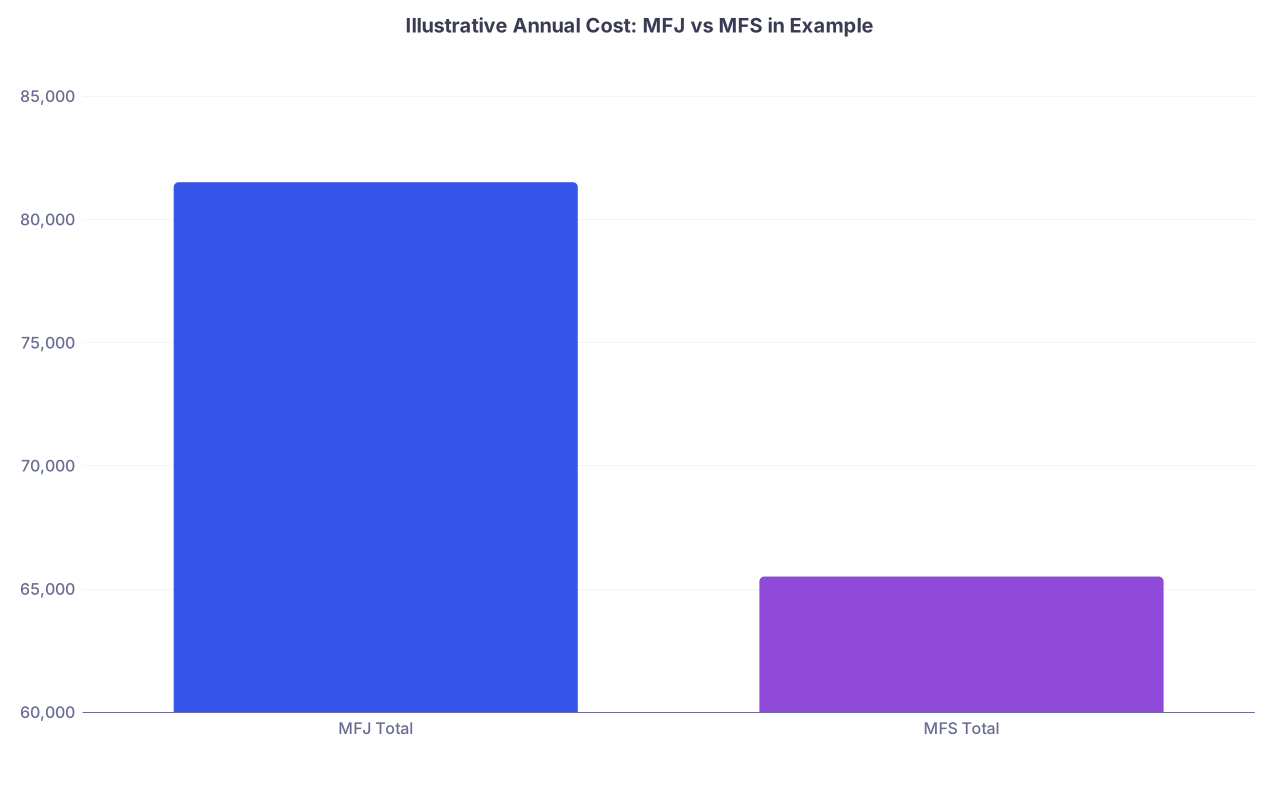
Full comparison, annually:
- MFJ: Tax $55k + Loans $26.5k = $81.5k
- MFS: Tax $61k + Loans $4.5k = $65.5k
Net savings ≈ $16k per year while building PSLF credit. Over 5–7 years, that is game-changing.
This is why guessing based on “joint usually saves on tax” is deadly when you have big loans.
| Category | Value |
|---|---|
| MFJ Total | 81500 |
| MFS Total | 65500 |
FAQ (Exactly 4 Questions)
1. If we file Married Filing Separately to lower my IDR payment, will that hurt our chances for a mortgage?
Possibly, but usually not in the dramatic way people fear. Lenders care mainly about your actual monthly obligations (the payment reported to credit bureaus) and your combined credit profiles. Filing separately may change your reported income profile, but many underwriters will review both returns anyway. The bigger factor is often whether your IDR payment is reported as very low (good for debt-to-income ratio) versus a high standard payment. If you are close to debt-to-income limits, work directly with the loan officer and provide context. I have seen plenty of couples get approved with MFS returns when they can document stable incomes.
2. Can we switch back and forth between MFJ and MFS every year to chase the best deal?
Yes, legally you can choose your filing status each year (assuming you remain eligible for both). There is no rule that you must stick with one. The catch: switching has side effects. For example, you might lose certain credits one year, regain them the next, and your IDR payment may jump around with each recertification. That is not inherently wrong; it just needs to be intentional. The right approach is to model each year’s options based on expected income and then choose the filing status that produces the best combined tax + loan outcome for that year, understanding the downstream effect on your repayment trajectory.
3. If both of us have loans, should we consolidate them together as a couple?
No. Do not do this. Historically, joint spousal consolidations were a thing, and they were a disaster. Those loans became very hard to separate again, and many couples got trapped. Today, you generally consolidate your own loans only, not your spouse’s. Each of you should analyze your portfolio, decide which servicer and plan make sense, and consolidate individually if needed (for example, to access SAVE or PSLF). Keeping your loan structures separate gives you more flexibility in case of career changes, divorce, or different forgiveness paths.
4. How often should we revisit our student loan and tax strategy once we set it up?
At least once per year, anchored around tax season and IDR recertification. The minimum viable routine:
- Once a year, pull your loan data and last year’s tax return.
- Project next year’s income and run MFJ vs MFS comparisons again.
- Adjust retirement and HSA contributions if you are using IDR strategically.
Revisit earlier if there is a major change: new job, big raise, one of you leaving a PSLF-eligible employer, new child (changes family size), or a refinance opportunity with much lower rates. The strategy is not “set it and forget it”; it is “set it and recheck annually with a structured process.”
Open your last tax return right now and write three numbers at the top: your AGI, your spouse’s AGI, and your total federal tax. Then build a two-row table—MFJ vs MFS—and plug in rough student loan payments under each. Once you see those totals side by side, you will stop guessing and start actually managing your marriage, taxes, and loans like a coordinated system instead of a random accident.