
Most student loan advice gets one thing wrong: it tells you to do either debt payoff or savings. That binary thinking is why people stay one flat tire away from a crisis for years.
You do both. At the same time. On purpose. With rules.
This is a playbook for exactly that: how to build a real emergency fund while you still have student loans hanging over your head. No motivational fluff. Just a clear system you can run every month.
Step 1: Get Out of Vague Land — Put Numbers on the Problem
You cannot fix what you refuse to measure. So you start here.
1. List every loan and your minimums
Five minutes on a legal pad or spreadsheet:
- Loan name (or servicer)
- Balance
- Interest rate
- Required monthly payment
- Type (federal / private)
You want something that looks like this:
| Loan/Servicer | Type | Balance | Rate | Min Payment |
|---|---|---|---|---|
| Fed Direct 1 | Federal | $18,000 | 4.5% | $125 |
| Fed Direct 2 | Federal | $12,000 | 5.2% | $90 |
| Grad PLUS | Federal | $30,000 | 7.0% | $220 |
| Private Refi | Private | $25,000 | 6.1% | $270 |
Total minimum payment: add them up. That number matters more than your total balance for monthly planning.
2. Define what “emergency fund” actually means
There are three common levels. Pick your target based on your risk:
Starter emergency fund: $1,000–$2,500
For: very tight budgets, high debt, early career. Buys you breathing room for small hits (car repair, copay, broken phone).Core emergency fund: 1 month of bare-bones expenses
For: almost everyone with active student loans. This is the primary goal while you are still aggressively paying down debt.Full emergency fund: 3–6 months of bare-bones expenses
For: after you stabilize loans or are in long-term income-driven repayment.
“Bare-bones expenses” = what you truly need to survive a few rough months:
- Rent / mortgage
- Utilities
- Groceries (realistic, not fantasy)
- Transportation
- Insurance
- Minimum debt payments (including loans)
- Basic phone/internet
Not included: vacations, restaurants, new clothes, subscriptions you forgot to cancel.
So first exercise:
- Write out your bare-bones monthly number.
- Multiply by:
- 1 for core fund
- 3–6 for full fund (longer term)
That gives you a concrete emergency fund target.
Step 2: Decide Who Gets Paid First — And How Much
Here is the part most people screw up: your dollars need a strict order of operations every month. Once you set the order, you do not renegotiate it in the middle of the month because you “felt like” buying something.
This is the basic hierarchy that actually works when you have student loans:
- Essentials (rent, utilities, food, transport)
- Minimum payments on all loans and credit cards
- Starter or core emergency fund build
- Extra student loan payoff
- Everything else
Notice where “attack loans” lands: after you are building at least a starter emergency fund.
The 60/30/10 allocation rule (simple baseline)
When your essentials and minimums are covered, this is a clean split for leftover money:
- 60% → Emergency fund (until you hit your starter or core goal)
- 30% → Extra payments on highest-priority debt
- 10% → Short-term flexibility / sanity money
Once your core emergency fund is built, you reverse the ratio:
- 60% → Extra student loan payoff
- 30% → Emergency fund (growing toward full fund)
- 10% → Flex money
Does it have to be 60/30/10? No. But you need some rule that does not change every month.
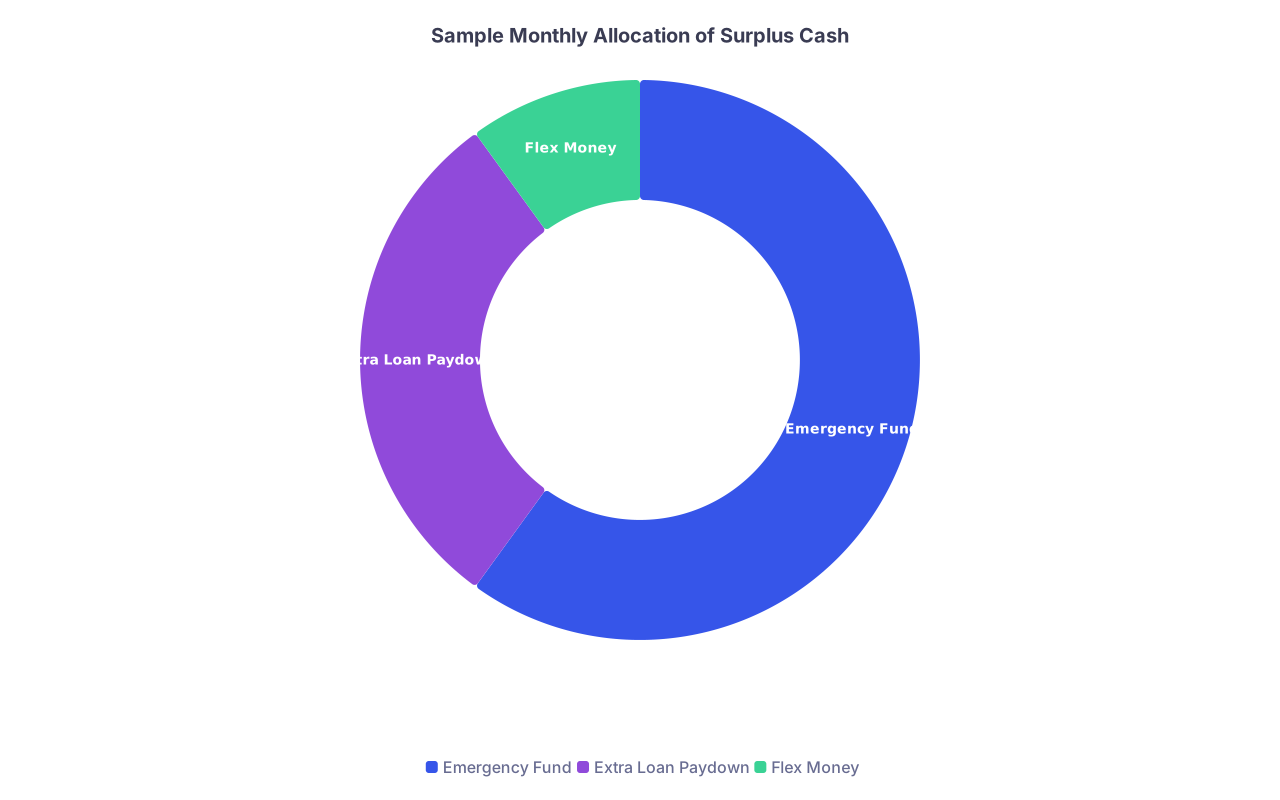
Here is what a real monthly allocation might look like for someone with $600 “left” after essentials and minimum payments:
| Category | Value |
|---|---|
| Emergency Fund | 360 |
| Extra Loan Paydown | 180 |
| Flex Money | 60 |
- $360 → Emergency fund
- $180 → Extra towards highest-priority loan
- $60 → Guilt-free spending
Not dramatic. Very effective.
Step 3: Fix the Order of Operations by Risk Level
You are not everyone. So the blend between “save” and “attack” depends on your actual risk.
Scenario A: No savings, unstable job, moderate loans
- You are early career.
- You have almost no savings.
- Your job is new or shaky.
- Loans are there, but not crushing (for example, total payments under 20% of your take-home pay).
Your priority: Build a starter fund fast.
Protocol:
- Pay all minimums on student loans and credit cards.
- Set a tight temporary spending cap (3–6 months).
- Direct 70–80% of every extra dollar to your emergency fund.
- With the remaining 20–30%, pay extra on either:
- The highest-interest loan, or
- The smallest balance (if you need quick wins).
Once you hit $1,500–$3,000 in cash:
Shift to the 60/30/10 ratio.
Scenario B: Some savings, stable job, higher-interest loans
- You have $1,000–$3,000 saved.
- Job is relatively secure.
- Loans include some ugly high-interest ones (7–10%+).
Your priority: Balance risk and interest.
Protocol:
- Keep a hard floor on savings (do not dip below your existing buffer).
- Split free cash 50/50:
- 50% → Emergency fund (until you hit 1 month bare-bones).
- 50% → Highest interest loan (usually private or Grad PLUS).
- When core fund (1 month) is reached, push 60–70% of extra cash to loans.
Scenario C: In income-driven repayment (IDR or SAVE), long horizon
- You are on SAVE, PAYE, IBR, etc.
- Payments are based on income and may be low.
- You are likely aiming for forgiveness after 20–25 years or PSLF after 10.
Your priority: Emergency fund and long-term flexibility.
In this world, extra payments often do less for you compared to building savings and investing, because you are playing a different game: staying solvent and compliant until forgiveness hits.
Protocol:
- Always make the required IDR payment on time.
- Build a core emergency fund of 1–3 months as fast as you reasonably can.
- Keep making standard IDR payments.
- Any significant “extra” money is split:
- 40–50% → Emergency fund (aim toward 3–6 months).
- 50–60% → Retirement investing (401k, IRA).
- 0–10% → Extra loan payment (only if you are sure forgiveness is not your end game).
I have watched residents on PSLF dump extra cash onto loans they were going to forgive in 8 years. That money would have been much more powerful in cash reserves and Roth IRAs.
Step 4: Build a Money Flow System That Runs Itself
This is where people either succeed or fail. If you “try really hard” manually, you will fall off as soon as life gets hectic. You need automation.
1. Use two checking accounts, not one
Stop running everything out of a single checking account. Split it:
Account A – Bills & savings hub
- Direct deposit lands here.
- All fixed bills auto-draft from here.
- Transfers to emergency fund and loans happen from here.
Account B – Spending account
- Once per paycheck, move your planned spending amount to this account.
- This is your “I can swipe this” card.
Why it works: if there is extra money in Account A, it belongs to your plan (emergency fund / loans), not to Uber Eats.
2. Automate your priorities in order
Imagine your paycheck hits on the 1st and 15th.
Set up:
- On the 2nd and 16th:
- Auto-transfer: $X → Emergency fund savings account.
- Auto-transfer: $Y → Extra loan payment on target loan.
- Auto-transfer: $Z → Spending account.
The emergency fund transfer should be:
- Fixed dollar amount (example: $200 each paycheck)
or - Fixed percentage (example: 20% of net pay)
Do not wait to “see what is left” at the end of the month. There is never anything left.
Step 5: Make a Rational Order for Your Debts
Attacking student loans while building an emergency fund only works if you stop doing random extra payments.
You pick a clear strategy:
Debt avalanche = Mathematically optimal
You pay extra on the highest-interest loan first.Debt snowball = Psychologically powerful
You pay extra on the smallest balance first.
With student loans, I usually recommend a hybrid:
- Make minimums on everything.
- If any loan has truly bad interest (8–10%+), hit that first (avalanche).
- Then choose between:
- Tiny balance for quick win (snowball), or
- Next-highest rate (avalanche).
| Priority | Loan Type | Balance | Rate | Strategy Reason |
|---|---|---|---|---|
| #1 | Private Refi | $25k | 6.1% | Highest private rate |
| #2 | Grad PLUS | $30k | 7.0% | High federal rate |
| #3 | Fed Direct 2 | $12k | 5.2% | Next highest rate |
| #4 | Fed Direct 1 | $18k | 4.5% | Lowest priority |
Your emergency fund contributions proceed in parallel with these extra payments. The point is: you always know who gets the extra $50, $100, or $300.
Step 6: Choose the Right Place to Park Your Emergency Fund
Parking your emergency fund in checking is basically agreeing to slowly leak it out through convenience spending.
Use a high-yield savings account (HYSA) that is:
- FDIC/NCUA insured.
- Separate from your main bank (adds a small “friction” to impulse spending).
- Paying a decent yield relative to others (do not obsess over 0.10% differences).
A typical setup that works:
- Main bank: everyday checking and spending account.
- Online bank (Ally, Marcus, SoFi, Discover, etc.):
- Emergency fund savings
- Maybe a second bucket for “near-term goals” (moving, car repair fund).
You want instant accessibility, but not instant temptation. A 1–2 day transfer delay is actually your friend.
Step 7: Adjust the Plan When Life Punches You in the Face
You will get hit with a real emergency at some point:
- Car transmission dies.
- Pet needs urgent surgery.
- You or a partner lose a job.
- Sudden move, broken lease, etc.
The whole point of this system is that when that happens, you do not blow up your finances.
When you must tap the emergency fund
Protocol:
Use the emergency fund first
Do not immediately run to credit cards unless the emergency exceeds your cash.Drop extra student loan payments temporarily
Keep making minimums only. Keep loans current.Rebuild in phases
- Phase 1: Rebuild back to your “hard floor” (for example, $1,500) as fast as possible.
- Phase 2: Then resume your normal 60/30/10 or chosen split.
If income dropped (job loss, big hours cut):
- Contact loan servicers immediately.
- Apply for:
- Income-driven repayment recalculation, or
- Temporary forbearance / deferment (last resort, but better than default).
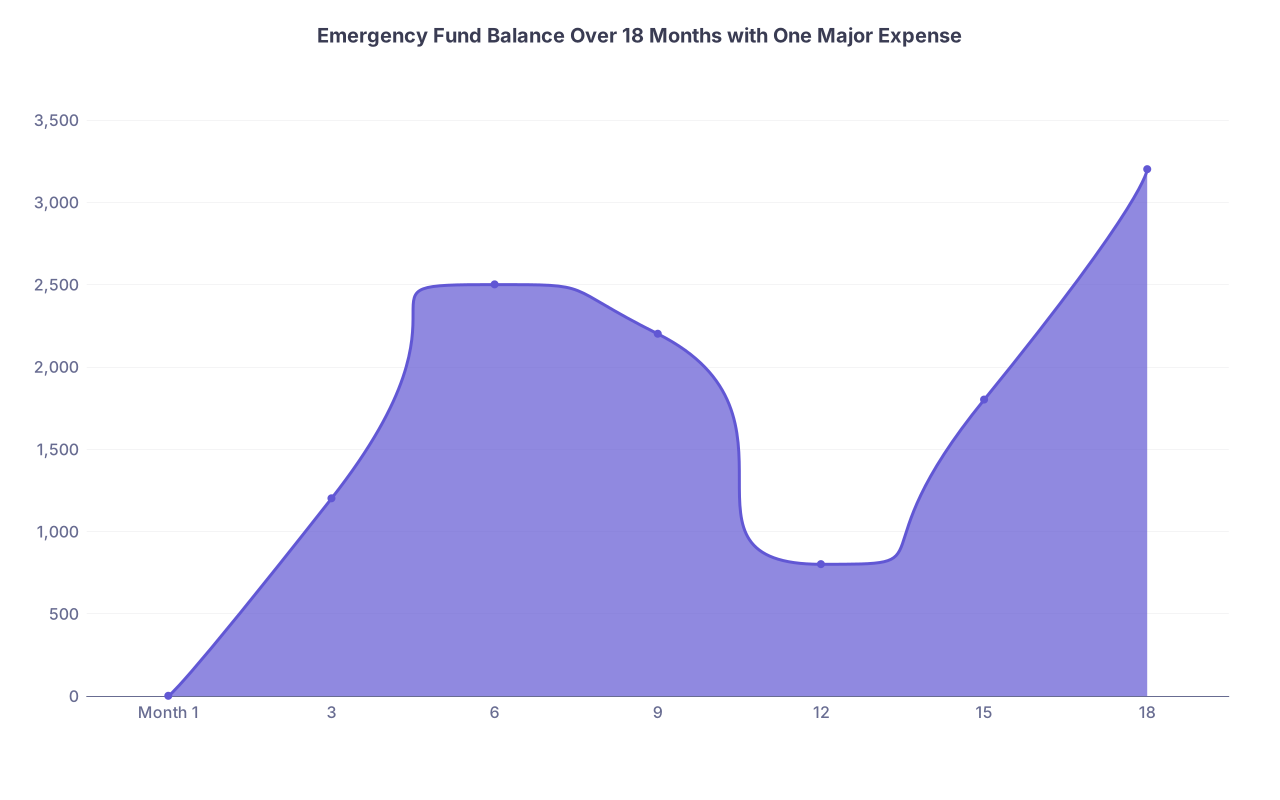
Here is what this looks like over time for many people:
| Category | Value |
|---|---|
| Month 1 | 0 |
| 3 | 1200 |
| 6 | 2500 |
| 9 | 2200 |
| 12 | 800 |
| 15 | 1800 |
| 18 | 3200 |
Month 9: big expense hits, fund dips from $2,200 to $800.
Months 10–15: rebuilding.
Month 18: stronger than before.
That is success, not failure. Using the emergency fund is the plan.
Step 8: Legal and Policy Angles You Cannot Ignore
There is a “financial” side to this, and there is a “rules of the game” side. Ignore the latter and you can sabotage yourself.
1. Federal vs private is not just a label
Federal loans:
- Eligible for income-driven repayment, deferment, forbearance.
- Eligible for forgiveness programs (SAVE forgiveness, PSLF, etc.).
- Much more flexible structure in a crisis.
Private loans:
- Contract-driven. Whatever is in your promissory note rules.
- Limited forbearance options; often discretionary and short-term.
- No statutory forgiveness.
Translation:
Federal loans deserve more patience and strategy. Private loans deserve more aggression if their rates are high and flexibility is low.
2. Do not default your way into an “emergency”
Skipping federal loan payments to “build savings” is playing with fire:
- You can get hit with collection fees, wage garnishment, tax refund seizure.
- You wreck your credit, which makes actual emergencies harder to handle (try getting an apartment with a default on file).
If you are truly strapped:
- Call your servicer.
- Get on or recertify income-driven repayment.
I have seen people qualify for payments under $50 when income is low.
3. Protecting your cash
- In most states, funds in checking/savings are not legally “protected” from all creditors if they get a judgment against you.
- Federal student loan collectors have special powers (like tax refund seizure) but do not typically freeze bank accounts directly for active, compliant borrowers.
Bottom line:
The bigger immediate legal risk is defaulting on debts, not having a few thousand in a savings account.
Step 9: Concrete Example — Putting It All Together
Let us walk through a realistic scenario.
You:
- Take-home pay: $3,800 per month
- Rent + utilities: $1,300
- Food + transport + basic bills: $900
- Total essentials: $2,200
Student loans:
- Federal loans: $40,000 at 4.8%, minimum $220
- Private loan: $18,000 at 8.5%, minimum $220
- Total minimum student loan payments: $440
Other:
- Credit card: $1,200 at 22%, minimum $40
- Savings today: $150
Step 1: Calculate what you have to work with
Take-home: $3,800
Minus essentials: $2,200 → $1,600 left
Minus minimum debt payments ($440 + $40): $480 → $1,120 left
So $1,120 is your “active choice” money.
Step 2: Set your emergency fund target
Bare-bones monthly (if life got ugly): You could trim a bit:
- Rent + utilities: $1,300
- Food + transport: $650
- Phone/Internet: $150
- Minimum debt payments: $480
- Bare-bones: about $2,580 → call it $2,600
Core fund target: $2,600
Starter target: $1,000
You are at $150 now.
Step 3: Months 1–3 — Starter fund sprint
For the first three months:
- 70% of $1,120 → Emergency fund = $784
- 20% of $1,120 → Extra on credit card = $224
- 10% of $1,120 → Flex money = $112
Month 1:
- Emergency fund: $150 + $784 = $934
- Credit card: $1,200 - $224 - $40 (min) ≈ $936
Month 2:
- Emergency fund: $934 + $784 = $1,718 (starter goal passed)
- Credit card: $936 - $224 - $40 ≈ $672
Month 3:
- Emergency fund: $1,718 + $784 = $2,502 (almost at full core fund)
- Credit card: $672 - $224 - $40 ≈ $408
By end of Month 3:
- You have almost one month of bare-bones expenses saved.
- Your credit card balance is close to gone.
- You never missed a loan payment.
Step 4: Months 4–12 — Shift to 60/30/10 with clearer priorities
From Month 4 onward:
- 60% of $1,120 → Extra student loan payoff = $672
- 30% → Emergency fund = $336
- 10% → Flex = $112
First job: kill the credit card fully with two more months of $672 extra + minimized lifestyle. After that:
- Extra $672 goes to the private 8.5% loan until it is dead.
- The $336/month keeps slowly pushing your emergency fund past 1 month, then toward 2–3 months.
You stick to this for a year. You end up with:
- Credit card gone.
- Private loan much smaller or gone.
- Federal loans shrinking.
- A real emergency fund, not a story you tell yourself.
This is exactly what “both at the same time” looks like in real dollars.
Step 10: Simple Rules to Keep You Out of Trouble
Let me condense this into rules you can actually remember on a bad day:
Never stop minimum payments.
You cannot emergency-fund your way out of default damage.Build at least $1,000 fast.
Use a short sprint, then back off to a sustainable pace.Automate your savings and extra payments.
If it is not automatic, it is optional. If it is optional, you will skip it.Private high-rate loans do not get to live long.
Unless you are in a very special case, you attack these aggressively once you have a small buffer.Your emergency fund is allowed to go down.
That is not failure. That is success under stress. Then you rebuild.Change the ratios as your life changes, not your mood.
New job, new income, partner, kids, major move — fine, revisit the numbers.
Random Tuesday “I feel broke” — not a valid reason to blow up the plan.
Key Takeaways
- Stop choosing between saving and paying loans; design a fixed monthly split that does both and automate it.
- Build a starter emergency fund quickly, then grow to a core 1-month buffer while targeting your highest-risk debts.
- Use structure—separate accounts, automatic transfers, clear debt priority—to protect yourself from emergencies and get your student loans shrinking at the same time.