
The worst mistake you can make with delinquent med school loans is doing nothing.
If you are already delinquent on your student loan payments, you are not “a bad borrower.” You are in a bad system. But you still have to play the game correctly or it will eat you alive. I am going to walk you through exactly what to do, in order, to stop the bleeding and get control back.
Step 1: Stop the Panic Spiral and Get Your Facts in One Place
Do not call anyone. Do not fill out any new forms. First, you need a clean picture of what you are dealing with.
Here is what “delinquent” actually means:
Federal loans: You are delinquent the day after you miss a payment.
- At 90 days late: the servicer usually reports it to credit bureaus.
- At 270 days late: your federal loans typically go into default (much worse than delinquency).
Private loans: Each lender sets its own delinquency and default rules (often 90–180 days to default).
Your first job is to figure out three things:
- What loans do you have? (federal vs private)
- How late are you? (days delinquent)
- Who actually services each loan? (the company collecting payments)
Concrete actions for the next 60 minutes
Log into the federal system
- Go to StudentAid.gov and sign in.
- Under “My Aid”, download your full aid summary.
- Note for each loan:
- Type (Direct Unsub, Grad PLUS, Perkins, FFEL, etc.)
- Status (In repayment / Delinquent / Default / Forbearance)
- Servicer name and phone
-
- Use AnnualCreditReport.com (the legitimate free one in the U.S.).
- Pull from all three: Equifax, Experian, TransUnion.
- Look for:
- Private student loans not listed on StudentAid.gov
- Status: “late 30/60/90 days”, “charged off”, “collections”
Make a simple loan tracker
- Open a spreadsheet or a blank page and list:
- Lender/servicer
- Federal or private
- Balance
- Minimum monthly payment (if known)
- Status (current / delinquent + how many days / default)
- Phone number
- Open a spreadsheet or a blank page and list:
You cannot fix what you cannot see. This one exercise turns a vague sense of dread into a specific, solvable problem.
Step 2: Triage – Are You Delinquent or in Default?
You treat a 45‑day delinquency differently from a 320‑day default. The rules, protections, and options change.
| Status | Days Late (Typical) | What It Means | Priority Action |
|---|---|---|---|
| Current | 0 | Paid as agreed | Keep on IDR / auto-pay |
| Delinquent Light | 1–89 | Missed recent payment | Get into IDR or forbearance fast |
| Delinquent Severe | 90–269 | Reported to credit bureaus | Request IDR + retroactive forbear. |
| Default | 270+ | Full balance due, collections | Rehab / Fresh Start / consolidation |
How to check federal status precisely
On StudentAid.gov and your servicer’s site, look for:
- Words like “past due,” “delinquent,” “default,” “in collections.”
- Any reference to Fresh Start, Rehabilitation, or Collection agency.
For private loans, check:
- The lender’s portal for “serious delinquency,” “charged off,” “collections”.
- Your credit report for those same terms or collection agency names.
You should now be able to label each loan as:
- Federal – current
- Federal – delinquent
- Federal – default
- Private – delinquent
- Private – default/charged off/collections
Keep that in front of you. The next steps depend on those labels.
Step 3: For Federal Loans – Get Yourself Out of the Line of Fire
Federal loans give you tools. Most delinquent medical grads simply are not using them correctly.
There are three main levers:
- Income-Driven Repayment (IDR)
- Deferment/Forbearance
- Default resolution (Fresh Start, Rehab, or Consolidation)
3A. If you are delinquent but not yet in default
Your goal:
Get to $0 or affordable payments immediately and request that the delinquency be resolved.
Apply for an Income-Driven Repayment (IDR) plan today
- Go to StudentAid.gov → “Manage Loans” → “Repayment” → “Enroll in an IDR Plan.”
- For most med grads: SAVE (or REPAYE/SAVE if still in transition) is the best default choice.
- You will need:
- Last tax return or
- Recent pay stubs / proof of no income.
- If your income is low (resident, prelim year, or unemployed), your required payment can legally be $0. That still counts as “on time” for credit and for forgiveness tracking.
Call the servicer the same day
Script (approximate, use your own voice):
“I see I am currently delinquent on my federal loans. I have just submitted an application for an income-driven repayment plan. I cannot afford the current payment. I need to:
- Place my account in forbearance or reduced payment while the IDR is processed, and
- Discuss whether you can adjust the reported delinquency once I am in a qualifying plan.”
Ask for:
- Administrative forbearance while the IDR is pending.
- A clear explanation of how they will treat the delinquent months once you are on IDR.
Request backdated forbearance if appropriate
- If you had a legitimate hardship (residency pay gap, unmatched year, illness), ask:
“Can you apply a retroactive forbearance or deferment for the months I missed, to bring my account current?”
- They may not always say yes. But they do sometimes fix the timeline, especially for short gaps.
- If you had a legitimate hardship (residency pay gap, unmatched year, illness), ask:
-
- Once IDR is approved, enroll in auto-debit.
- You usually get a 0.25% interest rate reduction, and it prevents “oops I forgot” delinquencies.
3B. If your federal loans are already in default
Default is ugly, but it is not permanent. You have three main routes:
- Fresh Start (if still active)
- Loan rehabilitation
- Loan consolidation out of default
Use a quick decision flow:

| Step | Description |
|---|---|
| Step 1 | Loan in Federal Default |
| Step 2 | Use Fresh Start |
| Step 3 | Return to Current Status |
| Step 4 | Enter IDR Plan |
| Step 5 | Consider Rehab |
| Step 6 | Rehab or Consolidation |
| Step 7 | 9 On-time Payments |
| Step 8 | Default Removed |
| Step 9 | Direct Consolidation |
| Step 10 | Eligible for Fresh Start |
| Step 11 | Wage garnishment or tax offset? |
Option 1: Fresh Start (time-limited program)
The Department of Education has offered a Fresh Start initiative for defaulted federal loans (created during and after the pandemic forbearance). If it is still in effect when you read this, it is usually the best first move.
- Benefits often include:
- Loans moved out of default.
- Collections activity paused or stopped.
- Eligibility restored for IDR, deferment, and new aid.
- What you do:
- Go to StudentAid.gov and look for Fresh Start section.
- Or call the default resolution group number listed there.
- Opt in, then immediately set up IDR payments once the loans are transferred back to a servicer.
Option 2: Rehabilitation
If Fresh Start is not available or does not apply:
- You agree to make 9 reasonable, affordable monthly payments within 10 months.
- After successful rehab:
- Your loan is taken out of default.
- Some negative credit history tied to the default can be removed or updated to “current.”
Key points:
- Those “reasonable” payments can be as low as $5–$25 in some hardship cases.
- Get the payment amount and schedule in writing.
- Set those rehab payments to auto-debit. You miss one, you risk starting over.
Option 3: Consolidation
Another route:
- You consolidate defaulted loans into a new Direct Consolidation Loan.
- The new loan is not in default.
- You then immediately choose an IDR plan.
When to prefer consolidation:
- You want a faster path than 9 months of rehab.
- You need to clean things up quickly for:
- Licensing
- Credentialing
- A mortgage
- You understand that some technical forgiveness timelines may be affected differently than with rehab.
If you are pursuing Public Service Loan Forgiveness (PSLF) as a resident or attending at a qualifying institution, get clarity:
- For PSLF-focused borrowers, I often prefer:
- Consolidation → IDR → count all new payments toward PSLF.
Bottom line: pick one default resolution path and execute. Do not bounce between them randomly.
Step 4: For Private Loans – Contain the Damage and Negotiate Like an Adult
Private student loans are less forgiving. They do not care that you are in residency earning $64,000 and working 80 hours a week. Their contract is their contract.
But you still have options.
4A. If you are delinquent but not in default
Here is how you handle a phone call, step by step.
Prepare your numbers before calling
- Net monthly income (after tax).
- Essential expenses:
- Rent
- Food
- Transportation to work
- Insurance
- Minimum payments on higher-priority debts (federal loans, taxes, court-ordered obligations).
- What you can realistically afford monthly for this lender. Maybe that is $50. Maybe it is $300. Make it real.
Call and say this clearly
- Script:
“I see that my private loan is currently delinquent. I want to resolve this and avoid default, but I cannot afford the current payment. My monthly take-home pay is approximately $X. After basic living expenses and my federal loan obligations, I can reliably afford $Y per month toward this loan.
What options do you have for:- Temporary reduced payments,
- Extended repayment, or
- A new hardship plan?”
- Script:
Ask specifically about:
- Temporary hardship forbearance (short pause or reduced payment).
- Term extension (stretch the loan over more years to drop the monthly payment).
- Interest rate reduction (sometimes modest, but every bit helps).
- Any “modified repayment” programs they offer.
Get every agreement in writing
- Do not rely on “the rep said…”
- Ask them to:
- Send written confirmation of any new arrangement.
- Confirm how they will report your account to credit bureaus if you enter that arrangement.
4B. If your private loan is in default or in collections
Once private loans hit default:
- They can:
- Sue you
- Get a judgment
- Potentially garnish wages (depending on your state law)
- They also may be willing to negotiate settlements or structured deals.
Understand the hierarchy:
- Federal loans are usually legally higher priority (they have more powerful collection tools).
- Private lenders know this, and some will deal when they realize you legitimately cannot pay full freight.
Your playbook:
Do not agree to a payment you cannot sustain
- A common, dumb move: borrower agrees to $600/month “just to stop the calls,” then defaults again in 3 months. That weakens your position.
Ask about settlement options
- If the loan is already charged off or with collections, ask:
“Is there a settlement option for a lump-sum or structured settlement that resolves the entire debt?”
- Sometimes you will see offers like:
- “Pay 40–60% of the balance in lump sum.”
- Or “Pay $X/month for 36 months, then we consider it satisfied.”
- If the loan is already charged off or with collections, ask:
Do not drain essential protections
- Do not:
- Empty your entire emergency fund to settle a private loan if you are one car transmission away from disaster.
- Take on new high-interest personal loans or credit card debt to pay this off without a clear plan.
- Do not:
If you are being sued
- Do not ignore the summons.
- Talk to:
- A local consumer law attorney, or
- A legal aid organization if your income is low.
- Many states have defenses and negotiation levers that only appear once an attorney is involved.
Step 5: Protect Your License, Job, and Future Income
As a medical professional, you are not just dealing with credit scores. You are dealing with licensing boards, credentialing committees, and background checks.
5A. Know what actually shows up
- Credit report: Delinquencies, defaults, collections, and judgments.
- National Practitioner Data Bank (NPDB): Not student loan delinquencies, but malpractice, clinical privilege issues, and some adverse actions.
- State medical boards:
- Some states historically flagged federal loan defaults.
- Many have backed off aggressive policies, but do not assume.
Your defensive strategy:
Get every federal loan back to “current” status ASAP
- Through Fresh Start, rehab, or consolidation plus IDR.
- This alone can remove one of the biggest red flags.
Keep documentation
- Save:
- IDR approval letters.
- Rehab agreements.
- Settlement letters.
- If you ever get questions on a credentialing form, you can show:
- “Yes, I had issues. Here is the evidence I fixed them responsibly.”
- Save:
Be honest on forms
- If an application asks if you have defaulted, answer truthfully.
- Follow with a brief written explanation:
- Short residency income
- Family or medical hardship
- Then “Loan rehabilitated and now repaid under income-driven plan.”
The subtext here: institutions care more about whether you take responsibility and fix problems than whether you had a rough year financially.
Step 6: Stop the Cycle – Build a System That Does Not Let You Slide Again
Once you get out of delinquency, you must not repeat this every 12–18 months. That pattern destroys credit and peace of mind.
6A. Use automation ruthlessly
- Auto-pay for all student loans
- Federal: IDR amount (even $0 is tracked as active).
- Private: Whatever negotiated or minimum you have.
- Automated “pay yourself first”
- Set a monthly transfer, even $50–$100, into a dedicated “loan buffer” savings account.
- Use this to cover months you are short without missing payments.
6B. Build a simple monthly money check-in
This should take 15–20 minutes tops:
- Open:
- Bank account
- Credit cards
- Student loan accounts
- Ask:
- Do I see any “past due” messages?
- Is my contact info up to date everywhere?
- Is any IDR renewal due in the next 3 months?
Put a recurring monthly calendar event for this. Non-negotiable.
6C. Plan for changes in income
Your income as a medical professional is volatile:
- MS4 → gap → residency start
- Residency → fellowship or attending
- Locums, moonlighting, parental leave, disability, etc.
Each time your income shifts significantly, do this:
- Recalculate:
- New take-home pay
- New realistic federal IDR level
- Log into StudentAid.gov and re-certify IDR early if your income drops.
- Call private lenders proactively:
- “My income has temporarily decreased from $X to approximately $Y. I want to avoid delinquency. What hardship options can we set up now for the next 6–12 months?”
You are playing offense instead of defense.
Step 7: When You Should Bring in a Professional
There is a moment when DIY becomes dumb. Specifically:
- You have multiple defaulted loans (federal and private) and cannot track the moving parts.
- You are being sued or have a judgment.
- You are aiming for PSLF and already have a messy payment history.
- You are within 1–2 years of major life decisions (buying a house, starting a practice, partnership track) and your credit is a mess.
Here is who can actually help:
Student loan–focused financial planners
- Fee-only, fiduciary planners who specialize in physicians or high-debt grads.
- They build the full strategy:
- IDR choice
- PSLF vs private refinance
- Tax planning around forgiveness years.
Consumer law attorneys
- For:
- Lawsuits
- Collections abuses
- Questionable private lender behavior.
- Many do low-cost consultations.
- For:
Nonprofit credit counseling agencies
- Mostly for credit cards and non-student debt.
- Can sometimes help you prioritize what to pay first.
Notice who is not on this list: debt settlement companies that blast local radio ads and charge huge fees to “resolve all your debt.” I have seen them make things worse more often than not.
Quick Reality Check: What This Looks Like Over a Year
Here is how a realistic “from delinquent to stable” year can unfold.
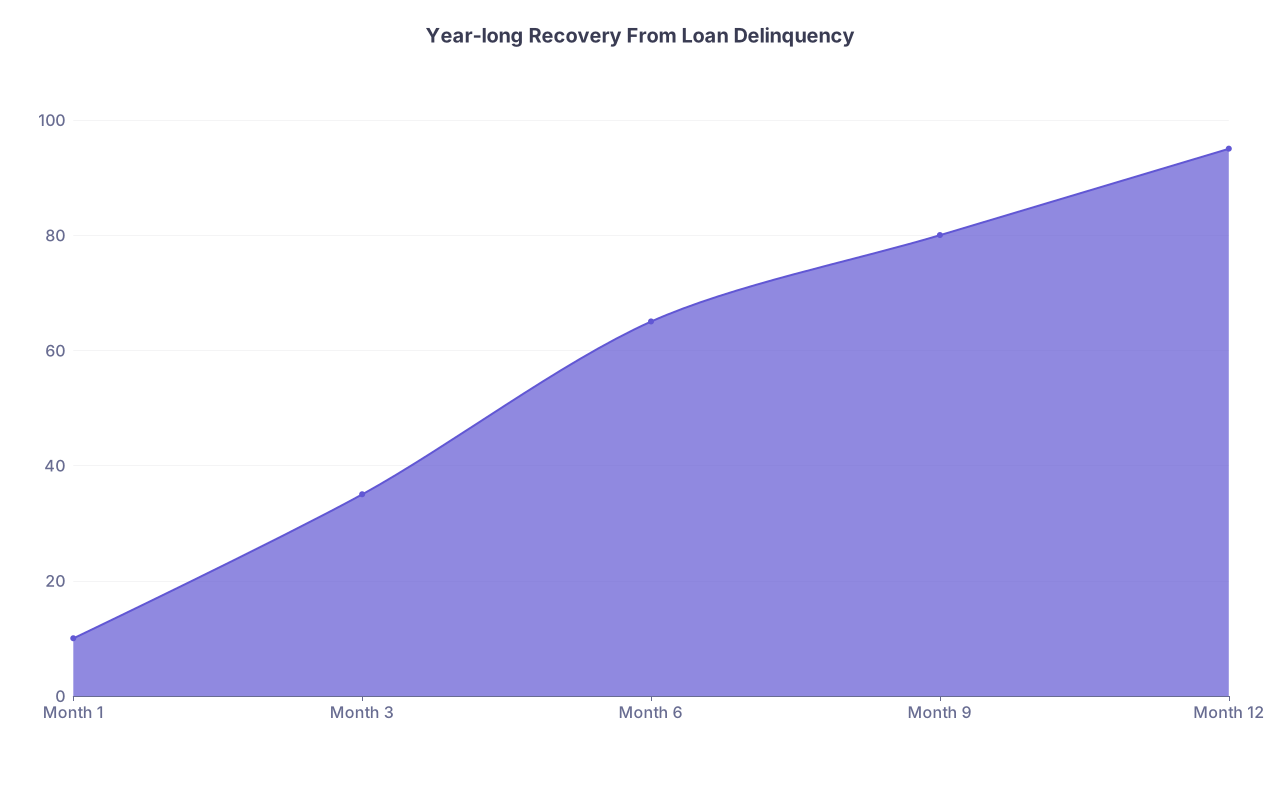
| Category | Value |
|---|---|
| Month 1 | 10 |
| Month 3 | 35 |
| Month 6 | 65 |
| Month 9 | 80 |
| Month 12 | 95 |
Think of the values above as “percent of your student loan situation under control”:
- Month 1:
- You have your full loan list.
- IDR application submitted.
- First calls to private lenders made.
- Month 3:
- Federal loans on IDR.
- Default resolution chosen and in progress if needed.
- Private loans in some form of hardship or modified plan.
- Month 6:
- No active delinquencies.
- One or more defaults cured or locked into a rehab/consolidation path.
- Month 9–12:
- Credit damage begins to normalize.
- Systems (auto-pay, buffer account, monthly check-ins) are in place.
- You are no longer waking up at 3 am thinking about loan notices.
Not heroic. Just methodical.
Visual: Your Action Plan on One Page
| Step | Description |
|---|---|
| Step 1 | Loan in Federal Default |
| Step 2 | Use Fresh Start |
| Step 3 | Return to Current Status |
| Step 4 | Enter IDR Plan |
| Step 5 | Consider Rehab |
| Step 6 | Rehab or Consolidation |
| Step 7 | 9 On-time Payments |
| Step 8 | Default Removed |
| Step 9 | Direct Consolidation |
| Step 10 | Eligible for Fresh Start |
| Step 11 | Wage garnishment or tax offset? |
Print that if you need to. Follow it box by box.
FAQ – Exactly 4 Questions
1. My loans are over 120 days late. Is it already too late to fix my credit?
No, it is not “too late,” but the damage is real. 90+ day delinquencies hurt scores a lot. What you can do:
- Get every loan back to current status (through IDR, forbearance, rehab, or consolidation).
- Ask your servicer—especially federal—for any retroactive forbearance to adjust reported delinquencies (no guarantee, but sometimes granted).
- Keep perfect payment history going forward for 12–24 months.
Lenders care both about the mistake and the pattern afterward. A single rough year is survivable. A decade of chaos is harder to explain.
2. I am starting residency soon and cannot afford standard payments. Should I just ignore notices until I am paid more?
No. Ignoring them is exactly how you go from “annoying problem” to “default and collections.” Instead:
- Before or right when you start residency, enroll in an IDR plan. With resident income, your payment often drops dramatically, sometimes to near $0.
- Call private lenders and proactively set up residency hardship or extended-term plans. Many have them, but they do not advertise them loudly. The point: use your low income to your advantage legally, instead of letting the system punish you by default.
3. Will defaulting on my federal loans stop me from getting/keeping my medical license?
It can create issues, but it is rarely an automatic career death sentence. Historically, some states could discipline physicians for defaulted federal loans. Many have eased that stance, but an unresolved default still looks bad on any background or credentialing review. Your defense is simple:
- Get the loans out of default (Fresh Start, rehab, or consolidation).
- Keep documentation showing that they are now in good standing. If a board ever asks, you show that you had a problem and you handled it like a responsible professional.
4. I am considering refinancing my loans, but I am delinquent. Should I refinance now to get better rates?
Refinancing while delinquent is usually a fantasy. Private refinance lenders want:
- Clean payment history
- Decent credit score
- Stable income
Delinquency wrecks all three from their perspective. The realistic order is:
- Stabilize federal loans with IDR (and default resolution if needed).
- Resolve or at least bring current any private loans.
- Spend 12–24 months building a clean payment record and improving your credit. Then you reevaluate refinancing—especially for high-interest private loans—not before.
Open your loan tracker right now and mark each account with one of three labels: “federal – delinquent,” “federal – default,” or “private – delinquent/default.” Once that is done, take the next single step from the relevant section above—today, not this weekend.