The myth that “your credit is ruined forever after default” is nonsense. You can rebuild it during training—if you stop guessing and follow a strict plan.
You got hit during school or residency. Forbearance stretched too long. Maybe payments were missed. Maybe you slipped into default. Now you are staring at:
- Delinquencies or default on your credit report
- A FICO score that dropped 80–150 points
- Anxiety every time someone runs your credit (apartment, car lease, even some jobs)
You are not alone. I have seen PGY1s who did not even know their loans were in default until they got denied for a basic credit card. The damage is real—but it is fixable.
Here is the blunt truth:
Rebuilding credit after forbearance or default is not about “magic disputes” or “credit hacks.” It is about:
- Stabilizing the loans
- Cleaning up the mess on your credit reports
- Building a track record of on-time payments
- Avoiding new landmines during training
I will walk you through this in a way that works with a trainee schedule and income.
Step 1: Identify Exactly What Happened to Your Loans
Before you rebuild anything, you have to know what you are rebuilding from. “I think I was in forbearance” is not a plan.
1. Pull all three credit reports
Use AnnualCreditReport.com (the official one) to get:
- Experian
- Equifax
- TransUnion
Download them as PDFs. Save them to a secure folder. Name them with the date.
What you are looking for:
- Student loan accounts listed as:
- “Forbearance”
- “Deferment”
- “Delinquent” (30/60/90/120+ days late)
- “Collections”
- “Default” or “Claim filed with government”
- Dates of first delinquency
- Current status: open/closed, transferred, sold
Highlight every student loan entry, federal and private.
2. Confirm federal loan status with the source
Go to your official federal login:
- studentaid.gov
Check:
- Which servicer currently has your loans (MOHELA, Nelnet, Aidvantage, etc.)
- Loan types (Direct, FFEL, Perkins, Grad PLUS)
- Current status:
- In repayment
- In-school / grace
- Deferment
- Forbearance
- Default
- Fresh Start eligible (if applicable—more on this later)
If your federal loans show as “Default” or “In collections,” you may see:
- A “Default Resolution Group” or similar collections entity
- Balance that looks larger than you remember (fees, interest, capitalization)
3. Confirm private loans separately
Private loans will not show on studentaid.gov.
You may find them:
- On your credit reports under names like Sallie Mae, Navient, SoFi, Discover, Citizens, etc.
- In old emails or mailed statements
- Through your bank statements (look back for monthly loan payments that stopped)
Call each private lender and ask:
- Current status (good standing, delinquent, charged-off, in collections)
- Total balance
- Interest rate
- Whether the account has been sold to a third-party collector
Document every call. Date, time, person you spoke to, and what they said.
Step 2: Stabilize the Federal Loans First (They Drive Most of Your Credit Damage)
Federal loans give you the most structured way to dig out. Use it.
Scenario A: You are in or coming out of forbearance (but not in default)
If your loans are just in forbearance—not default—you are in better shape than you think.
Here is the issue:
Long-term forbearance during training often leads to:
- Ballooning balances from accumulating interest
- Missed chance to build positive payment history
- Potential delinquency if forbearance was not renewed correctly
Your move now is to re-enter a real repayment plan that fits your resident income.
Action plan:
Log into studentaid.gov
Use the “Loan Simulator” to compare income-driven repayment (IDR) options:
- SAVE (replacing REPAYE in many cases)
- PAYE (if still eligible)
- IBR (older but still used sometimes)
For a typical resident income (say $60,000–75,000), IDR often gives:
- Manageable monthly payments (sometimes <$200–300)
- Payment counts that can later qualify toward PSLF or forgiveness
- Protection from runaway interest under newer rules (especially under SAVE)
Enroll in IDR and set up autopay. This is non-negotiable for credit rebuilding.
30 straight months of on-time autopay on your federal loans is one of the strongest positive signals you can send to FICO.
Scenario B: You are in default on federal loans
This is where most trainees panic. Do not. Federal default has clear exit paths.
You likely have three options:
- Fresh Start (time-limited program if still in effect)
- Loan rehabilitation
- Direct Consolidation Loan
Option 1: Fresh Start (if eligible)
If the federal Fresh Start initiative is still active for you, it is usually the best move.
What Fresh Start can do:
- Return defaulted loans to “current” status
- Remove default notation from your credit report
- Move loans back to a regular servicer
- Allow you to enroll directly into IDR
Your job:
- Check studentaid.gov or call the Default Resolution Group to see if you qualify
- If yes, follow the instructions exactly and do not delay—these programs do not stay open forever
- Once loans are out of default, immediately set up IDR + autopay
Option 2: Rehabilitation (if Fresh Start is not available)
Rehabilitation is the classic path out of default.
How it works, in plain English:
- You agree to make 9 on-time, reasonable payments in 10 months
- “Reasonable and affordable” payments are based on income, sometimes as low as $5–$50/month for residents with tight budgets
- After successful rehab:
- Default status is removed from your credit report
- The loan is transferred back to a servicer
- You can then enroll in an IDR plan
Key points:
- Those 9 payments must be on time. Miss more than one and you can blow the rehab.
- The late payment history before default may still appear, but the default status itself is removed. That is huge for your score.
Call the Default Resolution Group or your collection agency and say:
“I am a medical resident with limited income. I want to get out of default through loan rehabilitation and need to set up a reasonable and affordable payment amount.”
Get the payment amount, date, and method in writing if possible.
Option 3: Direct Consolidation Loan
Consolidation can also pull you out of default more quickly, but with tradeoffs.
You apply for a Direct Consolidation Loan and agree to repay under:
- An income-driven plan, or
- A standard repayment plan
Once processed:
- The defaulted loans get rolled into a new consolidated loan
- The default status is resolved, but unlike rehab, the old negative history usually remains on your report
When to consider consolidation:
- You need to fix default status fast (for credentialing, licensing, mortgage, etc.)
- You cannot reliably commit to 9 rehab payments in 10 months
- You want to simplify many loans into one
Do not consolidate without understanding PSLF implications if you plan on it. Some old payment credits can be lost if you consolidate at the wrong time.
Step 3: Deal with Private Loans Without Letting Them Wreck You
Private loans do not have the forgiving structure of federal loans. They are more rigid, more aggressive, and more credit-sensitive.
If private loans are current but heavy
You are not in disaster territory yet. Your credit just reflects high balances and maybe high utilization.
Your job:
- Do not miss payments. Set up autopay.
- If cash flow is tight during residency, call and ask about:
- Temporary interest-only payments
- Term extension to lower monthly payments
- Hardship options (some lenders have trainee/resident-specific programs)
You are not trying to optimize interest right now. You are trying to survive training without a 30-day late mark that will crush your score.
If private loans are delinquent or in collections
Now we are in damage control.
What to know:
- 30-day lates hurt, 60- and 90-day lates hurt worse, and charge-offs or collections leave long scars.
- Unlike federal loans, there is no official “rehab” process. Everything is negotiation.
Action plan:
Get full details from the lender or collector:
- Total balance
- Status (delinquent vs. charged-off vs. in collections)
- Any lawsuit or judgment activity
For active accounts (not yet charged off):
- Try to bring them current if possible
- Ask explicitly:
“If I bring this current or set up a payment plan, will you agree to stop negative reporting and reflect the account as current?”
Get any promises in writing.
For charged-off or collection accounts:
- You are negotiating from a weaker position, but you still have leverage:
- They want money. You have some money, just not much as a trainee.
- Discuss:
- Settlement for less than full balance, or
- Payment plan with a “pay for delete” agreement (they remove the tradeline upon full settlement)
Many collectors will say “We do not do pay for delete.” Some do. Some will hint at “We will update to ‘paid in full’ or ‘settled’” instead. Even that is better than unpaid.
- You are negotiating from a weaker position, but you still have leverage:
Whatever you negotiate, insist on a written agreement before you send a cent.
Step 4: Clean Up Your Credit Report Like a Professional
Once your loans are stabilized or on a path out of default, now you turn to the actual credit rebuilding.
1. Identify factual errors worth disputing
Common errors after forbearance or default:
- Late payments reported during a period that was properly in forbearance or deferment
- Duplicate tradelines for the same loan (often after transfers)
- Status not updated after rehab, Fresh Start, or consolidation
- Wrong dates of first delinquency
You are not disputing truthful negatives (“I missed six months of payments”). That rarely works and sometimes backfires.
You are targeting things that are simply wrong.
2. Dispute with precision, not emotion
Dispute online or by mail with each bureau:
- Experian
- Equifax
- TransUnion
Your dispute letter should:
- Identify the account (loan ID, lender, last four digits)
- State exactly what is wrong
- Provide documentation (forbearance approval letters, rehab completion, consolidation confirmation)
Example line:
“This account was in an approved forbearance from 07/01/2023 to 06/30/2024, yet your report shows 60-day and 90-day late payments during that period. Please correct this to show ‘current’ with no late payments during the forbearance period.”
Set a reminder to check back in 35–45 days. If the correction does not appear, follow up. Do not assume they did their job.
Step 5: Build Positive Credit Lines Strategically (Not Recklessly)
You cannot rebuild credit with loans alone. You need a mix of revolving credit (cards) and installment credit (loans) managed well.
During training, you want low risk, high reward moves.
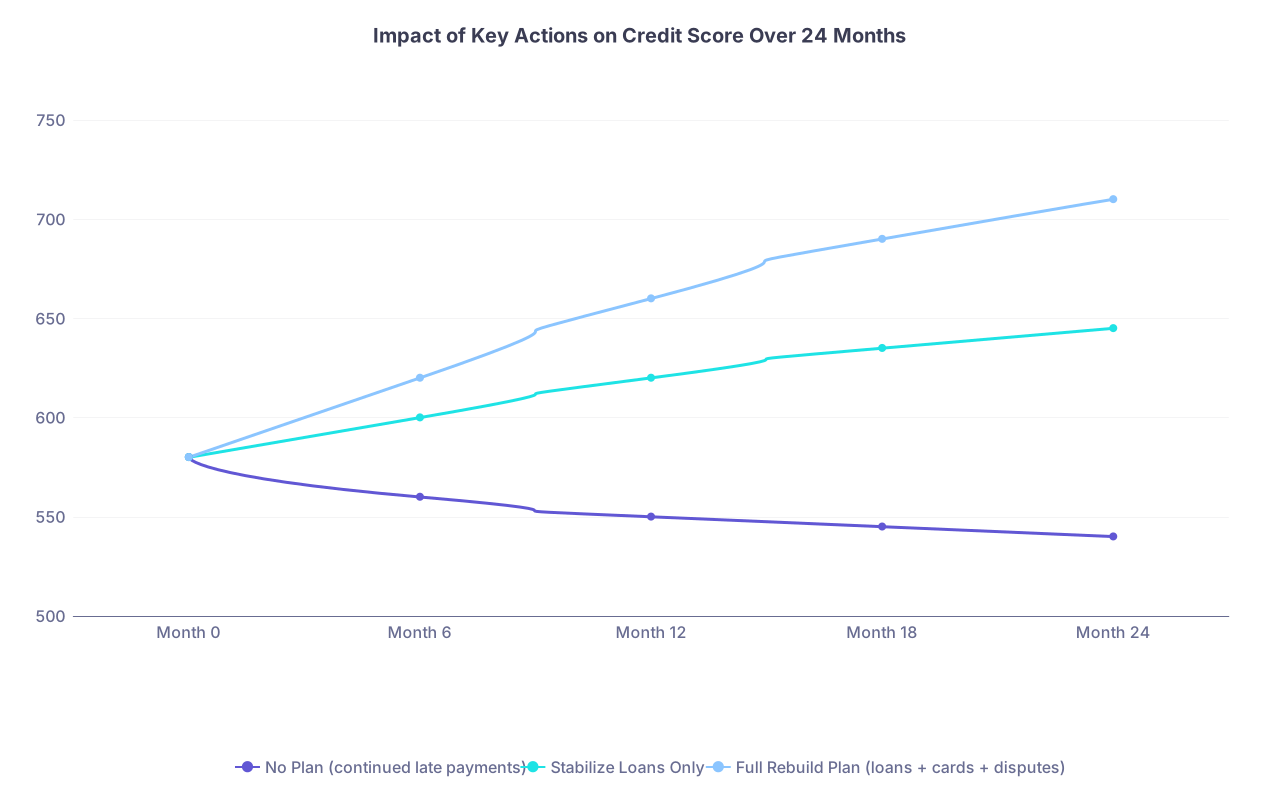
| Category | No Plan (continued late payments) | Stabilize Loans Only | Full Rebuild Plan (loans + cards + disputes) |
|---|---|---|---|
| Month 0 | 580 | 580 | 580 |
| Month 6 | 560 | 600 | 620 |
| Month 12 | 550 | 620 | 660 |
| Month 18 | 545 | 635 | 690 |
| Month 24 | 540 | 645 | 710 |
1. Get at least one low-limit card you can handle perfectly
If you already have a card:
- Keep it open if possible (aging your accounts helps)
- Set one small recurring charge (e.g., Netflix, $20–30/month)
- Put autopay to pay statement balance in full every month
If you were denied or are starting from scratch:
- Apply for a secured credit card from a bank or local credit union:
- You put down a deposit (e.g., $200–$500)
- That becomes your credit limit
- It reports like a normal card to all three bureaus
Your only job with this card:
- 3–5 small charges per month (gas, groceries)
- Utilization under 10–20% of limit
- Autopay in full every month
Do this for 12–18 months. It is boring. It works.
2. Consider one additional card after 6–12 months
Once your score improves and your primary card is spotless:
- Add one more card, preferably a non-predatory one:
- Credit union card
- Entry-level card from a major bank
Two well-managed cards are usually enough during training. More than that invites chaos and missed payments at 2 a.m. post-call.
Step 6: Control the Variables That Quietly Tank Your Score
People obsess over the default mark and ignore the things that quietly keep their score 40–60 points lower than it could be.
Key levers you can actually control
| Factor | Target During Training |
|---|---|
| Payment history | 100% on-time (no 30-day lates) |
| Credit utilization ratio | Under 30%, ideal under 10% |
| Number of open cards | 1–3, managed flawlessly |
| New hard inquiries | Max 2–3 per year if possible |
| Collection accounts | Settle or pay with strategy |
On-time payments
- One 30-day late can drop your score more than 60–90 points.
- So: autopay on everything: loans, cards, utilities where possible.
Utilization (how much of your card limits you use)
- Keep total utilization under 30%. Under 10% is better.
- If you have a $500 secured card, do not put $450 on it and float it. Use $50–$100 and pay it off.
Hard inquiries
- Every new credit application can ding your score a few points.
- Cluster applications when needed (e.g., apartment + one card in the same month), then cool off.
Old accounts
- Do not close your oldest card “because I never use it.” Use it once every few months to keep it alive. Age matters.
Step 7: Work This Plan Around a Resident / Trainee Schedule
You do not have long afternoons for financial projects. You have 12–28 hour calls and charting after midnight. So you need a tight protocol that fits your life.
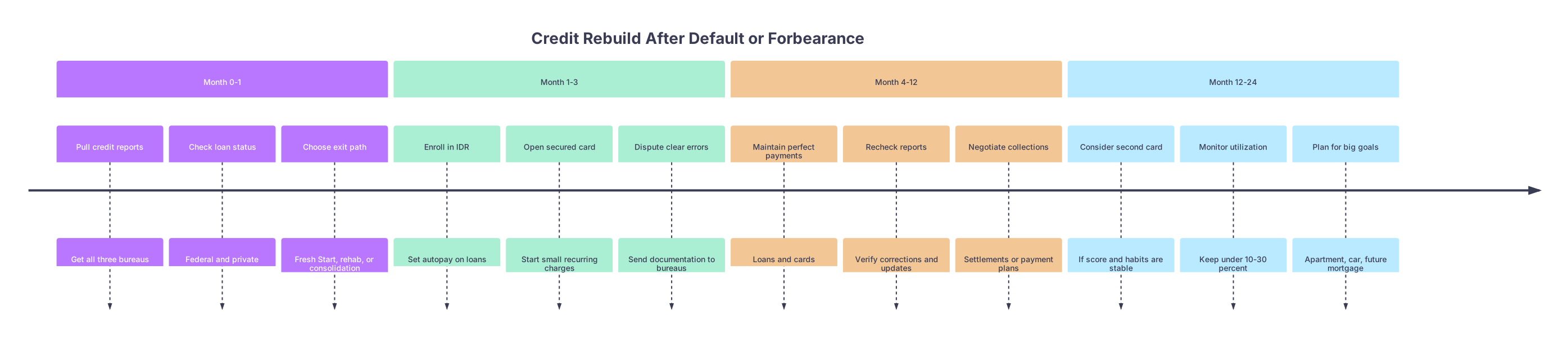
Here is a realistic structure:
| Period | Event |
|---|---|
| Month 0-1 - Pull credit reports | Get all three bureaus |
| Month 0-1 - Check loan status | Federal and private |
| Month 0-1 - Choose exit path | Fresh Start, rehab, or consolidation |
| Month 1-3 - Enroll in IDR | Set autopay on loans |
| Month 1-3 - Open secured card | Start small recurring charges |
| Month 1-3 - Dispute clear errors | Send documentation to bureaus |
| Month 4-12 - Maintain perfect payments | Loans and cards |
| Month 4-12 - Recheck reports | Verify corrections and updates |
| Month 4-12 - Negotiate collections | Settlements or payment plans |
| Month 12-24 - Consider second card | If score and habits are stable |
| Month 12-24 - Monitor utilization | Keep under 10-30 percent |
| Month 12-24 - Plan for big goals | Apartment, car, future mortgage |
Weekend 1
- Pull reports, log into studentaid.gov, list all loans with status.
Weekend 2
- Call Default Resolution Group / servicers, choose rehab vs. consolidation vs. Fresh Start.
- Apply for one secured card if needed.
Weekend 3–4
- Set up autopay on everything.
- Draft and submit disputes for any clear reporting errors.
After that, you are in maintenance mode:
- 10 minutes once a month:
- Log into your bank and verify autopays posted
- Glance at credit card utilization
- Check that no new derogatory items appeared (use free monitoring tools)
What Improvement Can You Realistically Expect?
No fluff here. This is the pattern I have seen repeatedly when people actually follow the plan.
Starting point: FICO in the mid-500s to low 600s, with:
- Federal default
- Some lates on private loans or cards
- High anxiety about every credit pull
With a disciplined 18–24 month rebuild:
- Resolve federal default (Fresh Start/rehab/consolidation)
- Get loans into IDR with perfect on-time payments
- Add 1–2 clean credit cards with low utilization
- Dispute and correct genuine errors
You can often reach:
- Mid-600s within 12 months
- High-600s to low-700s in 24–36 months if you avoid new mistakes
Is it instant? No.
Is it salvageable during residency? Yes—if you stop bleeding and start building.
Common Pitfalls to Avoid (I See These Constantly)
Ignoring mail from servicers or collectors
- Silence is how you end up with wage garnishment, tax refund seizure, or a lawsuit.
Relying on “credit repair” companies to fix what you caused
- Most of them dispute everything blindly. It may generate noise but rarely creates sustainable improvement.
- You still need stable loans and on-time payments.
Opening 4–5 new cards to “build credit faster”
- That is how overstretched interns create a new disaster. Two cards, done right, beat five cards in chaos.
Putting everything on forbearance during residency “to think about later”
- Later never comes. Interest compounds. You waste years of potential IDR payment credit and positive history.
Your One-Page Action Checklist
Print this. Tape it above your desk.
Week 1–2
- Pull all three credit reports from AnnualCreditReport.com
- Log into studentaid.gov and list each federal loan + status
- Identify any private loans and their status
- If in default on federal loans, choose:
- Fresh Start
- Rehab
- Consolidation
Week 3–4
- Enroll in an income-driven repayment plan (IDR) for federal loans
- Set up autopay for all loans
- Open one secured / low-limit credit card if you have none
- Put 1–2 small recurring charges on that card
- Set autopay to full statement balance
Month 2–3
- Identify any inaccurate late payments or statuses on your reports
- Submit targeted disputes with documentation to all three bureaus
- Contact private lenders about hardship options or realistic payment plans
Month 4–12
- Maintain 100% on-time payments
- Keep card utilization under 30%, ideally under 10%
- Recheck credit reports every 4–6 months
- Negotiate any remaining collections or charged-off accounts
Month 12+
- Consider one additional card only if your habits are solid
- Begin planning for bigger goals (car, apartment, eventual home mortgage) using your new score as leverage