
You have three browser tabs open: your loan servicer, your checking account, and a FIRE subreddit thread telling you to live on rice and beans and pay off everything in 12 months. Your calculator says if you throw almost every free dollar at debt, you could wipe out your loans in a year or two. Your stomach says: that looks like misery.
You want a “debt sprint” year. But you also want to stay solvent, sane, and not destroy your relationships or your health.
Good. Because the “go broke to kill debt” mindset is how people end up right back where they started—plus a side of burnout and resentment.
Here is how you design a deliberate, aggressive, but sustainable debt sprint year. Step by step. With real numbers, real constraints, and built‑in guardrails against financial collapse.
1. Get Clear On What a “Debt Sprint Year” Actually Is
A debt sprint year is not:
- You cancel every joy, live in darkness, and survive on instant noodles.
- You drain every emergency fund dollar “because interest.”
- You make random huge payments whenever you feel guilty.
A proper debt sprint year is:
- Time‑boxed: 6–18 months with a clear start and end date.
- Goal‑based: specific payoff or reduction target, not “throw extra at it.”
- Rule‑driven: pre‑decided limits for spending, saving, and payoff.
- Reversible: you can ease off without wrecking your finances.
Think of it like a training plan for a race. Intense. Structured. With built‑in rest so you do not blow a hamstring.
Your sprint year needs three numbers locked in before you start:
- Minimum Survival Number – what it truly costs you to live.
- Security Floor – emergency fund and non‑negotiable savings you will not cross.
- Sprint Payment Target – how much, per month, you will send to debt.
We will build those next.
2. Map Your Real Financial Floor (No Fantasy Budgets)
Before you talk about “extra,” you need to know the bare minimum cost of your current life. Not the life you think you “should” have. The one you are actually living in.
Step 1: Build a ruthless but honest monthly baseline
Pull the last 3 months of transactions (bank + credit cards). Average them. Then classify:
Fixed essentials (must keep to function):
- Rent / mortgage
- Utilities (power, water, internet, phone)
- Required insurance (health, disability, car, renter’s)
- Transportation to work (gas, transit, parking, tolls, basic car maintenance)
- Minimum loan payments (student, car, credit cards)
- Child support or legally required payments
Variable essentials:
- Groceries
- Basic household supplies
- Medical copays / meds
- Commuting extras (occasional Uber when transit fails, etc.)
Discretionary (everything else):
- Eating out
- Subscriptions (streaming, apps, gyms, boxes)
- Travel
- Clothes beyond basic replacement
- Hobbies, entertainment, gifts beyond a core minimum
You want two numbers:
- Fixed Essentials Total
- Variable Essentials Average
Add them: that is your Baseline Essential Spend.
Now strip the discretionary stuff to a realistic minimum, not zero. You are designing for 12 months, not 12 days.
Typical reasonable cuts:
- Eating out 6x/month → 2x/month
- 5 subscriptions → 1–2 you actually use
- Travel → 1 pre‑planned low‑cost trip instead of 3 random ones
- Shopping → a fixed monthly “personal” budget
You decide your Lean Discretionary Budget. Be firm, not masochistic.
Then:
Survival Number = Baseline Essential Spend + Lean Discretionary Budget
This is what it costs to live a life you can tolerate for a year.
3. Set Your Security Floor So You Do Not Blow Yourself Up
This is where many people get reckless. They say, “I’ll just drain my emergency fund; then I’ll rebuild it later.” Then the car dies or they get laid off.
You are sprinting, not gambling.
You need three protections:
-
- If you are in a stable job: 3 months of Survival Number.
- If you have variable income (1099, PRN, self‑employed): 4–6 months.
- This money is untouchable for debt. That is the rule.
Mandatory Long‑Term Savings (yes, even in a sprint)
If you have an employer match on retirement and you skip it to pay extra on a 4–6% loan, that is a bad trade.- Contribute enough to get the full employer match. Non‑negotiable.
- If you have no match: I still recommend a minimum 5% of income to retirement in a sprint year, unless you are literally in emergency triage (collections, high‑risk debt).
One‑Time Big Expense Reserve
Look 12 months ahead and list big known costs:- Car registration, insurance premiums if paid semi‑annually
- Planned move
- License renewal, board exams, professional dues
- Weddings / travel you are committed to
Add them up. Divide by 12. That monthly amount becomes a sinking fund line in your budget. That is not optional if you actually want to survive the year without new debt.
Put those together:
Security Floor = Emergency Fund + Retirement Contributions + Sinking Funds
The rule: sprinting never pulls from the security floor. You do not cut below these.
4. Decide If a Debt Sprint Year Even Makes Financial Sense
Here is the part most “kill your debt at all costs” advice skips: sometimes sprinting is mathematically dumb.
You should only sprint hard on debt if at least one of these is true:
- High‑interest debt:
- Any balance above ~8% interest is sprint‑worthy.
- 6–7% can justify a sprint if you are highly debt‑averse.
- Psychological leverage:
- You have multiple debts and clearing 1–2 will free up serious cash flow and mental bandwidth.
- Timing advantage:
- You want to qualify for a mortgage, refinance, or switch jobs; lower monthly payments help.
But if:
- Your loans are all federal, on income‑driven repayment (IDR), with forgiveness in play (PSLF or 20–25 year IDR), and
- Your effective interest rate after subsidies is low,
then a hard sprint might hurt more than it helps.
To make this concrete:
| Situation | Sprint? |
|---|---|
| Credit cards at 19% APR | Yes, aggressively |
| Private student loans at 8–10% | Yes, strong candidate |
| Federal loans at 6.8%, no PSLF, stable job | Often yes |
| Federal loans, enrolled in PSLF | Usually no (focus on payments + savings) |
| 0% promo balance for 12 months | Conditional (pay off before promo ends) |
If you are in a PSLF or long‑term forgiveness path, your “debt sprint” may actually be:
- Building your emergency fund
- Maxing retirement to reduce AGI (and thus IDR payments)
- Saving for the eventual tax bomb on forgiveness
Different sprint. Same discipline.
5. Do the Math: How Big Can Your Sprint Payment Be?
Now we put it together.
Step 1: Total Monthly Income
Take your average monthly net income (after tax, after health insurance, etc.). If it fluctuates:
- Use a 12‑month average,
- Or pick your worst of the last 6 months as your “guaranteed” base.
Step 2: Subtract Non‑Negotiables
From income, subtract:
- Survival Number (from earlier)
- Retirement contributions (at least to match)
- Sinking fund contributions (annual/big expenses)
- Any mandatory savings (for a near‑term move, tuition, etc.)
What is left is:
Potential Sprint Money = Income – (Survival Number + Mandatory Savings)
This is the theoretical maximum you could throw at debt monthly.
Now apply a sanity check.
You almost never want to live at 0 buffer.
Set a rule:
- Use 80–90% of Potential Sprint Money for extra debt payments.
- Keep 10–20% as a monthly buffer or “life happens” fund.
So:
Sprint Payment Target = 80–90% of Potential Sprint Money
Let’s anchor with numbers.
Say:
- Net income: $5,000 / month
- Survival Number: $3,000
- Retirement to get full match: $300
- Sinking funds (car, license fees, planned trip): $200
Potential Sprint Money = 5,000 – (3,000 + 300 + 200) = $1,500
Use 85% → Sprint Payment Target = 0.85 × 1,500 = $1,275
That means:
- You pay minimums on all debts, plus
- An extra $1,275 each month, directed by your payoff plan (avalanche/snowball), and
- You keep $225 as a small monthly flex/buffer.
6. Choose the Right Debt Strategy for Your Sprint Year
A sprint year is not the time for improvisation. You pick one system and stick to it.
Option A: Avalanche (financially smarter)
- Pay minimums on every debt.
- Put all extra on the highest‑interest balance first.
- When that is gone, roll its payment into the next highest.
You pay the least total interest. This is the most rational for large balances and longer payoffs.
Option B: Snowball (psychologically powerful)
- Pay minimums on every debt.
- Put all extra on the smallest balance first.
- When that is gone, snowball onto the next smallest.
You get wins faster. For a sprint year where motivation is a risk, this often works better.
If your loans are mostly similar interest rates (e.g., 5–7%), I have no problem telling you: use snowball. The increased engagement is worth the tiny extra cost.
Use whatever tool: spreadsheet, Undebt.it, YNAB, Monarch, whatever you like. But put it in writing:
- Month 1–3: target X loan
- Month 4–8: target Y
- Month 9–12: target Z
Even if the numbers end up off by a month, you know the path.
7. Build a 12‑Month “Debt Sprint” Calendar
Now we turn this into a plan you can follow, not a vague budget.
You want a year‑long calendar with:
- Payment dates and target amounts
- Known big expenses
- Planned lifestyle exceptions (e.g., a wedding, a milestone trip)
- Review checkpoints
Here’s the structure.
Step 1: Fixed Monthly Rhythm
Pick:
- One primary debt payment day each month, ideally right after payday.
- One budget check‑in day mid‑month.
Make the extra payment automatic for the Sprint Payment Target. If you want to add more manually, fine. But the base sprint amount is not negotiable.
Step 2: Plot Known Disruptions
Take out a 12‑month calendar. Mark:
- All annual/irregular bills from your sinking fund list.
- Any known income drops (rotations, unpaid leave, maternity, switching jobs).
- Any non‑negotiable travel or events.
This tells you which months are tight and where you may:
- Temporarily lower the sprint payment a bit, or
- Increase it in “easy” months to compensate.
Step 3: Set Review Points
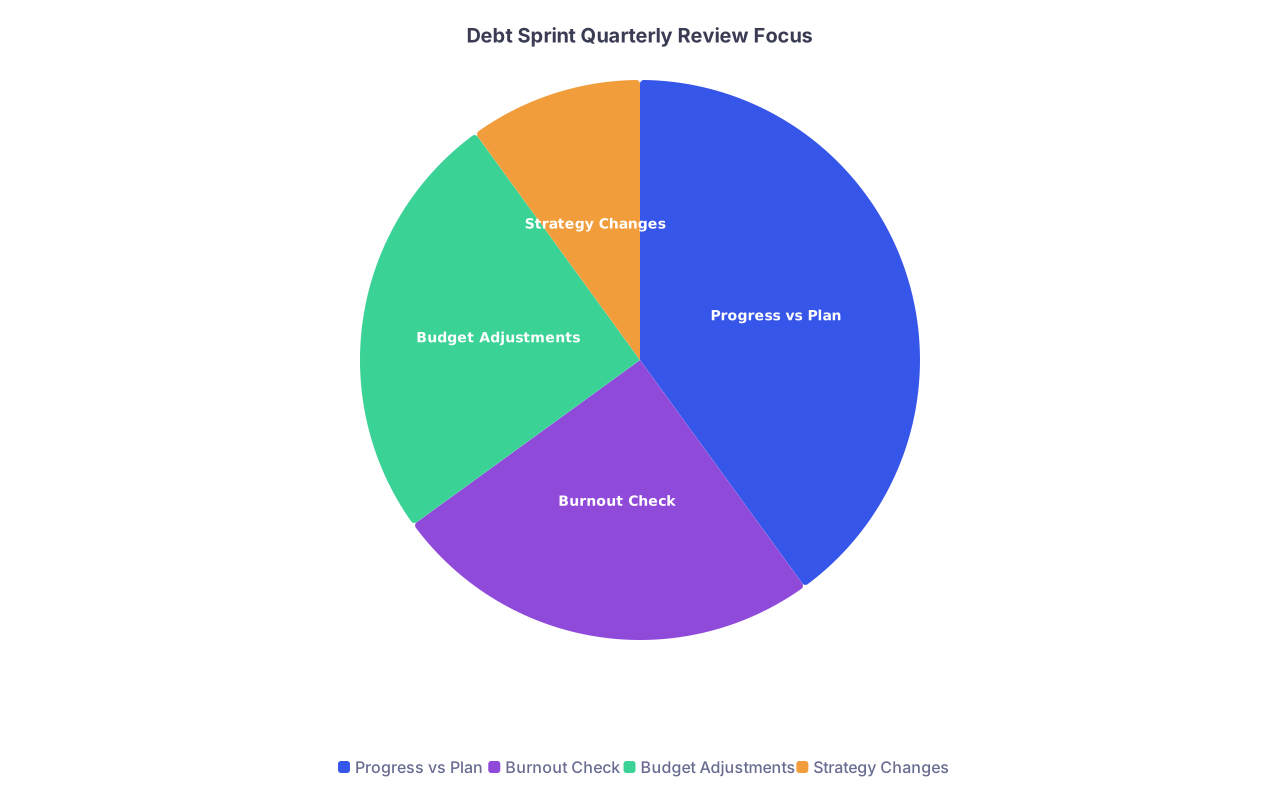
Every quarter (3 months), schedule a:
Debt Progress Review:
- Are balances dropping as expected?
- Any surprises (interest hikes, fees)?
Burnout Check:
- Are you white‑knuckling it, or is this tough but doable?
- Are you constantly tempted to blow up the budget?
This is where you tweak, not quit.
8. Protect Your Brain: Anti‑Burnout Rules
The fastest way to fail a debt sprint year is to make it feel like punishment. People can do extreme restriction for about 4–8 weeks. Then they crack.
You are designing for sustainability, not bragging rights.
Rule 1: Keep a Modest “Fun” Line Item
Cut back hard. Do not cut to zero.
Examples:
- $50–100/month for restaurants or takeout
- $20–40/month for entertainment (movie, one concert every few months)
- A small “no questions asked” personal allowance for each adult in the household
This is not about being soft. It is about staying on the rails.
Rule 2: Pre‑approve a Few Bigger Joys
If you know you will resent missing your best friend’s wedding or a once‑a‑year family trip, plan them in.
You do not have to say yes to everything. But pick:
- 1–2 events or trips in the year that you will prioritize.
- Save for them in your sinking fund.
- Scale them to your sprint budget (cheaper hotel, shorter stay, etc.).
Rule 3: Put Temptations on a 30‑Day List, Not a Credit Card
Whenever you want to buy something outside the plan:
- Add it to a “30‑Day Wants” list.
- If you still want it after 30 days, see if it fits your fun/personal allowance.
- If not, it waits until post‑sprint or a quarterly adjustment.
Simple, boring. Very effective.
Rule 4: Do Not Starve Health and Work Performance
I have seen this too often: people cut so hard they start skipping:
- Therapy
- Medications
- Basic doctor or dental visits
- Reasonable groceries and sleep
Then they get sick, burnt out, or tank their job performance. That is expensive.
Your sprint rules should explicitly say:
- Health costs are essential.
- You do not optimize your way into malnutrition.
9. Handle Student Loans Specifically (PSLF, IDR, and Private Debt)
Since this is in student loan management, let’s tighten this up.
You likely have one of three situations:
- Pure federal loans, PSLF path
- Federal loans, not PSLF (private sector)
- Mix of federal + private loans
Scenario 1: Federal + PSLF
If you are working full‑time for a qualifying employer (government or 501(c)(3)), and you are heading for Public Service Loan Forgiveness:
Your “debt sprint” should not be paying extra on PSLF‑eligible loans. You will likely never recoup that. Instead:
Your sprint year goals:
- Maximize retirement contributions to lower AGI → lowers IDR payment → increases forgiven amount.
- Build a robust emergency fund so you never miss a PSLF payment.
- Aggressively pay down any non‑PSLF debt (private loans, credit cards).
Your payoff priority might look like:
- Credit cards / high‑interest personal loans
- Private student loans
- Car loans
- Retirement and cash reserves
- PSLF loans → pay minimum IDR only
Scenario 2: Federal, no PSLF
You are in private practice, industry, or non‑qualifying work.
Here the decision is:
- Are you aiming to pay off aggressively, or
- Ride a long‑term IDR plan with forgiveness in 20–25 years?
A sprint year makes sense if:
- Your debt‑to‑income ratio is not outrageous (say, total loans ≤ 1.5× gross income),
- You have stable income, and
- You want the freedom of quicker payoff.
Here I would:
- Pick the highest interest loans (often Grad PLUS at 7–8%) as top sprint targets.
- Consider refinancing a portion to lower rate private loans if:
- You have strong income and credit,
- You will not need federal protections (forbearance, flexible IDR), and
- You are genuinely committed to the payoff track.
But do not refinance out of federal just because a podcast told you to. Once you lose federal protections, they are gone.
Scenario 3: Mixed federal + private
Your sprint plan, usually:
- Credit cards / 15–25% APR
- Private loans at high rates
- Any other mid‑rate consumer debt
- Only then start pushing extra on federal, if you are not using PSLF or long IDR forgiveness
10. Add Guardrails: What Happens When Life Goes Sideways
A real plan assumes something will go wrong.
You need pre‑decided tripwires and response rules so you do not make panicked moves.
Tripwire 1: Emergency Fund Drops Below X
Define:
- “If my emergency fund drops below 2 months of Survival Number, then:”
- I temporarily cut sprint payments to the minimum.
- All extra cash goes to rebuild the emergency fund.
- Sprint resumes when the fund is re‑filled.
Tripwire 2: Income Drop > 15–20%
- You lose a shift, bonus, or job.
- Response:
- Immediately reduce sprint to zero extra.
- Re‑calculate Survival Number with updated income.
- Only resume aggressive payoff when your budget is stable for 2–3 months.
Tripwire 3: Burnout Score Above Threshold
You do not need a formal scale. But every month, ask yourself:
- Are you constantly anxious about money?
- Are you isolating socially because “I cannot spend $10”?
- Are you obsessively tracking every half‑dollar?
If your answer is “yes” to all, and it has been that way for 2–3 months straight:
- Increase your fun/personal line item by a small amount ($50–100).
- Extend your sprint end date by 1–3 months to compensate.
- This is not failure. It is maintenance.
11. Track Progress So You Actually Feel the Wins
Debt payoff feels slow and invisible. If you do not see progress, you will mentally quit.
Put your progress in your face.
Simple tracking system:
A single spreadsheet or app with:
- Starting balance for each loan
- Current balance updated monthly
- Target payoff date
A visual:
- Debt payoff thermometer on your fridge or wall.
- A bar chart that fills from 0% to 100%.
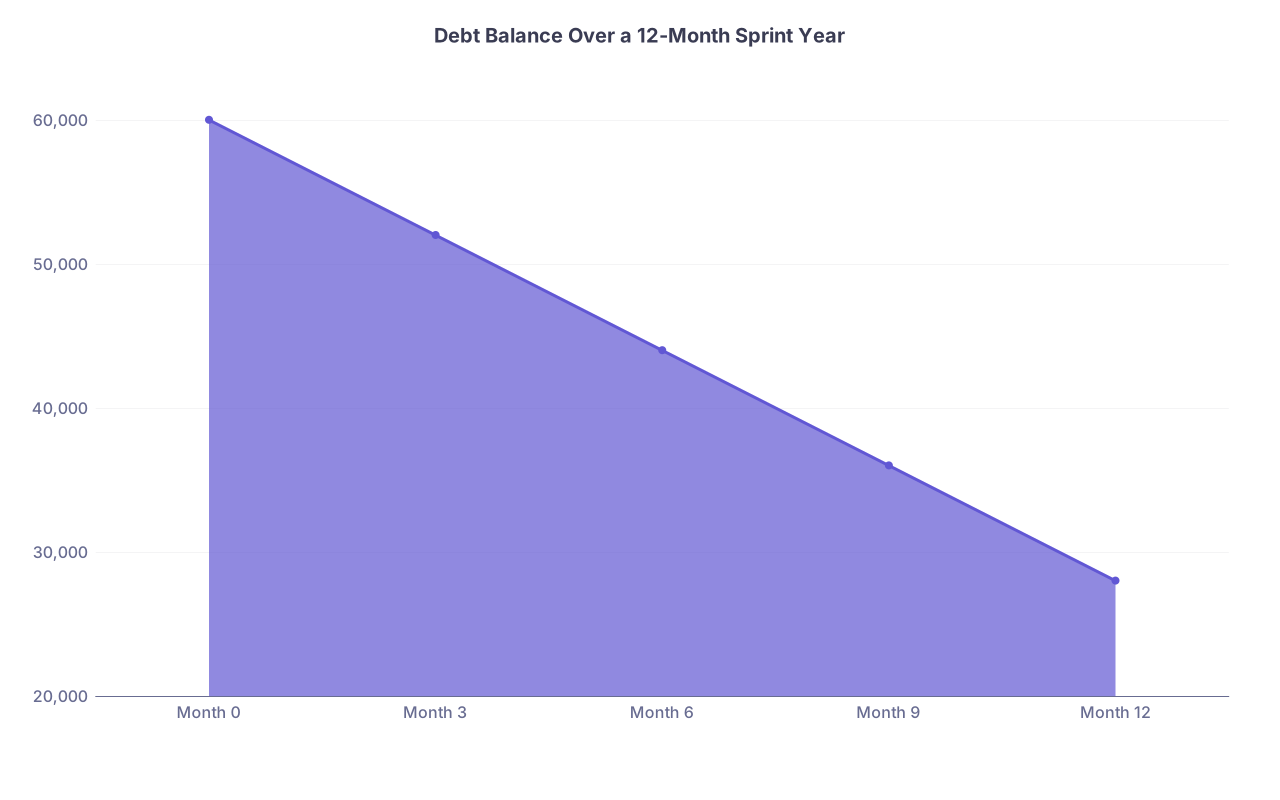
Here’s how your sprint could look numerically:
| Category | Value |
|---|---|
| Month 0 | 60000 |
| Month 3 | 52000 |
| Month 6 | 44000 |
| Month 9 | 36000 |
| Month 12 | 28000 |
You want to see that line going down. Even if it is not as steep as you wish, it is directionally correct. That keeps you moving.
12. Example: Putting It All Together
Let’s run a realistic case.
- Net income: $6,000 / month
- Federal loans: $90,000 at blended 6.3% (no PSLF)
- Private loan: $20,000 at 9%
- Credit card: $6,000 at 19%
- Baseline Essential Spend: $3,200
- Lean Discretionary: $400 → Survival Number = $3,600
- Retirement to get full match: $360
- Sinking funds: $240
Potential Sprint Money = 6,000 – (3,600 + 360 + 240) = $1,800
Use 85% → Sprint Payment Target = $1,530
Minimum payments (say):
- Credit card: $150
- Private loan: $250
- Federal loans IDR: $400
Total minimums: $800
Strategy: Avalanche (because of high‑interest credit card first)
Monthly payments:
- Credit card: $150 + $1,530 extra = $1,680
- Private loan: $250
- Federal loans: $400
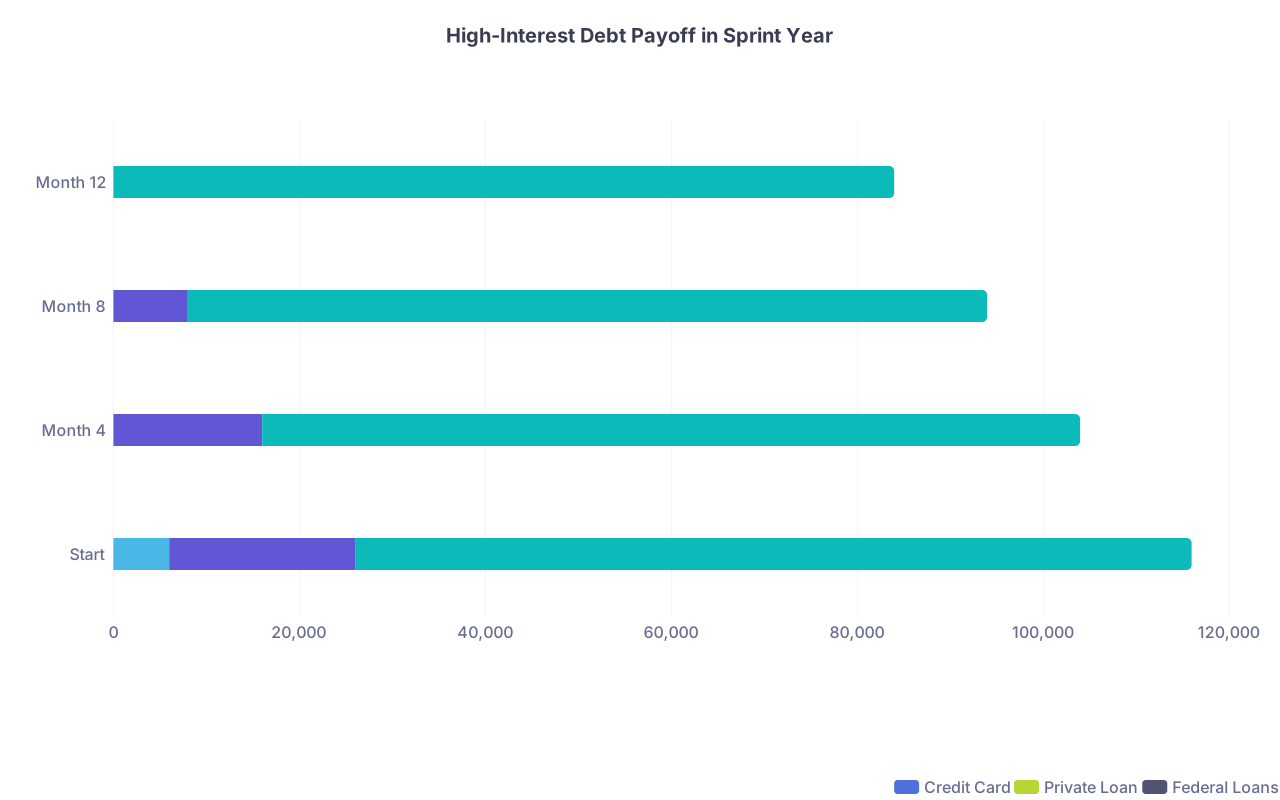
In ~4 months, the card is gone. Then:
- Private loan: $250 + former $1,680 = $1,930
- Federal loans: $400
In roughly 12 months total, the credit card and private loan are obliterated or close. You then roll that $1,930 onto federal loans for year 2, or you ease off the sprint and redirect some of that to savings/investing.
Visually, your “bad” high‑interest debt disappears first:
| Category | Credit Card | Private Loan | Federal Loans |
|---|---|---|---|
| Start | 6000 | 20000 | 90000 |
| Month 4 | 0 | 16000 | 88000 |
| Month 8 | 0 | 8000 | 86000 |
| Month 12 | 0 | 0 | 84000 |
That is what a sane, aggressive sprint looks like.
13. Common Mistakes That Blow Up a Debt Sprint (And How to Avoid Them)
I see the same landmines over and over.
Mistake 1: Starting Without an Emergency Fund
Fix:
- Before sprinting, build to at least 2–3 months of Survival Number.
- Until then, you are in “stabilization,” not “sprint.”
Mistake 2: Ignoring Retirement Completely
If your employer offers a match and you skip it to pay more on 5–7% debt, you are burning free money.
Fix:
- Always contribute to get the full match, even in sprint mode.
Mistake 3: Optimistic Income Assumptions
People assume every month will be a “good overtime month.” Then they get slammed.
Fix:
- Base your sprint payment on guaranteed income only.
- Treat overtime/bonuses as optional extra payments, not baked into the plan.
Mistake 4: All‑or‑Nothing Thinking
You break the budget once, decide you “failed,” and the sprint collapses.
Fix:
- Treat slip‑ups like a blown workout. Annoying, not fatal.
- Re‑set the next month. Do not restart the whole plan; just keep moving.
14. Design Your Personal Debt Sprint Blueprint (Quick Checklist)
This is your build order. Do it in this sequence:

| Step | Description |
|---|---|
| Step 1 | List Income and Expenses |
| Step 2 | Calculate Survival Number |
| Step 3 | Set Emergency Fund Target |
| Step 4 | Identify Loan Types and Interest |
| Step 5 | Decide If Sprint Makes Sense |
| Step 6 | Choose Payoff Strategy |
| Step 7 | Set Monthly Sprint Payment |
| Step 8 | Build 12 Month Calendar |
| Step 9 | Add Tripwires and Guardrails |
| Step 10 | Start Automatic Payments |
And then, keep a simple quarterly review:
| Category | Value |
|---|---|
| Progress vs Plan | 40 |
| Burnout Check | 25 |
| Budget Adjustments | 25 |
| Strategy Changes | 10 |
You are adjusting how you run, not whether you finish the race.
15. Your Next Action Today
Do not “research” this to death. Do one concrete thing.
Today, before you close this:
Open your banking app and your loan dashboard. Write down three numbers:
- Your total take‑home pay this month.
- Your current minimum required payments on all debts.
- Your total balance on anything above 8% interest.
Then ask yourself:
“How much could I realistically add to those minimums for the next 12 months without touching my emergency fund or retirement match?”
Whatever number pops into your head—$200, $800, $1,500—write it down. That is the seed of your sprint payment target.
Tomorrow, you turn that seed into a full 12‑month debt sprint plan using the steps above.