You just got walked into the office.
The administrator closed the door, used a lot of words like “restructuring” and “budget constraints,” and now you’re sitting in your car in the parking lot as an attending physician… without a job. You still have six figures of student loans. Maybe a mortgage. Maybe daycare bills. Maybe a spouse who doesn’t work.
You’re staring at your phone thinking: “What do I do right now so this doesn’t blow up my entire life?”
This is that guide. Short-term, tactical, first-30–90-days triage for an attending who just lost their job and has loans hanging over their head.
I’m going to walk you through this in the exact order I’d tell a friend who called me from that parking lot.
Step 1: Stabilize Cash Flow (First 24–72 Hours)
Your first job isn’t to find a new job. It’s to stop financial bleeding and buy yourself time.
1. Freeze all nonessential money leaks today
Open your last 1–2 months of statements and go hunting. Assume nothing is sacred except:
- Housing (rent/mortgage)
- Utilities
- Basic groceries
- Insurance (health, disability, malpractice tail if needed)
- Transportation (gas, car payment, minimum insurance)
Everything else is negotiable for now.
Go line by line and cancel, pause, or downgrade:
- Gym memberships
- Subscription boxes
- Extra streaming (do you need Netflix, Hulu, and Max right now?)
- Premium apps you barely use
- Charitable recurring donations (you can restart later)
- Extra cell phone lines or bloated data plans
- Automatic “nice to have” savings transfers to taxable accounts
Do not touch retirement accounts yet. We’ll talk about that later.
You’re not doing this because you’re broke. You’re doing it to stretch your runway so this doesn’t turn into a panic 60 days from now.
2. Build a bare-bones “unemployed” budget
You’re an attending. You’re used to not having to think about every line item. That ends for a bit.
Write down three numbers:
- Essentials only (housing, utilities, food, transportation, minimum debt payments, basic insurance).
- Nice-to-have (some eating out, kids’ activities, modest entertainment).
- Old lifestyle (what you were spending last month).
You’re living in Box #1 for now. Maybe a bit of Box #2 if your cash cushion is strong. But if you keep living in Box #3, you’ll blow through savings before a new job is locked in.
Step 2: Immediate Student Loan Damage Control
You do not ignore your loans and hope this works out. You stabilize them so they don’t wreck your credit or mental bandwidth while you reboot your career.
The exact move depends on your loan type and current plan.
First: Identify what you actually have
Spend 30 minutes and pull this together:
- Log into studentaid.gov for federal loans:
- Total federal loan balance
- Current repayment plan (e.g., SAVE, PAYE, IBR, Standard)
- Servicer (Mohela, Nelnet, etc.)
- Any PSLF qualifying payment count (if applicable)
- Log into each private loan servicer:
- Total balance per lender
- Interest rate
- Minimum payment
- Refinance status (any prepayment penalties? likely none)
Make a simple table for yourself. Something like:
| Loan Type | Balance | Rate | Plan/Status | Min Payment |
|---|---|---|---|---|
| Federal | $280k | 6.5% | SAVE | $1,150 |
| Private A | $75k | 4.8% | Refi | $820 |
| Private B | $35k | 7.2% | Original | $400 |
Now you know what you’re dealing with.
Step 3: Federal Loans – Use the System Without Nuking Your Future
Federal loans are more flexible. Use that flexibility fast.
Scenario A: You’re on an IDR plan (SAVE, PAYE, IBR)
Good. This is the best starting point.
Your IDR payment is tied to income, not job title. You’ve just lost your income (or most of it).
Here is what you do:
- Log into your servicer and update your income ASAP.
- Use the “alternative documentation of income” option:
- If you’re truly out of work: submit a statement that you have $0 income (some servicers allow an attestation; others want a brief letter).
- If you’re picking up per-diem or locums: use your new lower income level.
- Request an immediate recalculation of your IDR payment based on current income.
Result: your required IDR payment may drop to nearly $0/month or something close, and:
- You stay in good standing.
- Months still count toward PSLF if you remain with a qualifying employer later or already were (depending on specifics).
- You avoid forbearance/late marks.
If you were at a 6-figure IDR payment because of attending income and you suddenly have no job, you should not be paying last year’s attending-level payment. Use the system as designed.
Scenario B: You’re on Standard or Graduated repayment
You probably chose this to crush loans fast. That’s fine—when the job exists.
Right now, that aggressive plan can sink your cash flow.
You have two better moves:
- Switch to an IDR plan (SAVE is usually best now) and immediately report reduced income.
- Use short-term forbearance only if:
- You need 30–60 days to reorganize, AND
- You’re not chasing PSLF, AND
- You accept that interest keeps accruing.
Do not sit in forbearance for a year because you’re “waiting to see what happens.” That’s how balances explode.
Scenario C: You’re in or targeting PSLF
Extra care here.
- If you move to $0 based on $0 income and you’re with a qualifying employer (a 501(c)(3) hospital, academic center, etc.), those months can still count for PSLF as long as you’re working full-time there.
- But if you just lost your 501(c)(3) job and are sitting unemployed, those months do not count—no employer, no qualifying service.
So your task is:
- Preserve as much PSLF history as possible (do not default, do not leave IDR if you plan to go back to a qualifying employer).
- While you’re between qualifying jobs, focus on:
- Keeping loans in IDR (even if $0 payment).
- Not refinancing federal loans to private if PSLF is at all likely to matter later.
Step 4: Private Loans – Negotiation and Prioritization
Private loans are less friendly. But you’re not totally powerless.
1. Contact each private lender within a week
Don’t wait until you miss a payment. Call and say:
“I’m a physician who was just laid off unexpectedly. I want to stay in good standing. What hardship or temporary reduced payment options do you offer?”
Most lenders have:
- Short-term forbearance or deferment (3–12 months, interest still accrues).
- Temporary interest-only payments.
- Temporarily reduced payments.
Your goal: Preserve credit, lower required payment, buy 3–6 months of breathing room.
If they offer you 3 months forbearance, take it only if you’re truly tight on cash. If you can afford at least interest-only, that’s better.
2. Prioritize payments by risk, not just by interest rate
If money is tight:
- Make sure you’re not delinquent on federal IDR payments (they may now be very low).
- Then, stay current on private loans because:
- They’ll hammer your credit faster.
- They can sue or pursue aggressive collections more quickly.
- If you cannot cover everything at once, it’s more defensible to:
- Keep federal loans in $0–low IDR.
- Use hardship options on private loans, then ramp back up when employed.
You’re trying to avoid:
- Any 30-day+ late payments.
- Default designations.
- Ruined credit right before you maybe need to move, buy a home, or take on business debt (if you start a practice).
Step 5: Decide How Much Cash You Actually Need (Runway Math)
Now you stabilize loans, you figure out how long you can survive and at what burn rate.
1. Count your cash
Add up:
- Checking, savings
- Emergency fund
- HSA (do not touch unless for medical expenses)
- Upcoming severance (if any)
- Unused PTO payout
Ignore retirement accounts for this calculation. Pretend they don’t exist.
Let’s say:
- You have $40k in accessible cash.
- Your new stripped-down “essential” budget is $5k/month.
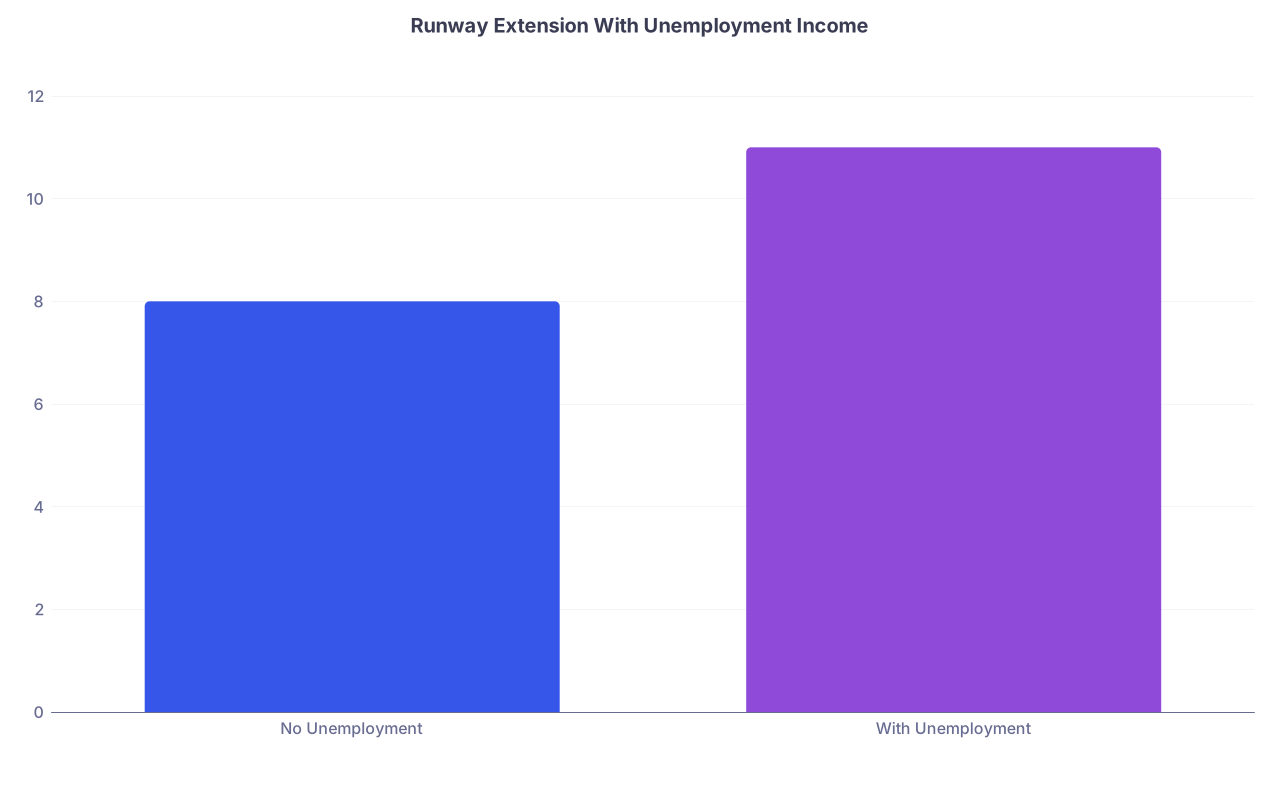
- That’s 8 months of runway before side income, unemployment, or cutting deeper.
2. Layer in unemployment (if eligible)
Many attending physicians wrongly assume they can’t get unemployment. Sometimes you can, depending on:
- Whether you’re W-2 or 1099.
- Your state’s rules.
- If you were terminated vs. left voluntarily.
Apply. Worst case, they say no. Best case, you get a few hundred to a thousand+ a week for a period, which extends your runway significantly.
| Category | Value |
|---|---|
| No Unemployment | 8 |
| With Unemployment | 11 |
(Example: same $40k savings and $5k/month expenses; unemployment adds 3 extra months.)
Step 6: Professional & Legal: Don’t Get Screwed on the Way Out
You’re not just a laid off employee. You’re a physician with a contract.
1. Pull your employment contract and actually read it
Look at:
- Termination clause: cause vs. no-cause
- Notice period: did they follow it?
- Severance: are you owed anything?
- Non-compete: how far, how long, what geography?
- Tail coverage: who pays for malpractice tail if you need it?
If you’re confused (most people are), pay for a 1–2 hour consult with a healthcare attorney who reads physician contracts routinely. This is money well spent.
You want to know:
- Can you work across the street at another hospital?
- Do you owe tail coverage that could be $20–$80k?
- Did they breach the contract in how they terminated you?
2. Don’t sign anything on the spot
Often they slide papers at you during the termination meeting: “Severance agreement,” “Release,” “Confidentiality.”
Do not sign immediately.
Say: “I’d like to review this with my attorney. I’ll get back to you within X days.”
Signing may waive your right to:
- Sue for wrongful termination.
- Negotiate better severance.
- Challenge non-compete scope.
This directly affects how fast you can get to your next income stream. Which matters a lot when you have $250k in loans.
Step 7: Fast Income Options That Don’t Blow Up Your Long-Term Plans
You don’t have to find the “perfect” job first. You need to get money coming in.
1. Locums, per diem, and telemedicine
Real talk: if you’re a reasonably employable attending, your medium-term problem isn’t employability, it’s timing and geography.
So for the next 3–6 months:
- Look into locums agencies.
- Check per-diem shifts at nearby hospitals or urgent cares.
- Explore telemedicine gigs (though some are drying up or pay less now).
These are bridge jobs. They:
- Keep clinical skills fresh.
- Add income quickly.
- Don’t require you to commit long-term while you reassess.
But run them through your non-compete limits first.
2. Avoid desperate permanent moves
Do not:
- Sign a terrible long-term contract out of panic.
- Take the first offer with a 3-year lock-in and brutal non-compete because you’re scared about this month’s loan payment.
Short-term, flexible income > long-term handcuffs you’ll regret for a decade.
Step 8: What NOT to Do With Loans Right Now
There are a few “nuclear” options that people get tempted by in a panic. They often make things worse.
1. Do not cash out retirement accounts unless you’re absolutely cornered
Withdrawing from:
- 401(k)/403(b)
- Traditional IRA
Triggers:
- Income tax on withdrawal.
- 10% penalty if under 59½ (with some exceptions).
- Lost compound growth that future you desperately needs.
I’d rather see you:
- Move federal loans to IDR at low or zero payment.
- Use private loan hardship options.
- Work part-time.
…than torch retirement accounts in month 1 of unemployment.
2. Do not refinance federal loans to private right now
If you:
- Might pursue PSLF again.
- Might need IDR flexibility.
- Are uncertain about future income.
Refinancing federal loans to private for a slightly lower rate is a one-way door. You lose PSLF eligibility and federal protections forever.
This is dumb in the middle of a layoff.
Revisit refinancing after you land in a stable attending role with clarity on your long-term path.
3. Do not ignore servicer communications
Sticking your head in the sand is how you end up in default with wrecked credit.
Even if you can’t pay full amounts, respond. Ask for options. Get things in writing. Keep copies.
Step 9: 30–90 Day Plan – Put It All Together
Let’s organize this into a rough timeline so it doesn’t feel like a chaos pile.

You’re not trying to optimize every financial angle on day 3. You’re trying to:
- Prevent disasters (default, lawsuits, blown credit).
- Keep options open (PSLF, future jobs).
- Secure runway and income.
Once you’ve got a new job or stable coverage:
- Revisit your student loan strategy with a clear head.
- Decide if you want to be aggressive (refi, big payments) or strategic (PSLF, SAVE, minimal payments plus investing).
Step 10: Two Example Scenarios So You Can See This in Real Life
Sometimes abstract rules don’t land. Let’s do two quick scenarios.
Example 1: Hospitalist, 2 Years Out, PSLF Eligible
- 2 years into 501(c)(3) hospital.
- $300k federal loans on SAVE.
- Suddenly laid off due to hospital closure.
- No private loans.
Moves:
- Within first week, update IDR with $0 income → payment likely drops to $0.
- Stay in IDR; do not refinance.
- Apply for unemployment (if state allows).
- Seek new job at another qualifying hospital to preserve PSLF path.
- Locums in the meantime for cash, ideally in non-PSLF settings while searching for another PSLF-eligible spot.
- Once new PSLF job obtained, certify employment and keep payments based on reality of new income.
Outcome: You don’t lose PSLF history, you avoid unnecessary payments while income is low, and you don’t panic-refi.
Example 2: Private Practice Surgeon, High Income, Heavy Private Loans
- Employed by private group.
- $150k federal loans on Standard.
- $200k private refi at 4.5%.
- Group dissolves, you’re out of work.
Moves:
- Switch federal loans from Standard to SAVE, report sharply reduced income.
- Call private lender:
- Ask for 3–6 months of reduced payments or forbearance.
- Cut personal burn rate hard; build 6-month runway.
- Start aggressive job search + locums in non-compete-safe areas.
- Once in new high-income role:
- Reassess: maybe refi federal loans if PSLF is obviously off the table and income is stable.
- Ramp up private loan payments aggressively.
Outcome: You survive the gap without defaulting or wrecking credit; you use flexibility in federal system and negotiation with private.
| Category | Federal Loan Payment | Private Loan Payment |
|---|---|---|
| While Unemployed | 100 | 300 |
| After New Job | 1200 | 1500 |
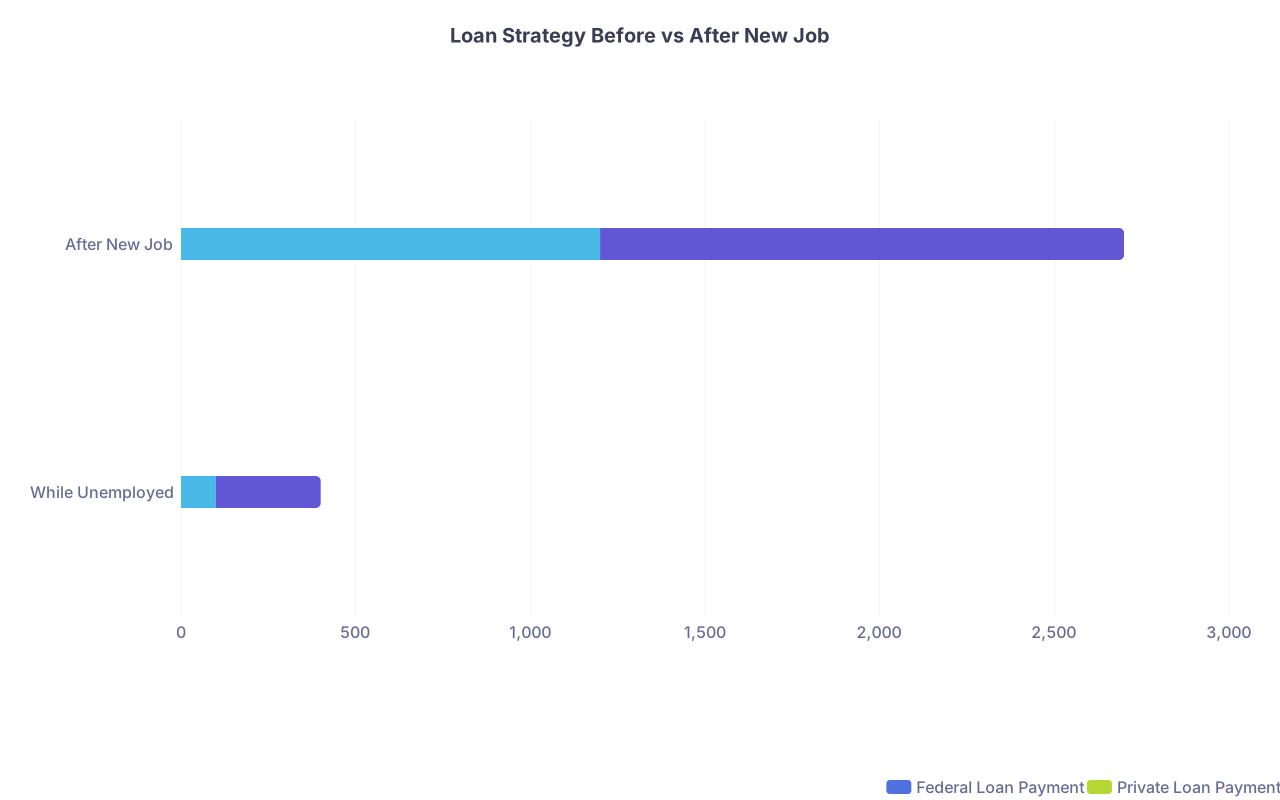
(Example: dramatically lower payments while unemployed, aggressive repayment after.)
Step 11: Mental Game – Because This Will Mess With Your Head
One more thing people pretend doesn’t matter: ego.
You went from, “Doctor with stable income and respect,” to “laid off with debt” in one meeting. That hits hard.
Here’s the part I’ve seen derail people:
- Shame → avoidance → unopened bills → disaster.
- Anger → impulsive decisions → signing bad contracts or cashing out retirement.
Do the opposite:
- Treat this like a patient emergency: stabilize, gather data, act in sequence.
- Talk to your partner honestly about numbers. No financial secrets.
- Use a therapist, coach, or at least a trusted colleague as a sounding board before big decisions.
You’re not a failure because you got caught in hospital politics or budget cuts. You’re just temporarily out of a seat in a messy game of musical chairs.

Quick Recap: What Actually Matters in the First 90 Days
Three core priorities:
Protect cash and credit.
Cut spending, apply for unemployment if eligible, use IDR and hardship options so you don’t default. Retirement accounts stay untouched unless it’s truly life-or-death financially.Keep future options open.
Don’t refinance federal loans in the middle of chaos. Don’t sign away rights with your employer without legal review. Don’t take a terrible contract just to feel “employed.”Get some income flowing, then re-optimize.
Use locums, telemedicine, or per diem work if you need a bridge. Once you land in a stable job, then you rebuild your long-term student loan strategy with clear numbers and a calm brain.
You’re allowed to be rattled. Just don’t be paralyzed. Handle these triage steps and you’ll give yourself room to rebuild on your terms.