
The biggest threat to your PSLF is not high interest or bad consolidation choices. It is losing qualifying months because your training path got messy.
Non‑categorical year. Switching specialties. Extra prelim. Research year. Transitional year. This is where people get burned.
If you are in one of these situations—or suspect you might be—your PSLF path is not automatic. You have to protect it on purpose.
Here is how to do that, step by step, with as little wishful thinking and as much reality as possible.
Step 1: Get Clear On What Actually Counts for PSLF
You cannot protect what you do not understand. So let’s strip PSLF down to the parts that matter for you as a resident bouncing between paths.
To get PSLF, you need:
- The right loans
- The right employer
- The right repayment plan / payment type
- 120 qualifying payments while all of the above are true
- Proof (PSLF forms) that ties your payments to your eligible employment
Now, translated into your life:
Employer: Almost all ACGME-accredited residency programs at:
- University hospitals
- County hospitals
- VA hospitals
are qualifying public service employers. A few weird private programs are not. Do not assume; verify.
Loans:
- Direct federal loans are PSLF-eligible.
- FFEL or Perkins loans only count if you consolidate them into a Direct Consolidation Loan.
- Parent PLUS loans / private loans do not help you here.
Payment plan / payment type:
- Any income-driven repayment (IDR) plan counts (PAYE, REPAYE/SAVE, IBR, ICR).
- Now, many deferment/forbearance months during residency can count as well under the IDR/PSLF fixes—but the rules are nuanced and evolving.
- Old advice “avoid forbearance at all costs” is now incomplete. But relying on future retroactive fixes is dumb as a primary strategy.
The safest mindset:
You want to be in an IDR plan with Direct Loans, enrolled with your current servicer, and regularly submitting PSLF forms for each employer. Everything else is risk.
Step 2: If You’re Starting or In a Non‑Categorical Year
Non‑categorical = you have a one‑year slot in a specialty (often prelim or transitional) without a guaranteed categorical spot to continue.
Typical examples:
- Prelim surgery year before switching to anesthesia/IM
- Transitional year before dermatology/ophtho
- Non‑cat IM year because match did not go as planned
Here is what you do to keep PSLF on track.
2.1 Before You Start (or ASAP if you already started)
Confirm employer eligibility
Email GME or HR, or call:- “Can you confirm the hospital’s tax status and whether it qualifies as a 501(c)(3) or government employer for PSLF?”
Then check the PSLF Help Tool on StudentAid.gov and see if your employer pops up as eligible.
- “Can you confirm the hospital’s tax status and whether it qualifies as a 501(c)(3) or government employer for PSLF?”
Confirm your loan type and consolidate if needed
- Log in to StudentAid.gov → My Aid → Download your data.
- If you see FFEL / Perkins:
Consolidate to a Direct Consolidation Loan before you start counting your 120 payments.
Every month that passes before consolidation is likely lost PSLF time (unless later re-credited by special waivers, which you should not bank on).
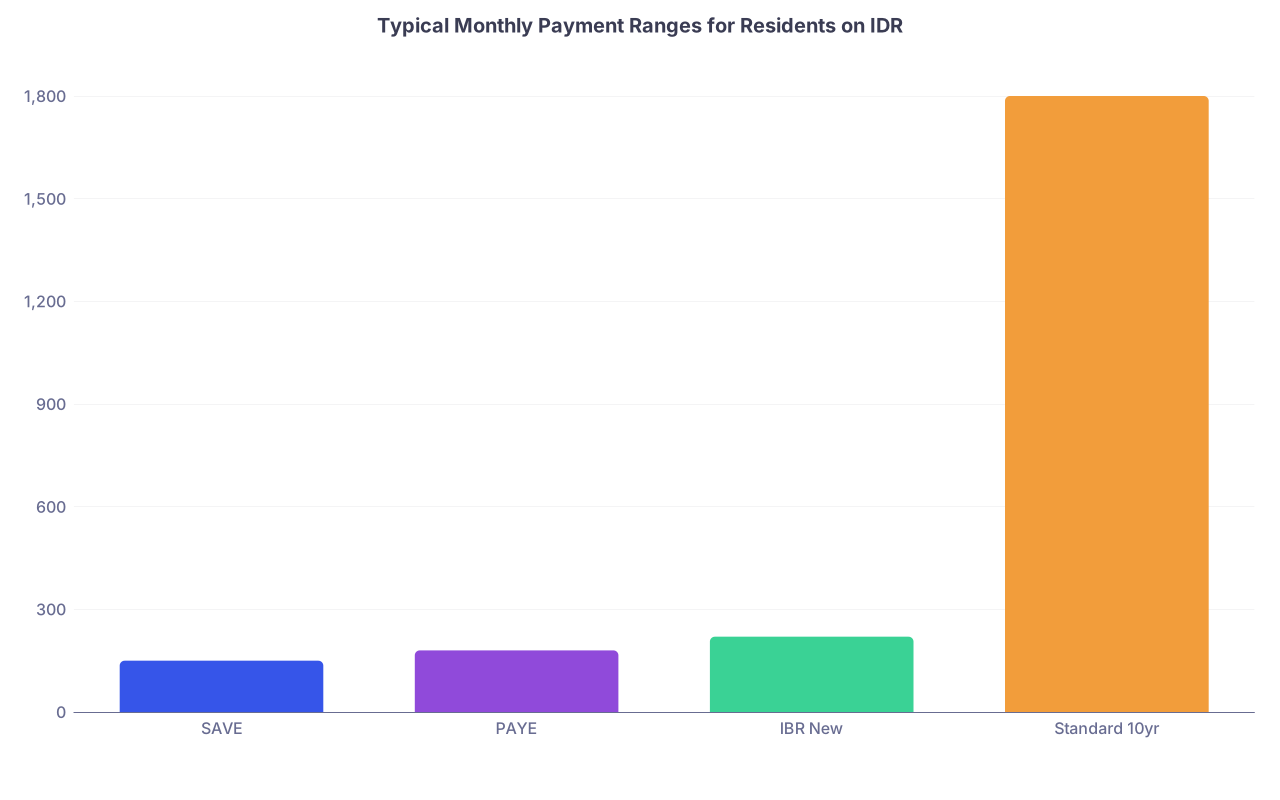
Pick an IDR plan intentionally
- During training, you almost always want:
- SAVE (the REPAYE replacement) if available, because of the interest subsidy.
- Get your IDR application in before or very early in your PGY‑1 so payments start low and counting.
- During training, you almost always want:
| Category | Value |
|---|---|
| SAVE | 150 |
| PAYE | 180 |
| IBR New | 220 |
| Standard 10yr | 1800 |
- File a PSLF form for this non‑categorical employer
- Use the PSLF Help Tool to generate a PSLF form.
- Get HR or GME to sign it once per year or when you leave.
Non‑categorical does not hurt PSLF by itself. What hurts is the chaos that follows if you do not capture proof for that year.
Step 3: When You Switch Specialties (or Programs)
Switching specialties is where PSLF timelines go to die. Not because switching itself ruins anything, but because:
- You move employers
- You enter gaps between contracts
- You change servicers or loan status
- You forget to keep IDR active during the transition
Here is the practical playbook.
3.1 As Soon As You Know You’re Switching
Lock in your current PSLF months
- Submit a PSLF form for your current program/employer right now.
- That forces your servicer and the Dept. of Ed to count/track those months under your current employer before you disappear.
Ask about gap months
- Are you finishing June 30 and starting new residency July 1? Perfect—no gap.
- Are you finishing in March and not starting until July? You will have a gap.
- Write those dates down. They matter.
Plan what happens to your loans in the gap Here’s where people make expensive mistakes:
- They let loans go into administrative forbearance due to confusion or missed recertification.
- They request general forbearance “just to be safe” and lose low payment months.
In a gap between programs, you have three core choices:
- Stay on IDR, keep making payments, and build PSLF months (assuming you are working for a qualifying employer—or none at all; PSLF technically requires qualifying employment plus payment; no employer = no qualifying month, but payment may still set you up well for future forgiveness).
- Request economic hardship deferment or other specific deferment (which under newer rules can sometimes be credited later, but not guaranteed).
- Do general forbearance (worst option for PSLF).
I have watched residents call servicers and be steered straight into forbearance because the rep “wanted to help you afford the transition.” That’s not their job. Your job is to say:
“I want to stay on my income-driven plan if possible, and I want to avoid unnecessary forbearance.”
Step 4: Protecting PSLF During Each Phase of a Switch
Break your journey into chunks. Because PSLF eligibility can change at each one.

| Step | Description |
|---|---|
| Step 1 | Current Residency |
| Step 2 | New Residency Starts |
| Step 3 | Unemployed or Research |
| Step 4 | New Employer PSLF Form |
| Step 5 | PSLF Eligible Months |
| Step 6 | Non Qualifying Months |
| Step 7 | Leaving Program |
| Step 8 | Working at Qualifying Employer |
4.1 When You Leave Your First Program
Before your last day:
- Submit a PSLF form with end date filled in.
- Confirm last day on payroll with GME. PSLF uses dates, and a one‑month discrepancy can screw up a “120th payment” in the future.
- Make sure your IDR plan will not lapse because of income recertification timing. If your recertification date is near the transition, do it early.
4.2 During Gaps (Unemployed, Research, or Non‑Qualifying Work)
Scenarios:
Gap with no job (Step studying, life stuff)
- No qualifying employer = no PSLF credit, even if you make IDR payments.
- But: staying on IDR keeps interest subsidy (on SAVE) and stabilizes your payment track.
- If you truly cannot pay anything, request deferment / forbearance but understand these months probably will not count unless later fixed by new regulations.
Research year at the same med school or a new academic center
- Check whether you are actually employed (W‑2, paid) by a 501(c)(3)/government entity.
- If yes: that year can be PSLF‑qualifying.
- If you are funded by a stipend through a university: still probably qualifying if the university is a 501(c)(3) or public; confirm and file PSLF forms.
Working locums or moonlighting for a private group
- Private group ≠ PSLF employer, even if at a nonprofit hospital.
- Those months will not count unless your employer itself is qualifying.
Your move:
For every change in status (resident → jobless → research fellow → new residency), ask two questions:
- “Am I being paid by a qualifying public service employer?”
- “Am I still enrolled in an IDR plan with Direct Loans?”
If either answer is no, fix it or accept you are not earning credit for that window.
Step 5: When You Land in the New Specialty / Program
New specialty does not reset your PSLF clock. New employer just starts a new segment.
Here is the checklist for your new residency:
Verify employer again
- Many academic centers are slam-dunk PSLF employers. Some community programs are run by private for-profit hospital systems. Those may not count.
- Use the PSLF Help Tool to search the specific entity that issues your paycheck.
File a fresh PSLF form within the first 3–6 months
- Do not wait until the end of PGY‑2 or PGY‑3.
- This also ensures your servicer knows you are still in qualifying employment and avoids “IDR weirdness” where they assume your income jumped.
Check your payment amount and recertification date
- After your first year in the new program, update income with paystubs if required.
- If your income dropped (rare) or stayed resident-level, keep IDR going and budget for the new payment.
Create a simple PSLF log A literal one‑page log with:
- Employer name
- Start date / end date
- Whether PSLF form was filed and the date
- Servicer name during that period
When you hit year 7–10, you will be glad you are not trying to reconstruct your entire training path from memory.
Step 6: Non‑Categorical → No Categorical Spot → Reapplying or Taking a Gap
This is the worst‑case scenario many people quietly worry about.
You matched into a non‑cat year. You did not secure a PGY‑2 or categorical slot. Now what happens to PSLF while you regroup?
6.1 If You Will Be Temporarily Out of Training
You might:
- Work as a hospitalist/non‑boarded doc (rare, but happens in some settings)
- Take a research job
- Work outside clinical medicine for a bit
- Be unemployed while reapplying
From a PSLF standpoint, your priorities:
If you get any job, try to choose a PSLF‑eligible employer
- University research job
- VA research position
- County public health role Not glamorous maybe, but every year of PSLF‑qualifying employment is tens of thousands of dollars of future forgiveness.
Stay on an IDR plan if at all possible
- If income is low or zero, your payment may be $0, which still can count as a qualifying payment.
- $0 qualifying payments are golden.
Avoid unconstrained forbearance
- Do not let a servicer talk you into long, open‑ended forbearance “just until things stabilize.” That is code for “we stop counting time.”
Get PSLF forms signed for any stopgap qualifying employment
- Even a 6‑month PSLF‑eligible job while you reapply is valuable. Do the paperwork.
Step 7: How Non‑Categorical and Switching Changes Your PSLF Timeline
You’re probably wondering: “How much damage did this actually do to my PSLF clock?”
Let’s compare typical pathways.
| Scenario | Training Length | Gaps / Non-Qual Months | PSLF-Eligible Years by End of Fellowship |
|---|---|---|---|
| Straight 3-yr IM, 3-yr cards | 6 years | 0 | ~6 years |
| 1-yr non-cat surgery, 3-yr anesthesia | 4 years | 0 | ~4 years |
| 1-yr non-cat IM, 1-yr research (PSLF-eligible), 3-yr neurology | 5 years | 0 | ~5 years |
| 1-yr non-cat prelim, 1-yr gap non-qual, 3-yr FM | 5 years | ~1 year | ~4 years |
Moral:
Switching specialties itself is not the killer. Uncounted years and gaps without PSLF‑qualifying employment are.
You can absolutely finish fellowship with 5–7 years of PSLF credit even with a twisty path, if you are deliberate.
Step 8: Common Bad Advice You Should Ignore
I’ve seen residents get wrecked by casual advice in resident lounges and Facebook groups. A few greatest hits:
“Just put everything in forbearance during prelim, it’s only one year.”
That one year could have been 12 qualifying payments. Also, it trains you to treat loans as “future-you’s problem,” which never goes well.“You have to wait until you’re an attending to start PSLF.”
Completely wrong. Residency and fellowship count if the employer qualifies.“If you switch specialties, you lose your previous PSLF progress.”
Flat out false. Your months stay with you as long as they were qualifying when you made the payments.“Your program/hospital will handle the PSLF paperwork.”
No. HR will sign what you bring them. That’s it. You are the project manager here.
Step 9: Know When You Might Want to Pause PSLF Intentionally
I am not here to push PSLF at all costs. There are situations where you might reasonably decide:
“My path is too fragmented, or I’m aiming for high-paying private practice; PSLF is not worth contorting my life.”
Situations where a softer grip on PSLF makes sense:
- You are certain you will end up in high-paying private practice, not academia or VA, and your total debt is modest relative to projected income.
- You already lost years early on (e.g., long private practice stint, then back to training) and PSLF would require you to stay in public service far longer than you want.
- The emotional/administrative cost of chasing every qualifying month outweighs the financial upside for your actual numbers.
But that’s a deliberate calculation, not an accident. Run the numbers with a good student loan calculator or financial planner who knows PSLF before you walk away.
Step 10: Red-Flag Situations That Need Professional Help
If you are in any of these situations, get a one-on-one consult with a legit student loan expert (not a random financial advisor who mainly sells insurance):
- You have >$400k in loans and are about to switch to a non‑PSLF‑eligible employer for fellowship or attending practice.
- You married someone with significant federal loans and your payment plan situation just got complicated.
- You already did years of forbearance and are trying to figure out what will/can be retroactively credited under SAVE/IDR account adjustment rules.
- Your servicer’s PSLF count does not match your records.
PSLF is fixable in a lot of messy stories. But not if you keep guessing.
Your Move Today
Do not just “remember this for later.” PSLF only rewards what you actually document.
Today, do this:
- Log into StudentAid.gov and download your aid data.
- Open the PSLF Help Tool and start a PSLF form for your current employer—even if you plan to leave or switch.
- On a piece of paper, write your training path so far and what’s next: each program, exact dates, and whether the employer is PSLF‑eligible.
Once that’s in front of you, the gaps and risks will be obvious. Then you can fix them before they get expensive.