
It’s August 2023. You’re finishing residency, sitting in the call room between pages, scrolling through another PSLF article that tells you—again—to “make 120 qualifying payments and you’re golden.”
Except you just watched a senior attending on your service retire last year with their loans completely wiped out, and you know damn well they didn’t just “wait 10 years and hope.” They did something before all these PSLF changes hit. Something no one bothered to explain to you in med school.
Let me tell you what actually happened behind the scenes—how senior physicians quietly restructured their loans before PSLF rules tightened and why you keep hearing “oh, I’m already taken care of” from older docs who swear they “just followed the rules.”
They didn’t “just” follow the rules. They used the rules before they changed.
The Part Nobody Tells You: PSLF Was a Gold Mine for Early Adopters
When PSLF launched in 2007, nobody trusted it. Most attendings thought it was a political mirage that would disappear the first time Congress needed to “reduce wasteful spending.”
The ones who did their homework? They saw a loaded opportunity.
Here’s what they quietly did between 2007–2014 while everyone else shrugged:
- Consolidated to the right federal loans, early
- Locked into income-driven repayment (IDR) when their AGI was artificially low
- Piled every possible year of fellowship, chief year, faculty time at a 501(c)(3), and even some VA work into qualifying employment
- Re-certified income strategically (not automatically)
- Stopped overpaying their loans on purpose
The end result: a huge chunk of them got hundreds of thousands forgiven under the “old” PSLF and IDR rules, while your generation is staring down tighter calculations, fewer loopholes, and far more documentation.
And yes—many of them knew the hammer would eventually drop.
How They Quietly Restructured Loans Before PSLF Changes Hit
Most stories you hear are sanitized: “I just did PAYE and kept working at an academic center.” That’s not the real story. The real story is timing and structure.
Let me walk through what actually went on behind closed doors.
Step 1: They Consolidated Early — And Correctly
Senior physicians who won this game understood something residents still screw up every year: loan type decides your eligibility before anything else.
Before the big PSLF/IDR “count adjustment” and rule changes, here’s what they were doing:
- Taking every stray loan—Stafford, Grad PLUS, Perkins, older FFEL loans—and rolling them into a single Direct Consolidation Loan
- Making sure it was done once and at the right time, so all the pieces started counting together
- Avoiding consolidation during fellowship if they already had qualifying years from residency they didn’t want to reset (this bit changed later with the one-time adjustment, but at the time it mattered)
You know that “oh, I didn’t realize my FFEL loans weren’t eligible” horror story? Attendings who knew what they were doing avoided that entirely. They read the fine print, talked to advisors who actually knew PSLF inside out, or frankly just spent a weekend reading fedloan forums and government PDFs.
Most residents now consolidate late, sloppily, or not at all—and lose years.
The senior docs? They treated consolidation like setting up a chessboard before the match starts.
Step 2: They Chose the IDR Plan With an Endgame in Mind
Here’s what you usually hear:
“Just pick REPAYE or SAVE, it’s the best now.”
That’s short-term thinking. The attendings who won PSLF looked at something different: Which plan will still exist in 10 years and be the most favorable when my income explodes?
Back then, the main characters were:
| Plan | Percent of Discretionary Income | Spousal Income Rule | Interest Subsidies |
|---|---|---|---|
| IBR | 15% | Can file separately | Limited |
| PAYE | 10% | Can file separately | Some |
| REPAYE | 10% | Must include spouse | Strong |
Most high-income physicians who were PSLF-bound gravitated to PAYE (when they were eligible) because:
- 10% of discretionary income
- Ability to exclude spouse income by filing taxes separately
- Payment cap at the 10-year standard amount
That last part is misunderstood. The cap meant: even when they hit $350k as an attending, their monthly IDR payment could never exceed what a standard 10-year payment would’ve been from the start.
So they structured it this way:
- Low-income residency + fellowship years = very low payments, often barely covering interest
- As income rose, payments stayed manageable and capped
- The principal never meaningfully shrank—because they didn’t want it to
They weren’t trying to pay the loans off. They were trying to make them last until the forgiveness finish line.
They understood the unspoken PSLF formula:
“The less you pay along the way, the more is forgiven at the end.”
Step 3: They Stopped Being “Good Borrowers”
You know what med students are trained to do? Be responsible. Pay extra. “Attack the principal.”
That mentality killed a lot of people’s PSLF upside.
The senior physicians who structured things right did something that felt wrong to them at first: they stopped overpaying their loans intentionally.
I’ve literally heard an academic attending say to a PGY-3:
“I didn’t pay a penny more than my IDR payment for 10 years. Felt gross, but the government wiped out $220k at the end. I’m over it.”
This is what they figured out:
- Every extra dollar they paid while on track for PSLF was a dollar they’d never get forgiven
- PSLF forgiveness is tax-free, unlike some IDR-forgiveness scenarios (especially pre-SAVE changes)
- Their effective after-tax investment return from not prepaying loans was far higher if they invested elsewhere
So they:
- Locked into IDR (often PAYE)
- Paid exactly what was required
- Refused to “round up” or do extra principal payments
- Parked extra money into retirement accounts, real estate, or index funds instead
It wasn’t laziness. It was strategy.
Step 4: They Maximized Qualifying Employment While It Was Still Easy
The PSLF definition of “qualifying employer” has always sounded simple: government or 501(c)(3) non-profit. But how people used that definition? That’s where the game got interesting.
Here’s what I watched them do:
- Stacked residency + fellowship + early attending years at academic hospitals, VA systems, and safety-net institutions
- Worked 0.8 or 0.9 FTE clinically but maintained full-time PSLF status under HR definitions
- Took admin roles (education, quality, research) that still counted toward full-time hours
- Made sure HR forms were worded to reflect 30+ hours/week or the internal definition of “full-time”
There were attendings who:
- Did 3–4 years residency
- 3 years fellowship
- 3–4 early attending years at an academic center
- Then jumped to private practice after hitting forgiveness
From the outside, it looked like:
“Oh, they did a long training path then went to private.”
Inside their loan file? 10+ years of qualifying PSLF payments.
Step 5: They Played the Tax-Recertification Game
You know how student loan servicers tell you to just “auto-recertify” your income every year?
The doctors who came out ahead did not do that.
They understood something residents still underestimate: AGI is a negotiable number. Legally. If you use the system correctly.
They coordinated:
- Timing of IDR recertification around big shifts in income
- Delaying recertification after a large raise to keep payments low for another 12 months
- Using the prior year’s lower resident income on their first attending year
- Filing married filing separately when it significantly lowered their required payment
- Aggressively using pre-tax contributions to lower AGI
- 403(b), 457(b), HSA, dependent care FSA, etc.
So when they moved from $60k to $300k, their loan payment didn’t jump linearly. It lagged. And sometimes lagged hard.
They often “froze” their loan payment for an extra year of attending salary by using last year’s tax return, then recertifying right before their final PSLF payments. That’s how someone at $400k income was still making $600–$900 IDR payments some years.
And it was all within the rules.
Step 6: They Used Consolidation and Refinancing Only When It Helped the Endgame
Here’s where younger physicians get burned: they reflexively refinance to private lenders because “the rate is lower.”
Senior docs who understood PSLF drew a bright line:
- If they were committed to staying in qualifying employment → never refinanced out of federal
- If they were bailing on PSLF (switching to private practice early) → refinanced quickly and aggressively
They didn’t live in that miserable middle ground—half-in/half-out—where someone:
- Works 6 years at an academic center
- Refinances to private for a slightly better rate
- Then realizes they were already 60% of the way to PSLF eligibility and just lit six figures of forgiveness on fire
What the savvy older docs did:
- Ran realistic scenarios: “Am I staying in academics/VA for 10 years or not?”
- If yes → structured everything around PSLF and IDR
- If no → abandoned PSLF early and refinanced with SoFi, Laurel Road, etc., when their income could handle rapid payoff
They understood the biggest PSLF loss is not “I never had PSLF.” It’s “I almost had PSLF, then killed it at year 7.”
The Quiet Counseling You Never Got in Training
Here’s the ugly truth: most of your mentors never sat you down and walked through this. Some didn’t understand it themselves. Some did, but didn’t feel like opening that can of worms.
I’ve been in faculty meetings where this kind of sentence was said, verbatim:
“We probably don’t need to get into PSLF details during orientation. It gets political and complicated. Just tell them to use income-driven repayment.”
So residents walked out with half-baked guidance, while the attendings had already:
- Locked in PAYE
- Perfected their tax strategy
- Ensured HR completed their PSLF certification forms every year and kept copies
This explains why you hear a 55-year-old cardiologist casually mention:
“Oh yeah, my $240k got forgiven last year. It was nice.”
Like it just happened. It didn’t “just happen.” It was structured.
How PSLF & IDR Changes Tightened the Window
Now to the part you actually care about: what changed, and what did senior physicians do right before those changes?
Around the time the government started tightening PSLF approvals and tinkering with IDR:
- Servicers got more aggressive about documentation and recertification
- Definitions and details around “qualifying payment,” “employment certification,” and “IDR eligibility” got stricter
- Some IDR plans (like PAYE eligibility for new borrowers) started phasing into more complex rules, while SAVE emerged with its own quirks
Senior docs didn’t wait around to see where it would land. They:
- Completed consolidations before cutoffs or new eligibility rules kicked in
- Locked themselves into their preferred IDR plan before newer rules made it unavailable to future borrowers
- Front-loaded employment certification forms so there was a paper trail going back years
- Used temporary programs like the PSLF Waiver and IDR Account Adjustment proactively to pull in previously ineligible months
And this is the key: once you’re in an older, legacy plan, you’re often “grandfathered” under those rules. New grads don’t get access to the same structure. You’re stuck with what exists now.
They aren’t smarter than you. They were just earlier.
What You Can Still Learn From Their Playbook
You don’t get to rewind to 2010. But you can absolutely steal the logic they used.
The core lessons:
Decide your trajectory early:
Academic/VA/non-profit long term → PSLF and IDR strategy.
Definite private practice → refinance and destroy the loans quickly.Treat loan structure like a contract, not a suggestion.
Loan type, consolidation timing, and IDR choice matter more than your feelings about “being responsible.”Use the tax code like they did.
You’re not a passive victim of AGI. Filing status, timing, and deductions are tools.Stop half-committing.
PSLF works best when you lean into it fully. So does refinancing. The worst place is the middle.
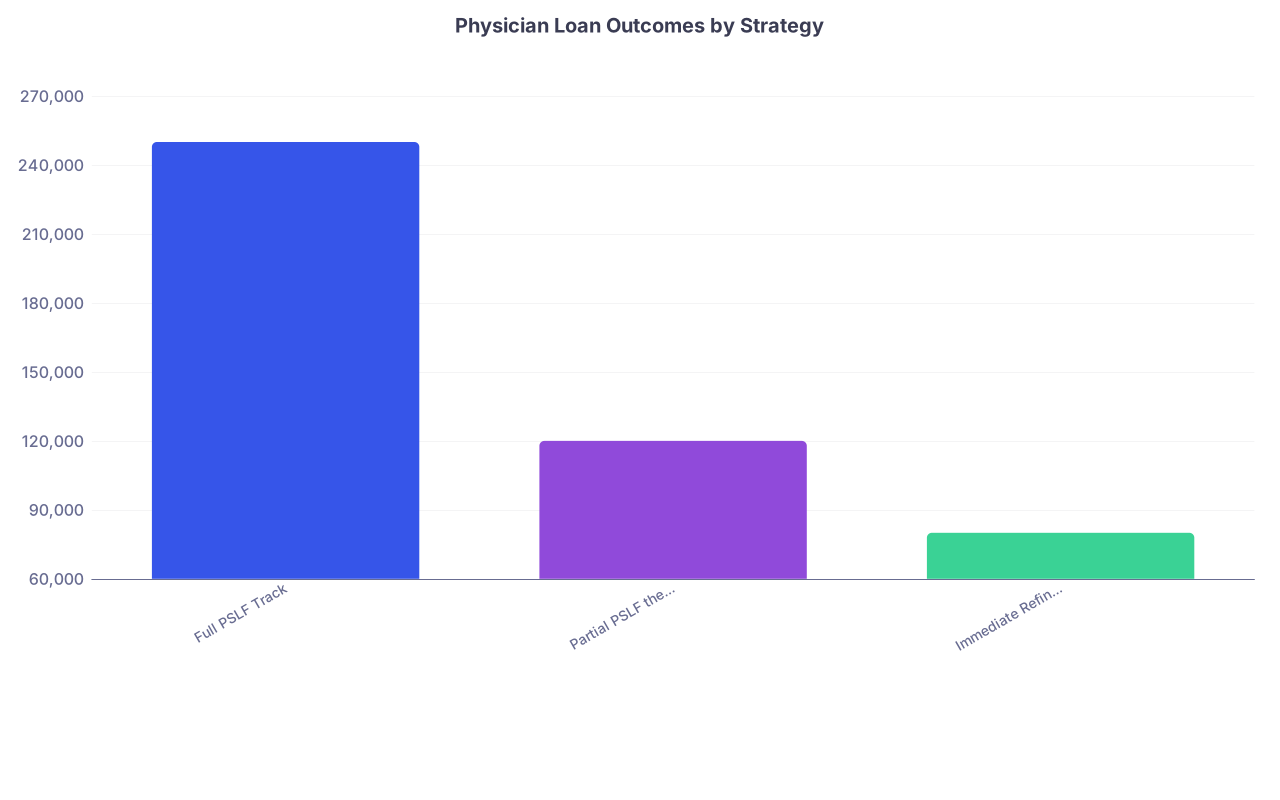
| Category | Value |
|---|---|
| Full PSLF Track | 250000 |
| Partial PSLF then Refinance | 120000 |
| Immediate Refinance | 80000 |
That bar chart is a rough picture of real life. The “partial PSLF then refinance” cohort gets hammered. That’s the group that didn’t structure anything—just reacted.
The older docs you envy? They weren’t reacting. They were planning ten years out while you were still figuring out Step 1.
A Concrete Example: The Attending Who Walked Away Clean
Let me give you a realistic composite case I’ve seen play out, with only minor details changed.
- Graduated med school with $280k federal loans at ~6.5%
- Did 3 years IM residency + 3 years cardiology fellowship at a 501(c)(3) academic center
- Consolidated everything into a Direct Consolidation Loan at the start of residency
- Chose PAYE when income-based options were explained at orientation
- Married a non-medical spouse making $90k, filed married filing separately every year
- Maxed 403(b), 457(b), and HSA, dropping AGI each year
- First attending job: academic cardiologist at the same 501(c)(3), salary ~$380k
On paper, a disaster for loan repayment. High income, big balance.
But what actually happened:
- Residency/fellowship years: payments low—$150–$400/month range
- Early attending years: due to tax filing and lagged recertification, payments around $600–$1,200/month
- After 10 years of qualifying payments: remaining balance north of $200k forgiven, tax-free
Out of pocket, over a decade, they may have paid something like $70k–$90k. They walked away with $200k+ erased.
That didn’t happen by accident. It was structured from PGY-1.
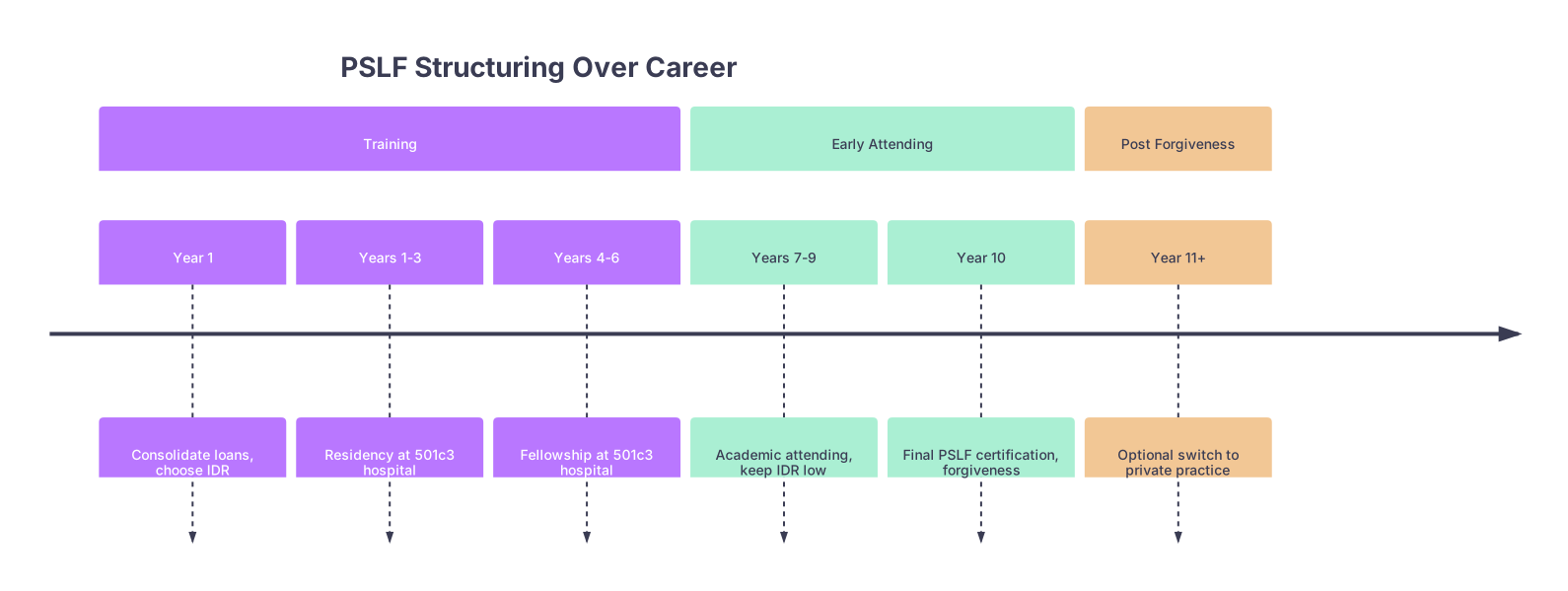
| Period | Event |
|---|---|
| Training - Year 1 | Consolidate loans, choose IDR |
| Training - Years 1-3 | Residency at 501c3 hospital |
| Training - Years 4-6 | Fellowship at 501c3 hospital |
| Early Attending - Years 7-9 | Academic attending, keep IDR low |
| Early Attending - Year 10 | Final PSLF certification, forgiveness |
| Post Forgiveness - Year 11+ | Optional switch to private practice |
That’s how senior physicians quietly walked into their 40s and 50s debt-free while younger docs are still arguing on Reddit about REPAYE vs SAVE.
The Legal and Policy Layer Nobody Bothered to Explain
There’s one more uncomfortable layer to this.
Policy makers know high-balance, high-income professionals like physicians have been some of the biggest PSLF winners. That’s part of why:
- Newer IDR plans are structured to be more progressive
- Eligibility windows, grandfathering rules, and caps have shifted
- Temporary waivers were time-limited and highly technical
The government is slowly squeezing the loopholes that older doctors exploited openly and legally. They’re not retroactively ripping forgiveness away—that’d be political suicide. But they are making it harder for a new attending in 2024 to pull off the same play as one in 2010.
So the legal/financial reality for you:
- You must assume the rules you see now will either stay flat or get slightly less favorable for high-income borrowers, not more
- Waiting “to see what happens” is a losing bet
- Anything that requires many years of stable political support (like PSLF) should be used aggressively and early, not timidly at the end
The senior docs understood that. They didn’t trust PSLF politically long term, so they front-loaded qualifying years and finished the 120 as soon as they reasonably could. Then they stopped caring what Congress did after.

What You Should Take Away From Their Moves
No, you can’t time travel. But you can stop being the naive version of yourself that thinks “I’ll figure it out after fellowship.”
Here’s the stripped-down, no-BS takeaway from how senior physicians quietly structured their loans before PSLF changes:
They treated PSLF like a 10-year contract, not a vague hope.
From Day 1 of residency, they set up loan type, repayment plan, and employment intentionally.They refused to be “good little borrowers.”
No extra principal payments. No emotional satisfaction from watching balances drop. They optimized for forgiveness, not feelings.They used tax law aggressively and legally.
Filing status, AGI manipulation, pre-tax contributions—all weaponized to drop IDR payments while income rose.
You’re not behind because you’re dumb. You’re behind because nobody bothered to show you the playbook early. Now you’ve seen it.
Use it.

FAQ (Exactly 3 Questions)
1. If I’m already an attending and never planned for PSLF, is it too late to benefit?
Not necessarily. If you’ve been working at a qualifying employer (academic hospital, VA, county system, major non-profit) and have federal Direct loans, you may have more qualifying time than you think—especially with recent one-time IDR/PSLF count adjustments. The move now is to get your employment certification forms submitted for every year you’ve worked in a qualifying role, confirm your loan types are Direct (or consolidate appropriately), get on a qualifying IDR plan, and have someone who actually understands PSLF run the numbers. You can still claw back value, but you need precision, not vibes.
2. How do I decide between committing to PSLF versus refinancing to private loans?
Draw a line in the sand around your career path. If you are highly likely to stay in non-profit/academic/VA practice for 10 total years of qualifying payments, PSLF usually wins by a mile. If you’re dead set on private practice, surgery center ownership, or concierge models without a non-profit umbrella, PSLF becomes a 5–7 year half-measure that often fails you. Run projections: compare 10 years of IDR + forgiveness versus 5–7 years of aggressive payoff after refinancing at a lower rate. Do not refinance federal loans until you are very sure PSLF is off the table.
3. Is the new SAVE plan always better than older IDR plans like PAYE for physicians?
No. That’s the kind of simplistic messaging that screws doctors. SAVE can be extremely favorable early on, especially during residency, due to lower payment percentages and better interest subsidies. But for high-income attendings, legacy plans like PAYE (if you’re eligible and already in it) can be better because of payment caps and spousal income rules. Senior physicians who locked in PAYE years ago are often sitting on structurally better deals than what you have access to now under SAVE. Your job isn’t to pick the “best plan on paper,” it’s to pick the best plan for your 10–15-year trajectory—which usually requires someone walking through actual numbers, not generic advice.