
You’re halfway through a brutal call night. It’s 3:17 a.m. You’re walking back from a rapid response, exhausted, your vision a little blurry from lack of sleep. And this thought hits you out of nowhere:
“If something happens to me… like actually happens… what happens to my loans?”
Not the vague, philosophical “what happens to my soul” kind of thought. The cold, terrifying “I owe $300K, my back already hurts, what if I get disabled during residency and I literally can’t pay any of this back?” kind of thought.
And then it spirals.
If I’m in a car accident.
If I develop MS.
If I get long COVID and can’t stand for long cases.
If my hands start shaking and I can’t operate.
If my depression or anxiety gets so bad I can’t safely practice.
Do they still come after me? My spouse? My parents who cosigned something I barely even remember? Does this wreck my credit on top of wrecking my life?
You’re not crazy for thinking about this. You’re actually smarter than most people in your program who are just hoping nothing bad happens.
Let’s go straight into the messy part.
First thing: not all loans are treated the same
This is where a lot of people get burned. You say “loans” like it’s one thing, but legally, it’s multiple completely different beasts.
Broad buckets:
- Federal loans (Direct Unsubsidized, Grad PLUS, some old Perkins/FFEL)
- Private loans (Sallie Mae, SoFi, Laurel Road, Earnest, random bank, etc.)
- Refinanced loans (used to be federal, now private with a new company)
The rules about disability and forgiveness depend almost entirely on which bucket you’re in.
If you take nothing else from this: federal loans have the strongest built‑in disability protections. Private loans are all over the place and sometimes brutal. Refinancing can permanently throw away your best disability protection.
So before anything else, you need to know what you actually have. Not “I think most of mine are federal.” No. Log into studentaid.gov and then log into each private lender and write it down.
| Loan Type | Disability Protection |
|---|---|
| Direct Federal | TPD discharge possible |
| Grad PLUS | TPD discharge possible |
| Old FFEL/Perkins | Often TPD, may need consolidation |
| Private (no refi) | Depends on contract, varies |
| Refinanced | Whatever private lender offers |
The big one: federal loans and Total and Permanent Disability (TPD) discharge
Here’s the one piece of good news in this whole nightmare spiral: if you have federal loans and you become totally and permanently disabled by the government’s definition, you can get them wiped out. Completely.
Not paused. Not reduced. Gone.
I’m not going to sugarcoat it: the process is paperwork‑heavy, and the definition of “total and permanent” is stricter than “I can’t reasonably work a 60‑hour attending job.” But it’s real, and people use it.
There are three ways to qualify for a federal TPD discharge:
You’re a veteran with a VA determination of unemployability or 100% disability
If the VA says you’re unemployable because of a service‑connected disability, your federal loans can be discharged. This is actually the most straightforward path.You receive SSDI or SSI with a long enough review period
If Social Security is paying you disability (SSDI or SSI) and your next disability review is scheduled 5–7 years out, that usually meets the “long-term” part they want.Your physician certifies you’re totally and permanently disabled
A doctor (MD, DO, or other qualifying specialist) has to certify that you can’t engage in “substantial gainful activity” due to a physical or mental impairment that:- Has lasted at least 60 months, or
- Is expected to last at least 60 months, or
- Is expected to result in death
So let’s translate that into the actual fear:
“I’m a PGY-2 neurology resident. I get diagnosed with severe progressive MS. I can’t do call, can’t reliably stand, my fatigue is extreme. Eventually, I can’t work any job consistently. What happens to my federal loans?”
If your doctor can honestly certify you meet that standard (can’t engage in substantial gainful activity, long term), you can apply for TPD discharge.
Same if you get into a catastrophic car accident and end up paraplegic with cognitive issues. Or you develop severe bipolar disorder or treatment‑resistant major depression that makes consistent employment impossible. They do not limit this to “physical” disabilities. Mental health conditions can absolutely qualify if they’re severe and long‑lasting.
The annoying part: “substantial gainful activity” and gray zones
Here’s where your anxiety brain kicks in: “What if I’m not totally unable to work? What if I can do some low‑stress telehealth thing or part‑time chart review… does that disqualify me?”
“Substantial gainful activity” is basically the government’s way of saying “work that actually pays you a meaningful amount and shows you’re employable.”
The gray zone is real. Suppose:
- You can’t safely do clinical work, but you can do 10 hours of remote non‑clinical work from home.
- You can’t handle full‑time, but you can do some consulting.
- You technically could work, but only in an extremely limited way and your income is tiny.
In these murky situations, qualifying for TPD is harder but not impossible. The doctor’s certification matters a lot. So does your SSDI status if you’ve applied.
But the core fear—“If I’m truly unable to work, I’ll still be crushed by six‑figure loans”—is not accurate for federal loans. Truly unable to work long‑term? There’s a legal mechanism to get rid of them.
What if I get disabled temporarily during residency?
Different nightmare, I know.
You break your leg badly, need multiple surgeries, you’re out for 6–12 months. Or you have a mental health crisis and need to take a leave. You’re expected to recover, but right now you can’t work or your income disappears or drops.
In that situation, you’re probably not going to qualify for TPD, because they expect you to eventually get back to work.
But you still have tools:
- Income‑Driven Repayment (IDR): If your income drops to zero or near zero, your IDR payment can drop to $0. It’s not magic, but it stops you from defaulting while you’re not earning.
- Deferment/forbearance: You can get a temporary pause on payments. Interest may still accrue, but it protects you from delinquency and default.
- Disability forbearance specifically exists in some cases, but honestly, IDR with low income is often better long-term than endless forbearance.
So if you’re thinking, “If I miss 3–6 months of work as a resident, I’m going to default and my life is over”—no. It’ll be stressful. Your finances will feel tight and scary. But the system does have levers you can pull before you fall off a cliff.
The trap: refinancing and losing your safety net
Now the part no one tells you in those slick refinance ads promising “Save $30K in interest!”:
If you refinance your federal loans with a private lender, you lose the federal TPD discharge option. Permanently.
Now your disability protection is whatever your refinance contract says. Sometimes it’s decent. Sometimes it’s absolute garbage.
Best case with private refinance loans:
They have a “total and permanent disability discharge” clause that mimics the federal one somewhat. You qualify, they write off your remaining balance. Great.
Worst case:
They only offer a short-term disability forbearance. Or they don’t clearly define what counts. Or they require their own doctor. Or they deny you because “You could technically work in some other role.”
And there’s zero government backstop. This is just you vs. a private company that profits from your payments.
So if you’re a PGY-3 seriously considering refinancing, ask yourself:
- Am I comfortable giving up guaranteed federal TPD discharge for maybe a somewhat lower rate?
- Do I have any risk factors—chronic illness, mental health history, family history, high-risk specialty—that make disability more likely than average?
Nobody likes thinking about this. But once those loans are refinanced, you do not get your federal protections back. Ever.
Private loans: the “read the fine print or regret it” category
Private loans are pure contract law. Whatever the promissory note says is what you get.
Some private lenders have decent disability discharge policies. Others treat you like you’re just late on a car payment.
Common patterns I’ve seen:
- Some will forgive loans in the event of total and permanent disability, but their definition is narrower than the federal one.
- Some will forgive only if you’re fully, permanently unable to work any job for which you’re reasonably qualified. That’s a higher bar than “can’t be a practicing physician.”
- Some only allow temporary disability forbearance and then expect payments to resume.
- Co‑signers may still be on the hook in some contracts even if you’re disabled. Yes, your parents could be dragged into this.
You absolutely cannot assume, “If I’m disabled, they’ll just wipe it.” That is not universal.
If you’re still in med school or early residency and already have private loans, it’s worth pulling the actual promissory note and reading the disability section. If the language is vague or terrifying, that’s useful information.
What if I die? Do my loans follow my family?
Morbid, but I know you’ve thought this too.
- Federal loans: Discharged upon death. If you die, your loans die with you. Your family does not inherit them.
- Parent PLUS loans: Also discharged if either the parent borrower or the student dies.
- Private/refinanced loans: This is entirely lender-specific. Many do discharge on death. Some might still pursue the estate or co-signer. Again, contract rules everything.
If someone cosigned a private loan for you (like a parent), and the lender does not have strong death/disability discharge language, they can absolutely go after that cosigner. This is why I get a little angry when I hear advisors casually say, “Just take out private loans, the rates are better,” without talking through the downside risk.
Disability insurance vs. loan forgiveness: they are not the same thing
Another thing that gets blurred a lot: disability insurance protects your income, not your loans directly. Loan discharge protects the loan, not your living expenses.
Ideally, as a resident or young attending, you want both:
- Own-occupation disability insurance (the kind that pays out if you can’t work in your specialty, even if you could theoretically do some other job)
- Federal TPD protection on your federal loans, and if you must have private loans, the best disability clauses you can find
The common horror story:
Young attending. $400K in loans. Early 30s. Has long-term disability insurance that only pays partial income. Has refinanced all loans privately because “federal rates were too high.” Develops a condition that makes clinical medicine impossible but maybe allows part-time desk work.
Result: income drops. Private lender says, “You’re not totally and permanently disabled according to our definition, keep paying.” There’s no automatic loan discharge. They’re stuck.
That’s the scenario you’re trying to avoid.
Tax bomb? Does loan discharge count as income?
Another thing to stress about, I know.
- Federal TPD discharge used to sometimes create a taxable event (the so-called “tax bomb”).
- Right now, under current law (through at least 2025), federal loan forgiveness and discharge are not taxed as income at the federal level.
States are a different story—some may still tax it. That’s annoying, but it’s not the same as “I got $300K forgiven and now I owe $90K in taxes.” For most people, the tax risk now is much lower than it used to be.
Always double‑check the current rules when you’re actually in that situation, because tax laws change and Congress loves to keep everyone confused.
So what does this actually mean for you, sitting here freaking out?
It means:
If you keep your loans federal and you truly become unable to work long‑term, there is a way out. That doesn’t fix the disability, but it does mean you’re not chained to your med school debt for life while also dealing with major illness or injury.
If you refinance or rely heavily on private loans without reading the fine print, you’re betting your entire future health on the assumption you’ll never be seriously disabled. Most people will be fine. A small but very real minority will regret that decision permanently.
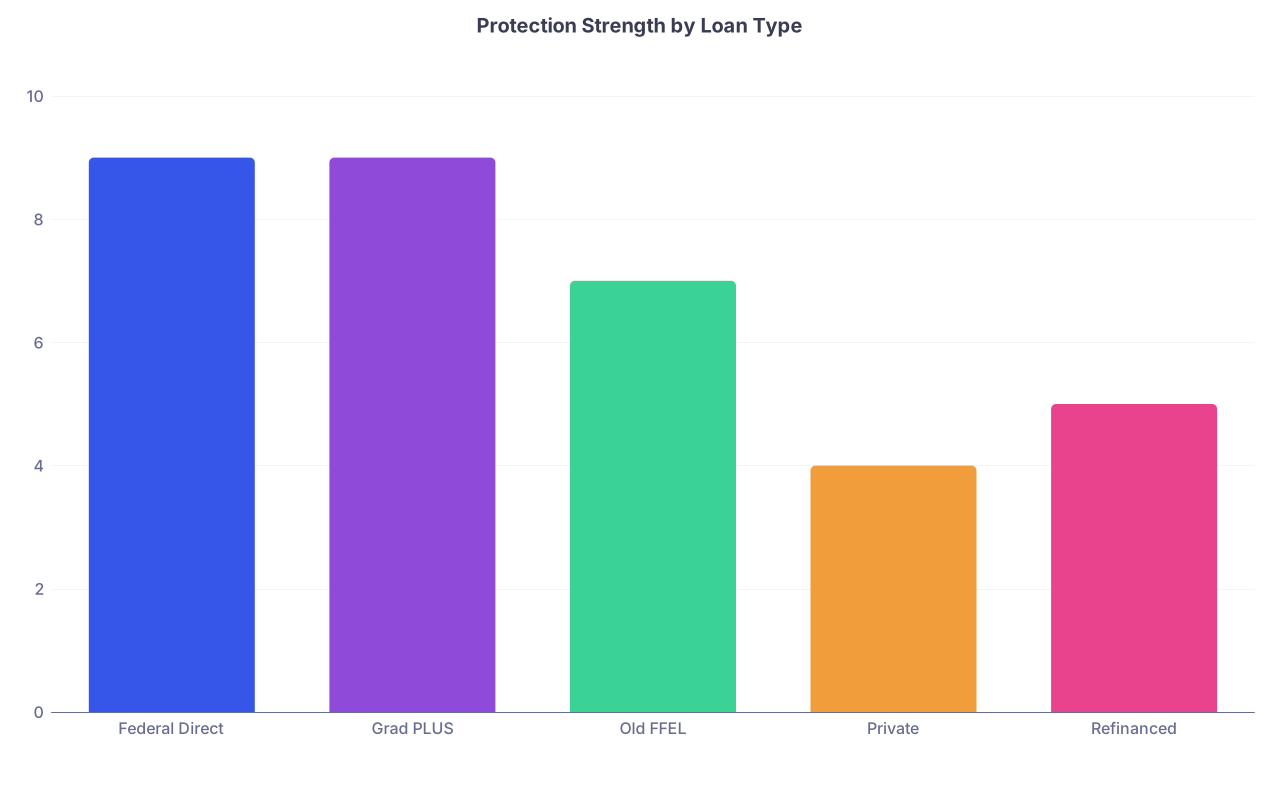
| Category | Value |
|---|---|
| Federal Direct | 9 |
| Grad PLUS | 9 |
| Old FFEL | 7 |
| Private | 4 |
| Refinanced | 5 |

If you want to actually do something about this instead of just spiral
Three concrete moves you can make without blowing up your life:
Inventory your loans. For real.
Log into studentaid.gov and every private lender. Write down:- Federal vs private
- Approximate balances
- Who the servicer/lender is
Stick this in a simple document. This alone will lower your anxiety a bit because “unknown” is usually worse than “bad but defined.”
Do not reflexively refinance your federal loans in residency or early attending years.
At least not until:- You understand exactly what you’re giving up (TPD, IDR, PSLF, forbearance flex)
- You’re confident you have strong long-term disability insurance in place
If you already have private loans, pull the actual promissory note.
Find the section on:- Death
- Disability
- Cosigner responsibility
If the language freaks you out, that’s not you being dramatic. That’s you actually seeing the real risk.

| Step | Description |
|---|---|
| Step 1 | Resident with Loans |
| Step 2 | Keep Federal Protections |
| Step 3 | Review Disability Terms |
| Step 4 | Maintain TPD and IDR |
| Step 5 | Compare Lender Disability Policy |
| Step 6 | Check Cosigner Risk |
| Step 7 | Decide if Rate Savings Worth Risk |
| Step 8 | Federal or Private? |
| Step 9 | Refinance? |

The emotional part nobody talks about
A lot of this fear isn’t literally “what happens to my loans.” It’s deeper than that.
It’s, “If my body or my brain gives out after I’ve sacrificed my 20s, I’m screwed twice. I lose my career and I’m buried in debt from trying to get that career.”
You’re not dramatic for being scared of that. You’re just not lying to yourself.
But there is a difference between catastrophic, life-shattering disability and every single lesser thing that can go wrong. The system is flawed, but it’s not “you get hit by a bus and Sallie Mae eats your parents alive” by default.
If you have federal loans and you become truly unable to work long-term, there is a mechanism to wipe that debt out.
If you temporarily can’t work during residency, you have options to get $0 payments or forbearance without defaulting.
If you still have the power to choose, you can avoid making your future worst-case scenario even worse by not casually giving up those protections for a slightly lower interest rate.
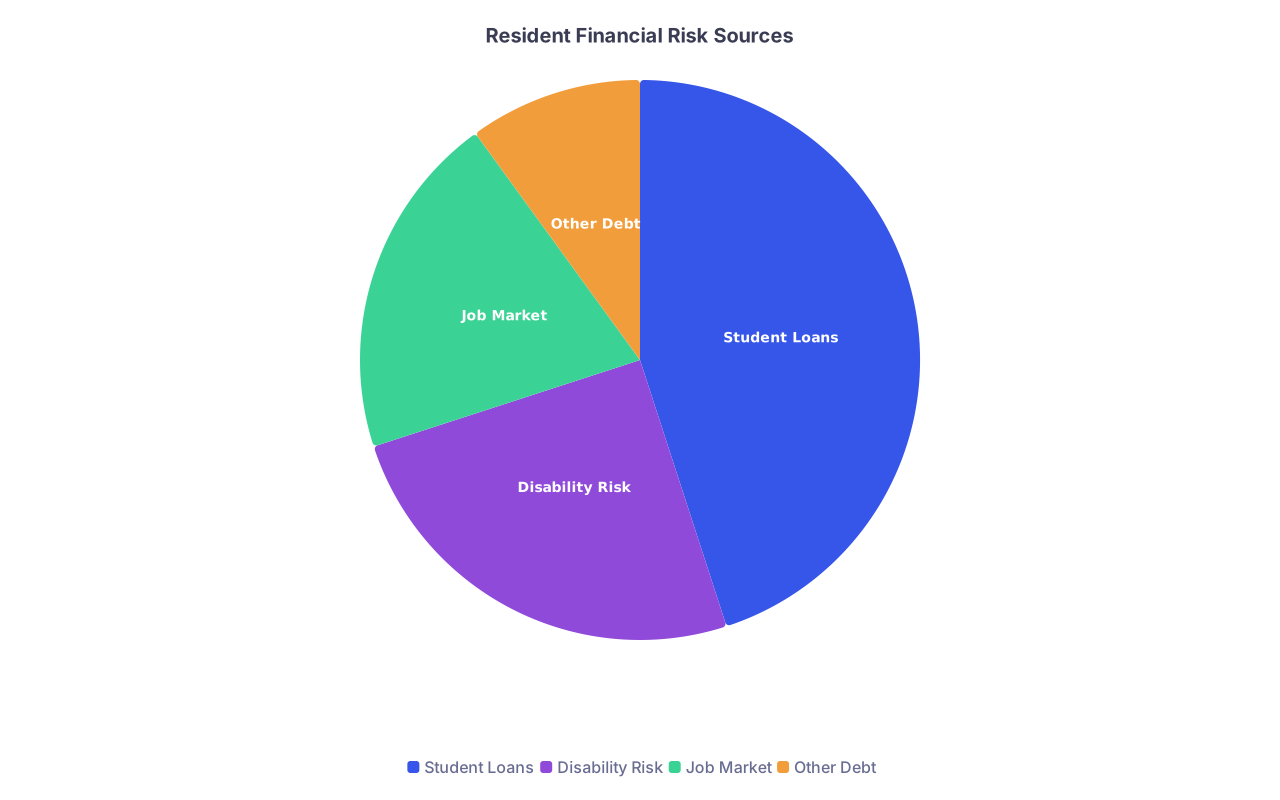
| Category | Value |
|---|---|
| Student Loans | 45 |
| Disability Risk | 25 |
| Job Market | 20 |
| Other Debt | 10 |
Three things to keep in your head when your brain starts spiraling
- If your loans are federal and you’re truly, permanently unable to work, there is a legal path to have them forgiven. You’re not trapped forever with impossible payments on top of disability.
- The biggest irreversible mistake is refinancing federal loans to private without understanding you’re trading away that protection for some interest savings.
- You don’t have to solve everything right now. But you can do the basics: know what loans you have, keep the federal protections unless there’s a very good reason not to, and pair that with real disability insurance once you can.
You’re allowed to be scared about this. Just don’t let that fear push you into decisions that make the worst‑case scenario worse.