
You’re sitting there with your loan servicer page open, staring at a six-figure number that doesn’t even feel real. $280,000. $420,000. Maybe closer to $600,000 if you went out-of-state or private. You keep clicking “refresh” like the number might magically change. It doesn’t.
And the thought that won’t stop looping in your head:
“Am I ever going to retire? Like… actually retire? Or did I just sign up to work until I literally can’t stand up in clinic anymore?”
That’s the fear, right? Not just “Will I be okay next year?” but “Did I just trade my entire future for this degree?”
Let’s talk about that. Honestly. No sugar-coating, but also no catastrophizing beyond what’s actually real. You’re already doing enough of that in your own head.
The Ugly Math: How Bad Is “Massive” Medical School Debt Really?
Here’s the part that makes your stomach drop: the numbers do look bad at first glance. I’m not going to pretend they don’t.
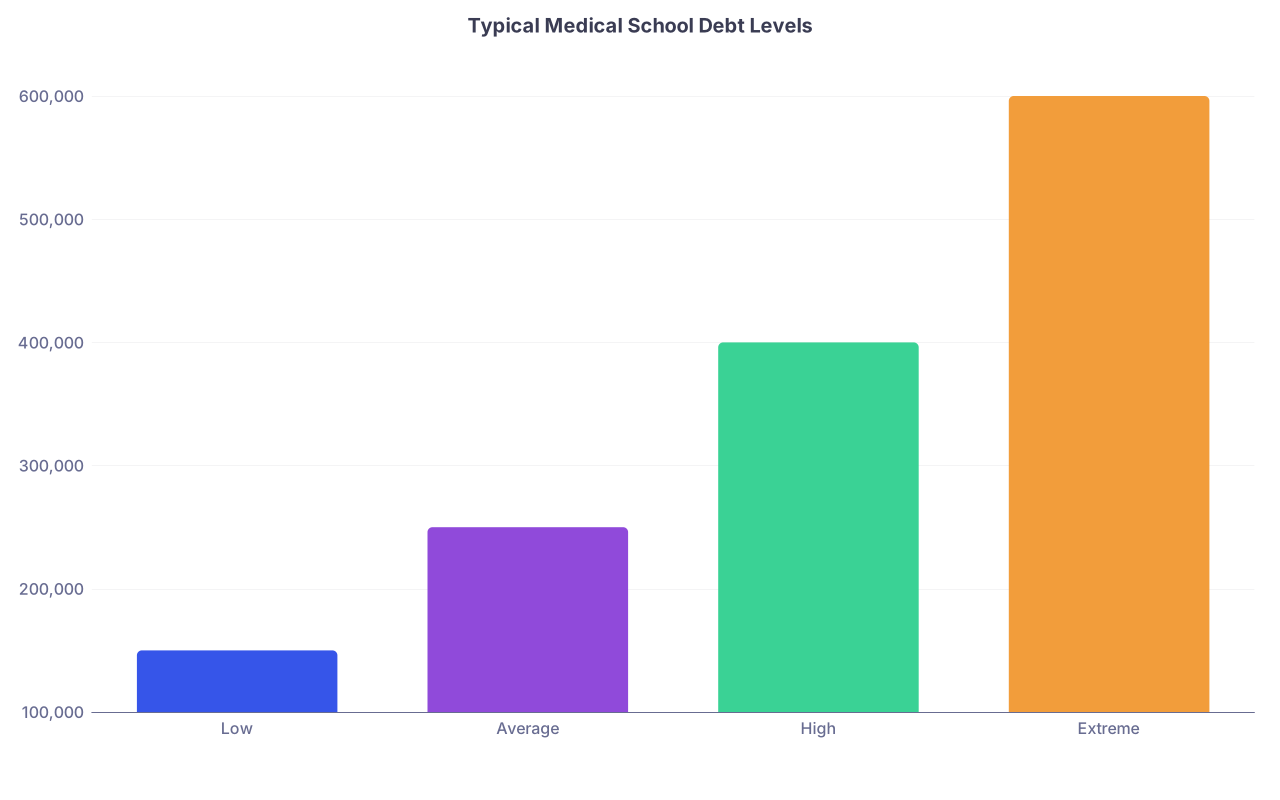
| Category | Value |
|---|---|
| Low | 150000 |
| Average | 250000 |
| High | 400000 |
| Extreme | 600000 |
If you’re in the “high” or “extreme” categories, you probably run some version of this nightmare scenario in your head:
- If I owe $400k at ~6–7% interest, that’s like… a mortgage. On a house I don’t get to live in.
- If I do standard repayment over 10 years, my monthly payment could be $4k+. How do I live on top of that?
- If I stretch it to 25 years, sure the payment’s lower, but now I’m paying back something like $700–800k total. That feels disgusting.
And behind all that:
“How do people with this much debt ever retire? Or are they all just silently drowning and I haven’t heard about it yet?”
Here’s the real answer: yes, people with massive med school debt retire all the time. But the ones who do it comfortably have three things in common:
- They pick a repayment path deliberately instead of emotionally.
- They start retirement investing earlier than feels comfortable.
- They don’t ignore the problem for 10 years and then panic at 45.
If you do what a lot of anxious new attendings do—avoid, defer decisions, just auto-pay the minimum with no strategy—you can absolutely wreck your retirement prospects. Not because it’s impossible. But because drifting is how you waste your highest-earning years.
The Big Question: Can Student Loans and Retirement Savings Coexist?
You’re probably thinking: “I can barely imagine paying rent and loans as a resident. How am I supposed to ALSO save for retirement? That feels fake.”
Here’s the harsh truth that’s actually kind of freeing:
If you wait to “feel ready” before saving for retirement, you will not retire comfortably. Period.
You won’t wake up one day at 45 magically debt-free, with tons of free cash flow and no lifestyle creep, saying, “Perfect time to start from zero on retirement.” That’s fantasy.
So can loans and retirement coexist? Yes. But only if you do something that feels completely backward to your anxiety brain: you save for retirement while you’re still in debt.
Not after. During.
This is where people mess it up. They make it binary in their heads:
“Either I attack my loans OR I save for retirement.”
That’s the wrong framework. The real game is:
“How do I structure my loans so they’re controlled and predictable, and then carve out room for steady, boring retirement saving every single year?”
How Different Paths Affect Your Chance of Retiring
Let me walk through the usual paths people take and how each one plays with retirement, because this is where most of the quiet panic lives.
| Strategy | Retirement Outlook |
|---|---|
| 10-year aggressive payoff | Very strong if disciplined |
| 20–25-year IDR + PSLF | Strong if invest early |
| 20–25-year IDR, no PSLF | Fine with tax planning |
| Minimum payments, no plan | Weak, often delayed |
1. Aggressive 10-Year Payoff
This is the “I hate this debt so much I want it gone yesterday” route.
You finish training, live like a resident for 3–5 more years, and throw a disgusting amount of your attending income at your loans. I’m talking $6k–$10k+ per month, depending on your specialty and debt size.
Can you retire comfortably on this plan?
Yes—if you don’t sacrifice retirement contributions completely during that time.
The trap:
Some people go nuclear: “I’ll pay NOTHING into retirement until my loans are gone.” Then by the time they’re 40 and finally debt-free, they’ve missed out on a decade of compound growth. That decade is brutal to replace.
Better version of this plan:
- Contribute at least enough to get your employer 401(k)/403(b) match from day one. That match is free money. Walking away from it to pay extra on loans is almost always dumb.
- Once you hit a decent baseline in retirement accounts, then yes, you can ramp up the loan payoff.
You can absolutely do the “ridiculous loan sprint” and retire well. But if that sprint consumes everything and you toss retirement a $0 bone for years, you’re trading one form of financial anxiety for another.
2. IDR + PSLF (Public Service Loan Forgiveness)
If you work for a qualifying nonprofit or government employer (most academic centers, VA, county hospitals), PSLF is your golden ticket if you treat it like a 10-year project, not a vague hope.
Basic idea:
- You make income-driven payments for 120 qualifying months.
- At the end, the remaining balance is forgiven tax-free.
Here’s where the retirement anxiety kicks in:
You look at your projected forgiveness and think, “They’re going to forgive, like, $200k. That can’t be real. What if the program dies? What if I’m the one person they deny?”
I’ve seen people cripple themselves with overpayments because they don’t trust the program. They throw extra money at loans that would’ve been forgiven—money that could’ve gone into Roth IRAs, 403(b)s, or brokerage accounts growing for decades.
If you actually commit to PSLF and do the paperwork right, it’s one of the best ways to both control debt and accelerate retirement. Because your monthly payment stays relatively lower, which frees money to invest.
The emotional challenge: trusting the math more than your fear.
3. Long-Term IDR Without PSLF (Private Practice, For-Profit Jobs)
This is where people really panic about retirement. Because now it feels like the debt might just follow you forever.
You pay under IDR for 20–25 years. Whatever’s left at the end gets forgiven, but unlike PSLF, that forgiveness currently comes with a tax bill (after 2025, unless laws change again).
People hear “tax bomb” and freak out. Imagining some IRS agent showing up when they’re 50 with a giant bill they can’t pay.
Reality:
- That tax is predictable and can be estimated.
- You can save for it in a separate investment account over decades.
- If you’re saving for that and retirement in parallel, you’re not doomed.
So can you retire comfortably on this plan? Yes—if you structure it intentionally:
- Accept that your loan is a long-term controlled expense, like a second mortgage.
- Save monthly in a “tax bomb fund” while also contributing to retirement.
- Don’t wait until year 18 and suddenly remember, “Oh right, taxes.”
The people who get wrecked here are the ones who never plan for the tax at all, spend everything else, and then feel sucker-punched.
The Emotional Mess: Why This Feels So Much Worse Than It Is
Let me say the quiet thing out loud: doctors with $300–500k of debt are not financially ruined by default. But they feel ruined.
Because you’re combining:
- Insane delayed gratification (you watched your college friends start careers at 23; you’re still a trainee at 30+).
- Huge numbers that don’t feel human.
- A culture that’s weirdly silent about money, so everyone assumes they’re the only idiot drowning.
I’ve seen residents with $450k in loans and zero retirement savings who still end up in great shape by their 40s, because once they hit attending pay, they stopped acting like victims and started acting like CFOs of their own lives.
On the flip side, I’ve seen attendings with $150k in loans, living like they’re multi-millionaires—Tesla, giant house, private school—who are quietly on track to work until 70 because they “deserved” immediate lifestyle upgrade.
Debt size matters. But what you do with your first 5–10 years post-training matters more.
How Retirement Actually Gets Built When You Start Deep in the Hole
Let’s be concrete. You probably want someone to just tell you: “If I start here, is it actually possible?”
Short version: Yes, if you do this:
- You pick a loan strategy on purpose:
- PSLF? Then stop throwing extra money at loans that’ll be forgiven.
- No PSLF? Decide: short aggressive payoff vs. long IDR with planned tax bomb.
- You commit to baseline retirement saving early:
- As resident: even $100–200/month into a Roth IRA is not a joke. That money gets decades to grow.
- As attending: at minimum, hit your employer match, ideally more.
- You don’t inflate your lifestyle to match your attending income day one:
- You can’t go from $65k resident to $350k attending and instantly “live like a doctor” in the Instagram sense without sacrificing your future self.
The wild thing: If you put even 15–20% of your gross income toward retirement once you’re attending—and don’t start at 50—you can absolutely hit a retirement portfolio big enough to give you options in your 60s. Even with giant loans in your 20s and 30s.
A Quick Reality Check: Your Earning Power vs Your Debt
You’re terrified of the debt because it’s big and visible. You don’t see your earning potential in your loan portal, so it feels abstract.
Let’s put some numbers side by side.
| Path | Total Debt | Lifetime Earnings* |
|---|---|---|
| Primary Care | $250k–400k | $8–10 million |
| Non-surgical specialty | $300k–450k | $10–14 million |
| Surgical specialty | $350k–600k | $12–18 million |
*Over 30–35 years, pre-tax, very rough ranges.
Yes, taxes, overhead, burnout, part-time work—lots of stuff eats into this. But the point is:
Your debt feels like a mountain because you’re seeing it at the worst possible time—when your income is at its lowest. Once you’re at attending level, if you don’t let lifestyle eat everything, the ratio of “debt vs earning power” shifts hard in your favor.
Where Legal / Policy Stuff Fits Into Your Retirement Anxiety
You’re also probably quietly worried: “What if the government changes all the rules and I’m screwed?”
That’s not a stupid fear. PSLF rule changes, IDR plan tweaks, interest pauses—policy has been chaos.
Reality check though:
- Changes have generally been more generous over time for existing borrowers, not worse.
- Already-enrolled borrowers often get “grandfathered” into old terms.
- Building your retirement plan assuming the worst (no forgiveness, no policy improvements) will usually overshoot in a good way.
Also: freaking out about politics doesn’t save you a dollar. Having a concrete plan and adjusting as law changes do.
What You Should Actually Do Right Now (Not Someday, Not “When Things Calm Down”)
You’re probably looking for some sign that “Yes, you’ll definitely retire comfortably, don’t worry.”
I’m not going to lie to you like that. If you finish training, crank your lifestyle to max, make minimum payments with no strategy, and never invest a meaningful amount? No, you probably won’t retire “comfortably.” You’ll just slow-walk your way into a cage you built yourself.
But if you:
- Choose a loan path like an adult,
- Put your retirement on autopilot early,
- And resist the urge to soothe your training trauma with luxury purchases,
then yes—even with massive med school debt—you can retire, and not in poverty.
Not by being a genius. Just by not doing what most scared, exhausted new attendings do.
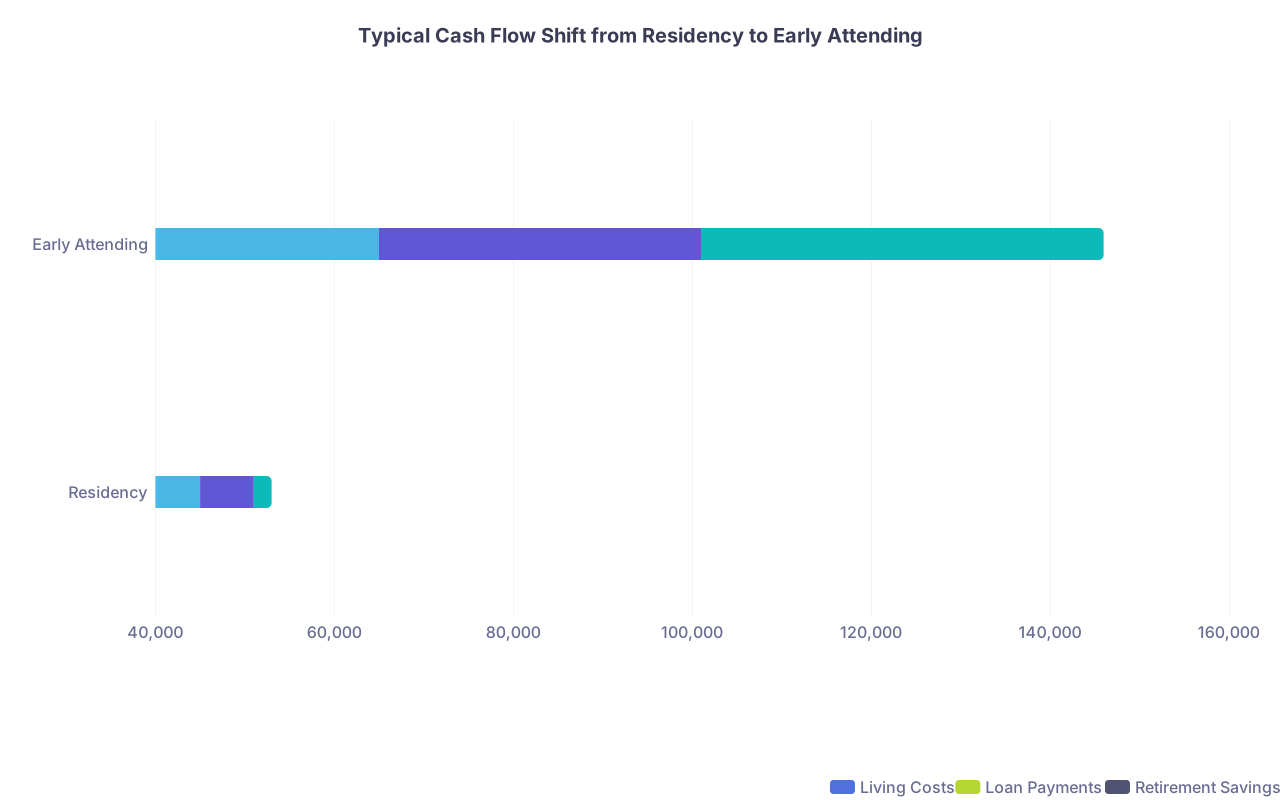
| Category | Living Costs | Loan Payments | Retirement Savings |
|---|---|---|---|
| Residency | 45000 | 6000 | 2000 |
| Early Attending | 65000 | 36000 | 45000 |
You see that last bar? That’s where your retirement comes from. Not from magic. From deciding that a significant chunk of your attending income goes to Future You, not Present You’s anxiety.
FAQ (You’re Not the Only One Thinking These)
1. What if I’m already in residency and haven’t saved anything for retirement yet? Am I screwed?
No. You’re normal. Honestly, most residents have either nothing or a tiny amount saved. Start now, even if it’s $50–100/month into a Roth IRA or a simple target-date fund in a 403(b). The habit matters more than the amount at this stage. Those early dollars have the longest time to grow.
2. Is it ever actually smart to invest instead of aggressively paying down loans?
Yes. If:
- Your loans are on a solid forgiveness track (PSLF) or a low IDR payment.
- Your employer offers a match—free money outruns guaranteed 6–7% “return” from paying loans faster.
- You understand that the market is volatile short-term but has historically grown long-term, while your loan interest is fixed.
Killing debt feels emotionally satisfying. Growing a retirement portfolio is mathematically satisfying. You need some of both.
3. What if I don’t match into a high-paying specialty? Is comfortable retirement still realistic with big debt?
Yes, but it’s tighter. If you’re in primary care or a lower-paying field with $350k+ debt, you can’t be casual. PSLF becomes very attractive. Long-term IDR might fit. You’ll need to be more intentional about housing, car purchases, and how quickly you let lifestyle inflate. But plenty of family med, peds, psych docs with huge loans still retire comfortably because they respected the math early.
4. Should I feel guilty spending on anything fun while I have this much debt?
You’re not a monk. Total deprivation backfires. The goal isn’t “no joy until the loans are gone.” The goal is: structure your financial life so retirement contributions and loan payments happen first, automatically. Then enjoy what’s left without shame. Guilt doesn’t pay down debt or grow your nest egg. Systems do.
Open your loan account and your retirement account side by side right now. Then write down—literally, on paper—which path you’re on: aggressive payoff, PSLF, or long-term IDR with tax planning. If your answer is “I don’t actually know,” that’s your next step: pick a path this week, even if it’s just a draft version you refine later.