
The myth that income-driven repayment will destroy your credit score is lazy and wrong.
Let me say that again because I know your brain is screaming the opposite: choosing an income-driven repayment (IDR) plan in residency does not inherently tank your credit score. Your anxiety can absolutely tank your sleep. But the IDR plan itself? Not the villain here.
You’re worried your credit will be ruined right when you need it most—for apartments, maybe a car, maybe a spouse’s mortgage app. You’re picturing your attending swiping a fancy Amex while you get denied for a basic apartment because “you picked the wrong payment plan.” I know exactly where your head is going.
Let’s untangle this, slowly and brutally honestly.
The Big Fear: “Low Payments = Bad Credit, Right?”
Here’s the core misconception:
You’re thinking, “If my payment is super low during residency—maybe even $0/month—the credit system will think I’m a deadbeat who isn’t really paying my loans. So they’ll trash my score.”
That’s not how it works.
Credit scoring models don’t care if your student loan payment is $0, $75, or $5,000 per month as long as it’s on time and under a valid repayment plan. Income-driven repayment is a valid repayment plan. Completely legitimate. Designed for you, not as some loophole.
Your credit report doesn’t say:
“This person is paying $75/month on $300k in loans, what a joke, please destroy their FICO.”
It says something like:
Loan status: Current
Repayment plan: Income-Driven Repayment
Payment history: On-time
FICO cares about “On-time” vs “Late,” not “Big payment” vs “Small payment.”
But I know your brain: “Are you sure? There must be a catch.” So let’s get painfully specific.
How Credit Scores Actually Treat IDR (Not the Horror Movie Version in Your Head)
| Factor | What Matters Most |
|---|---|
| Payment history | On-time vs late / missed payments |
| Amounts owed | Your total debt & credit utilization |
| Length of credit history | How long accounts have been open |
| New credit | Hard inquiries from new credit applications |
| Credit mix | Types of debt (credit cards, loans, etc.) |
Notice what’s missing?
“Whether you picked PAYE, SAVE, IBR, REPAYE, or Standard.”
The scoring formula doesn’t give a single damn about the name of your plan.
What it does care about:
- Do you have a payment due?
- Did you pay it on time?
- Is the loan in good standing (current) or bad standing (delinquent, default, collections)?
If you’re on an income-driven plan:
- Your lower (or $0) payment is considered your full, required payment.
- If you make that required payment on time, your loan is “current.”
- “Current” payments are positive for your credit history, or at least neutral.
IDR is not reported as “partial payment.” It’s not coded as “this idiot can’t afford real payments.” It’s just “this borrower is repaying under an income-driven plan.”
What Actually Tanks Your Credit During Residency
Your credit doesn’t get crushed because you chose IDR. It gets crushed when residency chaos plus bad communication leads to one of these landmines:
Forgetting to recertify your income
- Every year you have to update your income for IDR.
- If you forget, your payment can jump to a massive “standard” amount.
- You miss that huge payment because you didn’t see the email or you froze.
- Loan becomes 30+ days late.
- Now your servicer reports: “30 days late” → that does hammer your score.
Missing payments right after the grace period or end of deferment
- You think your loans are still in deferment…
- They’re not.
- Your “first real” bill comes, you’re exhausted post-call, you ignore your mail.
- Boom, missed payment gets reported after 30 days.
Letting loans slip into delinquency or default
- Ignoring servicer messages.
- Moving and not updating your address or email.
- Telling yourself “I’ll deal with it after this rotation” for six straight months.
- This is the stuff that leaves deep scars on your credit report, for years.
None of those things are “caused” by choosing IDR. They’re caused by chaos, avoidance, and systems that are frankly hostile to tired residents.
IDR vs Deferment vs Forbearance: Which Looks Worst on Credit?
You might be wondering if you should just throw everything into forbearance during residency so your credit looks “clean.”
Let me be blunt: long-term forbearance is usually the worst strategy both financially and psychologically, even if it sounds like the path of least resistance.
Here’s how these options generally show up:
| Status / Plan | How it Usually Reports | Credit Impact if No Late Payments |
|---|---|---|
| IDR (e.g., SAVE) | Current, in repayment | Neutral to positive |
| Deferment | Deferred, not in repayment | Neutral |
| Forbearance | Forbearance, not in repayment | Neutral, but can raise red flags |
Key points your anxious brain will try to ignore:
- IDR with tiny payments is not worse than deferment. It’s arguably better, because you’re building a history of on-time payments.
- Deferment/forbearance isn’t a credit score death sentence either, as long as the loan is in an official paused status and not delinquent.
- Lenders might look at forbearance and think “this person is struggling” if they manually read your report (like for a big mortgage), but for routine stuff like basic credit cards or many apartments, it’s usually a non-issue compared to missed payments.
For public service loan forgiveness (PSLF), IDR is almost always the smarter move because paused months in forbearance often don’t count, while IDR payments do (even if tiny).
So if you’re training at a nonprofit hospital and even might go for PSLF? Long-term forbearance is usually shooting yourself in both feet.
What Lenders Actually See When You’re in Residency
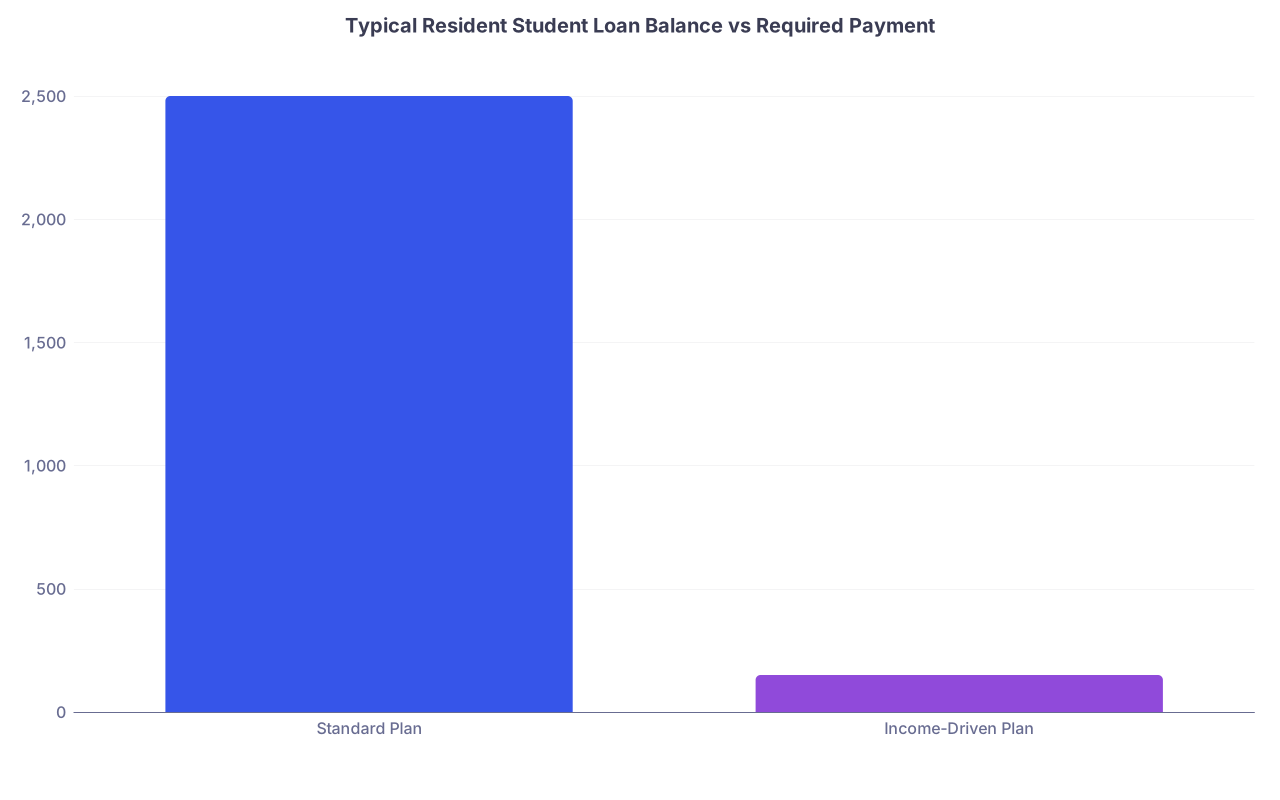
| Category | Value |
|---|---|
| Standard Plan | 2500 |
| Income-Driven Plan | 150 |
Imagine you’re applying to rent an apartment PGY-1. The landlord pulls your credit.
What do they see?
- A big student loan balance (maybe $200k, $300k, even $400k+). Welcome to medicine.
- Status: “Current.” No late payments.
- Possibly shows “In Income-Driven Repayment” or something similar.
- A small required monthly payment.
Landlords and lenders in big residency cities (NYC, Boston, Chicago, Houston, etc.) see this constantly. You’re not their first heavily indebted doctor-in-training. They expect this. Many actually like it better when:
- Your required monthly payment is small → your monthly budget looks less crushed.
- You don’t have a history of late payments.
That’s the key: clean history beats “huge payment” almost every time.
Where it can get tricky:
Debt-to-income calculations for big loans like a mortgage. That’s a whole different beast. Most residents aren’t getting a big mortgage anyway, but there are “physician mortgage” programs that understand IDR. These lenders know that your current income is fake-low compared to your future attending income.
Your credit score is one piece. Your payment history is a bigger piece. Your plan type is… background noise.
The One IDR-Related Trap Almost Nobody Tells You About
The thing you should really be scared of is not IDR itself. It’s the paperwork treadmill attached to it.
Every year on IDR, you have to:
- Recertify your income and family size by a deadline.
- Submit documentation (tax return, pay stubs, etc.).
- Watch for the servicer to process it correctly, which they sometimes don’t.

| Step | Description |
|---|---|
| Step 1 | Enroll in IDR |
| Step 2 | Make Monthly Payments |
| Step 3 | Annual Recert Due |
| Step 4 | New Low Payment Set |
| Step 5 | Payment Jumps |
| Step 6 | Risk of Missed Payment |
| Step 7 | Late Reported to Credit |
| Step 8 | Recert On Time |
If you miss that annual recertification:
- Your payment can skyrocket to the 10-year standard amount.
- Auto-pay can suddenly pull way more than you expected.
- Or you freeze, don’t pay it, and boom—now you’re late.
That late mark? That’s what dings your score hard. Not the fact that you were in IDR, but that your IDR lapsed into chaos.
So what do you do?
You treat that recertification date like your absolute highest-priority non-clinical task of the year.
Set calendar alerts.
Your phone, your email, your partner’s phone if you have one.
Write it on a literal sticky note taped to your laptop. I’m not kidding.
If You’re Terrified Right Now, Here’s the Grounding Reality
Let me speak to the worst-case scenarios your brain is cooking up:
“If I go on IDR, will my credit tank?”
Not if you make your required payments on time and stay on top of recertification. The plan itself does not hurt your credit.“What if my payment is literally $0/month?”
$0 under an IDR plan is still an on-time payment. It’s not reported as delinquent. That’s the whole point of the plan.“What if I already had a late payment?”
It sucks, but it’s not a permanent death sentence. One 30-day late mark is bad, but ongoing on-time payments over the next 12–24 months can soften the damage.“What if my balance keeps growing and lenders see this huge number?”
They will. And they will also see that you’re in medicine, with a history of on-time payments. High student loan balances are practically normal for physicians. Not great, but not shocking.
Quick Reality Check: What Actually Helps Your Credit During Residency
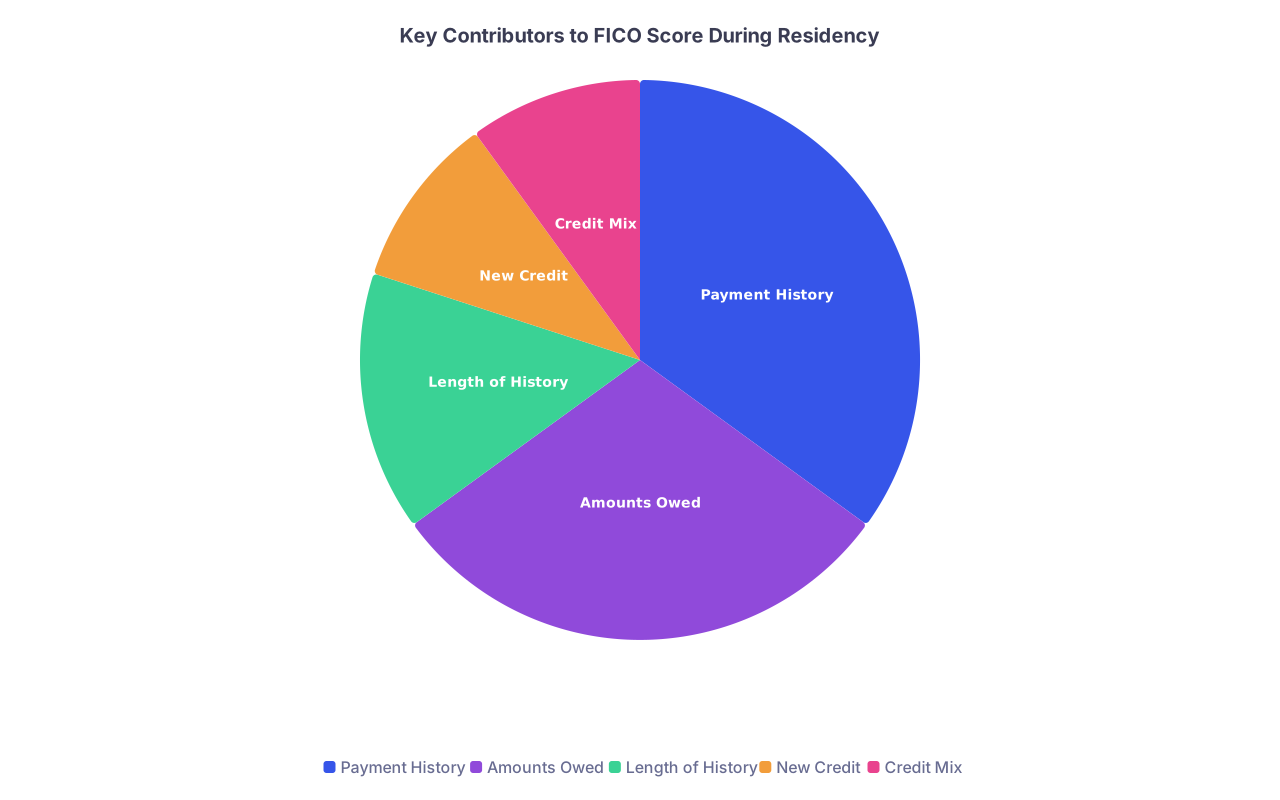
| Category | Value |
|---|---|
| Payment History | 35 |
| Amounts Owed | 30 |
| Length of History | 15 |
| New Credit | 10 |
| Credit Mix | 10 |
If you want to aim your limited mental energy where it actually matters:
Protect your payment history like it’s your board score.
- Auto-pay on.
- Correct bank account linked.
- Check after any servicer transfer.
Avoid random late credit card payments.
- One 30-day late on a $40 card bill hurts just as much as a late student loan in many scoring models.
Don’t apply for five new credit cards out of stress.
- A couple cards used lightly and paid in full are fine. A frenzy of new accounts + high utilization is not.
Keep your contact info updated with your servicer.
- New address? New email? New phone? Update them. Missed mail is how people walk straight into delinquency.
Putting it Together: Should You Choose IDR in Residency?
Here’s my very clear, non-hedged opinion:
If you’re a resident with a normal resident salary and six-figure debt, and especially if you’re at a nonprofit hospital and PSLF is even a remote possibility, IDR is usually the smartest and safest choice.
Not because it magically erases the psychological weight of your loans. It doesn’t.
But because:
- It keeps your payments manageable.
- It keeps your loans in good standing.
- It builds a record of on-time payments.
- It positions you for forgiveness programs like PSLF.
Your credit score is far more at risk from disorganization, burnout, and ignoring your inbox than it is from the words “Income-Driven Repayment.”

FAQ (You’re Not the Only One Spiraling About This)
1. Will choosing an income-driven repayment plan lower my credit score compared to the Standard 10-year plan?
No. The scoring formula doesn’t reward you for choosing the Standard 10-year plan or punish you for choosing IDR. What it rewards is consistent on-time payments. If IDR is the only way you can realistically make those payments during residency, then IDR is actually the safer option for protecting your credit. Forcing yourself into a giant standard payment that you might miss is how people blow up their score.
2. Can a $0 income-driven payment really count as “on-time” and not hurt me?
Yes. A $0 required payment under an IDR plan is still a valid, on-time payment. There’s no secret penalty code that says “this person didn’t really pay.” Credit reports don’t say “pays $0” as some failure. They show the account as current and in repayment under an income-driven plan. The only time you get hit is if your loan is reported 30+ days late, delinquent, or in default.
3. If my loans are in forbearance during residency instead of IDR, is that better for my credit?
For pure credit score purposes, both “current in IDR” and “in authorized forbearance” are usually neutral—as long as there are no late payments. But for your long-term financial life (and especially if PSLF is on the table), IDR is usually much better because those months can count toward forgiveness, while forbearance typically doesn’t. Also, relying on forbearance can become a habit, and people often forget when it ends and then accidentally miss payments. That’s when the real damage happens.
4. I already had a late student loan payment reported. Is my score ruined forever?
No, but it’s going to sting for a while. A 30-day late mark can hurt your score significantly in the short term, but it doesn’t mean you’re permanently broken. The best thing you can do now is:
- Get the account current as fast as possible.
- Set up auto-pay so it doesn’t happen again.
- Keep everything else (credit cards, other loans) perfectly on time.
Over 12–24 months of clean history, the weight of that old late mark slowly shrinks. It won’t vanish from your report for several years, but it will matter less and less. Your job is to make sure it’s a one-time event, not the start of a pattern.
Years from now, you won’t remember the exact FICO score you had in PGY-2. You’ll remember whether you faced this stuff head-on or let fear and avoidance make the decisions for you.