
A pediatric intern told me this on call at 2 a.m.: “I’m not scared of overnight shifts. I’m scared Congress is going to wake up one day and just… delete PSLF.” She laughed when she said it, but her hands were shaking while she refreshed her loan account.
If you’re in training or early attending life, you probably know that feeling. PSLF is this huge promise hanging over your head, and yet it feels like it’s written in pencil, not pen.
Let’s talk about how to protect yourself if PSLF rules change. Not the sugar‑coated version. The “this could get messy, so here’s how you don’t get crushed” version.
First: How Likely Is PSLF to “Disappear” Completely?
Let me be straight: I don’t lose sleep over PSLF being nuked overnight for people already in the system. Could it happen? Technically yes. Do I think that’s the realistic threat? No.
The real threat is more subtle:
– Narrowing who qualifies
– Changing what counts as qualifying payments
– Capping forgiveness amounts for future borrowers
– Messing with tax treatment down the road
Politically, pulling the rug completely from under people who already structured their entire careers around PSLF—especially doctors in underserved hospitals, social workers, public defenders—would be radioactive. Courts would get involved. Lawsuits would fly. Unions and hospital systems would lose their minds.
What’s more realistic is this kind of move:
“PSLF remains in place for existing borrowers who already have federal loans, but starting with borrowers who take out loans after X date, the program will be modified/limited/capped.”
That’s exactly how changes to income‑driven repayment (IDR) have happened. Old borrowers get grandfathered into old terms. New borrowers get new rules.
But here’s the scary part: even if they don’t cancel PSLF, they can absolutely make it harder to qualify, or less generous, or more confusing so more people screw it up.
So your plan can’t be: “I trust PSLF. Full stop.”
Your plan needs to be: “I’m using PSLF. But if they pull something, I don’t go down with it.”
The Big Picture: Your PSLF “Defense Strategy”
Think of yourself as running a dual track:
- Track A: PSLF works as promised → you get forgiveness after 120 qualifying payments
- Track B: PSLF breaks, shrinks, or you get denied on a technicality → you’re not wrecked, just annoyed and prepared
Your whole goal is to keep both tracks alive. PSLF is Plan A, but you never let yourself become completely helpless if Plan A dies.
Here’s what that looks like in real life:
- You keep your loans 100% federal, no private refinancing while PSLF is on the table
- You make sure every single year is documented for PSLF, in writing, with confirmations
- You choose your IDR plan deliberately (not just auto‑enrolling in whatever the servicer pushes)
- You build some parallel savings/investments so you’re not fully dependent on forgiveness
I know what you’re thinking: “I can’t even afford coffee, you want me to build a PSLF backup fund?”
We’ll get to that. But first, you need to understand where the landmines are.
The PSLF Landmines That Hurt People Even If Rules Don’t Change
I’ve seen people get screwed without Congress changing a single thing. The damage comes from:
- Servicer incompetence
- Missing documentation
- Employment that they thought counted but didn’t
- Periods in the wrong repayment plan
- Changing from one IDR plan to another and losing qualifying months
If you want to sleep at night, you can’t just “trust” your servicer. Their phone reps are reading scripts. They will absolutely say things like:
- “That should count.”
- “You’re probably fine.”
- “You don’t need to submit that every year.”
None of that will help you when PSLF is actually reviewed 10 years later and someone says, “We don’t see records of X.”
Your mantra needs to be: If it’s not documented and confirmed, I assume it doesn’t count.
Which leads into the very boring but absolutely crucial part…
Step 1: Lock Down Your PSLF Paper Trail (Even If Rules Shift)
If PSLF rules tighten, the people who are going to survive are the ones with clear, clean, “you can’t argue with this” documentation.
At a minimum, you should have:
- Every PSLF Employment Certification Form (ECF) you’ve ever submitted, saved as PDF
- Every confirmation/response from MOHELA (or whatever servicer), also saved
- Annual payment counts screenshots or letters showing how many qualifying payments they say you have
- HR contact info from each employer, in case you ever have to re‑verify something
Do not rely on “it’s in my servicer portal.” Portals go down. Systems migrate. Data gets corrupted. You want your own offline, backed‑up copies.
Honestly, I’d keep a dedicated folder:
| Item Type | How Often to Update |
|---|---|
| Employment Certification Forms | Every 12 months |
| Payment Count Screenshots | Every 6-12 months |
| Employment Offer/Contract | Once per job |
| HR Contact Name & Email | Once per job |
| IDR Plan Confirmation Letters | When plan changes |
If rules change and you need to prove “grandfathered status” or argue that you followed the old program requirements, this stuff becomes gold.
Step 2: Choose Your Repayment Plan With Both PSLF and Backup in Mind
Right now, the drama is mostly around IDR plans (PAYE, REPAYE, SAVE, IBR, etc.). PSLF depends on you being in a qualifying repayment plan, but which one you pick still matters a lot.
Two competing goals:
- Minimize payments while training (to maximize eventual forgiveness under PSLF)
- Not accidentally put yourself in a horrible situation if PSLF dies and now you’re stuck paying the remaining balance out of pocket
There’s no one-size answer, but here’s the general principle:
- While you’re in low‑income years (residency/fellowship), a generous IDR like SAVE makes sense. Tiny payments, lots of unpaid interest covered. Great for PSLF.
- As you move into attending years, if PSLF is starting to feel shaky to you, it may be worth nudging payments higher (still via IDR) and starting to treat PSLF as a “bonus” rather than the only way your loans disappear.
This is where a lot of people mess up: they stay in super‑low payments as attendings and never build a backup plan. Then if they get denied PSLF at year 9, they’re staring at essentially their original principal plus some interest, and no savings to offset it.
One huge mental reframe that helps:
Assume you are responsible for paying these loans in full.
Assume PSLF is the government maybe stepping in at the end to bail you out.
Not the other way around.
Step 3: Build a “PSLF Backup Fund” (Even If It’s Pathetically Small at First)
This is the part that feels impossible when your checking account is gasping for air.
I’m not saying fully fund your retirement and a huge PSLF backup fund and private school for your future kids while you’re an intern. I’m saying: start building the habit and the bucket.
Even $25–$50 a month into a separate high‑yield savings or investment account labeled “Loan Backup” changes your psychology. It does a few things:
- Proves to you that you’re not completely helpless
- Gives you a growing chunk of cash that can either be:
– thrown at loans if PSLF dies
– repurposed into investments or a house down payment if PSLF works out - Acts as emotional insurance when headlines scream “PSLF under attack again”
For attendings, I’m much more aggressive: I think you should be saving/investing as if PSLF does not exist, and still doing PSLF correctly in the background. That way, if forgiveness happens, you’re overfunded and free. If it doesn’t, you’re annoyed but okay.
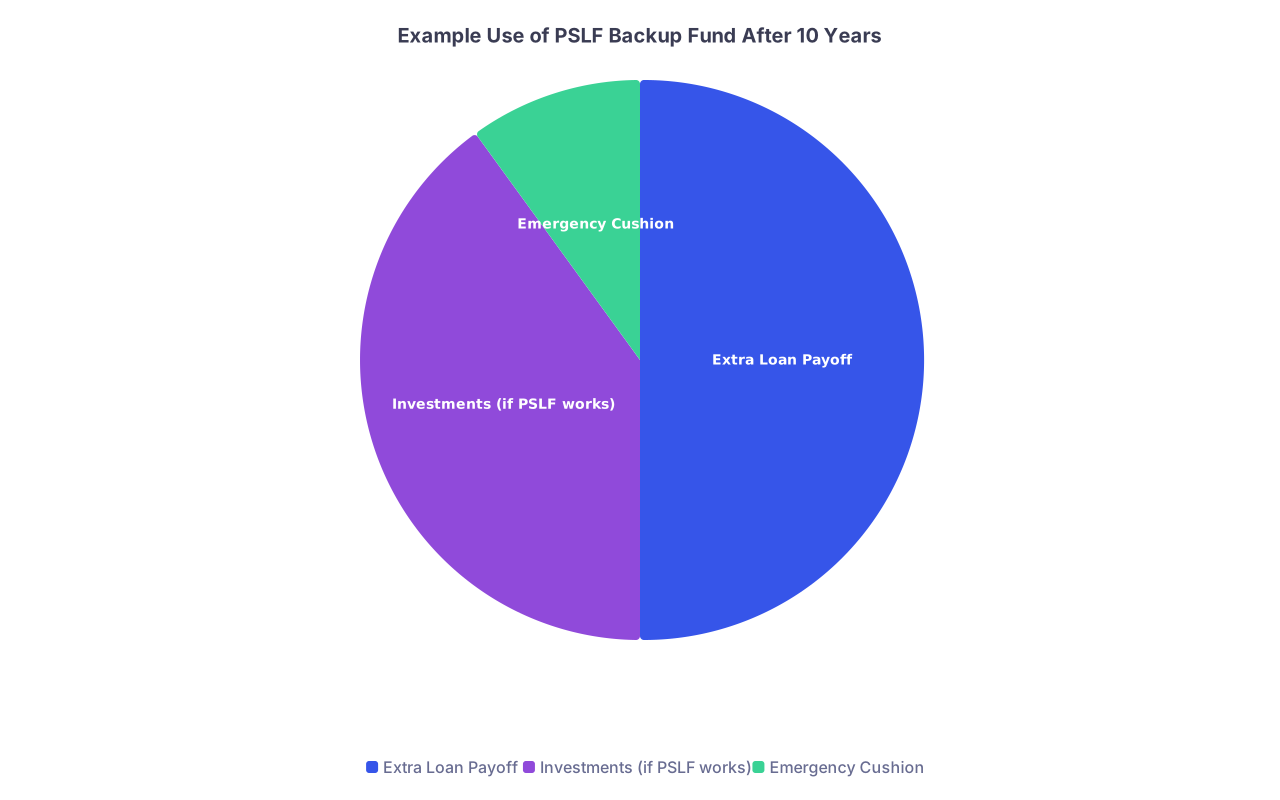
| Category | Value |
|---|---|
| Extra Loan Payoff | 50 |
| Investments (if PSLF works) | 40 |
| Emergency Cushion | 10 |
The point isn’t perfection. The point is not letting PSLF be the only bridge across the canyon.
Step 4: Be Very Careful About Refinancing Out of Federal Loans
This is the one decision you can’t undo.
If you refinance your federal loans to private, PSLF is gone. IDR is gone. Federal protections are gone. You are on the hook, no safety net.
There are attendings who should refinance. There are residents who should not touch refinancing with a 10‑foot pole.
But the real trap is the “I’m 40–50 payments into PSLF, but I’m anxious it’ll change, so I’ll just refinance and be done with it eventually” logic.
Here’s what you’re really saying there:
“I am so scared PSLF might not work out that I am going to guarantee it will not work out.”
If you’re already several years into PSLF and still working full‑time for a qualifying employer, the bar to justify refinancing should be extremely high. Like:
- You’re committed to leaving public/non‑profit employment long‑term
- You’ve modeled out costs with a very realistic PSLF denial scenario and still make more progress with refinancing
- You and possibly a financial planner have looked at the math, not just the vibes
Don’t kill PSLF because of a vague “what if.” Only walk away from it if you’ve run hard numbers and the math is screaming at you.
Step 5: Expect the Rules to Change—and Use It Against Them
This sounds backwards, but hear me out.
Every time PSLF has had a “change” in the last few years—waivers, account adjustments, IDR fixes—it actually helped a lot of people who were previously screwed. Years in the wrong plan suddenly counted. Old FFEL loans became eligible if consolidated. For once, chaos helped.
So instead of panicking at every headline, your job is:
- Stay extremely organized so you can pounce when there’s a waiver or adjustment
- Check your qualifying payments regularly and compare them to any new rules
- Be that annoying person who re‑submits forms during special windows because “just in case”
You want to be the person with everything ready when someone says, “You can get extra years counted if you submit X by Y date.” Not the person fumbling through old emails, missing yet another window.
Step 6: Legal / Policy Worst‑Case Scenarios—and How You Survive Them
Let me walk through a few nightmare scenarios people keep whispering about, and how you’d actually protect yourself in each:
Nightmare 1: “PSLF is canceled for everyone, immediately”
This would be political suicide, but fine, let’s go worst‑case.
Your defense:
- You still have IDR. You’re not left with immediate full repayment.
- Your backup savings/investments become the new payoff tool over time.
- Your years of low IDR payments were still not “wasted” — they kept you solvent at low income.
Is it awful? Yes. Is it catastrophic if you acted like PSLF was a maybe, not a promise? No.
Nightmare 2: “PSLF remains but is capped (e.g., only first $60k is forgiven)”
This feels more plausible.
Your defense:
- You’ve been building a backup fund that can cover the excess
- As an attending, you’ve treated PSLF as a bonus, not the only way out, so bigger payments + some investments are already happening
- Your career choices weren’t solely anchored to “I’ll never have to pay these back at all”
Nightmare 3: “Your previous years are re‑evaluated and some don’t count”
This one is already low‑key happening with payment recounts.
Your defense:
- Detailed records → you can prove employment dates and argue mistakes
- Multiple ECFs over the years → you’re not trying to reconstruct your life 10 years later
- If you do get hit and lose a chunk of years, your backup savings/investments soften the blow

How to Mentally Live With This Uncertainty Without Going Insane
The worst part isn’t even the financial risk. It’s the constant psychological static.
You’re trying to survive clinic, notes, pre‑rounding, boards, maybe kids, while this six‑figure bomb just hums in the background: “What if PSLF changes and I’m screwed?”
Two things that help:
Make a clear written plan
Not a vibe. A plan.
– “I’m on SAVE. I’m submitting PSLF ECF annually in January. I’m saving $X/month toward a backup fund. If PSLF is still intact by year 7, I’ll reassess my risk tolerance.”
Having this written down makes it feel less like drifting and more like executing.Decide in advance what level of risk you’re willing to tolerate
Some people are 100% all‑in on PSLF and feel fine. Others cannot sleep unless they assume it won’t be there. You don’t need the “right” answer; you need the one that lets you function without constant panic. It’s okay if your plan is conservative because your nervous system can’t handle full dependence on PSLF.
And one more thing: do not doomscroll headlines and Reddit threads as your main “strategy.”
Use them as intel, sure. But your actual moves should come from:
– Official Federal Student Aid announcements
– Written communications from your servicer
– Possibly a consult with a student loan specialist who lives in this stuff
Reddit can show you how people get screwed. It cannot tell you if you, specifically, are making the right moves.
Quick PSLF Stability Reality Check
To zoom all the way out for a second, here’s how I see the actual current risk profile:
| Scenario | My Risk Take |
|---|---|
| PSLF fully deleted for existing borrowers | Low |
| PSLF narrowed or capped for new borrowers | High |
| Technical denials due to bad documentation | Medium-High |
| Servicer screwups delaying forgiveness | High |
Basically: the program existing in some form is likely.
You actually getting forgiveness depends way more on your paperwork and planning than Congress suddenly erasing you.
FAQs
1. I’m early in residency. Should I plan my whole career around PSLF?
No. Use PSLF as a powerful tool, not a cage. It’s fine to say, “I’m likely to stay in academic medicine or a nonprofit system,” but don’t force yourself into misery for a decade just to chase forgiveness. You’ll do your best PSLF planning when you accept that life might change—locations, jobs, priorities—and your loan strategy should be flexible enough to survive that.
2. What if I’m already 7–8 years into PSLF—am I still at risk?
You’re in a much stronger spot than someone just starting, but you’re not invincible. At that stage, I would: obsess over documentation, confirm qualifying payments annually, avoid refinancing unless you’re absolutely sure you’re leaving qualifying employment, and start aggressively saving so that if something goes sideways at year 9 or 10, you’re not financially ruined. You’re close enough that walking away casually would be a bad move.
3. Should I switch to higher payments now in case PSLF dies later?
Not automatically. During training, low IDR payments are usually still the right call. As an attending, it depends on your income, specialty, and how much PSLF risk keeps you up at night. If you’re extremely anxious about PSLF failing, you can keep IDR but voluntarily pay more, or keep IDR minimums and shove extra money into a dedicated investment account labeled “loan hedge.” That way, you maintain flexibility: you can throw it at loans or keep it if forgiveness happens.
4. Is there anyone PSLF is clearly wrong for?
Yes. If you’re already sure you’ll work in private practice or a for‑profit setting long‑term, and your time in qualifying employment will be short, PSLF probably shouldn’t drive the whole strategy. Also, if your total debt is relatively low compared to attending income, you may be better off just planning to pay it off aggressively and treating PSLF as a distant maybe. But I’d still be cautious about permanently giving up federal protections until you’ve run the numbers, not just because you’re vaguely sick of the whole thing.
Bottom line:
- Assume PSLF could change.
- Act like it might work—but don’t need it to survive.
- Get your documentation and backup plan together now, so future you isn’t staring at a denial letter with nothing but regret.