
What if your loans are so big that no bank will ever touch you and you’ll never be able to buy a house or afford kids?
That’s the fear, right? Not just “this is stressful,” but “what if this debt has quietly ruined my entire future and no one wants to say it out loud?”
Let me say the scary part clearly: yes, huge student loans can absolutely make things harder. They can delay things. They can shut certain doors. And some lenders and landlords will judge you by a number on a screen without caring that your debt came from med school, law school, whatever.
But. They don’t automatically lock you out of a mortgage or a family. Even with eye-watering balances.
I’ve watched people with $300k+ med school loans close on houses. I’ve seen people with negative net worths have kids and somehow make it work. It’s not pretty or effortless or Instagram-friendly. But it’s possible.
The key is understanding how your loans actually show up on paper to lenders, what’s real risk vs anxiety spiral, and how to stop making decisions based only on the number in your loan portal.
Let’s go piece by piece.
How Lenders Actually Look at Your Student Loans (Not How Your Brain Does)
Your brain looks at your loan balance and thinks: “$250,000. I am screwed. No one will lend to me. I’m worse than someone with $0 debt.”
Lenders don’t really care about your balance. They care about your monthly payment and your reliability.
Three things matter a lot more to them than your total number:
- Your monthly required payment (what shows up on your credit report)
- Your income and job stability
- Your credit history and score
They boil this down into something called debt-to-income ratio (DTI). That’s just:
Total monthly debt payments ÷ gross monthly income
They want that number under certain thresholds. The exact numbers vary, but roughly:
| Type | Target DTI Max |
|---|---|
| Conventional mortgage | 43% |
| FHA loan (more flexible) | 50% (often) |
| “Comfortable” personal DTI | 30–35% |
So if you make $7,000/month before taxes, most lenders start getting nervous if your total monthly debts (loans, car, credit cards, etc.) are above about $3,000.
Notice what’s missing there: nobody is doing “$7,000 income vs $250,000 balance” math. They’re looking at the payment.
That’s why:
- A person with $300k in loans on an income-driven plan paying $350/month can sometimes look better on paper than
- A person with $80k in loans on the standard plan paying $900/month.
Your anxiety is obsessed with the total. Underwriting is obsessed with the monthly.
The Ugly Part: Ways Student Loans Do Mess With Mortgage Approvals
I’m not going to sugarcoat the ways this can go sideways, because honestly, the worst anxiety comes from feeling like you’re being lied to.
Here are the main ways big loans can bite you:
1. Your DTI looks awful
If your loans show a high monthly payment on your credit report, that blows up your DTI.
Example:
- Income: $80,000/year (~$6,667/month)
- Student loan payment reported: $1,200
- Car payment: $350
- Credit cards: $150
Total monthly debt: $1,700
DTI: $1,700 / $6,667 ≈ 25.5%
That’s actually fine. But if your loan payment were $2,000? Now you’re at ~38%. Add a slightly higher car payment, and suddenly the lender says “nope.”
The part that feels unfair: sometimes your actual payment (on an IDR plan) is lower, but the lender uses a fake higher number from their formulas (like 0.5% or 1% of your total balance) if they don’t trust the low IDR payment.
So $300k in loans × 0.5% = $1,500/month. Even if you’re literally paying $280/month on PAYE.
This is where people get blindsided.
2. Your loans are in forbearance or default
Lenders hate uncertainty. If your loans are:
- in default
- delinquent
- or in endless forbearance/deferment
that can freak underwriters out.
They start asking: what happens when these kick back in? Is this person going to get slammed with a huge payment later?
I’ve watched an underwriter say, verbatim: “I need to see a real, active repayment plan, not just ‘we’ll deal with it later.’”
So if you’re applying for a mortgage, “I’ve been in forbearance for three years” looks terrible. Even if you thought you were being responsible by kicking the can down the road.
3. Your credit score took a hit from missed payments
You can have $400k in student loans and get a mortgage, if:
- your payments are on time
- your credit score is decent
- and your DTI is reasonable
You can have $40k in loans and struggle, if:
- you’ve had 30/60/90-day lates
- collections
- or default
Lenders care more about “Do you pay when you say you’ll pay?” than “How big is the total?”
This is where the fear vs reality split is brutal. You’re panicking about the huge number, but the thing that actually blocks you is three missed payments from your intern year when you were drowning and ignored your loan emails.
4. You look overextended: house + daycare + loans
Here’s the part linked to starting a family.
Even if the bank technically approves you, you can still be screwed in real life. House payment + daycare + student loans + everything else can push you from “stretch” to “panic attack every time your car makes a weird noise.”
Quick reality check: daycare alone can be $1,200–$2,000/month in many cities. That’s a second rent. Stack that on $1,500 in loans and a $2,500 mortgage and your spreadsheet starts looking like a horror movie.
So no, the loans don’t always stop the bank from saying yes. But they can make your life feel terrifying once the baby actually shows up.
How Huge Loans Affect Starting a Family (Emotionally and Financially)
This is the part no one in “finance advice world” talks about honestly.
You’re not just asking: “Can I afford a kid?”
You’re asking: “Am I a terrible, selfish parent if I bring a child into my life while I owe $250k to the federal government?”
You’re not crazy for thinking that. I’ve heard:
- “I don’t want my kid to grow up with stressed, exhausted, debt-obsessed parents.”
- “I can’t even buy a house. How am I supposed to buy diapers?”
- “Am I cursing them to watch me drown financially for 20 years?”
Here’s the hard truth: there is no magical debt-free moment when kids suddenly become “affordable.” I’ve never seen it. People just decide at different levels of chaos what they’re willing to live with.
What matters more than the size of your loans is:
- Your monthly cash flow (what’s actually left after bills)
- Your tolerance for financial stress
- How much you and your partner are on the same page
Can loans delay things? Yes. Big time.
Will some people wait for PSLF year 10 or a big attending salary bump before trying? Yes.
But the loans themselves don’t physically prevent you from having a child. They just change what the life around that child looks like: apartment vs house, daycare vs family help, number of kids, timing, etc.
The Part Nobody Tells You: Lenders Often Treat IDR Payments Differently
This is the stuff that isn’t intuitive and makes everything feel random and rigged.
Different mortgage types treat your income-driven repayment (IBR/PAYE/REPAYE/SAVE) very differently:
| Loan Type | How They Often Treat IDR Payments |
|---|---|
| Conventional | May use actual IDR payment *or* 0.5–1% of balance |
| FHA | Often allows actual IDR payment if > $0 |
| VA | Often allows actual payment with documentation |
| USDA | Rules vary, sometimes more conservative |
So your saving grace might be:
- Switching to an IDR plan so your payment is lower
- Getting a letter from your servicer that states your actual monthly payment
- Choosing a lender/program that uses the real IDR amount, not 1% of your total balance
That can be the difference between:
- “We’re declining your application due to DTI”
and - “You’re approved.”
This is why one friend with the “same loans” gets approved and another gets denied. It’s not magic. It’s underwriting rules.
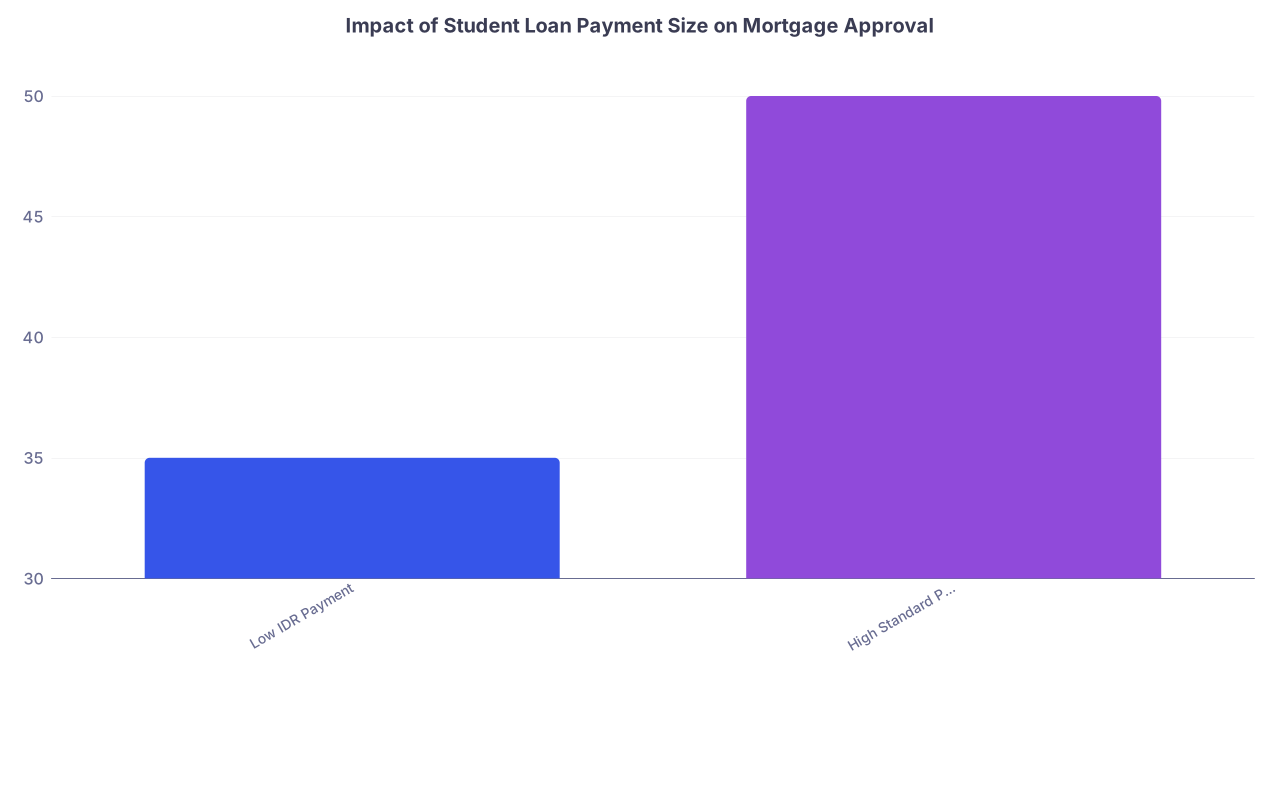
| Category | Value |
|---|---|
| Low IDR Payment | 35 |
| High Standard Payment | 50 |
Ways to Make Yourself More “Mortgage-Friendly” Even With Huge Loans
No, you don’t need to pay off $200k before you can buy a house. That’s fantasy land.
What you do need is to look less terrifying on paper.
Here’s what actually moves the needle:
Get on an income-driven repayment plan (if you’re not already)
Make your payment predictable and affordable. Lenders like predictable. Also, this keeps you out of forbearance/procrastination limbo, which looks bad.Avoid late payments at all costs
Set auto-pay. Double-check it actually runs. Missing one payment because you switched banks and forgot? That can hurt way more than the size of your balance.Clean up your credit report
Pull all three (Equifax, Experian, TransUnion). Fix errors. If you have old collections that can be negotiated or paid and removed, do it before you apply for a mortgage.Pay down other, smaller debts first
Weirdly, killing a $300/month car payment or a $100/month credit card minimum can help your DTI more than paying an extra $300 to your giant student loans.Consider where you apply and what loan type
Talk to a loan officer before you house hunt and say explicitly:
“I’m on [IBR/PAYE/SAVE]. Do you use my actual payment or a percentage of my balance for DTI?”
If they say “we use 1% of the balance,” maybe… find someone else.

| Step | Description |
|---|---|
| Step 1 | Huge Loan Balance |
| Step 2 | Check Credit Report |
| Step 3 | Start or Confirm IDR Plan |
| Step 4 | Document Monthly Payment |
| Step 5 | Reduce Other Debts |
| Step 6 | Talk to Mortgage Lenders |
| Step 7 | Preapproval |
| Step 8 | Adjust Budget or Wait |
| Step 9 | DTI Acceptable |
But What If I Never Own a Home or Have Kids Because of This?
Here’s the raw, late-night thought:
“What if I made one bad decision at 22 and doomed my entire adult life?”
I’m not going to pretend that massive student loans are nothing. They’re not. They’re heavy, they’re unfair in a lot of cases, and they steal options.
But they don’t erase all of them.
It’s possible that:
- You rent longer than you wanted.
- You buy a smaller place than your classmates.
- You wait 2–3 extra years before your first kid because daycare + loans is just too much right now.
Those are painful trade-offs. They hurt. You’re allowed to be angry about them.
But “I will never have a home, never have a family” is your anxiety catastrophizing, not reality.
People with:
- bankruptcies
- divorces
- foreclosures
- and absolutely crushing loan balances
still rebuild. Slowly. Messily. Boringly. Step by step, not with some magical fix.
You’re not uniquely doomed. You’re just in a really tight, really common corner.
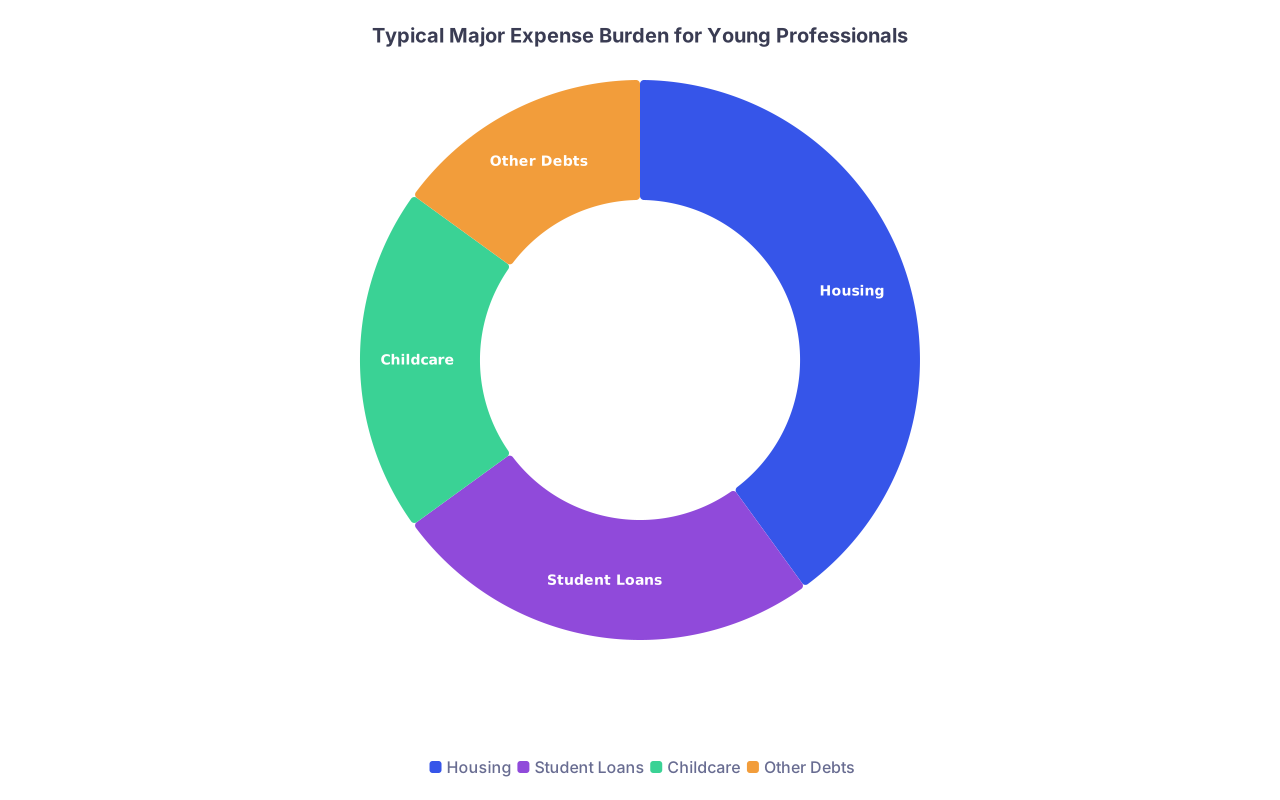
| Category | Value |
|---|---|
| Housing | 40 |
| Student Loans | 25 |
| Childcare | 20 |
| Other Debts | 15 |
How to Think About “House vs Kids vs Loans” Without Losing Your Mind
This is where it gets tangled. You’re not just juggling numbers. You’re juggling:
- Guilt (“I should have known better than to borrow so much”)
- Shame (“Other people my age are buying houses and I’m… not”)
- Fear (“If we have a kid now, we’ll drown”)
- Pressure (“My parents keep asking when we’re going to ‘settle down’”)
So you freeze. Or you doom-scroll Zillow and daycare costs and PSLF threads and do nothing.
Here’s a simpler way to think about it:
What’s your non-negotiable?
For some people it’s “I want kids even if we never own a house.”
For others it’s “I want the stability of a home before we have a baby.”You’re allowed to prioritize. You don’t have to pretend everything is equal.
What does your actual monthly budget look like with each choice?
Not vibes. Not “I feel broke.”
Real numbers. Rent/mortgage, loans, daycare, insurance, groceries. The boring list. Put it in a spreadsheet and look at what’s left.What’s your stress threshold?
Some people can live with $200 leftover each month and sleep fine. Others need a big cushion or they spiral.What’s reversible and what isn’t?
You can wait a year to buy a house.
You can move to a cheaper area.
You can’t rewind your fertility clock later (which is its own whole horror show of anxiety).
That’s how real humans make these decisions. Not “I’ll wait until I’m debt-free.” Because if that’s your standard, you might be waiting forever.

A Quick Word About PSLF, Forgiveness, and Long-Term Debt
If you’re in medicine, law, or any field where PSLF (Public Service Loan Forgiveness) or long-term IDR forgiveness is on the table, your loans might be a 20–25 year roommate, not something you ever fully crush.
That feels gross. It feels like failure. But honestly? For a lot of people it’s just… the plan.
You pay what you can afford. You certify your employment or recertify income. After 10 years (PSLF) or 20–25 years (IDR forgiveness), the rest gets wiped.
From a mortgage perspective, that means:
- Your monthly payment stays the main issue
- Your total balance may actually climb and look worse on paper over time
- But you still might buy a house and have a family during that period
It’s weird to accept that you can move forward in life with debt you might never “truly” pay off in the old-fashioned way. But that’s the system we’re in.

What You Can Do Today So This Feels Less Hopeless
You don’t need to fix all of this right now. You can’t. But you can stop letting it stay as one giant, formless, terrifying blob in your head.
Do this today:
Pull up your loan account. Write down:
- Total balance
- Current monthly payment
- Repayment plan name
- Status (in repayment, deferment, forbearance)
Open a blank document and write one clear sentence:
“My most realistic next big life goal is ___________ in the next 2–3 years.”
(Buy a house. Have a baby. Move cities. Whatever it actually is.)Then answer this, honestly, in 3–5 bullet points:
“For that to feel barely manageable financially, what would need to be true?”
Maybe: lower monthly loan payment, $X in savings, less credit card debt, stable job, etc.
That’s your actual starting point. Not the $250k. Not the “I’ll never be okay.” Just:
- Here’s what I owe.
- Here’s what I pay.
- Here’s what I want next.
- Here’s what would need to be true to not feel like I’m drowning.
Once you’ve got those written, your next step is clear:
Email or call one mortgage lender or financial planner and ask them, very specifically, how they would treat your student loans if you applied for a mortgage today.
Not someday. Not “when you’re ready.” Right now. Just to get actual rules instead of living inside worst-case scenarios.
You might not like the answer. Or it might be better than you think. But it will be real. And real is always less terrifying than what your brain makes up at 2 a.m.