
It is 11:45 PM after a brutal surgery clerkship day. You are still in your scrubs, sitting at your kitchen table, staring at an email from your loan servicer:
“Your estimated total repayment amount: $468,320. Projected payoff date: 2054.”
You scroll. And see the small line that makes your stomach drop:
“Based on your current repayment plan selection.”
This is where people quietly lose a decade of their life to bad medical student loan decisions. Not because they are lazy. Not because they do not care. But because no one ever explained the traps.
I am going to be blunt: I have watched residents and new attendings throw away six figures of their future for absolutely nothing. Not a nicer house. Not a better lifestyle. Just…interest.
Let us walk through the 10 most common, most expensive mistakes that will chain you to your loans for 10 extra years—and how to avoid them before it is too late.
1. Ignoring Interest During School and Residency
The first big mistake happens early: pretending your loans do not exist during school and training.
You know the line everyone loves: “Do not worry about it now. Focus on your studies.”
Terrible advice—if you take it literally.
Here is what actually happens to most med students:
- You borrow only what you need (or so you think).
- Your unsubsidized and Grad PLUS loans start accruing interest immediately.
- You defer or forbear during school and residency.
- Interest capitalizes (gets added to your principal) multiple times.
- You finish training and discover your original $250K turned into $350–400K.
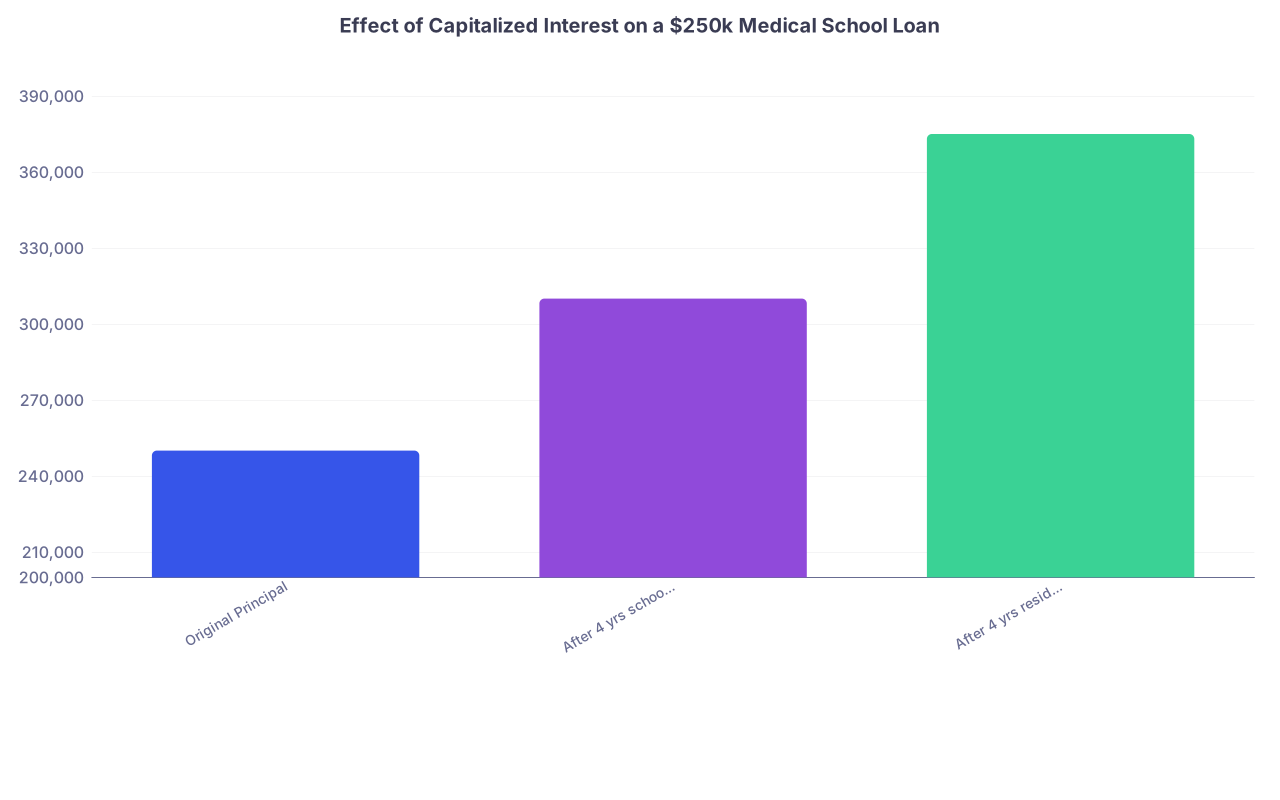
| Category | Value |
|---|---|
| Original Principal | 250000 |
| After 4 yrs school (no payments) | 310000 |
| After 4 yrs residency (no payments) | 375000 |
That “I will deal with it later” attitude easily adds 5–10 years to repayment.
Avoid this trap by:
- At least understanding your interest accrual every year. Know the number. Ignorance is not neutral; it is expensive.
- Making tiny, targeted payments in school or residency if you can:
- Even $25–$50/month toward accruing interest can prevent capitalized interest from snowballing.
- Not using forbearance by default in residency. It is almost always the worst option (we will get to that).
You do not need to fully pay your loans in training. But completely ignoring them is how you accidentally add a decade.
2. Using Forbearance Instead of Income-Driven Repayment in Residency
This one is brutal, because it sounds so reasonable.
Your program tells you:
“Just put your loans into forbearance during residency. You are too busy and not earning enough anyway.”
I have seen this repeated in orientation sessions like it is gospel. It is not. It is lazy.
Here is what forbearance does:
- Pauses your required payments.
- Lets all your interest accrue.
- Often leads to interest capitalization when forbearance ends.
- Does NOT count toward Public Service Loan Forgiveness (PSLF).
- Results in you paying more than necessary over time.
Now compare that to using an income-driven repayment (IDR) plan during residency—especially if you are at a 501(c)(3) or government hospital and aiming for PSLF:
- Your payments are based on income (often $0–$300/month as a resident).
- Every month you pay under IDR counts as a PSLF qualifying payment.
- Some plans (like SAVE) give partial interest subsidies.
- You keep your loans in good standing and limit capitalization events.

If you forbear all 3–7 years of residency instead of using IDR:
- You lose 3–7 years of PSLF credit.
- Your balance grows aggressively.
- You push your payoff, or forgiveness date, far into your attending years.
That is the decade trap.
Avoid this trap by:
- Enrolling in an income-driven plan (SAVE, PAYE, or IBR depending on eligibility) as soon as your grace period ends.
- Staying on IDR throughout residency, especially at PSLF-eligible institutions.
- Treating forbearance as a true emergency tool—job loss, illness—not as the default training strategy.
3. Refinancing Too Early “Because the Rate Is Lower”
This one hurts, because it preys on people trying to be “responsible.”
You see an ad from SoFi, Laurel Road, or another private lender:
“Refinance your federal loans from 7.05% to 4.2%! Save tens of thousands!”
Looks rational. Feels smart. Often a disaster.
Here is the mistake:
You refinance federal loans to private loans before you are absolutely certain you will never need:
- Income-driven repayment options,
- PSLF or other forgiveness,
- Deferment in tough times,
- Federal disability or death discharge protections.
Once you privatize a loan, it is like burning the bridge behind you. There is no going back to federal protections. None.
This is especially dangerous if you:
- Are still a student or resident,
- Are even possibly going into academic medicine, VA, county, or nonprofit hospital work,
- Might need PSLF,
- Are not 100% sure about your long-term career path or health.
Here is the kicker: Early refinancing can literally cost you six figures in lost PSLF benefit if you end up working at a qualifying employer.
| Feature | Federal Loans | Private Refinance Loans |
|---|---|---|
| PSLF Eligible | Yes | No |
| Income-Driven Plans | Yes | No |
| Hardship Protections | Strong | Limited/Varies |
| Discharge on Death | Yes | Varies by lender |
Avoid this trap by:
- Never refinancing during school or early residency if there is any chance you will use PSLF.
- Waiting until:
- You are an attending,
- You know your employer type (nonprofit vs private),
- You have run the math on PSLF vs aggressive payoff.
- Refinancing only the portion of loans you are sure will not be forgiven.
Lower interest is good. Losing federal safety nets too early is not.
4. Assuming PSLF Will “Probably Not Be There” So You Ignore It
The rumor mill in hospitals is strong:
“PSLF is going away.”
“No one actually gets it.”
“It is all a scam.”
Nonsense.
Is PSLF perfect? No. The early implementation was a mess. Servicers misled people, paperwork was done wrong, qualifying payments were miscounted. The usual government disaster.
But in recent years, thousands of physicians and other professionals have had hundreds of thousands forgiven. Quietly. Without headlines.
Here is the mistake:
You assume PSLF will not work for you, so you:
- Do not work at qualifying employers,
- Do not submit the Employment Certification Form (ECF) annually,
- Do not track your qualifying payments,
- Pick the wrong repayment plan,
- Or refinance out of federal loans entirely.
Then, surprise, you end up paying the whole amount plus interest—even though your career was in nonprofit systems the whole time.
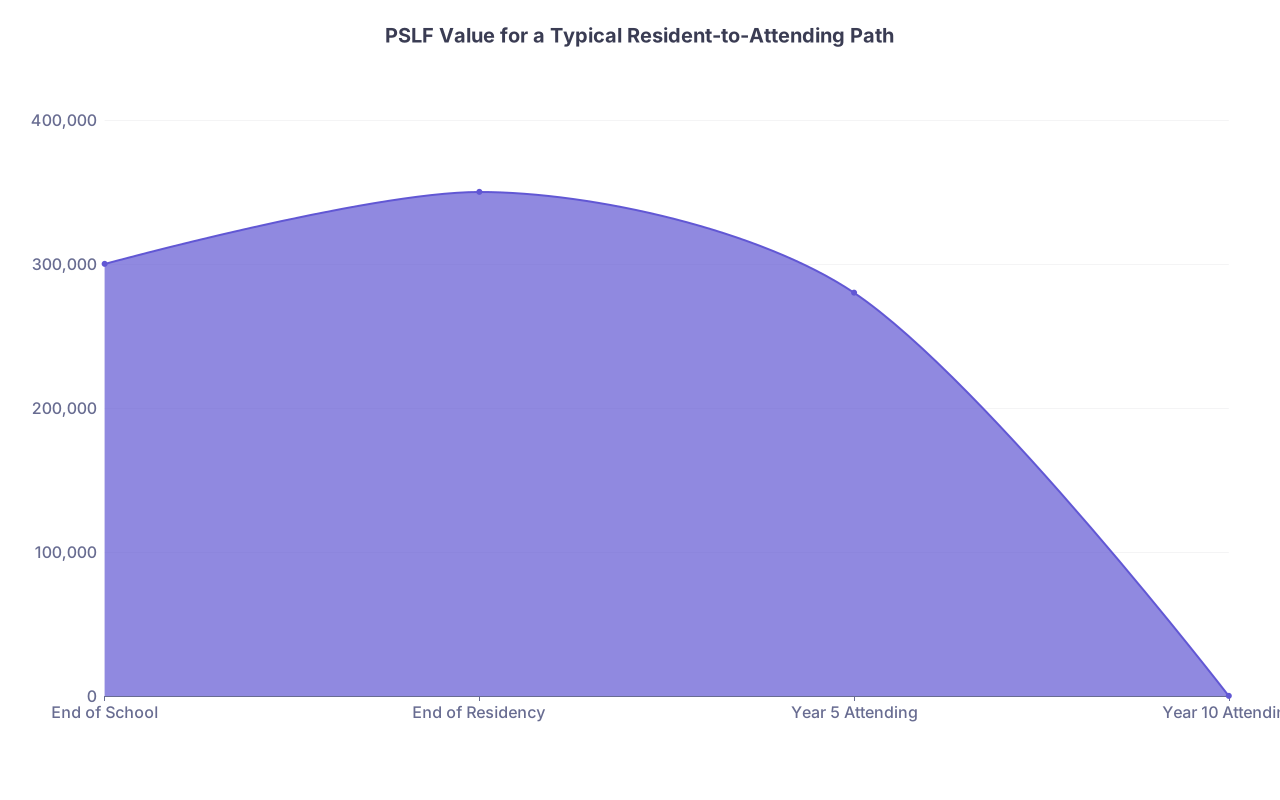
| Category | Value |
|---|---|
| End of School | 300000 |
| End of Residency | 350000 |
| Year 5 Attending | 280000 |
| Year 10 Attending | 0 |
Avoid this trap by:
- At least keeping the PSLF option alive:
- Stay in federal loans.
- Use a qualifying IDR plan.
- Work for a 501(c)(3) or government employer when possible.
- Submitting the PSLF form annually to confirm qualifying employment and payments.
- Running actual numbers:
- Use the federal loan simulator.
- Compare 10 years of PSLF vs 10–15 years of refinancing and aggressive payoff.
- Remembering: You can always pay faster later. You cannot retroactively make non-qualifying payments count.
Ignoring PSLF “because it is complicated” is a very expensive way to avoid reading paperwork.
5. Borrowing the Maximum “Because Future Attending Income Will Fix It”
I hear this a lot from M2s and M3s:
“I will be a doctor. I will be fine. I deserve to live decently now.”
You do deserve a humane life in medical school. You do not deserve to fund that entirely with 7–8% interest debt just because the form lets you.
The mistake is emotionally spending against a future salary that is already pre-sold to your loans.
Common patterns:
Taking the full cost of attendance every year without checking actual needs.
Using loans to support:
- High-rent luxury apartments.
- Frequent travel, upgraded flights.
- New car leases instead of a reliable used car.
- Lifestyle creep “because I will pay it off later.”
By the time you are a PGY-1, the damage is baked in. You cannot go back and “un-borrow” anything.

Avoid this trap by:
- Treating your cost of attendance as a ceiling, not a suggestion.
- Each year, ask:
- What is the absolute minimum I can borrow and still live safely and sanely?
- Cutting recurring costs aggressively:
- Roommates over solo luxury.
- Used car over new lease.
- Basic furniture over designer.
- Remembering: Every extra $10K you casually borrow can easily become $15–20K in repayment with interest.
Future you may be an attending. Future you may also be exhausted, burned out, and furious at the careless version of you adding five extra years of payments for a nicer couch.
6. Ignoring Tax Filing Strategy When on Income-Driven Plans
Income-driven repayment sounds simple:
“Your payment is based on your income.”
What most people miss: for married borrowers, tax filing status changes everything.
Here is the mistake:
- You get married in residency or early attending life.
- You automatically file Married Filing Jointly.
- Your spouse also has income.
- Your loan servicer recalculates your IDR payment using your combined income.
Your monthly payment jumps—sometimes doubling or tripling—overnight.
Your PSLF-eligible forgiveness shrinks.
Those “affordable” payments? Suddenly not.
Certain IDR plans (like PAYE, SAVE, and some versions of IBR) can calculate payments using only your income if you file Married Filing Separately. But most borrowers never even ask.
| Scenario | Filing Status | Income Used for IDR |
|---|---|---|
| Single Resident | Single | Your income only |
| Married to High Earner | Joint | Combined incomes |
| Married, Using PAYE or SAVE | Separate | Borrower income only |
Avoid this trap by:
- Before marriage or first tax filing as a couple:
- Talk with a tax professional who understands student loans.
- Run side-by-side projections: Joint vs Separate.
- If you are on IDR and your spouse earns significantly more:
- Ask your servicer how your plan handles Married Filing Separately.
- Do not let your accountant blindly pick “Joint” just for a small tax refund boost if it blows up your IDR strategy.
A few hundred more in tax refund at the cost of tens of thousands in extra loan payments is a terrible trade.
7. Not Understanding Capitalization Events
Capitalization is the quiet assassin of your loan balance.
The mistake is very simple: you do not understand when and why your unpaid interest gets added to your principal. So you accidentally trigger it. Repeatedly.
Common capitalization triggers:
- Ending a grace period and entering repayment.
- Leaving IDR or switching to a different plan.
- Coming out of forbearance or certain deferments.
- Loan consolidation in many cases.
Each time interest capitalizes:
- Your balance jumps.
- Future interest is now calculated on a bigger number.
- Total repayment cost grows—often dramatically.
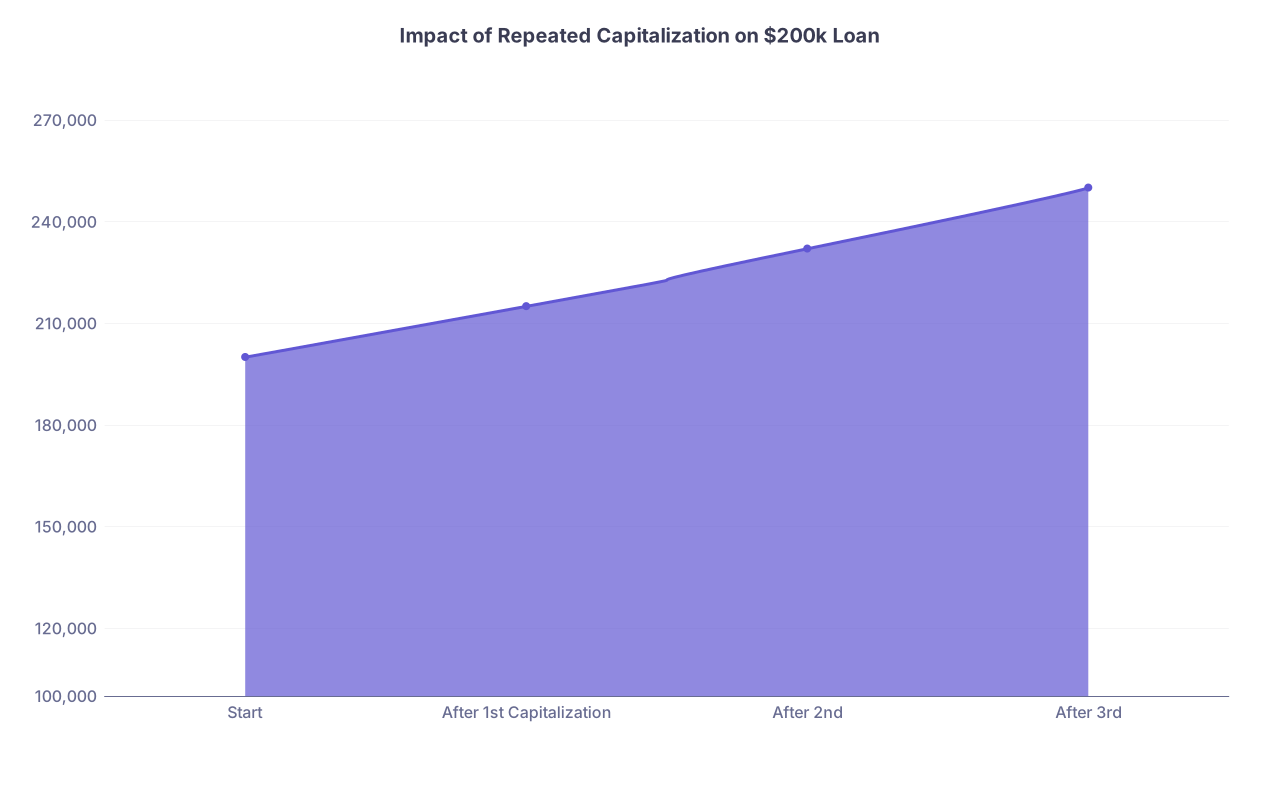
| Category | Value |
|---|---|
| Start | 200000 |
| After 1st Capitalization | 215000 |
| After 2nd | 232000 |
| After 3rd | 250000 |
Avoid this trap by:
- Minimizing the number of times you:
- Enter and exit forbearance.
- Change repayment plans.
- Consolidate loans unnecessarily.
- When you must switch plans or exit a pause:
- Try to pay down accrued interest first if at all possible.
- Reading the servicer’s explanation of when interest capitalizes. Yes, the boring PDF. This one actually matters.
You cannot avoid all capitalization. But you can avoid casually doing it three or four extra times and gifting the servicer an extra five years of payments.
8. Consolidating or Combining Loans at the Wrong Time
Consolidation is one of those tools that is either very helpful or very expensive, depending on when you use it.
Here is the classic mistake:
- You already have some qualifying PSLF years on your existing federal loans from med school or early residency.
- You decide to consolidate for “simplicity” or to access a different IDR plan.
- Your consolidation process resets the PSLF clock on some or all of those loans to zero.
- You wipe out 2–6 years of qualifying payments instantly.
I have personally seen people discover this as attendings. They thought they had 10 years of PSLF done. They actually had 4. Because they consolidated mid-residency without understanding the impact.
On the flip side, some borrowers delay consolidation that would have:
- Gotten them into a better IDR plan earlier.
- Combined older FFEL or Perkins loans into Direct Loans to qualify for PSLF.
- Simplified tracking and prevented missed payments.

Avoid this trap by:
- Before consolidating, calling your servicer and asking directly:
- “Will consolidating these loans reset my PSLF qualifying payment count on any of them?”
- Taking screenshots or saving PDFs of:
- Your current PSLF qualifying payment counts.
- Written confirmation from servicers about the impact of consolidation.
- Considering consolidating once, early, if:
- You have mixed loan types and need Direct Loans for PSLF.
- You are about to start residency and want everything lined up.
Consolidation is a scalpel, not a hammer. Use it precisely or do not use it.
9. Letting Your Loan Strategy Be Reactive Instead of Planned
Another trap: drifting.
The pattern looks like this:
- MS4: You match. You vaguely plan to “figure out loans later.”
- PGY-1: You pick a random repayment plan based on the first thing the servicer suggested.
- PGY-2–3: You ignore annual recertification emails until the last minute and upload whatever.
- Attending year: You suddenly see your first full attending-size payment and panic.
No overarching plan. Just reacting to deadlines and emails.
You will absolutely overpay if your approach is “click whatever keeps me out of default.”
There are really just a few intentional paths:
PSLF-focused strategy:
- Federal loans only.
- IDR the entire time.
- Work at qualifying employers.
- 10 years of qualifying payments, then forgiveness.
Aggressive payoff strategy (private practice / no PSLF):
- Possibly refinance as an attending.
- Red-line your savings rate.
- Pay off in 5–10 years max.
Hybrid strategy:
- Some PSLF-eligible work, some not.
- Likely no full forgiveness.
- Mix of federal IDR for protection + targeted extra payments or partial refinancing.

| Step | Description |
|---|---|
| Step 1 | Graduation |
| Step 2 | Stay Federal and Use IDR |
| Step 3 | Consider Refinance as Attending |
| Step 4 | Track PSLF Payments 10 years |
| Step 5 | Aggressive 5-10 year Payoff |
| Step 6 | Working at nonprofit or government hospital |
Avoid this trap by:
- Picking your primary strategy before or early in residency:
- PSLF مسیر vs non-PSLF.
- Writing it down:
- “I will stay at nonprofit hospitals for at least 10 years and pursue PSLF.”
- or “I will likely work private, refinance as an attending, and aim for payoff in 7 years.”
- Revisiting the strategy annually for major changes:
- New job.
- Marriage.
- Health issues or family obligations.
You can absolutely change plans if life changes. But “no plan at all” guarantees wasted years.
10. Trying to DIY Everything Without Getting a One-Time Expert Review
Final mistake: assuming you can wing it because you are smart.
You are smart. That is not the issue.
The problem is:
- Loan servicers give inconsistent, sometimes flat-out wrong advice.
- Frontline reps are undertrained and reading scripts.
- The rules around PSLF, IDR, consolidation, and tax interactions are nontrivial.
- The cost of one major mistake is not $200. It is often $50K–$200K.
I have seen physicians who:
- Did not submit PSLF forms for years.
- Stayed on the wrong IDR plan out of habit.
- Misunderstood spousal income rules.
- Refinance when they should not have, or failed to refinance when they should.
All because they never once paid for or sought a real analysis.
Avoid this trap by:
- At least once in early residency or early attending life, getting a full student loan strategy review from:
- A fee-only financial planner who understands physician loans, or
- A reputable student loan consulting service that will give you a written, detailed plan.
- Demanding specifics:
- Exact plan recommendation (SAVE vs PAYE vs IBR vs refinance).
- Expected monthly payments over time.
- Projected total cost under each path.
- Action steps with timelines.
You do not need a lifelong advisor. But one good consultation, at the right time, can prevent a decade of unnecessary payments.
FAQs
1. When should I start dealing with my loans—during school, residency, or as an attending?
The wrong answer is “as an attending.” That is too late for damage control. You should:
During school:
- Track how much you borrow each year.
- Understand interest rates and accrual.
- Avoid overborrowing for lifestyle inflation.
End of MS4 / start of PGY-1:
- Decide on a provisional strategy: likely PSLF vs non-PSLF.
- Enroll in an IDR plan as soon as grace ends.
- If PSLF is possible, make sure your employer qualifies and submit your first PSLF form.
Early residency:
- Adjust your plan as your specialty and career direction sharpen.
- Consider a one-time expert student loan review.
By the time you are an attending, you should already know whether you are on a PSLF track or a rapid-payoff track. Attending income is the execution phase, not the “figure it out” phase.
2. Is PSLF always better than refinancing and paying loans off aggressively?
No. That assumption is another way people lock themselves into the wrong path.
PSLF usually wins if:
- You will spend most or all of your first 10+ years post-graduation at:
- Academic centers,
- VA hospitals,
- County or state hospitals,
- Large nonprofit systems.
- You have high debt relative to income (e.g., $350K loans, $220K income).
Aggressive payoff / refinancing can be better if:
- You work in:
- Private practice,
- Physician-owned groups,
- For-profit hospitals only.
- You have strong earning potential and discipline to pay them off in 5–10 years.
- You do not need the safety net of IDR and PSLF.
The mistake is deciding based on vibes. You need actual math. Project total 10–15 year costs of:
- PSLF path (with IDR payments then forgiveness).
- Refinance path (with higher but finite payments, no forgiveness).
Once you see the numbers, the better option is usually obvious.
3. What is one action I can take this week to avoid a decade-long loan mistake?
Do this today, not “this weekend”:
- Log into studentaid.gov and your loan servicer.
- Download or screenshot:
- Total balance by loan type,
- Interest rates,
- Current repayment plan,
- PSLF qualifying payment count (if applicable).
- Write on a single sheet of paper:
- Your best guess: “PSLF path” or “No PSLF path / likely private practice.”
- If you are in training and not on an IDR plan, submit an application for SAVE or PAYE today.
Then set a 60-minute appointment with yourself this week to review:
- Are you using forbearance when you should be in IDR?
- Are you accidentally sabotaging PSLF?
- Do you need a one-time expert review?
Open your loan summary right now and look at your projected payoff date. If it makes you feel even slightly sick, that is your signal: your current strategy is not good enough.