
The worst thing you can do with your loans in residency is “just pick something and hope.”
You’re making a 5‑ or 6‑figure decision on a trainee salary. The forbearance vs income‑driven repayment (IDR) choice can easily cost or save you tens of thousands over your career.
Here’s how to sort it out without needing a PhD in loan policy.
The core decision in one sentence
If you might want Public Service Loan Forgiveness (PSLF) or any future forgiveness, you almost never should go into forbearance.
If you’re 99% sure you’re going private long‑term and PSLF is off the table, then the decision is: cheap cash flow (forbearance) vs faster payoff (IDR or aggressive repayment).
That’s the whole game. Now let’s unpack it.
Step 1: Know what each option actually does
Let me cut through the marketing language.
Forbearance during residency
What it really means:
- You don’t have to make payments.
- Interest on all loans keeps accruing.
- That interest usually capitalizes (gets added to principal) when forbearance ends.
- Time in forbearance does not count toward:
- PSLF’s 120 qualifying payments
- New SAVE plan’s long‑term forgiveness clocks
- It’s pure pause. No progress.
Typical use: PGY‑1 is overwhelmed, sees $0 due if they click “forbearance,” and that’s the end of the thought process.
What’s bad about it: You’re letting compound interest work against you while getting zero credit toward forgiveness.
Income‑Driven Repayment (IDR) in residency
Think of IDR as: “Payments based on your income, not your balance.”
The current key plans (for most residents with federal Direct loans):
- SAVE (the new REPAYE replacement)
- PAYE (closed to many new borrowers, but some residents still have it)
- Old IBR (usually worse for new borrowers)
For almost everyone in or starting residency now, SAVE is the main plan to look at.
What IDR does:
- Monthly payment based on AGI (Adjusted Gross Income) and family size
- After a set number of years (10 for PSLF, 20–25 for non‑PSLF), any remaining balance can be forgiven.
- Months in IDR do count toward PSLF if you’re at a qualifying employer (most teaching hospitals).
- Under SAVE, part of the accruing interest is covered by the government if your payment doesn’t cover it.
So instead of “pause with growing balance,” you’re in “low payments, at least some progress, maybe forgiveness.”
Step 2: Ask the only question that really matters first
Do you realistically expect to work for a nonprofit / academic / government employer for at least 10 years total (residency + attending years)?
If there’s even a decent chance the answer is “yes,” then forbearance is almost always the wrong move.
Why? Because:
- PSLF requires 120 qualifying monthly payments.
- Only payments made in a qualifying repayment plan (usually IDR) count.
- Forbearance = zero progress. Every month in forbearance is one more month you’ll work as an attending paying attending‑size payments instead of tiny resident‑size payments.
Residency years are the cheapest PSLF credits you’ll ever get.
Step 3: Compare the money in simple scenarios
Let’s make this brutally concrete.
Assumptions (rough but realistic):
- Federal Direct loans: $300,000 at 6.5%
- Resident AGI: $65,000
- Single, no dependents
- 3‑year residency at a 501(c)(3) hospital
Scenario A: Forbear all 3 years
- Required payment: $0
- Interest per year: about $19,500
- After 3 years, rough balance:
$300,000 + 3 × $19,500 = ~$358,500
(more once capitalization hits, but ballpark)
PSLF progress: 0 of 120 payments.
You still need a full 10 years of payments as an attending or academic doc.
Scenario B: Use SAVE all 3 years
SAVE payment is 10% of “discretionary income” (simplified):
- Discretionary income ≈ AGI − 225% of poverty line
Ballpark for single resident: ~65,000 − ~32,000 = ~33,000 - Annual payment: ~10% of 33,000 = $3,300
- Monthly payment: ~$275
Interest each year: ~$19,500
You’re paying ~$3,300 of that.
But under SAVE, all unpaid interest is subsidized on subsidized loans and 50% on unsubsidized. With med school loans, assume mostly unsubsidized, so:
- You pay $3,300
- Half of the leftover interest is covered
- Effective interest added each year is way less than full accrual
- Balance growth slows dramatically compared with forbearance.
More important:
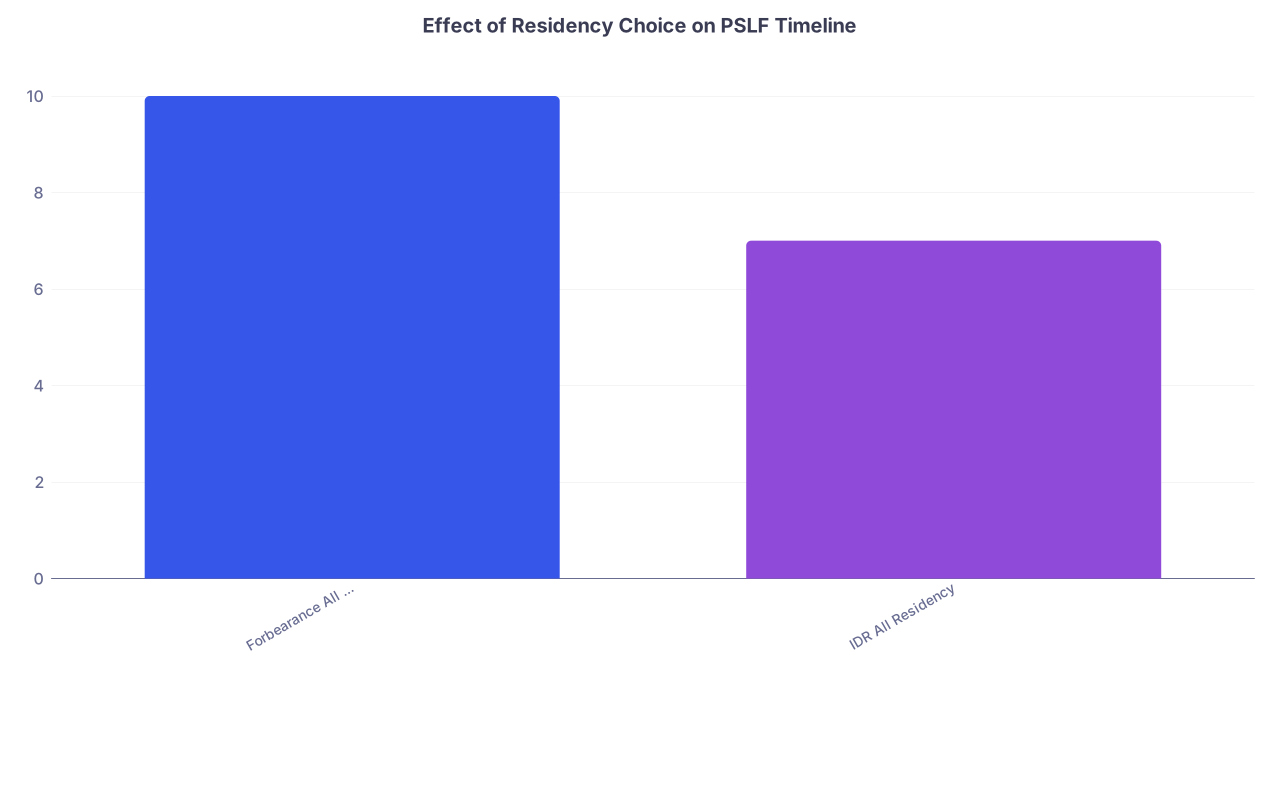
You get 36 PSLF‑qualifying payments at resident‑level payments.
Now after residency you only need 7 more years of payments. If you stay in PSLF‑qualifying work, that’s 7 attending‑level years vs 10.
| Category | Value |
|---|---|
| Forbearance All Residency | 10 |
| IDR All Residency | 7 |
(Years of attending-level PSLF payments needed after a 3-year residency)
Step 4: Use a simple decision tree
Here’s the clean mental framework.

| Step | Description |
|---|---|
| Step 1 | Start Residency |
| Step 2 | Private refi or standard plan |
| Step 3 | Choose IDR now |
| Step 4 | IDR with aggressive extra payments or refi later |
| Step 5 | Forbearance or low IDR for cash flow |
| Step 6 | Have federal Direct loans? |
| Step 7 | PSLF possible future? |
| Step 8 | Want to be debt free fast? |
Let’s spell that out in English.
If your loans are mostly private already
Forbearance vs IDR isn’t your main question; you’re looking at standard, extended, or refinance. Different rabbit hole.If you have federal Direct loans:
- PSLF possible? Use IDR.
- PSLF absolutely off the table? Then:
If PSLF is off the table, ask:
- Am I serious about crushing my loans ASAP?
- Or do I want maximum breathing room now knowing I’ll pay more later?
That’s the real trade‑off.
Step 5: PSLF vs non‑PSLF tracks
Track 1: PSLF is on the table
Examples:
- You’re in IM/peds/FM/EM/psych and like academic or hospital‑employed practice.
- You’re doing residency/fellowship at a big university or county hospital.
- You aren’t dead‑set on joining a purely private group.
If this is you:
- Get onto SAVE (or your best available IDR plan) as early as possible.
- Make sure your employer qualifies for PSLF (501(c)(3) or government).
- Submit the PSLF Employer Certification form every year.
Forbearance for PSLF‑bound people is usually a self‑inflicted wound. You’re throwing away the chance to make tiny payments that count the same as huge later payments.
Track 2: PSLF is almost certainly not happening
Examples:
- You’re aiming for private ortho, ophtho, derm, plastics, anesthesia in a private group, etc.
- Your residency is at a private for‑profit hospital, and you expect to stay in private practice.
Here, the calculus changes.
Your main options during residency:
Forbearance:
- Max cash flow now.
- Balance grows the most.
- No progress toward forgiveness clocks.
IDR (SAVE or similar):
- Modest payment ($150–$400/month for many residents).
- Slows balance growth.
- Starts the 20–25 year IDR forgiveness clock (even if not PSLF).
Standard or extended repayment:
- Payments likely too high for most residents.
- Only makes sense if your debt is relatively small.
If you’re going private and you hate debt and plan to refinance aggressively once attending, you can make an argument for either:
- IDR now to keep interest from exploding, then refinance and attack; or
- Forbear now to maximize cash, accept a larger balance, then refinance and attack.
What I’ve seen work well in real life:
Use SAVE in residency, keep your life sane, and then as an attending refinance and hammer the loans. Forbearance tends to be the choice people make when they aren’t really treating this like a big financial decision.
Step 6: Understand the hidden traps
Whichever way you lean, don’t miss these landmines:
Trap 1: Assuming interest is “forgiven” in IDR
It’s not. Under SAVE, some interest is subsidized, which is great. But the principal is still there. Unless you go all the way to forgiveness (PSLF or 20–25 years of IDR), that interest isn’t magically erased.
Trap 2: Ignoring capitalization
Forbearance usually means:
- Interest accrues.
- At certain points (leaving forbearance, changing plans, consolidation), that interest capitalizes and becomes principal.
- Now you pay interest on top of interest.
IDR doesn’t stop interest, but it typically avoids big, sudden capitalization events—especially if you stay in the same plan.
Trap 3: Not updating income correctly
Residents love to overreport here.
IDR payments are based on AGI:
- Use your most recent tax return or
- Provide pay stubs if income has fallen.
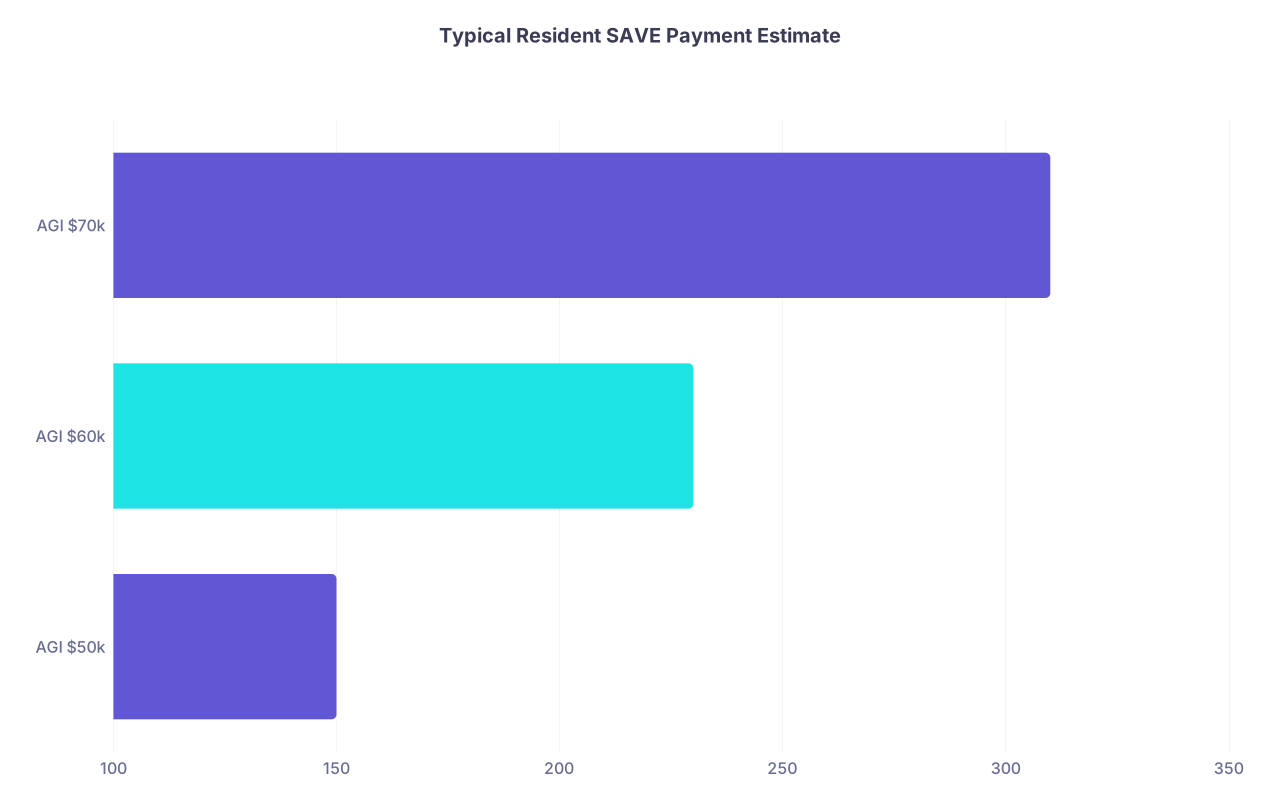
PGY‑1 who didn’t work much the prior year? Your AGI might be very low, and your SAVE payment could be close to $0… while still counting for PSLF. That’s insanely valuable.
| Category | Value |
|---|---|
| AGI $50k | 150 |
| AGI $60k | 230 |
| AGI $70k | 310 |
(Approximate monthly SAVE payments for single resident, no dependents; illustrative only)
Trap 4: Forgetting consolidation and plan eligibility
Some med students end up with:
- Old FFEL loans
- Perkins loans
- Or mixed loan types
To get PSLF and SAVE benefits, you often need to:
- Consolidate to a Direct Consolidation Loan
- Then pick SAVE or another IDR.
Beware: consolidation can reset certain forgiveness clocks, so don’t just blindly click buttons; understand what’s being reset.
Step 7: When forbearance actually makes sense
I’ve been pretty hard on forbearance, because it’s overused. It’s not never appropriate.
Reasonable cases:
Genuine financial emergency
Moving across the country, partner unemployed, kid on the way, no savings. You need cash to stay afloat? Use forbearance short‑term, then get back into IDR once the crisis passes.Tiny federal balance, big private loans
If your main problem is $300k of private loans at 9% and you’ve only got $10k federal left, you might prioritize private repayment and temporarily forbear the small federal balance.Short training with huge attending payoff and no PSLF
Think 5‑year ortho residency, then clearly private with $700k+ income. You might choose to stockpile cash or max retirement accounts in residency and accept higher later loan cost.
Even then, I’d still tell you: run the numbers with and without SAVE first. IDR is usually the safer baseline.
Quick comparison cheat sheet
| Factor | Forbearance | Income-Driven Repayment (SAVE) |
|---|---|---|
| Required payment | $0 | Low, based on income |
| Interest accrual | Full, usually capitalized | Full accrues, but partly subsidized |
| PSLF credit | No | Yes, if employer qualifies |
| 20–25 yr forgiveness | No | Yes, counts toward clock |
| Cash flow now | Best | Good, not perfect |
| Total long-term cost | Usually highest | Usually lower |
How I’d decide if I were you
If you want a simple rule of thumb, here’s the blunt version:
You have federal Direct loans + training at a nonprofit hospital + any chance of future academic/hospital work
→ Get on SAVE during residency. Do not forbear.You’re dead‑set private, high‑income specialty, at non‑PSLF hospital, and PSLF really is off the table
→ Default to SAVE anyway, unless you have a very specific cash flow reason to forbear. Revisit at the end of intern year with real numbers.You’re completely overwhelmed and can’t even think about this right now
- Put your loans in SAVE or other IDR.
- Set payments to auto‑debit.
- Put a calendar reminder 6 months out to review with someone who understands this (financial planner, student loan pro, or your institution’s financial aid office).
Doing nothing or “just forbear everything because I’m broke” is the move that bites the most people later.

FAQ: Forbearance vs IDR in Residency
1. My PGY‑1 salary is low and I feel broke. Is SAVE still better than forbearance?
Usually yes. Your SAVE payment as a PGY‑1 is often a couple hundred dollars a month or less, especially if your prior year AGI was low. Those low payments count toward PSLF and long‑term forgiveness, and SAVE’s interest subsidy keeps your balance from mushrooming as fast. Forbearance gives you slightly more breathing room today at the cost of a much bigger balance and lost forgiveness credit.
2. What if I’m not sure whether I’ll do PSLF?
Then act as if you will. Get on SAVE, make qualifying payments throughout residency, and keep your options open. If you end up in private practice with no PSLF, you can always refinance and attack the loans. You can’t go back in time and turn forbearance months into PSLF credit.
3. Does my fellowship count for PSLF and IDR forgiveness?
Yes, if your fellowship employer is a qualifying nonprofit or government entity and you’re on a qualifying repayment plan (like SAVE). Every qualifying month in residency and fellowship chips away at the 120 PSLF payments. For long‑term IDR forgiveness (20–25 years), all qualifying IDR months also count, regardless of employer.
4. I have a mix of federal and private loans. Should I treat them differently in residency?
Yes. Federal loans are where PSLF and IDR matter. Private loans don’t qualify for those benefits. Many residents:
- Put federal loans on SAVE to preserve forgiveness options and limit interest growth.
- Handle private loans separately: sometimes interest‑only payments during training, sometimes refinance if the numbers make sense, sometimes tight forbearance if truly necessary. Don’t let private loan terms push you into a bad decision on your federal loans.
5. Can I switch from forbearance to IDR later if I change my mind?
Yes. You can leave forbearance and enroll in an IDR plan, but you don’t get credit for the months you were in forbearance. Any interest that capitalized during that period is now part of your principal. That’s why I tell residents: if there’s any chance you’ll care about PSLF or forgiveness, start in IDR. Switching into PSLF strategy late usually means you’re starting 1–3 years behind where you could have been.
Key takeaways:
- If PSLF is at all possible, being in an IDR plan like SAVE during residency is almost always better than forbearance.
- For non‑PSLF folks, SAVE still usually beats blanket forbearance once you actually run the numbers.
- Forbearance should be a short‑term tool for emergencies, not the default setting for your entire training.