
Should I Pay Med School Interest During School or Wait Until Residency?
What actually saves you more money: paying a bit of loan interest while you’re drowning in anatomy and rotations, or waiting until residency when you finally have a “real” paycheck?
Here’s the blunt answer:
If you can safely afford it, paying at least some interest during school or residency is almost always financially better.
But no, it’s not always the right move for you.
Let’s break it down like someone who’s actually looked at real student budgets and real loan statements, not fantasy scenarios where MS2s have $800/month lying around.
Step 1: Understand What Happens If You Do Nothing
If you take out federal Unsubsidized or Grad PLUS loans for med school (which is 99% of people), interest starts accruing the second the loan disburses.
You’re in med school. You’re in deferment. You’re not required to pay a cent.
But the meter is running.
Say you borrow this over four years:
- $40,000 per year in Unsubsidized at 7%
- $40,000 per year in Grad PLUS at 8%
By graduation, your principal is $320,000.
But because interest has been piling up the whole time, your actual balance will be higher.
Rough math (not compounding daily, just close enough to show the problem):
- Year 1 loans accrue interest for 4 years
- Year 2 loans accrue for 3 years
- Year 3 loans accrue for 2 years
- Year 4 loans accrue for 1 year
Total extra interest could easily be $40,000–$60,000 by graduation.
Then what usually happens?
That unpaid interest gets capitalized (added to principal) when:
- You finish your grace period
- Or you consolidate
- Or you leave deferment for certain plans
Now your new “loan principal” might be, say, $360,000 instead of $320,000.
And guess what? Future interest now accrues on $360k, not $320k.
That’s the compounding you’re fighting.
So the core trade-off is this:
- Pay something now to keep interest from snowballing
- Or pay a lot more later when you’re an attending
Step 2: The Three Realistic Strategies
Forget perfect-theory finance. These are the actual patterns I see:
| Strategy | During School | During Residency | Long-Term Cost |
|---|---|---|---|
| Do Nothing | $0 | $0 | Highest |
| Pay Interest Only | Small | Small–Moderate | Lower |
| Targeted Partial Payments | Small | Flexible | Middle–Low |
Strategy 1: Do Nothing (Defer Everything)
What you do:
- Pay $0 in school
- Pay $0 in residency (on deferment/forbearance)
- Deal with it as attending
Pros:
- Maximum cash flexibility when you’re broke
- Simple mentally: ignore it and focus on surviving school
Cons:
- Sky-high total interest cost
- Massive balance shock later
- Forces you into higher payments or long forgiveness-based plans
- Capitalization’s going to hit you harder than you think
Who this sometimes makes sense for:
- You literally can’t spare $25–50/month without skipping food or meds
- You are 99% sure you’ll pursue PSLF (Public Service Loan Forgiveness) in a qualifying nonprofit / academic setting, and maximizing total forgiven amount actually helps you
Even then, I’m not a fan of full do-nothing unless you’re ruthlessly committed to PSLF.
Strategy 2: Pay All Accrued Interest (the “Aggressive” Option)
What you do:
- Every month or at least once a year, you pay all the interest that has accrued
- Goal: keep your principal from ever increasing
- So when you graduate, your balance equals what you originally borrowed
Pros:
- Keeps your loan from growing at all
- Saves a ton of interest over the life of the loan
- Future decisions (refinance vs PSLF vs IDR) all look better
Cons:
- It’s expensive during med school
- Can easily be $300–$700/month by MS3–MS4, depending on how much you borrowed and rates
- Not realistic for most students without family help or significant side income
Who this fits:
- Students with strong family support who are covering some living expenses
- Non-traditional students with savings or a spouse with solid income
- People dead-set on minimizing debt at all costs
If that’s not you, don’t beat yourself up. Strategy 3 is where most smart people land.
Strategy 3: Targeted Partial Payments (What I Recommend for Most)
This is the middle ground that actually works in real life.
What you do:
- Pick a small, consistent monthly amount: $25, $50, $100, maybe $150–$200 in later years if you can swing it
- Apply it every month toward accrued interest on your highest-rate loans (usually Grad PLUS)
- During residency, keep paying something on an IDR plan, not zero
Pros:
- Dramatically lowers how much interest capitalizes
- You don’t need to be rich in school to do it
- Keeps you in the habit of paying attention to your loans
- Gives you flexibility as your situation changes
Cons:
- Doesn’t fully stop growth of balance, just slows it
- Emotionally, it can feel like a drop in the ocean
But the math is still in your favor.
Say interest is accruing at $600/month by MS4.
You can only afford $75/month.
You’re not paying it all, but you’re cutting the monthly growth from $600 to $525. Over a few years, that adds up to thousands less in principal and many thousands less in long-term interest.
Step 3: How Residency Changes the Equation
Residency is a weird middle phase:
You’re finally earning money. But not that much. And you’re working 60–80 hours.
Here’s the important fork in the road:
If you’re aiming for PSLF:
Your goal is not to minimize interest. It’s to maximize forgiven balance while keeping your monthly payments low (but qualifying).If you’re planning to repay in full (either by refinance or aggressive payoff as attending):
Your goal is to limit growth and pay as little total interest as possible.
Let’s be specific.
If You’re Aiming for PSLF
You’ll:
- Use an income-driven repayment (IDR) plan in residency: SAVE, PAYE, or IBR (SAVE is usually best now)
- Make small payments based on your resident income
- Work full-time for a qualifying nonprofit / academic / VA hospital
In that case:
- Paying extra interest during school and residency doesn’t always help you, because a large balance that gets forgiven at 10 years is actually “good” for you
- Your focus is:
- Certify employment every year
- Stay in qualifying jobs
- Avoid forbearance (no credit toward PSLF while in forbearance)
Exception: If your PSLF plan is shaky (you might go private, join a for-profit group, or do locums), then I’d still pay some interest now. Keeping your balance from exploding gives you options.
If You’re NOT Counting on PSLF
This is most people heading to private practice, anesthesia groups, derm, ortho in private settings, etc.
Then the math flips:
- Every dollar of interest you don’t stop now will cost you more later
- IDR in residency still makes sense, but you should aim to pay more than the minimum when you can
- If you refinance during late residency or as a fellow, your smaller balance + lower rate + earlier payments = huge savings
Step 4: A Simple Framework to Decide
Here’s a no-BS decision guide.

| Step | Description |
|---|---|
| Step 1 | Start |
| Step 2 | Pay minimum on IDR in residency |
| Step 3 | Pay small interest in school and residency |
| Step 4 | Defer in school, use IDR in residency |
| Step 5 | Pay partial interest in school and above-minimum in residency |
| Step 6 | Plan to pursue PSLF? |
| Step 7 | Very likely to stay 10 years in nonprofit? |
| Step 8 | Can you afford any payments now? |
Now layer on income reality:
- If you can find $25–50/month in school → pay it
- If you can find $100–200/month in MS3–MS4 → even better
- As a resident, avoid $0 payments if at all possible; at least enroll in IDR
Step 5: Practical Tips If You Decide To Pay Interest
This is where people screw it up with servicers.
Make sure payments are applied to accrued interest
Check your statement. Verify that what you’re paying is actually reducing current interest, not just sitting in “paid ahead” status while interest keeps piling.Automate something small
Set up $25 or $50 auto-pay monthly. You can always add a one-off extra payment if you’ve got a windfall (tax refund, stipend, small scholarship).Prioritize higher-rate loans first
Grad PLUS usually has a higher rate than Unsubsidized. If you’re making targeted payments, hit the highest-rate loans.Don’t destroy your life to do this
If $50/month means credit card debt at 25% APR, you’re doing it wrong. High-interest consumer debt is worse than growing student loans.Revisit once per year
As you move from MS1 → MS4 → PGY-1 → PGY-3, your capacity changes. So should your plan.
Quick Reality Check: Emotional vs Mathematical Answer
Mathematically:
Paying interest earlier nearly always wins.
Emotionally and practically:
You’ve got finite bandwidth. Passing exams, not burning out, and maintaining your health are worth more than squeezing every last dollar out of your amortization schedule.
So here’s my actual recommendation for most med students:
- Don’t ignore your loans completely. That’s how people end up shocked at $400k+ balances.
- If you can find $25–100/month in school without pain, pay it toward interest.
- As a resident, get on an IDR plan. Avoid $0 payments if you can.
- If PSLF is your path and you’re solid on it, prioritize qualifying payments and career decisions over obsessing about interest.
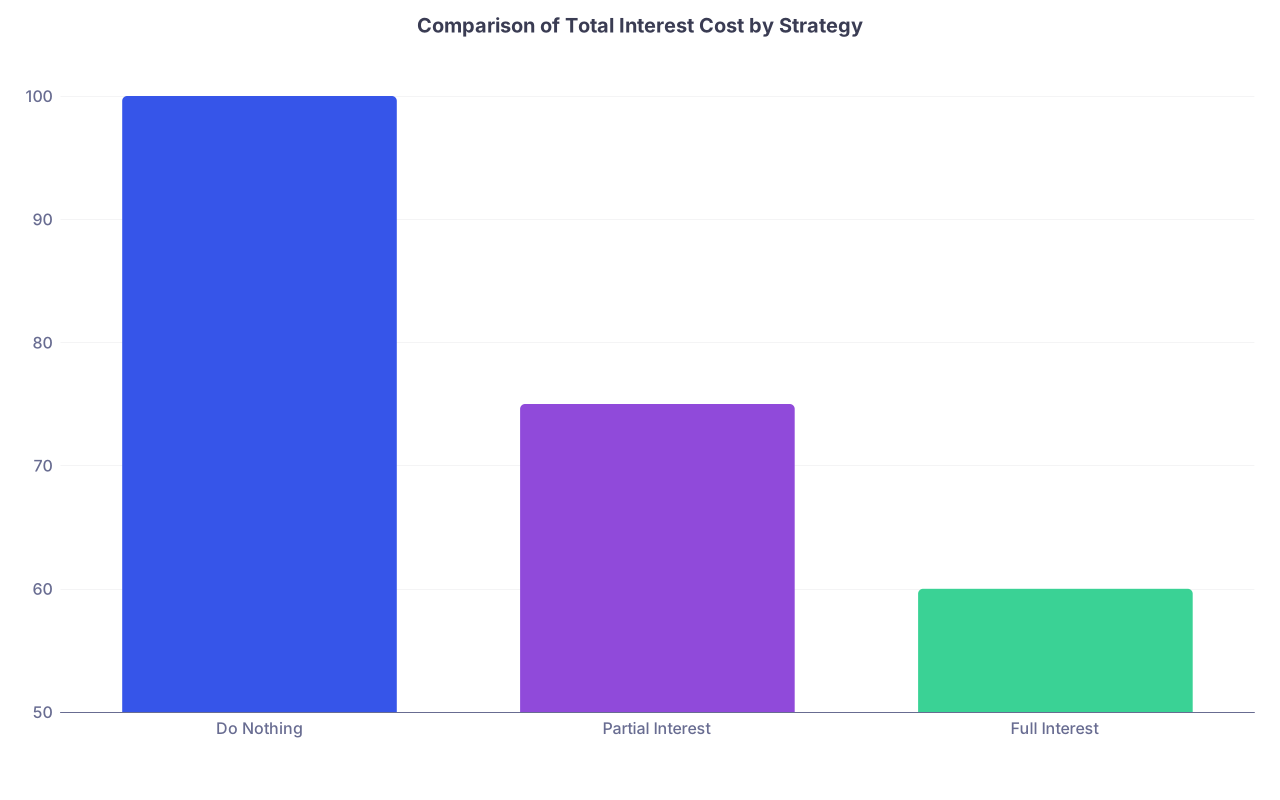
| Category | Value |
|---|---|
| Do Nothing | 100 |
| Partial Interest | 75 |
| Full Interest | 60 |
(Assume 100 = baseline highest interest cost. Partial and full interest payments reduce it.)
FAQs
1. Does paying interest during med school actually make a big difference, or is it symbolic?
It’s not just symbolic. Even $50–100/month can cut thousands off your long-term interest cost. The key is that early dollars have an outsized effect because they prevent interest from being added to your principal later. Is it life-changing on a $350k balance? No. But it’s very real money over 10–20 years, especially if you don’t end up doing PSLF.
2. Should I ever go into forbearance in residency to “focus on training”?
Almost never. Forbearance is a trap for most residents. During forbearance:
- Interest accrues on the full balance
- You get zero PSLF credit
- You lose the benefits of IDR-based subsidies (on some plans)
Unless you’re in a true financial emergency (unpaid leave, major health crisis, spouse lost job), you’re usually better off on an IDR plan with small payments than in forbearance with no payments and ballooning interest.
3. If I’m sure I’ll do PSLF, should I still pay any interest during school?
If you are genuinely confident you’ll spend 10 full years at qualifying nonprofit/academic employers, paying extra interest isn’t required. Your total forgiven amount will be higher if you let the balance grow. That said, I still like the idea of paying a token amount (even $25/month) for one reason: PSLF plans change, jobs change, life changes. Keeping your balance somewhat in check gives you flexibility if PSLF disappears for new borrowers or you pivot to private practice.
4. What if my parents offer to pay my interest during school—should they?
If they’re offering and can afford it without sabotaging their own retirement, yes, it’s a strong financial move. The best use of that help is often: pay accrued interest annually or semi-annually to keep the principal from growing. Just don’t let this create unhealthy pressure or control dynamics. Clarity matters: are they helping as a gift, a loan, or with expectations attached?
5. Is it better to pay interest during school or save that money for an emergency fund?
If you have no emergency fund at all, I’d prioritize building at least a mini-cushion first—something like $500–$1,000. After that, a split is reasonable: some toward savings, some toward interest. Being one flat tire away from a crisis is worse than a slightly higher student loan balance. Once you’ve got a small buffer, extra money has a strong case to go toward interest if PSLF isn’t your main plan.
6. When should I seriously consider refinancing my loans?
Refinancing (usually with a private lender) makes sense when:
- You’re out of med school
- You’re sure you won’t use PSLF or other federal forgiveness programs
- You have stable income (late residency/early attending)
- You can qualify for a significantly lower interest rate
Don’t refinance while PSLF is still realistically on the table. Once you refinance to private, PSLF is gone forever. For many, the best path is: IDR + possible PSLF during residency → decide in late residency if PSLF is still your future → refinance if private practice is locked in.
Key takeaways:
- Paying at least some interest during school or residency usually saves you real money; total silence and deferment are the most expensive path.
- Your PSLF likelihood is the pivot point—if PSLF is solid, interest matters less; if not, early payments matter more.
- Don’t aim for perfection; aim for a realistic, sustainable plan that you actually stick to and revisit every year.