
The biggest mistake medical trainees make about PSLF is thinking it’s automatically “the best deal.” It is not. It is a tool. Powerful when used right, expensive when used wrong.
Here’s the answer you’re actually looking for: PSLF is worth it if you expect high debt, a long stretch in qualifying employment, and you’re willing to commit to a clear plan. It’s not worth it if you’re headed for very high-paying private practice and plan to pay off loans aggressively.
You do not need a spreadsheet PhD to decide. You need a simple framework and a few honest assumptions.
Step 1: Get Clear on What PSLF Actually Is (and Is Not)
Public Service Loan Forgiveness (PSLF) does one thing: it forgives the remaining balance on eligible federal Direct loans after you make 120 qualifying monthly payments while working full-time for a qualifying employer.
Stripped-down version:
- 120 payments (minimum 10 years).
- On an income-driven repayment (IDR) plan (SAVE, PAYE, IBR, etc.).
- While working full-time for a government or 501(c)(3) employer (most teaching hospitals, VA, county systems).
Everything else is noise.
PSLF is not:
- A special “PSLF loan.” It’s just your existing federal loans plus a forgiveness program.
- A partial discount where you still owe tax on forgiven debt. PSLF forgiveness is currently tax-free under federal law.
- Guaranteed if you’re sloppy. Mess up your paperwork, use the wrong plan, or consolidate at the wrong time, and you can lose qualifying credit.
If your loans are private, you’re done: PSLF is not for you. No private lender participates. If some of your loans are federal and some private, PSLF can still make sense for the federal portion.
Step 2: Quick Eligibility Check – Do You Even “Fit” PSLF?
Before deciding if PSLF is worth it, you have to confirm if it’s even on the table.
Ask yourself these:
Do you have federal Direct loans?
- If they’re labeled “Direct” (Direct Unsubsidized, Direct Grad PLUS, Direct Consolidation), you’re in good shape.
- If you see FFEL or Perkins, they can sometimes be consolidated into Direct loans (with important pros/cons).
- If everything is private, PSLF is off the table.
Will your residency/fellowship employer qualify?
- Most academic medical centers, VA hospitals, county/public systems, and big nonprofits (e.g., Mayo, Cleveland Clinic) qualify.
- For-profit hospitals and many private practice groups do not.
Can you commit to an IDR plan during training (and ideally beyond)?
- PSLF only counts payments made under a qualifying IDR (or standard 10-year plan, which is almost never what you want if pursuing PSLF).
- IDR usually makes your payments very low during residency, which is a feature, not a bug, if you are ultimately going for PSLF.
If you’ve got Direct loans + non-profit/VA training + willingness to use IDR, PSLF is very likely an option. That still doesn’t mean it’s worth it for you. Keep going.
Step 3: The Simple PSLF Worth-It Framework
Forget complex calculators for a minute. Here’s the framework I use when I talk to residents.
You should strongly lean toward PSLF if:
- Your total federal student debt at graduation ≥ 1.5x your expected attending salary, and
- You expect to spend at least 10 years in qualifying employment (residency + fellowship + attending years at nonprofit/VA/academic), and
- You’re comfortable with the idea of maximizing forgiveness (meaning: smaller payments now, more forgiven later).
You should strongly question PSLF (or at least not build your life around it) if:
- Your total debt ≤ your expected attending salary, and/or
- You’re very likely to work in high-paying private practice after training, especially in a high-income specialty, and
- You like the idea of just paying it off fast and being done.
Here’s a compact comparison for typical cases:
| Scenario Type | PSLF Tends To Be | Why |
|---|---|---|
| $350k debt, academic IM attending at $250k | Very favorable | High debt, moderate salary, long nonprofit career |
| $250k debt, private anesthesia at $500k | Often unfavorable | Can crush debt quickly with high income |
| $450k debt, peds subspecialist at children’s hospital | Very favorable | Huge debt, lower income, nonprofit |
| $180k debt, derm private practice at $600k | Unfavorable | Low relative debt, very high income |
| $300k debt, EM split between VA and community | Depends | Mix of qualifying and non-qualifying work |
Is this simplified? Yes. But it’s directionally right.
Step 4: Understand the Two Main Paths – PSLF vs Aggressive Payoff
You’re choosing between two broad strategies:
PSLF path:
- Make IDR-based payments during residency and possibly early attending years.
- Keep working in qualifying employment.
- Aim for a large chunk of principal forgiven after 10 years.
Aggressive payoff path (private practice mindset):
- Maybe still use IDR during residency for cash flow, or forbearance (not ideal) if needed.
- Refinance to a lower interest rate once attending, usually with a private lender.
- Throw large payments at the loans, paying them off in 3–7 years.
To make this concrete, look at typical payment profiles.
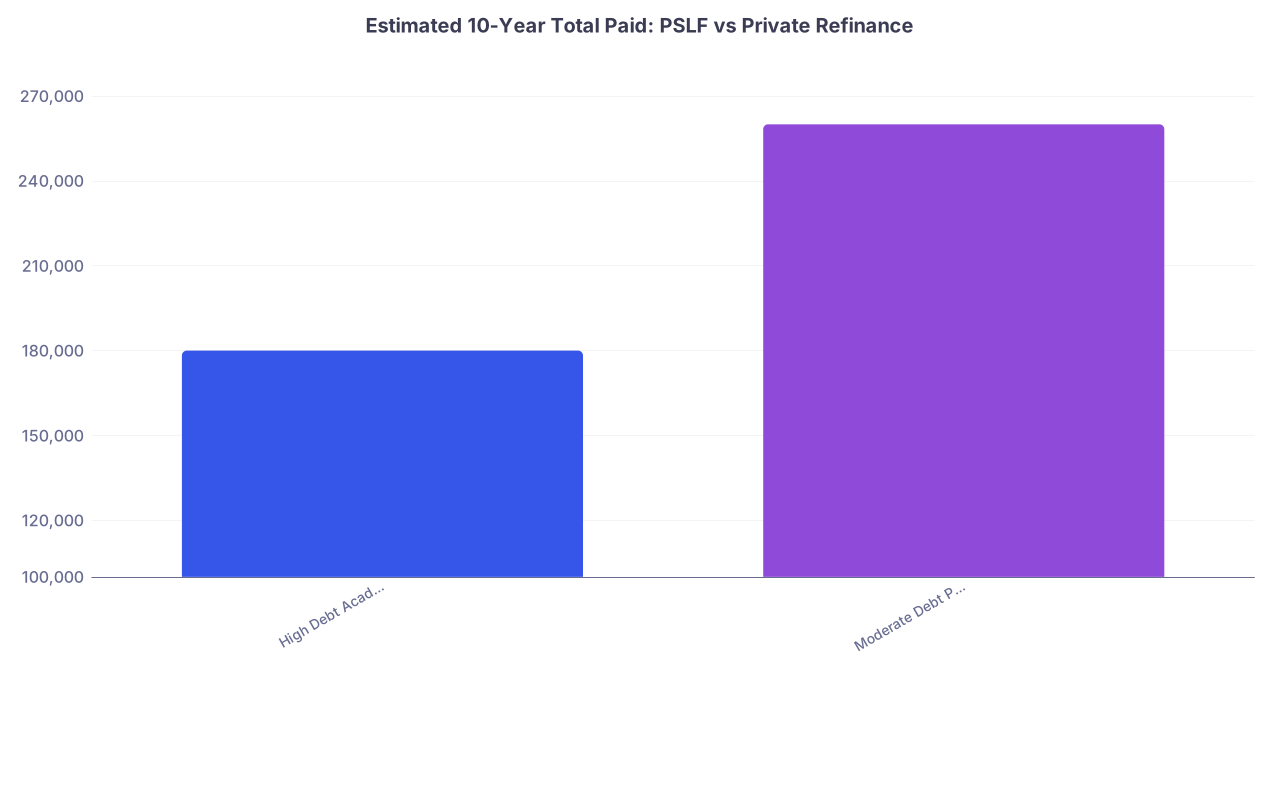
| Category | Value |
|---|---|
| High Debt Academic | 180000 |
| Moderate Debt Private Practice | 260000 |
Interpretation (rough example, not your exact numbers):
- High Debt Academic: PSLF path might have you pay ~$180k total on $350k+ debt over 10 years, then the rest is forgiven.
- Moderate Debt Private Practice: Aggressive payoff after refinance might cost you ~$260k total on $250k debt but you’re done in 5–7 years, no PSLF needed.
The right choice depends on two things:
- Your numbers (debt, specialty, expected career setting).
- Your goals (freedom vs forgiveness, flexibility vs commitment to nonprofit work).
Step 5: How Your Training Path Affects PSLF
Medical training complicates PSLF in a good way: those low-residency salaries plus IDR create “cheap” qualifying years.
Why that matters:
- Your IDR payment in residency is usually based on $60–80k income, not the $250–500k you’ll make as an attending.
- Those low payments still count toward the 120 needed for PSLF.
- That means: 3–7 years of dirt-cheap PSLF credit before you ever reach peak earning.
So for a 3-year IM resident who does a 3-year fellowship, that’s 6 years of low payment PSLF credit. You only need 4 more years as an attending in a qualifying job to hit 10 years total.
Let’s visualize a typical path.
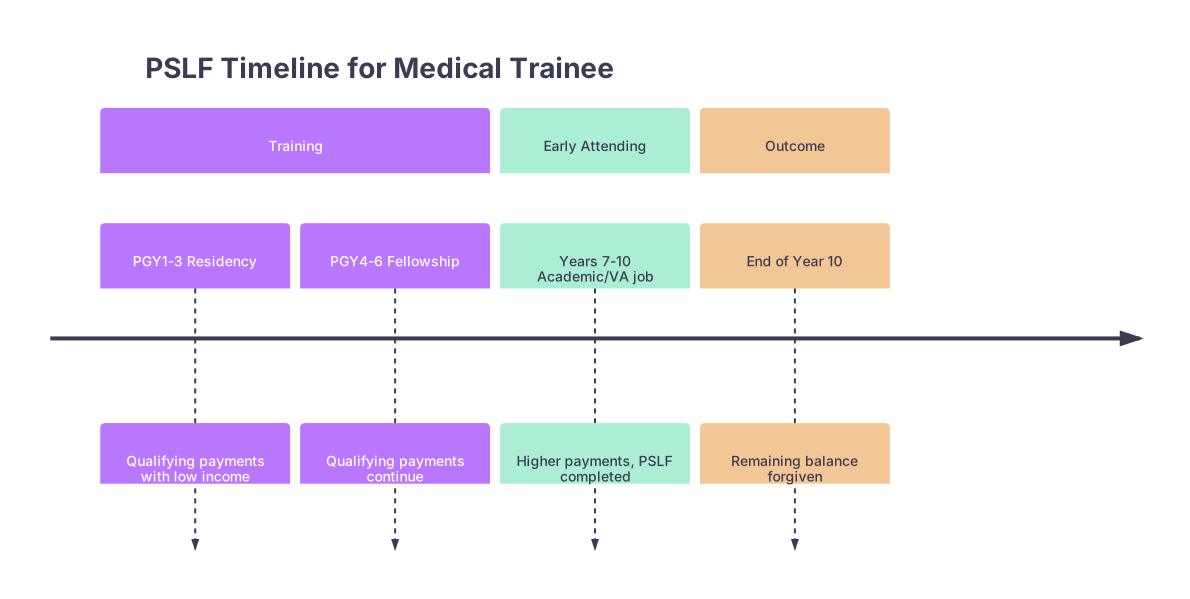
| Period | Event |
|---|---|
| Training - PGY1-3 Residency | Qualifying payments with low income |
| Training - PGY4-6 Fellowship | Qualifying payments continue |
| Early Attending - Years 7-10 Academic/VA job | Higher payments, PSLF completed |
| Outcome - End of Year 10 | Remaining balance forgiven |
If you’re likely to do:
- A long residency (5+ years – e.g., surgery, neurosurgery, ortho + fellowships), and
- At least some time in academic or VA practice,
PSLF becomes harder to ignore. You’re already being “paid” PSLF credit during years with limited income.
Step 6: Key Numbers You Need Before You Decide
Open your loan portal and grab these numbers. No hand-waving.
You need:
- Total federal Direct loan balance: Separate from private loans.
- Weighted average interest rate on those federal loans.
- Projected residency/fellowship length and likely locations (nonprofit vs for-profit).
- Probable attending path for at least the first 5 years:
- Academic/VA/nonprofit hospital
- Large private group
- Mix
Then roughly estimate your attending salary band:
- Primary care, peds, psych: $200–280k
- General IM hospitalist: $230–320k (varies widely)
- Most surgical/subspecialty: $350–700k+
- Dermatology, ortho, plastics, some anesthesia, private GI: often $500k+
Once you have those, plug them into a reputable PSLF vs refinance calculator (e.g., White Coat Investor, Student Loan Planner, or a major servicer like Mohela’s estimator). Do not rely purely on gut feeling.
Step 7: Red Flags That PSLF Might Not Be Worth It
Here’s where I see people chase PSLF when they shouldn’t:
- You’re almost certain you’ll work in private practice right after training.
- Your debt load is modest relative to your specialty income (e.g., $180k loans, ortho private practice at $650k).
- You’re tempted to stay in a lower-paying academic job only for PSLF, even though burned out and miserable.
If you’re staying in a job you hate solely for PSLF, that’s a hidden “cost” no calculator includes. Sometimes leaving for private practice, refinancing, and crushing the debt is psychologically and financially better.
Another trap: the “I’ll just decide later” plan. You do forbearance or standard payments in residency instead of IDR, assuming you can always pivot to PSLF later. Yes, temporary programs have given retroactive credit in some cases, but you can’t count on policy gifts.
If PSLF is even a maybe for you, get in a qualifying IDR plan during training and submit PSLF forms annually. That preserves the option.
Step 8: Concrete Actions if You Think PSLF Might Be Right For You
Here’s the punch list I’d give a PGY-1 sitting across from me:
Confirm loan types.
Log into studentaid.gov. Any non-Direct loans? Consider consolidating to Direct, but only after understanding how it affects existing PSLF/IDR credit and interest capitalization.Enroll in a qualifying IDR plan now.
For most current borrowers, SAVE is best by default. During residency, your IDR payment will likely be low. That’s exactly what you want if pursuing PSLF.File your PSLF Employment Certification Form (ECF) yearly.
Send it to your servicer (Mohela currently handles PSLF). Do this every year and whenever you change employers. Do not wait 10 years and then “hope they count everything.”Keep your contact info and income recertifications up to date.
Miss recertification, and your payment can jump or your plan can be kicked off track. That can cost you PSLF-eligible months.Plan your attending job with PSLF in mind.
If you’re 6–7 years into qualifying payments by the end of fellowship, running to private practice right away can be very expensive in lost forgiveness. Sometimes doing just 3–4 years at an academic/VA job to complete PSLF is a massive financial win, then you can move.
Step 9: What If You’re Unsure About Your Future Career Path?
You don’t need absolute certainty about your career to make smart moves now.
Here’s the flexible approach:
During residency and fellowship:
- Use IDR (SAVE, etc.).
- Certify PSLF employment annually.
- Collect as many cheap qualifying years as possible.
As you approach the end of training:
- If you’re close to 10 years of qualifying payments and see a clear path to finish them, PSLF likely makes sense.
- If you’re nowhere close (e.g., 3–4 years), and leaning toward private practice, you can always:
- Stop chasing PSLF.
- Refinance after you’re an attending.
- Aggressively pay loans off.
In other words, the default smart play for most trainees with federal loans is: protect your PSLF option now, decide whether to finish it later.
You’re not handcuffed to PSLF just because you started it.
Step 10: When PSLF Is Clearly Worth It
I’m going to be blunt. In these scenarios, not seriously considering PSLF is usually a mistake:
- Total federal loans > $300k
- Training and early attending years at nonprofits or VA (think: academic IM, peds subspecialties, psych, heme/onc in teaching hospitals)
- Likely long-term in academic or public service roles
In these cases, PSLF can easily save you six figures compared to refinancing and paying everything back. I’ve seen pediatric subspecialists with $400k+ forgiven after 10 years, having paid under $200k total.
That’s life-changing.
Step 11: When You Should Probably Ignore PSLF and Just Pay It Off
On the other hand, I usually advise people in these situations to focus on payoff:
- Debt < $200–220k
- High-income private practice specialty (ortho, derm, ophtho, radiology, anesthesia, GI, etc.)
- Little interest in academic/VA jobs and no desire to lock into 10 years of nonprofit work
Here, you probably win by:
- Using an IDR or even forbearance in residency if absolutely needed (IDR is still better for most).
- Refinancing to a lower rate once your attending income is stable.
- Paying it off in 3–5 years with a high savings rate.
You regain flexibility. No worrying about whether your employer qualifies or if Congress tweaks PSLF.
Your Next Step Today
Do this right now: log into studentaid.gov, write down your total federal Direct loan balance and interest rates, then jot down your likely specialty and whether your current/expected employers are nonprofit or VA.
With those five data points, you can:
- Roughly classify yourself as a PSLF-leaning or payoff-leaning borrower using the framework above.
- Then choose one concrete action: either submit a PSLF Employment Certification Form this week or research refinance rates and payoff timelines.
Open your loan summary today and force yourself to write those numbers on one sheet of paper. Until you see them all in one place, you’re not actually deciding—you’re just hoping it works out.