
The default advice on med school loans—“never touch your federal loans, never use variable rates”—is lazy and incomplete.
You can reasonably refinance federal medical school loans to a variable rate in some situations. But those situations are narrower than most doctors think, and the downside if you get it wrong is very real.
Let me walk you through a practical, decision-based way to answer this for yourself.
Step 1: If You Need Any Federal Protections, Stop. Do Not Refinance.
Before we talk about variable vs fixed, we have to settle the federal vs private question. If your loans are federal and you refinance, you’re giving up:
- Public Service Loan Forgiveness (PSLF)
- Income-driven repayment (SAVE, PAYE, IBR)
- Pandemic-style forbearance or interest waivers (if the government ever does this again)
- Generous economic hardship, unemployment, and forbearance options
If any of these are important to you, the conversation ends here: do not refinance. Variable or fixed does not matter. You stay federal.
Here’s who should almost never refinance federal med loans:
- You’re in training at a 501(c)(3) or VA hospital and might pursue PSLF
- You’re not sure if you’ll stay in non-profit vs private practice
- Your debt-to-income ratio is high (total loans > 1.5–2x expected attending income)
- Your specialty income is uncertain (pediatrics, family med, psych in low-paying markets)
- You want maximum safety net in case of disability, burnout, or part-time work
If you’re in any of these buckets, you keep your loans federal and optimize your repayment plan instead. The interest rate optimization game is not worth what you’re giving up.
Step 2: Only Consider Refinancing If You’re Squarely in the “Pay It Off Aggressively” Camp
You start considering refinancing—fixed or variable—if all of these are true:
- You are not going for PSLF (or are ineligible).
- You expect a stable, private-practice-style income.
- You plan to pay off loans in 5–7 years or less once attending.
- Your total debt is manageable relative to income (roughly ≤ 1.5x expected attending salary).
Example:
- $300k loans at ~6.5–7%
- Ortho, EM, anesthesia, derm, gas, radiology, or strong-paying IM subspecialty
- Plan to pay $4k–8k/month after training
In that situation, NOT refinancing is often the mistake. You’re effectively overpaying interest for protections you don’t plan to use.
Now we can have the real question: fixed or variable?
Step 3: Understand What Variable-Rate Refinancing Actually Means
Variable-rate student loans are usually tied to an index like SOFR plus a margin.
Basic structure:
Variable rate = Index (changes monthly/quarterly) + Margin (fixed)
(See also: debt-to-income ratio guidance for more.)
So you might see offers like:
- Variable: 4.8% (SOFR + 2.0%)
- Fixed: 5.7%
If short-term interest rates fall, your variable rate can fall. If they rise, your payment goes up and your total cost may increase.
In practice:
- Lenders usually cap maximum variable rates (e.g., 8–10%). Read the fine print.
- Payments can adjust monthly or quarterly.
- There’s no federal safety net anymore—only what the lender offers.
Variable is a bet on time and direction:
- Time: how long will you keep this loan?
- Direction: do you think rates will roughly stay flat or go down over that time?
If you plan to carry this debt for 15–20 years, variable is dangerous. If you plan to crush it in 3–5? Different story.
Step 4: When Variable-Rate Refinance Can Be Reasonable (Often Very Reasonable)
Variable can be reasonable—sometimes smarter than fixed—if you hit these conditions:
You will pay the loans off fast
Realistically ≤ 5–7 years from attending start, often faster.Your income is very stable and high relative to debt
Example: $350k+ income, $250k–$400k loans, no intention of cutting back soon.You actually commit to a payoff plan
Not “I’d like to pay them off in 5 years” but:- You’ve built a budget
- You’ve targeted a monthly payment
- You’re willing to keep lifestyle creep under control until they’re gone
The rate difference is meaningful
A 0.1% difference? Not worth the risk.
A 0.5–1.0%+ spread between variable and fixed? That can be thousands of dollars, especially early on.You’re comfortable with some rate risk and can handle higher payments if needed
If a 1–2% rate increase would wreck your cash flow, variable is the wrong choice.
Let’s cut the theory and look at numbers.
Step 5: Run the Numbers (Rough but Real)
Assume:
- $300,000 principal
- Fixed option: 5.8% for 10 years
- Variable option: starts at 4.6% with a 9% cap, you plan to pay off in 5 years
To make it obvious, look at what you’d pay if things go somewhat normally.
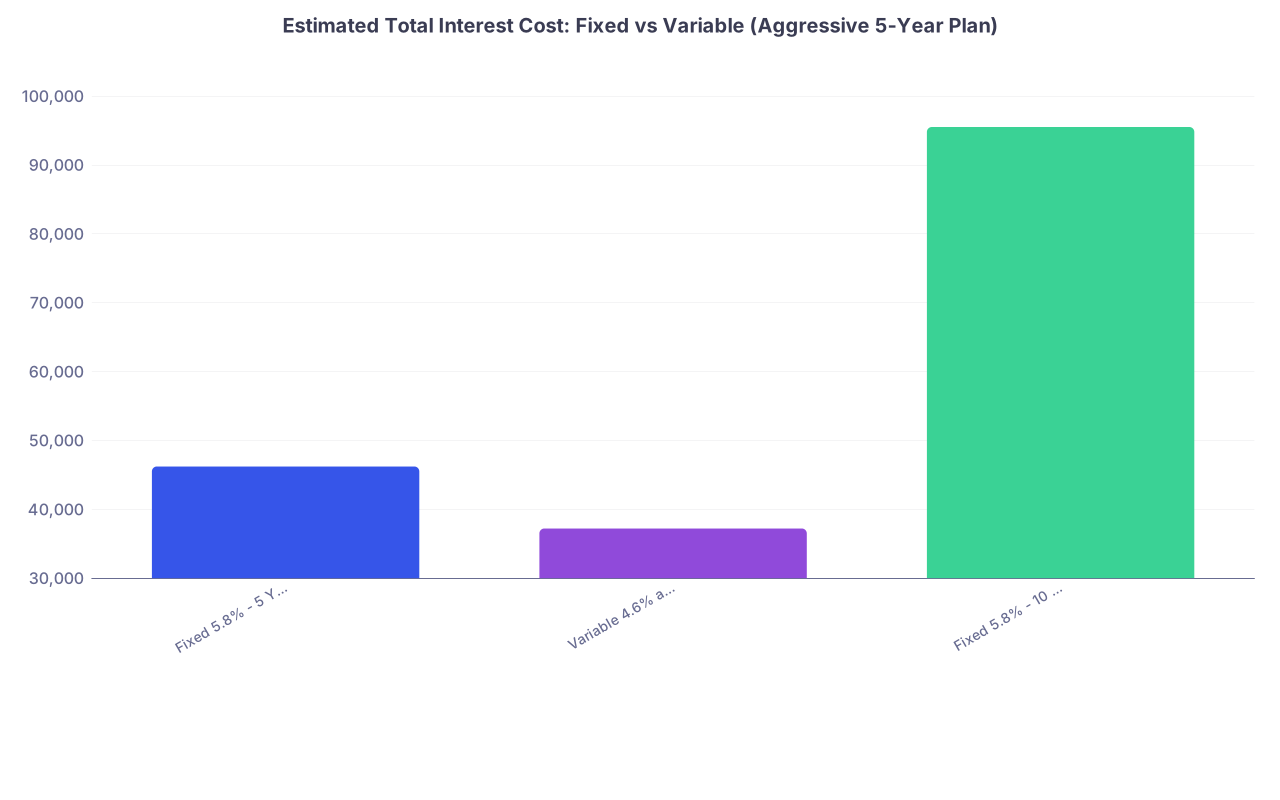
| Category | Value |
|---|---|
| Fixed 5.8% - 5 Years | 46200 |
| Variable 4.6% avg - 5 Years | 37200 |
| Fixed 5.8% - 10 Years | 95500 |
These are ballpark numbers, but here’s the idea:
- Refinance fixed to 5.8%, pay off in 5 years: roughly $46k interest
- Refinance variable, average 4.6% over those 5 years (even if it bumps around): roughly $37k interest
- Or stick to a 10-year fixed plan at 5.8%: about $95k interest
So compared to 10-year fixed, aggressive payoff plus variable can cut your total interest by ~$58,000.
That’s not pocket change.
Now, what if rates rise and your average over 5 years ends up more like 5.2% instead of 4.6%?
- Interest might look more like $41–42k instead of $37k
- You’d still be better off than a 10-year fixed plan at 5.8%
- Versus a 5-year fixed at 5.8%, you might still be slightly ahead or roughly break-even
The point: if you truly shorten the timeline, the interest-rate risk window is small, and variable can still win even if rates drift up.
The risk blows up when:
- You drag repayment out
- You refinance early in residency, then income or specialty plans change
- You chose variable because it made your monthly payment smaller, not because of a payoff strategy
Step 6: The Situations Where Variable Is a Bad Idea
Let me be blunt. Variable is usually a bad move if any of these apply:
- You’re still in residency or fellowship and not 100% sure on specialty or practice type
- You might switch to academic or non-profit work and later wish you had PSLF
- You’re tempted by the lowest monthly payment, not the lowest total interest
- You think you’ll take 10–20 years to repay
- You carry other big financial risks—unstable job, health concerns, divorce risk, business startup, etc.
This is how people get burned: they refinance federal loans into private variable-rate products during PGY-2 because a loan rep offered them “only $300/month,” then 3 years later realize they want PSLF or their specialty income isn’t what they thought.
If you’re anywhere near that story, stay federal. Or if you do refinance during training, strongly lean fixed.
Step 7: Fixed vs Variable – Quick Comparison for Med Borrowers
| Feature | Fixed Rate | Variable Rate |
|---|---|---|
| Payment stability | High | Low–Medium |
| Best for payoff time | 7–15+ years | ≤ 3–7 years |
| Risk of rising rates | None | Real but manageable if payoff is fast |
| Typical starting rate | Higher than variable | Lower than fixed |
| Psychological comfort | Higher | Lower unless you like some risk |
Here’s my usual framework:
- Planning to take 8–15 years to pay off loans, want predictability → fixed.
- Planning to take 3–7 years, disciplined, high income, rate spread ≥ 0.5–1% → variable is very defensible.
- Planning to take >15 years? Honestly, look in the mirror. At that point the bigger mistake is stretching loans that long at all if you aren’t using PSLF.
Step 8: A Practical Decision Flow
Here’s the real-world thought process I’ve watched physicians go through.

| Step | Description |
|---|---|
| Step 1 | Have Federal Med Loans |
| Step 2 | Stay Federal |
| Step 3 | Consider Refinancing - Prefer Fixed |
| Step 4 | Refinance Fixed if at all |
| Step 5 | Variable Reasonable if You Commit to Aggressive Payoff |
| Step 6 | Need PSLF or IDR Protections |
| Step 7 | In Training or Attending |
| Step 8 | 100 percent not PSLF and high future income |
| Step 9 | Debt <= 1.5x Income and Stable Private Job |
| Step 10 | Plan to Pay Off in <= 7 Years |
| Step 11 | Variable Rate >= 0.5 percent Lower than Fixed |
If you land in that last box—attending, strong income, no PSLF, fast payoff, meaningful rate spread—yes, refinancing to a variable rate can be reasonable.
Not automatically right. But absolutely reasonable.
Step 9: Guardrails If You Do Choose Variable
If you decide variable is the move, you do not wing it. You put in guardrails:
Lock in a short payoff timeline on paper
Even if the lender gives you a 10- or 15-year term, you treat it like a 3–7 year loan. Set an automatic payment far above the minimum.Stress test your budget
Imagine rates go up 2–3% over the next few years.- Would the new payment still fit?
- Would you still sleep at night?
Know the cap and adjustment schedule
- What’s the maximum rate the loan can reach?
- How often can it change?
If you don’t know these two numbers, you’re not ready to sign.
Re-evaluate annually
If rates spike and fixed rates become attractive, you can refinance again into a fixed product.Do not stretch lifestyle until loans are gone
The single biggest reason people regret variable: they acted like their lower initial payment was permanent, then built lifestyle and house payments on top of it.
Step 10: Concrete Scenarios
To make this less abstract:
Scenario 1: Ortho attending, $350k income, $350k loans
- Not PSLF-eligible, private group, stable market
- Plans to put $6k/month toward loans, be done in ~5–6 years
- Fixed at 5.7% vs variable at 4.6%
Here, I’m very comfortable with variable—if he truly sets recurring $6k payments and understands the risk.
Scenario 2: Pediatrics attending, $220k income, $350k loans
- Could work at children’s hospital (non-profit), not sure yet
- Minimum IDR payments would be manageable
- Long payoff horizon, career uncertainty
She should absolutely not refinance federal loans yet, variable or fixed. The PSLF/IDR options are worth more than the interest differential.
Scenario 3: EM resident PGY-2, $300k loans
- Works at academic hospital now, not sure if they’ll stay academic vs private
- Lender offers variable at 4.3%, fixed at 5.1% during residency, low payments
I would not touch federal loans here. Too many unknowns and too much PSLF upside.
Final Takeaways
Keep it simple:
- If you may ever need PSLF or income-driven protections, do not refinance federal loans. Variable vs fixed is irrelevant until that question is settled.
- Variable-rate refinancing can be reasonable for physicians who:
- Are clearly not using PSLF
- Have high, stable private-practice income
- Plan and commit to paying off loans aggressively (≤ 5–7 years)
- Get a meaningful rate advantage versus fixed
- If you choose variable, treat it like a short-term, aggressive payoff tool—not a way to have lower payments forever. The loan should be gone before interest-rate risk has time to really hurt you.