
The standard “just pay your loans and you’ll be fine” advice for new attendings is lazy and wrong. Your debt-to-income ratio (DTI) is the single fastest way to know if you’re actually okay or quietly headed for a wall.
Here’s the answer you’re looking for:
- Ideal target DTI for physicians post-training: around 1.0 or less (total student loan balance ≈ one year of gross attending income).
- Manageable range: up to 1.5–2.0 if you have a plan (PSLF, aggressive payoff, or high-paying specialty).
- Red zone: >2.0 almost always requires structured strategy and lifestyle restraint.
Let me break it down properly, because most people mix up 3 different ratios and then wonder why nothing makes sense.
1. Two Ratios You Actually Need: DTI and LTI
There are two main numbers you should care about post-training:
- Debt-to-Income Ratio (DTI) – total student loan balance divided by your gross annual income.
- Loan-to-Income Ratio (LTI) for payments – total required monthly debt payments divided by your gross monthly income.
They answer different questions.
- DTI = “Am I buried in loans compared to my income?”
- LTI = “How tight is my monthly cash flow?”
Most physicians only look at the payment (“My IDR payment is only $600, I’m fine”). Then five years later their balance is bigger than when they finished residency. That’s how people end up hating their loans at 40.
Basic formula cheatsheet
DTI (loan balance based)
DTI = Total student loan balance ÷ Gross annual incomeLTI (monthly payment based)
LTI = Total required monthly payments ÷ Gross monthly income
You should track both, but your primary long-term health target is the DTI. Payment can be gamed (IDR, forbearance, interest-only). The balance cannot.
2. What’s a Healthy Debt-to-Income Ratio for Physicians?
Let’s talk real thresholds, not vague “it depends” nonsense.
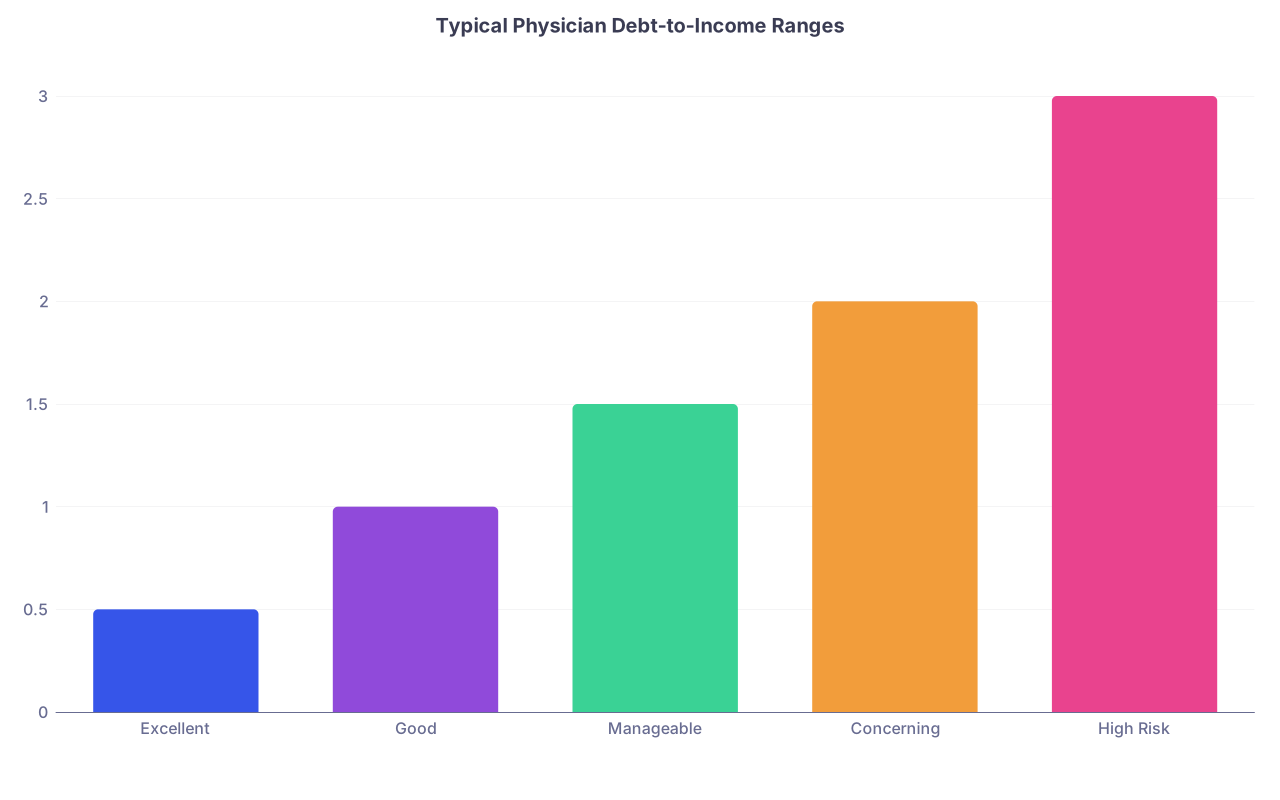
| Category | Value |
|---|---|
| Excellent | 0.5 |
| Good | 1 |
| Manageable | 1.5 |
| Concerning | 2 |
| High Risk | 3 |
Use this as your framework:
0.0 – 0.5: Exceptional
- Either no loans or loans are tiny relative to income.
- You can ramp up investing and lifestyle quickly without much risk.
- Main risk: getting complacent and inflating lifestyle too fast.
0.5 – 1.0: Ideal / Very Healthy
This is the sweet spot post-training.
- Example: $200k income, $100k–$200k loans.
- You can usually:
- Max retirement accounts.
- Pay off loans in 3–7 years without living like a monk.
- Still buy a reasonable house and live like a “normal human,” not a resident.
If you’re here, your goal should be steady payoff and aggressive saving. You do not need heroic measures.
1.0 – 1.5: Good but Requires a Plan
- Example: $300k income, $350k–$450k loans.
- This is still very workable, especially in higher-paying specialties.
- You’ll need to:
- Avoid massive lifestyle creep for the first 3–5 years.
- Decide early: forgiveness strategy (PSLF/IDR) vs rapid payoff.
- Put real dollars toward loans or savings monthly (think $3k–$8k/mo combined).
Totally survivable. But not if your first year out includes: $1.2M house, two new cars, private school, and zero budget.
1.5 – 2.0: Manageable but Tight
You’re entering “this can go wrong if you’re not deliberate” territory.
- Example: $250k income, $400k–$500k loans.
- You do not get to “just wing it.”
- You usually need ONE of the following:
- PSLF with clear qualifying employment and documentation.
- High income specialty (ortho, derm, rads, GI, anesthesia in a good market) plus disciplined payoff.
- Geographic arbitrage – high-paying job in low cost-of-living area.
If you’re primary care in a high-cost city making $210k with $450k loans, 1.8–2.0 DTI is very real and can feel suffocating unless PSLF is on the table.
2.0 – 3.0: Red Zone, Needs Strategy
- Example: $200k income, $450k–$600k loans.
- This is common for:
- Private med school + unsubsidized loans + low-paying specialty.
- DOs or Caribbean grads with extra years and more interest.
Here, a “healthy” ratio is not the current number, it’s the path:
- You probably:
- Need an income-driven forgiveness plan (PSLF or 20–25 year IDR).
- Or need to radically limit lifestyle and try to grow income (locums, rural, extra shifts).
- You cannot pretend this is a standard financial situation; it’s a project that must be managed.
>3.0: Critical – Needs Expert-Level Planning
- Example: $180k income, $600k+ loans.
- This is not a “just refinance and grind it out” scenario for most.
- Smart moves here:
- Strongly consider PSLF if any way possible.
- If no PSLF: IDR with long-term forgiveness, heavy tax planning, maybe side income.
- You should probably get a real student loan pro to run detailed projections.
This is survivable. But not if you ignore it and assume “attendings always figure it out.”
3. Monthly Payment Ratios: How Much of Your Income Should Go to Loans?
Now the other ratio: monthly payments relative to income.
General ranges for physicians:
| Category | Payment as % of Gross Income | What It Feels Like |
|---|---|---|
| Comfortable | 5–10% | Plenty of room for savings & lifestyle |
| Tight but OK | 10–15% | Manageable with some tradeoffs |
| Aggressive Payoff | 15–25% | Short-term sacrifice, fast payoff |
| Strain Zone | >25% | Lifestyle feels squeezed |
Real example:
- Attending income: $300k → $25k/month gross.
- 10% to loans = $2,500/month.
- 20% to loans = $5,000/month.
You can absolutely run at 20–25% for a few years if you have a clear payoff timeline and you’re okay delaying some lifestyle upgrades. That’s how people with $300k+ loans get debt-free in 3–5 years.
But if you’re paying 20–25% toward loans and still not seeing your balance meaningfully drop because of interest and low starting income, your DTI is simply too high for brute-force payoff to be efficient. That’s when forgiveness-based strategies make more sense.
4. How Your Specialty and Job Choice Change the “Healthy” Target
Not all $300k incomes are equal. A California pediatrician at $210k and a Texas anesthesiologist at $500k live in different worlds.
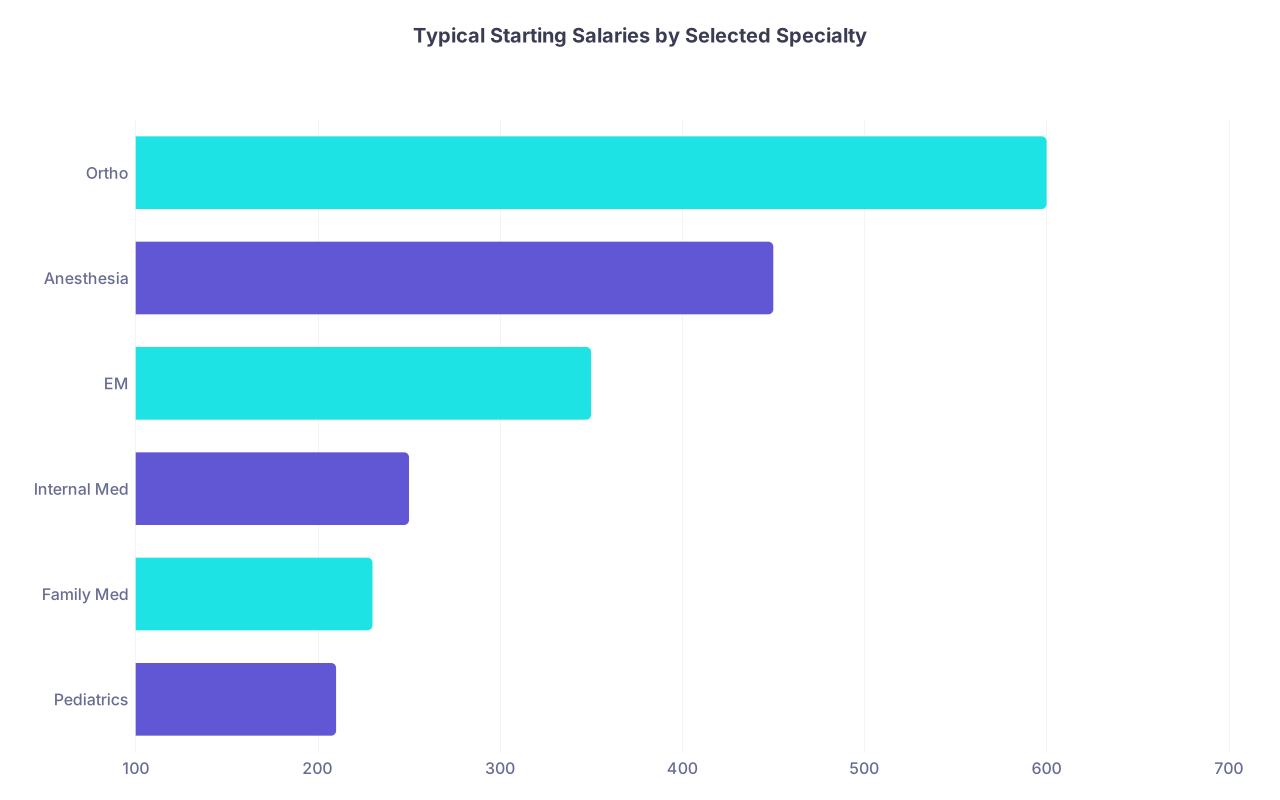
| Category | Value |
|---|---|
| Pediatrics | 210 |
| Family Med | 230 |
| Internal Med | 250 |
| EM | 350 |
| Anesthesia | 450 |
| Ortho | 600 |
Primary Care / Lower-Paying Specialties (Peds, FM, Psych)
- Realistic DTI goal: ≤1.0–1.5 if you’re planning to pay off loans yourself.
- If you’re already at 2.0+, you should strongly:
- Look at PSLF.
- Choose non-profit hospital employment if at all possible.
- Avoid refinancing federal loans privately until you’re sure forgiveness is off the table.
Procedural / Higher-Paying Specialties (Ortho, Derm, GI, Cards, Anesthesia)
- You can handle 1.5–2.0+ DTI more safely, assuming:
- Income is stable and above ~$400k.
- You do not let lifestyle explode year 1–3.
- Refis and aggressive payoff can make sense here, but do the math:
- Many of these folks can be debt-free in 3–5 years if they live like a well-paid resident for a bit.
Academic vs Private, Metro vs Rural
- Academic + big city + low pay and high COL: you want a lower DTI or strong PSLF plan.
- Rural or community with high pay and lower COL: you can tolerate higher DTI and still be okay.
Job choice is a financial decision, not just a “fit” decision, when you’re carrying 1.5–3.0 DTI.
5. How to Improve Your Physician DTI Over Time (Realistically)
The ratio is simple math:
- Decrease the numerator (loans).
- Increase the denominator (income).
- Do both faster than you inflate your lifestyle.
Step 1: Know Your Actual Numbers
Not vibes. Actual figures.
- Total student loan balance (all servicers).
- Interest rates per loan group.
- Current gross income (including bonuses, RVU, call pay).
Then calculate:
- DTI = total student loans ÷ annual income.
- Payment % = total monthly payments ÷ monthly income.
Step 2: Choose a Strategy That Matches Your DTI
Here’s a quick map:

| Step | Description |
|---|---|
| Step 1 | Calculate DTI |
| Step 2 | Refi or Standard Payoff |
| Step 3 | IDR + PSLF Focus |
| Step 4 | Aggressive Payoff if Income High |
| Step 5 | IDR and Forgiveness Planning |
| Step 6 | Specialist Advice + Forgiveness or Income Boost |
| Step 7 | DTI 1.0 or less |
| Step 8 | DTI 1.0 to 2.0 |
Step 3: Use a “Gap” Budget, Not a Fantasy Budget
Don’t start with “my lifestyle wish list.” Start with:
Income
– Taxes
– Retirement contributions (at least to match)
– Mandatory expenses (insurance, childcare, basic housing/food)
= Available for loans + extra savings + discretionary
From that available chunk, decide how much goes to loans vs building assets. You want:
- Some money destroying debt.
- Some money compounding for you (retirement, brokerage, HSA).
Step 4: Recalculate Your DTI Every 12 Months
You will not feel day-to-day progress. The numbers will show it.
Track yearly:
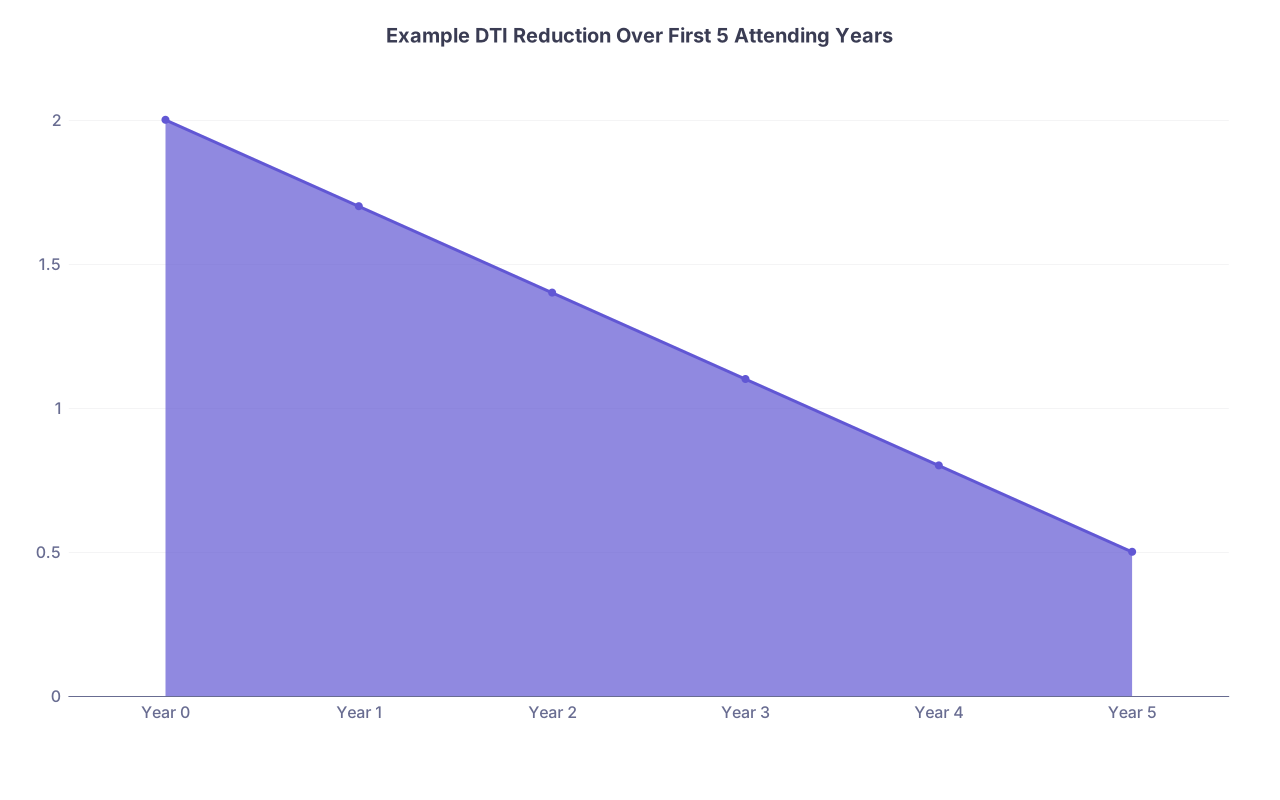
| Category | Value |
|---|---|
| Year 0 | 2 |
| Year 1 | 1.7 |
| Year 2 | 1.4 |
| Year 3 | 1.1 |
| Year 4 | 0.8 |
| Year 5 | 0.5 |
Watching DTI fall from 2.0 to 1.2 to 0.7 is motivating. It also tells you when you can loosen the reins a bit without blowing up your future.
6. Quick Guardrails Beyond the Ratio
A few hard lines I’d encourage:
House rule:
Total housing (PITI + HOA) ≤ 20–25% of gross income until your DTI is ≤1.0.Car rule:
- If DTI >1.5, buy used, pay it off in 3 years or less.
- Monthly car payments (all cars combined) < 10% of take-home.
Lifestyle creep rule:
First 2–3 years post-training, assume you’re living on 50–60% of your gross at most. The rest goes to taxes, savings, and debt.
These aren’t morals. They’re just math that keeps your debt ratios moving in the right direction without chaos.



FAQs
1. Is a 2:1 debt-to-income ratio too high for a new attending?
It’s not automatically catastrophic, but it’s not healthy by default. At 2:1 DTI, you need a defined game plan. If you have:
- $250k income and $500k loans
and you’re in a PSLF-eligible job, that can be workable with IDR and forgiveness planning.
If you’re in a lower-paying specialty with no PSLF, then “just refinance and grind” is usually a bad idea. You either:
- Aggressively try to boost income (geography, extra shifts), or
- Lean into long-term IDR and build assets while letting forgiveness handle the rest.
2. Should I try to get my DTI down to zero before investing?
No. That’s how people waste their best compounding years.
A more rational target:
- Get your DTI moving in the right direction (e.g., from 2.0 to 1.5 within a couple of years),
- While still:
- Getting employer retirement match,
- Funding at least some tax-advantaged accounts (401k/403b, 457b, HSA if available).
Total loan annihilation at the cost of zero investing is overkill for most physicians, especially once DTI is under ~1.0–1.5.
3. How does PSLF change what’s a “healthy” DTI?
PSLF completely changes the interpretation of a high DTI. If you’re confidently on track for PSLF:
- A DTI of 2.0–3.0 can be “healthy enough,” because you’re not planning to pay the full balance.
- What matters most is:
- Keeping your IDR payment affordable,
- Filing your PSLF certification forms annually,
- Building your own assets aggressively while the government handles the back end.
But that assumes you truly will stay in qualifying employment for 10 total years. If that’s shaky, pretend you are not getting PSLF and reassess.
4. Should I refinance my loans to improve my DTI?
Refinancing doesn’t change your DTI at all. It just changes your interest rate and payment structure.
You refinance when:
- You’re certain you will not use PSLF or federal IDR forgiveness, and
- You want lower interest and are ready to commit to a payoff timeline (5–10 years usually).
Your DTI might fall faster over time because more of each payment hits principal instead of interest. But the ratio itself doesn’t improve the day you sign the refi documents.
5. What’s a realistic DTI goal 5 years after training?
Good target ranges:
If you started with DTI ≤1.5:
Aim for ≤0.5–0.75 after 5 years (or completely debt-free).If you started between 1.5–2.5:
Aim to be at ≤1.0 after 5 years, or clearly on track for forgiveness with strong savings built up.
Bottom line:
- Post-training “healthy” DTI for physicians is ~1.0 or less, with up to 1.5–2.0 workable if you have a real plan and reasonable specialty income.
- Your monthly payment ratio matters too, but don’t let a low IDR payment fool you into thinking a 2–3 DTI is “fine” without a strategy.
- Job choice, lifestyle choices, and whether you use PSLF are what actually move the needle from “this is stressful” to “this is under control.”