
Yes, you can negotiate employer loan repayment in your physician contract—and you probably should.
Most physicians leave tens of thousands of dollars on the table because they treat loan repayment like a perk instead of a negotiable line item. That’s a mistake. If you’ve got six figures of student loans, employer loan repayment is not a “nice to have.” It’s compensation. And compensation is negotiable.
Let me walk you through how this actually works in real contracts, what’s realistic, and how to avoid getting burned by fine print.
1. Can you negotiate loan repayment… realistically?
Short answer: yes. But the ceiling and your leverage depend heavily on where you’re going and what you’re doing.
Here’s the basic reality:
- Hospital-employed and large health system jobs: Often have formal loan repayment programs. The “number” is usually negotiable within a range.
- Rural or underserved locations: Loan repayment is often expected and more generous. They’re buying your geography pain.
- Private practices: Less standardized. Sometimes they’ll do “signing bonus only,” but you can convert or structure some of that as loan repayment if you ask.
- Academic centers: Usually more rigid. Some have structured programs; some don’t. The title “Assistant Professor” does not magically pay your loans.
If you’re a hospitalist with multiple offers in the Midwest, you probably have more room to push than a new dermatology attending in Boston with one offer.
Typical loan repayment ranges
Numbers vary a lot by specialty and geography, but here’s what I actually see in contracts:
| Setting / Specialty | Common Annual Range | Typical Total Commitment |
|---|---|---|
| Rural Primary Care / FM / IM | $20k – $50k | 3–5 years |
| Hospitalist (non-urban) | $15k – $30k | 3–4 years |
| Psychiatry (shortage areas) | $20k – $40k | 3–5 years |
| Surgical subspecialties | $0 – $25k | Often 2–3 years |
| Academic centers | $0 – $15k | 3+ years, if offered |
Is more possible? Yes. I’ve seen >$200k total packages, especially when combining employer repayment with federal or state programs. But those are usually high-need locations and longer commitments.
2. How employer loan repayment actually works (mechanics)
This is where a lot of doctors get surprised. “We’ll pay $100,000 of your loans” rarely means a $100,000 check on day one.
The structures I see most often:
Annual payments after service is completed
For example: $25,000 per year, paid at the end of each year you complete.- If you leave after 18 months? You often only get the first year and owe nothing back from that year, but you don’t get year 2.
- Some contracts do prorated amounts; some don’t. Read the language.
Monthly or quarterly payments tied to employment status
- Example: $2,000/month sent directly to your loan servicer as long as you’re employed.
- If you leave, payments stop, but you usually don’t have to repay what’s already been paid.
Upfront lump sum with a clawback
- Example: $50,000 “loan repayment” paid in your first or second paycheck, forgiven over 3–5 years.
- If you leave early, you owe back the unvested portion. This is functionally a forgivable loan, not “free money.”
Conversion of signing bonus into loan repayment
- You have a $40k signing bonus. You ask to structure some/all as direct loan repayment.
- This can occasionally help if they have a separate loan repayment budget or you want stronger retention terms.
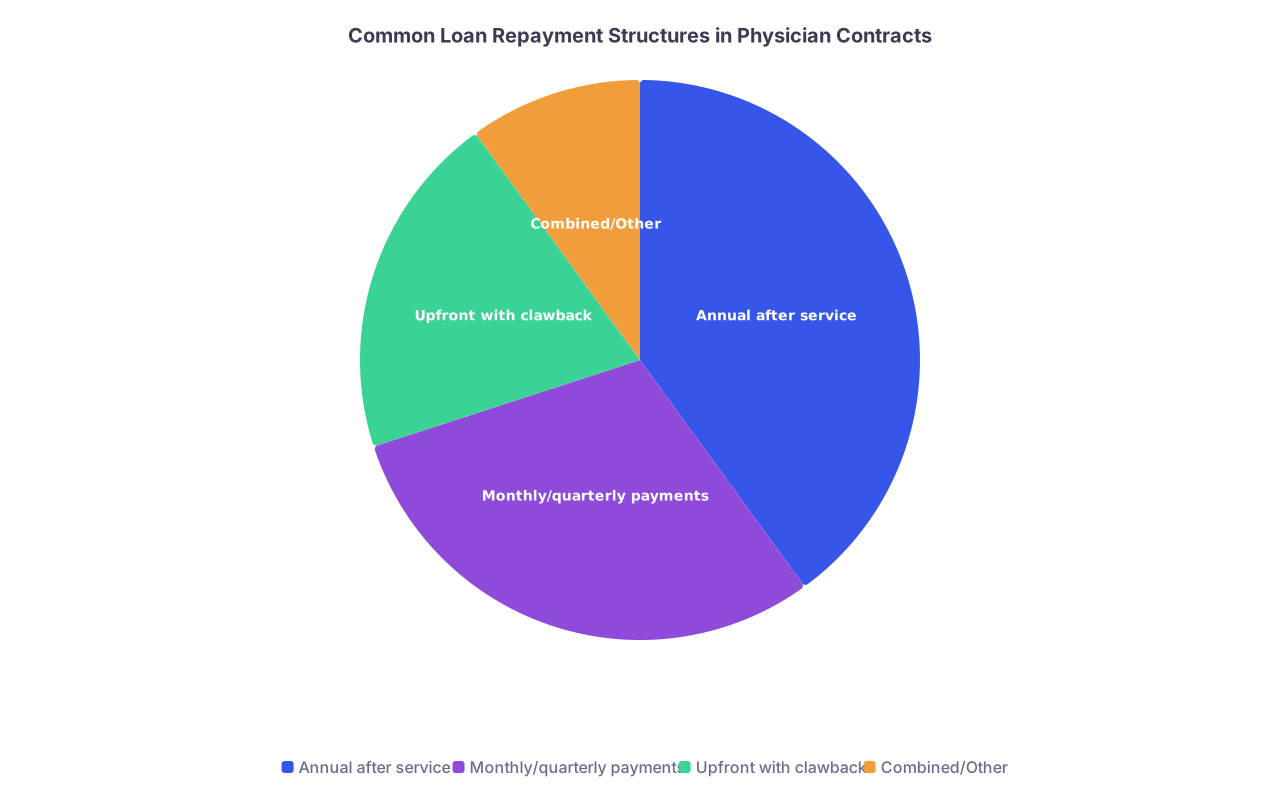
| Category | Value |
|---|---|
| Annual after service | 40 |
| Monthly/quarterly payments | 30 |
| Upfront with clawback | 20 |
| Combined/Other | 10 |
You’re not just negotiating the amount. You’re negotiating the structure—and that’s where a lot of the real value and risk live.
3. What’s actually negotiable in your contract?
Most people focus on the headline number—“Can you make it $40k instead of $25k?” That’s fine, but you should also push on the pieces that quietly cost you tens of thousands if you ignore them.
Here’s what you can—and should—negotiate:
1. Total amount and schedule
You can ask for:
- A higher annual repayment amount
- A shorter required commitment for the same amount
- Front-loaded payments (e.g., more in years 1–2, less later)
- Payments starting immediately rather than after a “probation” period
I’ve literally seen: “Loan repayment starts after 12 months of employment.” That’s a year of lost help. Ask to remove that.
2. Vesting and clawback language
This is the part you absolutely cannot gloss over.
Key questions:
- If they pay $25k/year for 4 years, and you leave after 3.5 years, do you:
- Owe anything back?
- Lose year 4 only?
- Owe a prorated portion of year 4 you didn’t complete?
- If they pay a $100k lump sum upfront:
- Over how many years is it forgiven (typical is 3–5)?
- Is it straight-line forgiveness (e.g., 20% per year over 5 years) or back-loaded?
- Is repayment due immediately if you leave, or can it be paid back over time?
You want vesting to be annual or monthly, straight-line, and clearly prorated. Anything else is them trying to trap you.
4. Tax traps: loan repayment is not “free”
Most employers do not explain this well. Their recruiter says, “We’ll give you $30,000 per year for your loans,” and forgets to mention the IRS.
Employer loan repayment is usually taxable income to you. That means:
- They pay $30,000 toward your loans
- It shows up as $30,000 of income on your W-2
- You pay income and payroll tax on it just like salary
So your real benefit is more like the after-tax value of that repayment.
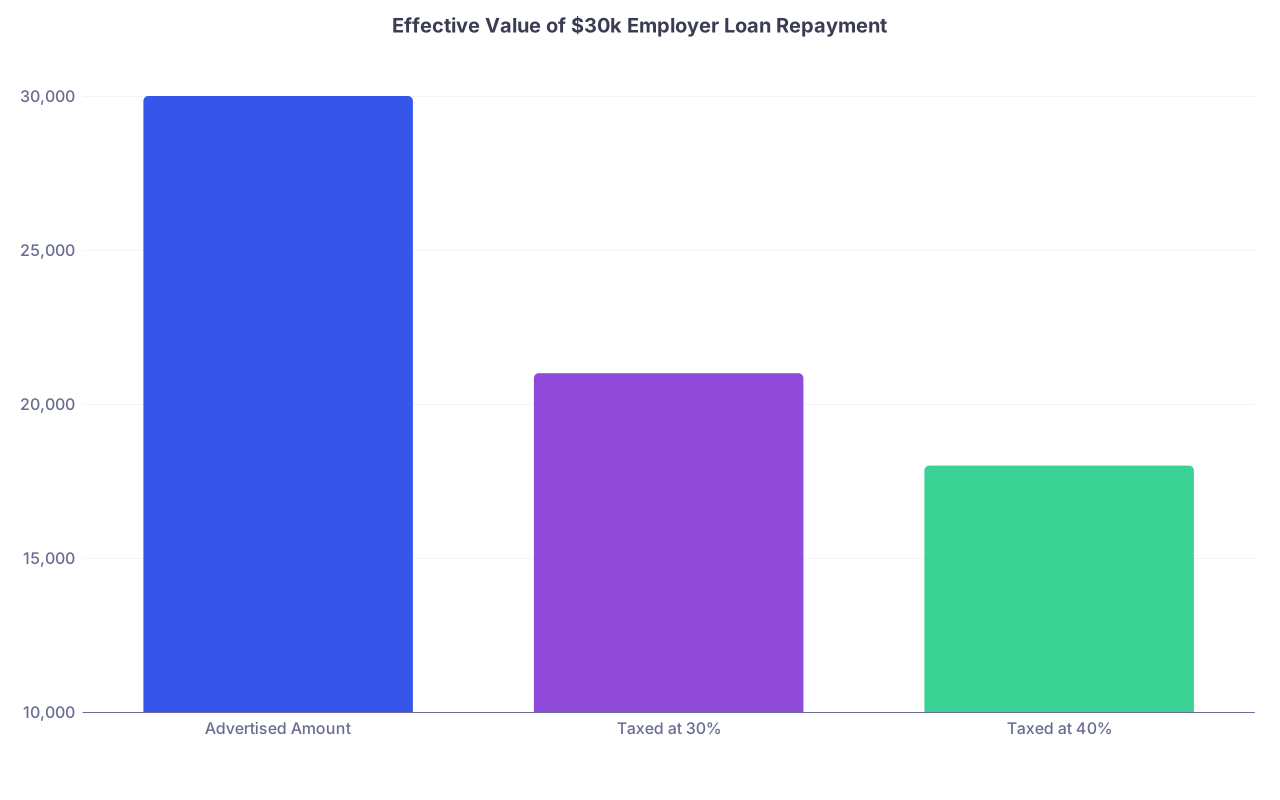
| Category | Value |
|---|---|
| Advertised Amount | 30000 |
| Taxed at 30% | 21000 |
| Taxed at 40% | 18000 |
What you can negotiate around taxes:
- Ask if they’ll gross up the payments
- Example: Instead of $30k, they pay ~$45k so you net ~$30k after tax.
- Many places will say no. Some will split the difference. It’s still worth asking.
- Make sure it’s clearly marked in the contract as “loan repayment,” not just rolled silently into base pay.
5. How to actually ask for loan repayment (scripts and timing)
You do not wait until after you sign to bring this up. You bring it up while everything is still fluid—ideally when they’ve shown serious interest (verbal offer or draft written offer), but before you sign anything.
Step-by-step approach
Wait for the initial offer
Let them show their hand first: base salary, bonus, call, etc.Express enthusiasm, then pivot
Example language:“I’m excited about this position and I think it’s a great fit. One major factor for me is student loan repayment. Does your system offer employer loan repayment, and if so, what does that typically look like for someone in this role?”
Get numbers and structure in writing
When they answer, your follow-up:“Thank you—that’s helpful. Could you send over how that’s structured in the contract? Specifically: when payments start, whether it’s paid annually or monthly, and how the vesting or repayment works if I were to leave early?”
Counter thoughtfully
Once you see the offer, you negotiate. For example:“Given my current loan balance and the competing offers I’m considering, I was hoping we could get closer to $30,000 per year in loan repayment instead of $20,000, with payments starting in the first year. Is there flexibility in that part of the package?”
Or:
“Would you be open to shifting part of the signing bonus into a structured loan repayment program—say $20,000 of the $40,000—as long as it doesn’t change the overall budget impact for you?”

| Step | Description |
|---|---|
| Step 1 | Receive Initial Offer |
| Step 2 | Ask if loan repayment available |
| Step 3 | Request written details |
| Step 4 | Review structure and fine print |
| Step 5 | Confirm in contract and sign |
| Step 6 | Propose specific changes |
| Step 7 | Decide to accept or walk |
| Step 8 | Acceptable as is? |
| Step 9 | Employer response |
Do not apologize for asking. You’re not being “difficult.” You’re negotiating compensation in a six- or seven-figure relationship.
6. How employer repayment plays with PSLF and other programs
This is where people really screw it up because they don’t think like a tax attorney and a loan servicer at the same time.
Public Service Loan Forgiveness (PSLF)
If your employer is a qualifying nonprofit or government entity:
- Your payments (IDR) and employer’s payments both happen while you are earning PSLF credit.
- Employer payments do not reduce your PSLF qualifying months. Time is based on months in qualifying repayment, not who pays.
- The employer payments just reduce your principal faster. You can still hit 120 months and get remaining loans forgiven.
Two key pitfalls:
- If the employer insists on putting you on a non-qualifying repayment plan, you could blow PSLF eligibility. Make sure your loan repayment plan stays PSLF-eligible (e.g., SAVE, PAYE, IBR if applicable).
- If employer repayment is front-loaded and large, you might end up with little or no balance left by year 10—at which point PSLF doesn’t matter. Sometimes that’s fine. Sometimes it’s a massive lost opportunity.
NHSC, state, and specialty programs
You can sometimes stack:
- Employer loan repayment
- National Health Service Corps (NHSC)
- State-specific programs (e.g., rural primary care incentives)
- Hospital-specific retention bonuses
But the rules are different for each program. Some reduce benefits if you’re already getting money from another source. Others don’t care.
You need clear written answers from the program admin, not just a recruiter saying, “Yeah, that should be fine.”
7. Legal landmines and what to have a lawyer review
Here’s the part almost no resident was trained for: the contract language that turns “loan help” into an anchor around your neck.
Have a physician contract attorney review at least these sections:
The loan repayment provision itself
- Is it clearly labeled as loan repayment, forgivable loan, or sign-on bonus?
- Is the schedule and vesting described in plain, objective terms?
The termination and repayment section
- What happens if you’re terminated without cause?
- What if you’re terminated with cause?
- What if you must leave due to disability or family emergency?
Any non-compete clause layered on top
- It’s one thing to repay unvested loan money.
- It’s another to be blocked from working locally and owing money back.

If a contract says you must repay 100% of all amounts ever paid if you leave even one day before a 5-year mark, that’s predatory. You push back hard or you walk.
8. Strategy: when is it worth pushing and when to let it go?
You only have so much negotiation capital. You can’t maximize everything at once—salary, bonus, schedule, call, location, academic title, and loan repayment—without looking unreasonable.
So prioritize:
- Giant loans + PSLF unlikely (private practice, for-profit system)?
Loan repayment should be high on your list. - Solid salary, reasonable schedule, PSLF-eligible employer?
You might prioritize a clean PSLF path and lifestyle over squeezing another $10k/year in repayment. - Family or location is non-negotiable (spouse’s job, kids in school)?
Your leverage is lower; still ask, but be strategic with your tone.
The right approach is usually:
- Get base and core compensation where you need them.
- Then ask: “What can we do on loan repayment support?”
- Then clean up the structure, vesting, and fine print.

9. Practical examples: what a good vs. bad loan repayment clause looks like
Let me simplify this.
Bad example:
Employer will pay $100,000 in loan repayment, paid in full after completion of 5 years of continuous employment. If Physician terminates employment for any reason prior to 5 years, Physician shall repay the full $100,000 within 30 days of termination.
This is essentially handcuffs.
Better example:
Employer will pay $25,000 per year, as taxable income, toward Physician’s qualifying student loans, paid in equal monthly installments. If Physician terminates employment before completing each full year, the annual amount will be prorated based on months completed. Amounts already paid are not subject to repayment by Physician.
And for a lump sum:
Employer will pay a $60,000 student loan assistance bonus upon commencement of employment. This amount will be forgiven in equal monthly installments over 36 months of continuous employment. If Physician terminates before 36 months, Physician shall repay the unforgiven balance, calculated on a prorated monthly basis, within 90 days of termination.
That’s at least predictable and fair. You know the cost of leaving.

FAQ: Employer Loan Repayment in Physician Contracts
1. Is it rude or risky to ask about loan repayment during physician contract negotiations?
No. You’re discussing compensation, not begging for charity. Ask respectfully and matter-of-factly, ideally after you’ve received an initial offer: “Can you tell me what your typical loan repayment support looks like for this role?”
2. What’s a reasonable amount of employer loan repayment to ask for?
Anchor your ask in context. For primary care, hospitalist, or psychiatry in non-urban or shortage areas, $20k–$40k per year is very common; more in high-need rural areas. For subspecialties or urban markets, $10k–$25k per year or a one-time lump sum is more typical. You can ask for the high end of the local norm; just don’t double what’s standard and expect a yes.
3. Can employer loan repayment hurt my chances of getting PSLF forgiveness?
It can, but only if the structure is bad or you choose the wrong repayment plan. If you’re at a PSLF-qualifying employer and stay in an IDR plan, employer payments simply accelerate payoff while you rack up PSLF-qualifying months. The real risk is overpaying your loans early and ending up with no balance left to forgive by year 10, wasting PSLF potential. You need a coordinated strategy, not random big payments.
4. Is employer loan repayment better than a higher base salary?
Mathematically, they’re both just taxable compensation. But in practice, loan repayment:
- Is often tied to retention (vesting), which can either help or trap you.
- May be easier for the employer to approve if they have a separate budget bucket.
- Forces you to actually direct money to loans instead of lifestyle creep.
Ideally, you evaluate the full package: sometimes a slightly lower repayment but much higher base and better schedule is the smarter long-term choice.
5. What happens to employer loan repayment if I’m fired or have to leave for personal reasons?
It depends entirely on the contract. Some require you to repay only unvested amounts. Others demand repayment of everything if you leave “for any reason” before a certain date. You want language that:
- Prorates vesting over time
- Protects you if you’re terminated without cause or disabled
- Gives you time (60–90 days) to repay any required amount
If the clause is harsh and non-negotiable, treat that as a red flag.
6. Who should review my contract before I agree to employer loan repayment terms?
A physician contract attorney. Not your co-resident, not your parent who’s “good with money,” and not the recruiter. You want someone who reads physician contracts all day and knows what’s typical in your specialty and region. The few hundred to low thousand dollars you spend now can easily save you tens of thousands in bad repayment and restrictive clauses later.
Bottom line:
Loan repayment is compensation, not a gift. You can and should negotiate the amount, structure, and fine print. And if you treat the contract like a legal and financial document instead of a formality, you’ll keep more of your money—and your freedom—over the next decade.