
The way most physicians “choose” between solo practice and employed status completely ignores the student loan math—and that is financially reckless.
You cannot talk about private practice vs employment in 2025+ without talking about REPAYE/SAVE, PSLF, AGI manipulation, and tax filing status. The structure of your income (W‑2 vs K‑1), your ability to control expenses, and your long‑term plan for forgiveness or rapid payoff all change the optimal answer.
Let me break this down specifically.
Step 1: Get Your Student Loan Endgame Right First
Before you argue about practice models, you need one decision on paper:
Am I (a) optimizing for forgiveness or (b) optimizing for fastest payoff?
Everything else hangs on that.
Two fundamentally different targets
Public Service Loan Forgiveness (PSLF) / IDR forgiveness optimization
You are trying to:- Keep IDR payments as low as legally possible
- Maximize amount forgiven (tax‑free for PSLF, taxable for 20–25 year IDR forgiveness)
- Maintain qualifying employment if PSLF is the goal
Aggressive payoff optimization
You are trying to:- Maximize cash flow to loans
- Eliminate debt in 3–7 years
- Accept higher payments now for lower lifetime interest
If you are not clear which path you are on, everything else in this article will feel contradictory. Because the right answer for a PSLF‑bound pediatrician at an FQHC is the exact opposite of the right answer for a non‑PSLF orthopedic surgeon in private practice.
Step 2: How Practice Type Interacts With Loan Strategy

Let us start with the basic structural differences that matter for loans.
Employed (W‑2) physician
Typically:
- Straight salary + productivity bonus
- W‑2 wages, limited deductions at personal level
- Easy PSLF qualification if employer is 501(c)(3), VA, academic, or government
- Benefits (401(k) / 403(b) / 457(b), health, malpractice, disability) pre‑packaged
Loan implications:
- Your AGI is fairly rigid. You get:
- Pre‑tax retirement contributions
- HSA contributions
- Maybe FSA, some pre‑tax premiums
- You cannot “create” business deductions or defer large chunks of income creatively
- Perfect for PSLF: clean 10 years of qualifying payments, predictable employment
Solo or independent practice (often 1099 / K‑1)
Models:
- True solo practice (you own the entity)
- Small group partnership
- Independent contractor 1099 (no benefits, but lots of deductions)
- S‑corp, PLLC, PC, partnership structures
You now:
- Control your own retirement plan design (solo 401(k), defined benefit plan, cash balance)
- Control what’s a business expense vs taxable income
- Have wider ability to shift income timing and character (within the law)
Loan implications:
- You can often reduce AGI much more aggressively
- Or increase AGI to attack loans faster if you want debt‑free sooner
- PSLF is usually off the table unless you moonlight at a PSLF‑qualifying employer 30+ hrs/week (rare but not impossible)
So the tension is obvious:
- PSLF strategy loves W‑2 employment at qualifying institutions
- Aggressive payoff or long‑term IDR tax‑bomb planning can pair extremely well with solo/independent practice because of AGI control
Step 3: Understanding IDR, AGI, and Why Entity Choice Matters
The key concept: income‑driven repayment (SAVE, PAYE, IBR) is based on AGI, not on your gross collections or “what you really make.”
If you do not understand what hits AGI, you cannot optimize.
Quick AGI refresher for physicians
AGI is roughly:
W‑2 wages
- business net income (Schedule C or K‑1 passthrough)
- interest, dividends, capital gains
- some other income
– “above the line” deductions (pre‑tax retirement, HSA, self‑employed health insurance, half SE tax, etc.)
Your loan servicer pulls this from your tax return.
For an employed hospitalist:
- $280,000 W‑2 salary
- $22,500 403(b) pre‑tax contribution
- $4,150 HSA contribution
AGI roughly: 280,000 – 22,500 – 4,150 = 253,350
For a solo practice internist:
- $450,000 gross revenue
- $250,000 practice expenses (staff, rent, malpractice, EMR, etc.)
- $200,000 net Schedule C income
- $66,000 solo 401(k) + profit‑sharing
- $7,300 HSA
- ~ $14,000 half SE tax deduction
AGI: 200,000 – 66,000 – 7,300 – 14,000 ≈ 112,700
Same “lifestyle” income potential, massively different AGI. That cascades directly into IDR payment amounts.
Step 4: PSLF – Why Employed Status Is Usually King
If your plan is PSLF, the math is brutal and simple: PSLF cares about three things:
- Direct federal loans
- 120 qualifying payments
- Qualifying employer
Private solo practice does not satisfy #3. At all.
Who should almost never go solo from a loan perspective?
If all of these are true, solo practice is usually financially stupid for the first decade:
- You have >$200,000 in federal loans at graduate/professional rates
- You are within your first 1–5 years of repayment
- You have guaranteed or very likely access to 501(c)(3)/government employment in your specialty
- You are willing to work there at least 10 years
Think: pediatricians at children’s hospitals, academic internists, hospitalists at major non‑profit systems, psychiatrists at county systems or VA.
Every time I have seen a PGY‑3 pediatric resident walk away from an academic 501(c)(3) job to “start a cash‑only private practice” with $350k in federal debt, they have lit six figures of PSLF benefit on fire. Usually because no one did the math with them.
PSLF and timing of going solo
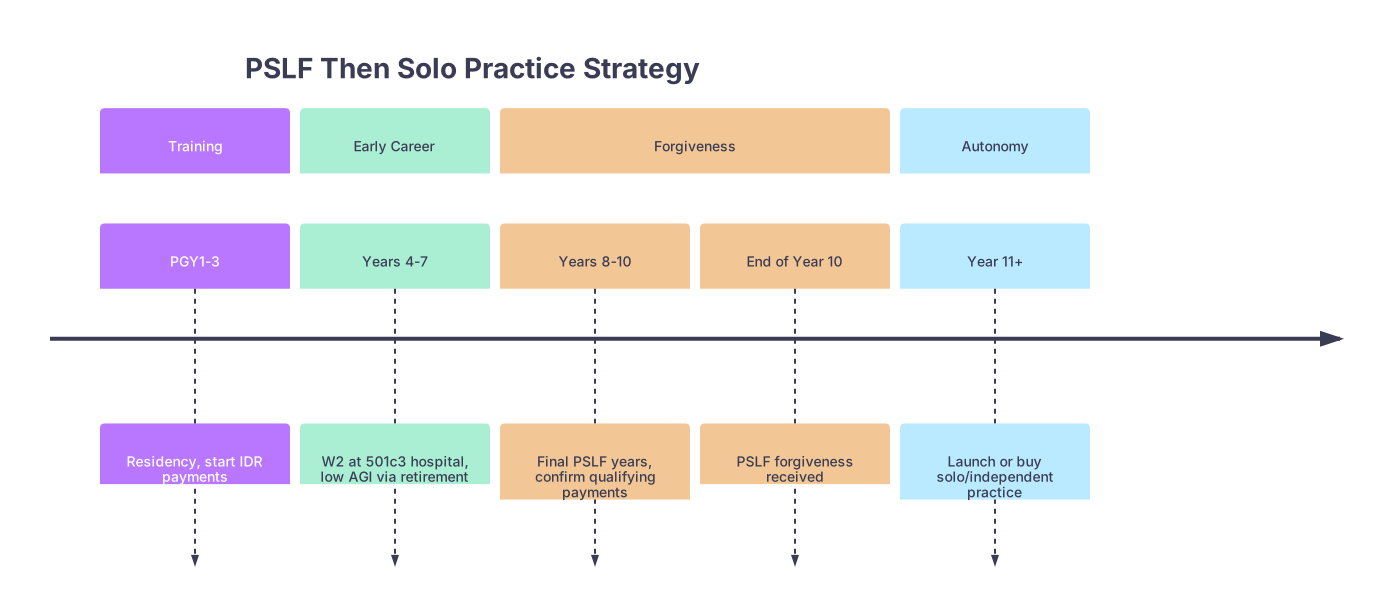
Strategic option that actually works:
- Do 10 years at PSLF‑qualifying W‑2 employer (residency counts if payments are made)
- Use SAVE to keep payments modest
- Max PSLF forgiveness
- Then, after forgiveness, pivot to solo practice when loan risk is gone
This is the cleanest way to have both PSLF and eventual autonomy. You trade some early‑career freedom for six‑figure tax‑free forgiveness, then build your own practice without that anvil over your head.
| Period | Event |
|---|---|
| Training - PGY1-3 | Residency, start IDR payments |
| Early Career - Years 4-7 | W2 at 501c3 hospital, low AGI via retirement |
| Forgiveness - Years 8-10 | Final PSLF years, confirm qualifying payments |
| Forgiveness - End of Year 10 | PSLF forgiveness received |
| Autonomy - Year 11+ | Launch or buy solo/independent practice |
If you are PSLF‑eligible and reasonably content with employed life, you do not overcomplicate this. Stay employed, optimize AGI with retirement/HSA, take PSLF, then reevaluate.
Step 5: When Solo or Independent Practice Wins the Student Loan Game
Now the other side. There are cases where solo practice or independent status is clearly superior for loan optimization.
Scenario A: High earner, no PSLF option, wants rapid payoff
Say you are:
- Orthopedic surgeon offered:
- $700k employed at a for‑profit surgical group
- Or partnership track in independent group with realistic income $900k+ in a few years
- $350k in federal loans, no 501(c)(3) job realistically available
Here, PSLF is basically off the table. The question becomes: which model lets you shovel the most after‑tax cash into the loans?
Solo / partnership often wins because:
- You can structure:
- Defined benefit or cash balance plans for huge pre‑tax savings (like $150k+/year in retirement, depending on age)
- Business deductions (CME, home office, mileage, etc.)
- You can control distributions vs salary to manage payroll taxes, though for IDR this matters less than total AGI
If your plan is to pay off $350k in 3–4 years, loans are just a transient cash flow sink. Your priority is maximizing net income, not minimizing AGI.
In that case, the better‑paying independent model that nets you $100k+ more per year after taxes is usually superior, even if AGI is higher and IDR payments are larger. Because you do not plan to stay on IDR for 20–25 years anyway.
Scenario B: Using IDR long‑term with taxable forgiveness and heavy AGI control
More subtle but powerful.
You are:
- Family med or psych in a non‑PSLF setting
- $400k+ federal loans at 6–7%
- Comfortable with 20–25 year IDR forgiveness strategy (SAVE) and planning for tax bomb
- Happy to invest aggressively instead of paying extra on loans
Here, you want to:
- Minimize AGI to reduce IDR payments
- Keep loans alive as long as strategically beneficial
- Use extra cash to build retirement/investment accounts
Independent practice or 1099 work can be very loan‑friendly:
- You create a solo 401(k) and push $66k+ pretax annually
- You add a defined benefit plan for another, say, $80k+ each year (age dependent)
- You deduct health insurance, half SE tax, legitimate business expenses
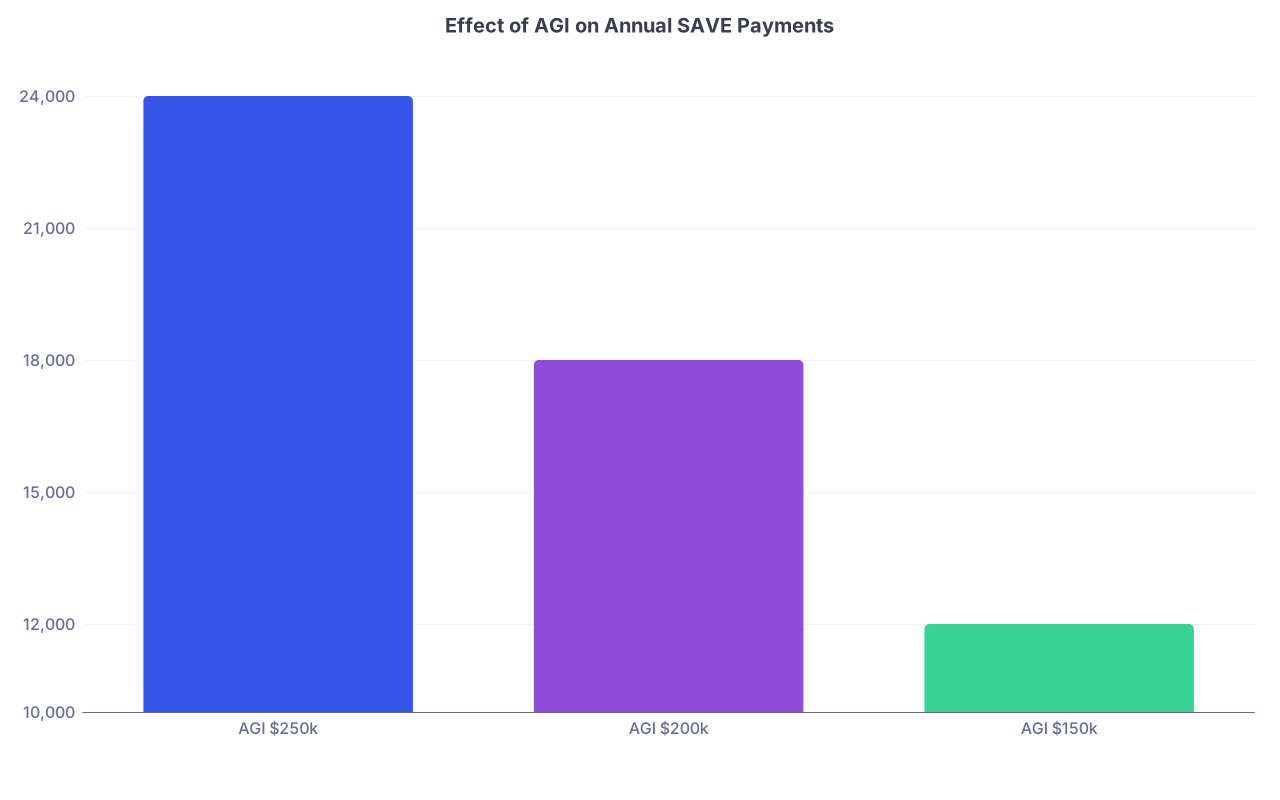
You might collect $350,000 but show an AGI closer to $150,000. Under SAVE, that difference can translate to thousands less per year in payments.
| Category | Value |
|---|---|
| AGI $250k | 24000 |
| AGI $200k | 18000 |
| AGI $150k | 12000 |
Rough illustration assuming:
- Family size 3
- 225% FPL deduction
- 10% marginal IDR rate under SAVE for med/professional school debt
Lowering AGI by $100k can easily cut payments by ~$10–12k per year. Over 20 years that is significant, especially when that “saved” cash is being invested instead of sent to MOHELA.
Step 6: W‑2 vs 1099 vs S‑Corp – IDR and Entity Nuances
Here is where people get bad advice from generic CPAs who do not understand IDR.
Common myth: “Use an S‑corp to pay yourself a low W‑2 salary and big distributions, that will lower your AGI and your IDR payments.”
Wrong. IDR cares about AGI. Both salary and pass‑through S‑corp income (Box 1 of K‑1) hit AGI. That trick does not work for loans.
What does work:
- Maximizing legitimate business deductions to lower business net income.
- Maximizing pre‑tax retirement and HSA contributions.
- Timing of extra income (e.g., delaying a big elective distribution to January to control AGI for the tax year used for recertification).
Entity choice considerations
Sole proprietor / single‑member LLC
- Simple, everything flows to Schedule C
- All net income subject to SE tax
- Clean integration with IDR because AGI is basically net profit minus “above the line” items
S‑corp
- Some SE tax savings possible
- Requires reasonable salary; extra profit as distribution
- For IDR: salary + K‑1 both hit AGI; complexity may not help loan strategy much
- Might still be worth it for payroll tax reasons, but do not expect IDR magic
Partnership / group practice K‑1
- Similar AGI impact: your share of income hits AGI
- Flexibility in retirement plan design can be fantastic for AGI reduction
Put differently: entity choice affects how much of your income you keep after tax and payroll, but it does not let you “hide” income from IDR. The lever for IDR is pre‑tax contributions and legitimate expenses, not entity labels.
Step 7: Using Tax Filing Status and Spousal Income Strategically
Married physicians get another layer of complication and opportunity.
Some of the biggest wins I have seen come from coordinating:
- Practice structure, and
- Tax filing status (MFJ vs MFS), and
- IDR plan choice (PAYE vs SAVE)
Classic setup: PSLF‑bound W‑2 doc with high‑earning spouse
Example:
- You: academic rheumatologist, 501(c)(3) hospital, $240k W‑2, $300k loans
- Spouse: tech professional, $250k W‑2, no loans
- You are on PAYE (10% of discretionary income, 20‑year forgiveness, uses borrower’s income only if Married Filing Separately)
Here, you might:
- Elect MFS to exclude spouse income from your IDR calculation
- Max out your 403(b) and 457(b) to drop your AGI further
- Accept higher total tax from MFS in exchange for lower IDR payments and more PSLF forgiveness
You would usually stay employed and PSLF‑eligible; solo practice makes no sense here.
Independent doc with loans, spouse W‑2
Now consider:
- You: solo psychiatry practice, $300k net income, $350k loans
- Spouse: teacher, $65k income, modest loans but chasing PSLF
- Both on SAVE
You might:
- Keep your solo setup to max retirement contributions and cut AGI
- File MFJ to allow both incomes in SAVE calculation, but with heavy pre‑tax sheltering on your side
- Or file MFS if that significantly lowers one spouse’s IDR when PSLF is targeted
The point: there is no one rule. But solo practice often gives the physician borrower more tools to manipulate AGI, which makes IDR and filing status games more powerful.
Step 8: Risk, Cash Flow, and the First 3–5 Years Out
Everyone loves theoretical models. Real life is messier.
The first 3–5 years out of training is where you are most fragile:
- Least savings
- Highest debt
- Most uncertainty about specialty fit, geography, and lifestyle
The loan strategy that works on paper but leaves you with:
- Unstable income
- Erratic cash flow
- No malpractice tail coverage
- No benefits
…can backfire, even if it technically lowers your lifetime loan cost.
This is why I often tell new grads:
- If PSLF is clearly on the table and you can tolerate the job, take the stable W‑2 PSLF‑eligible job for the first few years.
- If PSLF is off the table and you want solo, try:
- 1–2 years in a high‑pay, stable employed job
- Refinance to lower rate once income secure
- Build emergency fund and initial retirement
- Then pivot to solo when you have some financial padding
Solo practice launched with no buffer and $300k at 7% is a stress test most people underestimate.
| Strategy | Pros | Cons |
|---|---|---|
| PSLF W2 for 10 years | Max forgiveness, stable income | Less autonomy, slower upside |
| Employed 2–3 yrs then Solo | Build cushion, learn system | Delays autonomy, 2 transitions |
| Immediate Solo, aggressive payoff | Max control, high income ceiling | High risk, cash flow volatility |
Step 9: Concrete Scenarios – What I Would Do
Let me put some stakes in the ground. Three realistic composites.
Scenario 1: IM hospitalist, $280k, $280k loans, PSLF‑eligible job
- Age: 32
- Employer: 501(c)(3) academic hospital
- Loans: $280k federal, weighted ~6.5%
- Family: Married, 1 child; spouse makes $80k
I would:
- Stay employed at least 8–10 years to secure PSLF
- Enroll in SAVE or PAYE depending on spousal income strategy
- Max 403(b)/457(b) and HSA to drop AGI
- File MFJ or MFS based on actual tax/IDR simulations
- Defer any solo practice ideas until after PSLF
Going solo in year 2 here is financially irrational given likely $150k+ PSLF benefit.
Scenario 2: EM physician, $500k income potential, for‑profit group only
- Age: 35
- Income options:
- $400k W‑2 at corporate EM group
- $500k independent contractor 1099 in same region
- Loans: $250k private (already refinanced to 4%), $100k federal at 6.8%
- No PSLF‑eligible jobs realistically available
I would:
- Take the better‑paying structure if the group is stable and clinically acceptable
- Likely prefer the 1099 role with:
- Solo 401(k) max
- Maybe a defined benefit plan once income stable
- Aggressively pay down loans in 3–4 years while maximizing retirement
- Not bother with SAVE/IDR long‑term; use standard or refinance as needed
Here, solo/independent wins because PSLF is off the table and your ability to accelerate payoff is huge.
Scenario 3: Outpatient psychiatrist, wants lifestyle and autonomy, $400k loans
- Age: 33
- Options:
- $260k W‑2 at county mental health center (PSLF‑eligible)
- Build solo cash/insurance mix practice, realistic ramp to $350–$400k over 3–4 years
- Goals: 3‑day workweek, location freedom, not obsessed with maximum income
- Loans: $400k federal
If this person tells me they want maximum financial optimization, I would say:
- Do PSLF at county for 10 years, get likely $200k+ tax‑free forgiveness, then go solo with no debt.
If they tell me they value autonomy/lifestyle above that, I would:
- Support solo practice sooner
- Use SAVE with aggressive AGI management via solo 401(k), HSA, etc.
- Accept higher lifetime loan cost in exchange for practice satisfaction
This is the honest tradeoff: sometimes the “wrong” answer financially is the right answer for your life.
Step 10: Putting It Together – How To Decide For Yourself
You do not need a 40‑page spreadsheet. You need a structured approach.
Define your loan endgame
- PSLF, taxable forgiveness, or aggressive payoff?
Map your realistic job options for the next 5–10 years
- Which are PSLF‑eligible?
- What are realistic compensation ranges (not recruiter promises)?
Estimate AGI under each model
- Employed: salary – pre‑tax benefits
- Solo/independent: net income – retirement – HSA – SE deductions
Calculate IDR payments under SAVE/PAYE for each AGI
- Use reputable calculators; do not guess
Estimate:
- Total payments over your intended loan strategy horizon (10 or 20–25 years, or payoff date)
- Expected forgiveness (if PSLF/IDR)
- Tax bomb (if 20–25 year forgiveness)
Layer in:
- Risk tolerance
- Cash flow stability you need
- How badly you actually want to be independent vs employed
Then you choose. Deliberately. Not by inertia.
FAQ (exactly 4 questions)
1. If I plan to do PSLF, is there any reason to start solo practice early?
Very rarely. The only semi‑rational version is where you keep a 30+ hour/week W‑2 role at a PSLF‑eligible employer and slowly build a side solo practice on top. But in practice, most people burn out trying to do both. For pure loan optimization, you stay W‑2 with PSLF until forgiveness and then consider solo. If autonomy is more important than financial optimization, that is a different conversation.
2. Can an S‑corp or LLC structure actually lower my IDR payments?
Not by magic. IDR is based on AGI, and both S‑corp salary and pass‑through profit hit AGI. What lowers IDR is lowering AGI through real deductions and pre‑tax contributions. Entity choice can help you set up larger retirement plans or legitimate expense structures, but it does not hide income from the Department of Education.
3. Should I refinance my loans before leaving an employed job to go solo?
Only if you are 100% certain PSLF is off the table for good and you have stable income. Once you refinance federal loans to private, PSLF and federal IDR protections are gone permanently. A safer pattern is: confirm no realistic PSLF path, build some financial cushion in a stable role, then refinance when your cash flow and specialty market are solid.
4. Is it ever smart to intentionally keep my income lower to reduce IDR payments while in solo practice?
Yes, sometimes. If you are committed to a long‑term SAVE/taxable forgiveness strategy, minimizing AGI through retirement contributions and pacing your practice growth can be rational. But you should never sabotage the underlying business or under‑earn indefinitely just for lower IDR payments. The goal is to maximize after‑tax, after‑debt net worth, not win a contest for the lowest payment.
Key points to walk away with:
- Decide your loan endgame first (PSLF vs taxable forgiveness vs rapid payoff), then choose practice model. Not the other way around.
- PSLF usually pairs best with stable W‑2 employment at qualifying institutions; aggressive payoff or IDR tax‑bomb strategies often work better with the income and AGI control of solo/independent practice.
- Entity tricks do not beat the system; real optimization comes from AGI management, retirement plan design, and matching your practice structure to your loan strategy and risk tolerance.