The biggest mistake couples make with medical school loans is pretending they are “my debt” and “your income” instead of treating everything as one financial system.
If one of you has six figures of med school debt and the other has none, you are not in a normal planning situation. You are in a tax, legal, and cash‑flow puzzle that can either save you tens of thousands of dollars—or cost you that much—depending on how you handle it.
Let me break this down specifically.
1. First, Get Clinically Precise About the Debt
You cannot plan as a couple until you have a clean, unambiguous snapshot of the debt profile for the borrowing partner.
At minimum, write down:
- Lender type: Federal Direct vs. private
- Total balance by bucket
- Interest rates
- Current repayment plan(s)
- PSLF eligibility and employment status
- State of residence and marital property regime (community vs. common law)
Make it concrete. I will show you a fairly typical attending‑plus‑non‑medical‑spouse scenario.
| Loan Type | Balance | Interest Rate | Status |
|---|---|---|---|
| Direct Unsubsidized | $90,000 | 6.0% | IDR, PSLF qualifying |
| Direct Grad PLUS | $180,000 | 7.0% | IDR, PSLF qualifying |
| Private Refinance | $40,000 | 4.0% | 10-year fixed, autopay |
If your loans are all federal and you are in residency or working for a 501(c)(3), you have a very different optimal strategy than if you refinanced everything with a private lender during PGY‑3 because “the rate looked better.”
Also: do not skip the legal environment. If you live in a community property state (CA, TX, AZ, WA, ID, LA, NV, NM, WI), your tax return mechanics under income‑driven repayment (IDR) become more complex and, sometimes, more favorable with the right strategy.
2. Decide Whether These Loans Are “Family Debt” or “Individual Debt”
This is not about who is “morally” responsible. It is about how you will behave.
I have watched couples with:
- One partner: $320k federal loans
- Other partner: $0, earning $130k in tech
Scenario A: They keep finances separate. The physician pays minimum IDR and chases PSLF; the tech spouse throws all extra cash into brokerage accounts, saying “those are your loans, you chose med school.”
Scenario B: They treat it as family debt. They optimize taxes and IDR as a unit, invest as a unit, decide together whether PSLF actually makes sense for their shared career and location goals.
Scenario A often leads to resentment and suboptimal tax results. Scenario B usually leads to better math and better marriage.
Be explicit with each other:
- Are we trying to minimize total dollars spent, even if that means lower payments and longer timelines?
- Or trying to eliminate this debt quickly, even if that costs more in strict NPV terms?
- Are we jointly saving for future tax bomb (for non‑PSLF IDR forgiveness) if applicable?
If the answer is “we are optimizing as a team,” then your planning moves—filing status, retirement contributions, job choice, where you live—must be made jointly around the loans, not in isolation.
3. The Big Lever: Tax Filing Status When Only One Partner Has Debt
This is where couples either print money or light it on fire.
If only one partner has federal loans on an IDR plan, the single most powerful move you control is whether you:
- File Married Filing Jointly (MFJ)
- Or Married Filing Separately (MFS)
Because IDR payments are set based on AGI and family size, and your choice of filing status changes how AGI is counted.
How Each Plan Treats Spousal Income
For current IDR plans relevant to new and recent borrowers:
SAVE (successor of REPAYE)
- If MFJ → Uses combined AGI
- If MFS → Uses borrower’s AGI only
PAYE (closed to most new borrowers but older grads may still be on it)
- MFJ → Combined AGI
- MFS → Borrower’s AGI only
IBR (old)
- Same pattern: MFJ combines incomes; MFS uses borrower’s AGI
So the question is: how much will your IDR payment drop if you file separately, and does that reduction exceed the extra tax you will pay for using MFS?
Let’s quantify this with a very realistic example.
Worked Example: SAVE, One High‑Debt Physician + Low‑Debt Spouse
Assume:
- Doctor: $300k federal loans, all eligible for PSLF
- Doctor income: $250,000
- Spouse income: $90,000, no loans
- Family size: 2
- You live in a common law state (e.g., Illinois)
On SAVE in 2024:
- Discretionary income = AGI – 225% of poverty line
- For family size 2, 225% of poverty ≈ $45,000 (rounding for simplicity)
If you file MFJ:
- Combined AGI ≈ $340,000
- Discretionary ≈ $340,000 – $45,000 = $295,000
- SAVE payment = 10% of discretionary / 12 = (0.10 × 295,000) / 12 ≈ $2,458/month
If you file MFS:
- Borrower AGI = $250,000
- Discretionary = $250,000 – $45,000 = $205,000
- SAVE payment ≈ (0.10 × 205,000) / 12 ≈ $1,708/month
IDR savings from filing MFS: about $750/month, or $9,000/year.
Then you compare that $9,000 with the extra tax cost of MFS. For many dual‑income, high‑earning couples, the MFS penalty might be $3,000–$6,000/year, depending on deductions, credits lost, and state rules.
If the MFS tax penalty is $4,000 and you save $9,000 in IDR payments, you are net ahead $5,000. That is real money.
If the tax penalty is $10,000 because, for example, one spouse has a lot of deductible IRA contributions or childcare credits that vanish under MFS, then filing jointly and accepting the higher student loan payment may actually be more rational.
This is where you stop guessing and start modeling.
You run:
- A projected MFJ tax return, then
- A projected MFS pair of returns, then
- The IDR payments under each scenario, and
- Compare total “tax + loan payments” for the household.
You do not decide this emotionally. The math is straightforward once you build the spreadsheet.
4. How the Non‑Borrowing Partner’s Income Changes the Game
When only one partner has loans, the other partner’s income becomes either:
- A weapon you use to crush debt or juice retirement, or
- A handicap that inflates IDR payments and sabotages PSLF math.
Which category you fall into depends on four questions.
A. Is PSLF Actually Likely?
If the borrowing partner is:
- In academic medicine or employed long‑term by 501(c)(3) systems (think: university hospitals, major nonprofit health systems), and
- Already stacking qualifying PSLF payments (residency + fellowship + early attending years)
…then the optimal move is often to minimize IDR payments for 10 years, not to pay extra. Every dollar of extra payment is a dollar you never get forgiven.
In that scenario, the spouse’s income is dangerous if you do not aggressively control how it flows through onto the borrower’s AGI.
That means:
- Strong consideration of MFS if the math works
- Aggressive use of pre‑tax retirement accounts by the borrower to lower their individual AGI
- Sometimes, shifting savings priority so the borrower maxes 403(b)/457(b)/HSA while the non‑borrower uses Roth or taxable accounts
The non‑borrowing partner’s role in a PSLF‑optimizing marriage is often: carry more of the long‑term saving load while the physician keeps reported AGI modest.
B. If PSLF Is Not on the Table, What is the Time Horizon?
No PSLF? Then you are either:
- A) Targeting long‑term IDR forgiveness (20–25 years, taxable), or
- B) Going for aggressive payoff/refinance in 5–10 years.
If your household income is high (e.g., $450k combined), dragging out loans for 20–25 years on SAVE strictly for taxable forgiveness is usually bad math. Your payments will likely fully amortize the loan anyway.
In that case, the “no‑debt” partner’s income is a huge accelerator:
- They can shoulder more of the general living expenses so that the borrower can toss $5–10k/month at loans (after refinancing privately once PSLF is truly off the table and risks are acceptable).
- You can live on one income and throw the other at debt + retirement.
But this only works if you both agree that this is family debt and the household standard of living will be constrained accordingly. Otherwise the high income partner just upgrades lifestyle and the loans linger.
C. Does the Non‑Borrower Have Mission‑Critical Career Goals?
One trap: the non‑debt partner sometimes becomes the de facto “financial engine,” and then resents putting their own goals (e.g., going part‑time for kids, starting a business, switching to a lower‑pay but higher‑satisfaction job) on hold because “we have your loans.”
You need to be candid here: are you both comfortable using the non‑borrower’s income to subsidize med school debt? If yes, set explicit time frames and dollar targets:
- “We will live on your income plus $X from mine until loans are at $___.”
- “Once loans drop below $100k, we pivot to maxing all retirement accounts for both of us.”
The resentment shows up when the plan is vague.
D. Are You in a Community Property State?
If yes, the non‑borrower’s income can, oddly, be both a problem and an opportunity.
In community property states, income is split 50/50 for state law purposes. On a federal MFS return, you can sometimes use community property income splitting plus separate filing to dramatically lower the borrower’s IDR payment by equalizing AGIs.
There are advanced strategies here (e.g., “double debt loophole” variants) that you should not attempt without a CPA or planner who actually understands both community property law and IDR. But the punchline is: location matters. And the non‑borrowing spouse’s income is a critical part of that structure.
5. Tactical Tools for Couples: Where You Actually Move the Needles
Let me walk through specific, high‑yield levers couples can pull when only one of you has loans.
Lever 1: Retirement Contributions as IDR Weapons
For federal IDR, pre‑tax retirement contributions reduce AGI. Roth contributions do not.
If the borrowing partner is on PSLF track, you often want:
- Borrower: Max traditional 403(b)/401(k), 457(b) if available, HSA if available.
- Non‑borrower: Can choose Roth or pre‑tax based on household tax bracket and long‑term strategy—but they are not the primary AGI‑reduction target for IDR.
Simple example:
Borrower income: $220k
Family size: 2
On SAVE, MFS, borrower AGI before pre‑tax contributions: $220k
If borrower maxes:
- 403(b): $23,000
- 457(b): $23,000
- HSA: $4,150 (family HSA, 2025 est.)
New AGI ≈ $220,000 – 50,150 = $169,850
Discretionary income ≈ $169,850 – 45,000 ≈ 124,850
SAVE payment ≈ (0.10 × 124,850) / 12 ≈ $1,040/month
Without pre‑tax contributions, payment would have been ≈ $1,458/month.
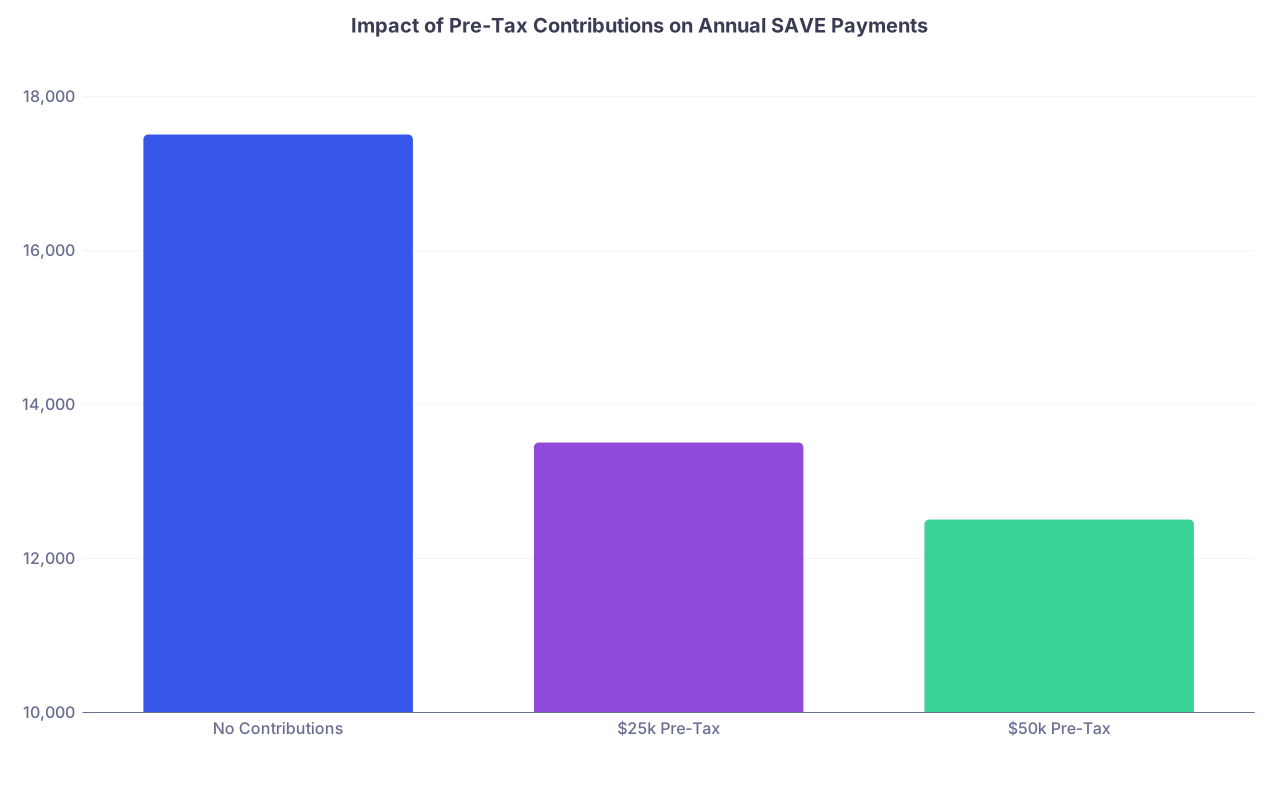
Annual savings: about $5,000. And they just stuffed more than $50k/year into pre‑tax retirement.
For PSLF households, this is the gold standard. You are buying forgiveness by sheltering income.
| Category | Value |
|---|---|
| No Contributions | 17500 |
| $25k Pre-Tax | 13500 |
| $50k Pre-Tax | 12500 |
Numbers are simplified, but the trend is real: more pre‑tax contributions by the borrower, up to the logical limit of your cash flow and risk tolerance, usually equals lower IDR payments.
Lever 2: Aggressive Payoff Using the No‑Debt Partner’s Income
If PSLF is off the table and you decide to refinance privately, now the playbook flips.
Now your goal is:
- Maximize guaranteed returns (debt payoff at 4–6% after-tax),
- While still hitting reasonable retirement and cash reserve targets.
Household plan might look like:
- Emergency fund: 3–6 months of joint expenses first
- Retirement: At least get any match, then consider 20% of gross income to broad retirement goals
- Everything above that: extra payments to highest‑interest loans
The non‑borrowing partner often:
- Covers core living expenses and health insurance,
- So the physician can live “like a resident” for 2–5 years as an attending and shovel $5–10k/month into extra loan payments.
Example: Combined income $400k after residency. Target:
- $80k/year retirement (20% of income, split across available accounts)
- $80k/year for taxes above withholding adjustments
- $150k/year fixed household expenses (mortgage/rent, child care, etc.)
- Leaves ~ $90k/year for debt and additional investing.
If loans total $250k at 4% after refinancing, $90k/year knocks them out in roughly three years. Meanwhile the no‑debt spouse is not stuck indefinitely subsidizing medical school—there is a hard end date.
Lever 3: Asset Protection and “Fairness” Structures
There is an uncomfortable but real question: what if we divorce?
If you are the no‑debt partner, it is not paranoid to think about this. If you are the heavily indebted MD, you should also think about it—because if you rely on your spouse’s cash to pay your loans and the relationship ends, you can be left exposed.
Tools couples actually use (quietly) include:
- Postnuptial agreements that clarify how premarital debt and post‑marital payoff will be treated if they split.
- Keeping certain accounts in individual names (though in many states, ownership title is less important than when and how money was earned).
- Documenting agreements: e.g., if the no‑debt spouse helps pay $150k of loans, that might be acknowledged in a postnup or as an offset in other marital property arrangements.
I am not saying you must do these. I am saying adults talking about six‑figure debts and legal marriage need to treat this like the legal contract it is. Pretending “it will all work out” is amateur.
If your state is community property, this is even more sensitive; debt incurred during the marriage can be community debt. You need a local attorney, not generic internet advice.
6. PSLF vs. Refinance vs. Long‑Term SAVE: How Couples Actually Decide
When only one partner has medical school debt, you effectively have three master strategies. Everything else is just a variation.
| Strategy | Typical Use Case | Time Horizon |
|---|---|---|
| PSLF + SAVE | Nonprofit/academic attending | 10 years |
| Private Refinance | High income, no PSLF, low risk need | 3–10 years |
| Long-term SAVE | Lower income or fee-for-service mix | 20–25 years |
Strategy 1: PSLF + SAVE (Minimize Payments, Maximize Forgiveness)
Best when:
- MD is confident they will spend 10 years in 501(c)(3)/government jobs
- Debt is large relative to income (e.g., 2× income or more)
For couples where only one partner has debt, PSLF households usually:
- File MFS if it produces meaningful IDR savings after tax impact
- Max out borrower’s pre‑tax retirement and HSA
- Keep extra savings in taxable or Roth accounts, not extra loan payments
- Use no‑debt spouse’s income to support lifestyle and long‑term investing while MD’s AGI stays “managed”
Key question for couples: can you honestly see yourselves in PSLF‑qualifying employment for a full decade? If one partner is already itching for a higher‑pay, private practice job in year 4, then the PSLF math will break.
Strategy 2: Private Refinance + Aggressive Payoff (Burn It Down)
Best when:
- MD is in (or planning for) private practice or non‑qualifying employment
- Combined household income is high enough to sustain large payments
- You have adequate emergency fund and disability insurance
The non‑borrowing partner is the difference between barely making payments and actually becoming debt‑free in a reasonable time.
Common pattern:
- Refinance to 5–7 year fixed or variable rate based on risk tolerance
- Live “like a resident” for 2–5 years as an attending
- Use the debt‑free spouse’s lower lifestyle baseline to avoid lifestyle inflation
The risk: job loss, burnout, illness. Once you refinance, federal protections and PSLF are gone. Which is why, again, the legal and insurance side must be in place.
Strategy 3: Long‑Term SAVE With Possible Tax Bomb (Lower Income or Mixed Path)
Best when:
- MD income is modest or highly variable relative to debt
- PSLF is uncertain or frowned upon by your actual career opportunities
- Household cannot or will not support big payments
Here, the couple uses SAVE to keep payments manageable and invests aggressively in parallel, preparing for:
- Either taking advantage of future legislative changes (which do happen), or
- Paying the eventual “tax bomb” on forgiven balances after 20–25 years (for non‑PSLF forgiveness, assuming current law)
The non‑debt spouse’s role here is to build liquid, taxable assets that could, in 20 years, write a check for a very large tax bill if necessary.
7. Housing, Kids, and Other Life Decisions You Will Screw Up If You Ignore the Loans
Let me be blunt: mortgages and childcare costs are where couples blow up otherwise sound loan strategies.
Housing
When only one partner has massive debt, lenders do not care that “it is their loans.” The debt counts against your back‑end DTI for mortgage underwriting. But under IDR, the actual monthly payment can be much lower than the “standard” payment lenders might plug into their formula.
What you should not do:
- Use a rosy, low IDR payment to justify a huge mortgage that assumes both incomes are maximally available forever.
- Forget that the high‑income MD might change jobs, go part‑time, or take an academic pay cut.
What works better:
- Cap your housing at a conservative % of one income (usually the non‑MD income if they are more stable), especially in early attending years.
- Assume loan payments might rise in the future (e.g., as IDR recertifications use higher AGI).
The non‑borrowing partner often pushes for “we can afford more.” The MD often underestimates risk. Reality usually sits somewhere between.
Kids and Childcare
Daycare at $1,800/month plus IDR or refinance payments at $2–3k/month plus a fat mortgage—this is where high‑income couples feel “poor.”
When only one partner has loans, you both need a pre‑kids cash flow plan:
- How will one income vs. two incomes interact with loan repayment?
- If the non‑borrowing spouse wants to go part‑time or stay home, do you still refinance aggressively, or do you keep federal flexibility?
- Does the MD need to carry the financial risk of the household solo for a few years?
Often, the correct answer is:
- Keep loans federal and on SAVE until your family size and childcare situation stabilize.
- Only then decide if refinance and aggressive payoff make sense.
| Category | Value |
|---|---|
| Loan Payments | 2200 |
| Housing | 2800 |
| Childcare | 1800 |
| Retirement Saving | 1500 |
| Other Expenses | 2000 |
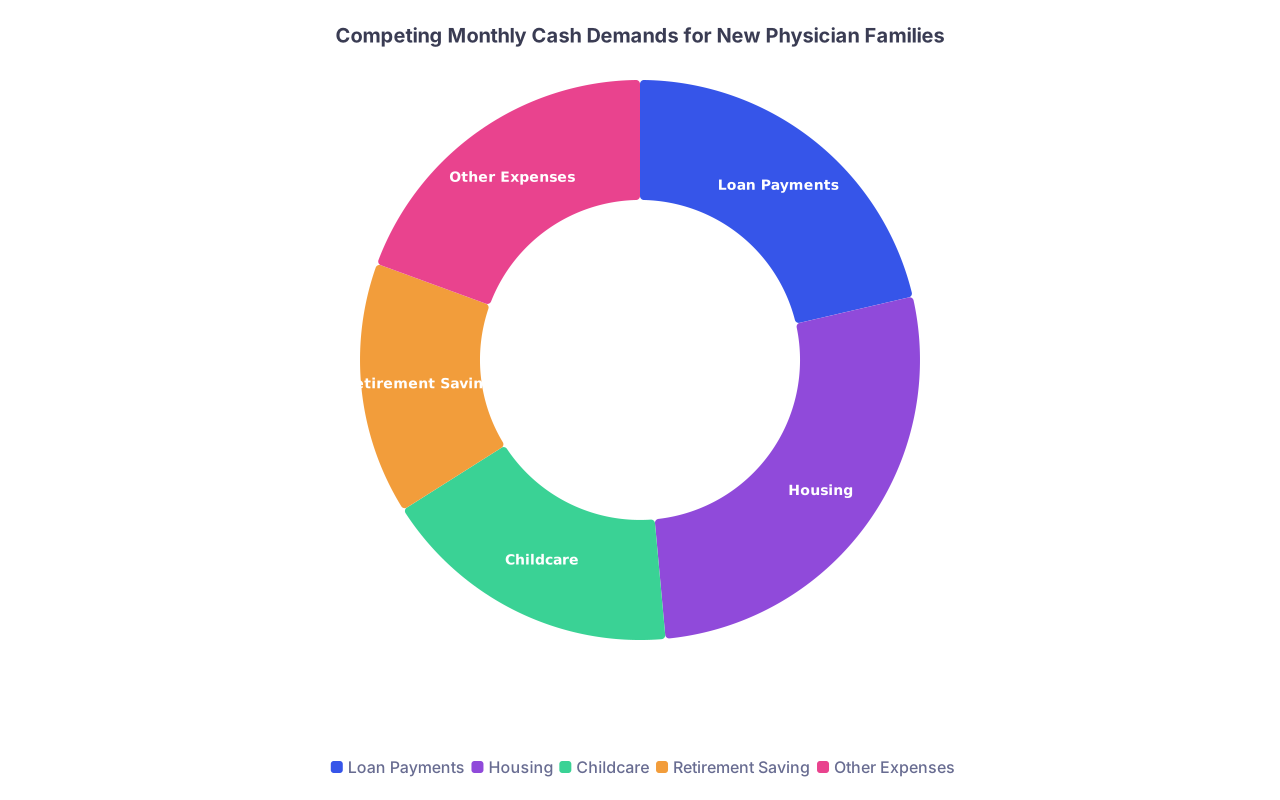
You do not need fancy optimization to see the picture: there is only so much monthly cash. The spouse without loans must be part of the planning, not just “along for the ride.”
8. Process Map: How a Couple Should Actually Approach This
Here is the workflow I would use with you in a planning session.

| Step | Description |
|---|---|
| Step 1 | Gather Loan and Income Data |
| Step 2 | Confirm Employment and PSLF Eligibility |
| Step 3 | Model SAVE with MFJ vs MFS |
| Step 4 | Compare Refinance vs SAVE Long Term |
| Step 5 | Optimize Retirement Contributions |
| Step 6 | Set Aggressive Payoff Plan |
| Step 7 | Plan for Long Term SAVE and Tax Bomb |
| Step 8 | Integrate Housing and Family Plans |
| Step 9 | Review Annually and at Life Changes |
| Step 10 | PSLF Likely? |
| Step 11 | Refinance Chosen? |
Do not skip the “review annually” step. IDR recertification, promotions, job changes, kids, moves between nonprofit and private groups—all of these change the math substantially.
9. Common Pitfalls I Keep Seeing (And How You Avoid Them)
I will keep this blunt and specific.
Refinancing before you actually know your career path.
Resident refinances at PGY‑2 because 4.5% “looks better than 6.8%,” then matches into a 501(c)(3) fellowship and wants PSLF. Too late.
Fix: Keep federal until you are certain PSLF is off the table and risks are manageable.Ignoring MFS because the CPA “does not like it.”
Some accountants reflexively push MFJ because it is simpler and usually tax‑optimal in a vacuum. They do not model IDR payments.
Fix: Work with someone who actually understands student loans, or run the numbers yourself. You are comparing household tax + loan payments, not just tax.Non‑borrower spouse building lifestyle while MD chases forgiveness.
PSLF works best when you deliberately underpay relative to possible income. Blowing the slack on lifestyle instead of retirement or liquid savings is wasted arbitrage.
Fix: Agree that any “PSLF savings” flow to long‑term wealth, not bigger cars.All‑or‑nothing thinking about fairness.
“They took the loans; I will never help” vs. “I am responsible for 100% of their debt now that we are married.” Both extremes cause problems.
Fix: Treat it as joint planning but with explicit agreements and guardrails, potentially written down in a postnup if the numbers are huge.Never running actual repayment projections.
People wing it. “SAVE seems good, we will just do that.” You need a 10‑, 20‑, 25‑year projection under plausible income paths.
Fix: Use a calculator or planner who can model multiple scenarios side by side.
| Category | Value |
|---|---|
| PSLF + SAVE | 180000 |
| Refinance 7 years | 260000 |
| SAVE 25 years with Tax Bomb | 310000 |
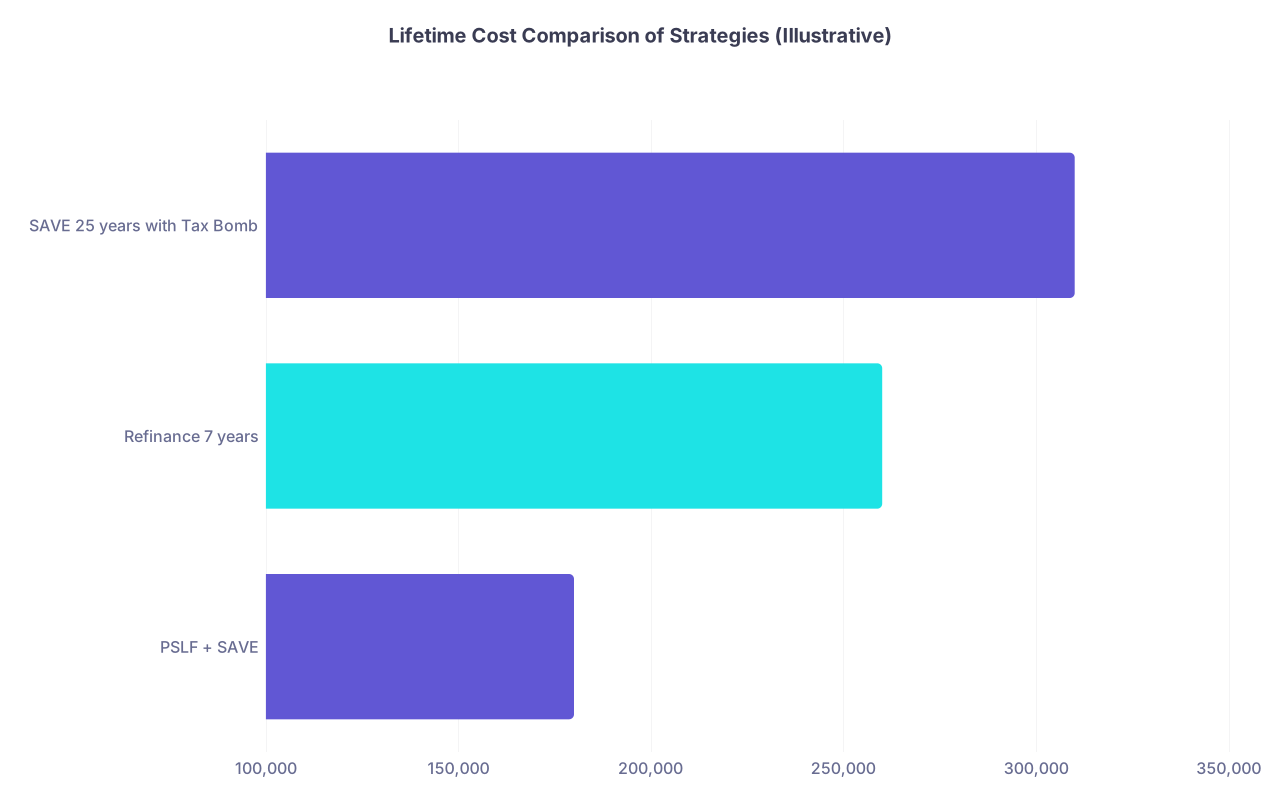
The exact numbers will be unique to your situation. The point is: the spread can easily reach six figures. Guessing is not acceptable for adult professionals.
10. How to Talk About This as a Couple Without Killing Each Other
One last section, because this is where many physician couples silently implode.
You cannot treat student loans like a private shame or a side note to “real life.” If one of you has medical school debt, it is a central part of your joint financial architecture for at least a decade. Maybe two.
Three practical rules:
Schedule explicit “money meetings.”
Once a quarter. Calendar it. You review: loan balance, repayment status, tax strategy, cash flow, and progress toward your agreed goals. 60–90 minutes. Phones down.Name the tradeoffs openly.
“If we refinance and pay $6,000/month, we will not take international vacations for 3 years. If we stay on PSLF, we accept that you will stay in academic medicine at a lower salary.” Do not pretend there is a magical path with no tradeoffs.Let each partner have some optionality.
The non‑borrower should not feel like a financial hostage to med school decisions. The MD should not feel perpetually guilty. You can design a plan with endpoints: “By year 7, loans gone or PSLF complete, then we rebalance priorities.”

11. When to Bring in Professional Help (and What Kind)
There are three professionals who matter here:
- A student loan–literate financial planner (not just anyone with a CFP® who mostly talks about mutual funds)
- A CPA who can model MFJ vs. MFS with community property nuances if relevant
- A family law attorney if you are considering a postnup or live in a state where premarital debts have complex community implications
You want someone who has literally said sentences like:
- “Let me run your SAVE vs. refinance projections under three income scenarios.”
- “Given your combined AGI and credits, MFS costs you about $3,200 extra in federal + state tax, but saves $7,800 in IDR payments, netting ~$4,600.”
- “If we assume 5% portfolio returns and 3% salary growth, PSLF saves you about $95k in present value versus refinancing, but requires you to stay employed at qualifying nonprofits for at least 9 of the next 11 years.”
If you are not hearing that level of specificity, you are not talking to the right expert.

With all of this on the table, here is the bottom line.
When only one partner has medical school debt, that debt is not a side story. It is one of the main characters in your joint financial life. Ignore it, and you stumble into a random combination of tax outcomes, tense conversations, and suboptimal choices that harden into regret.
Treat it explicitly—as family debt with a defined strategy, a modeled timeline, and shared responsibilities—and you can convert what looks like a massive burden into a manageable, even strategic part of your financial plan.
Get the data. Model the options. Decide together whether you are a PSLF household, a refinance‑and‑crush household, or a long‑term SAVE household. Then align tax filing, retirement contributions, housing, and family planning accordingly.
Once you have that foundation, the next step is more interesting: shifting from “How do we survive these loans?” to “How do we build real wealth on top of this, together?” That is where physician couples go from playing defense to playing offense—but that is a story for another day.