
The worst financial mistake new attendings make is treating loan repayment perks like free money instead of contractual obligations.
You are not “getting $200k in loan forgiveness.”
You are selling years of your life and career flexibility. That trade can be smart. Or financially disastrous.
Let me break this down specifically: how to evaluate contractual loan repayment in academic vs community job offers, with the level of detail your contract lawyer should be giving you but usually does not.
1. Start With One Blunt Question: Who Actually Pays Your Loans?
Before comparing academic vs community, you need to understand the three very different beasts lumped under “loan repayment” in job offers:
- Public Service Loan Forgiveness (PSLF) – federal program
- Employer-based loan repayment – written into your employment contract
- Sign‑on bonus disguised as “loan repayment” – looks nice, but functionally cash
If you mix these up, you will misjudge offers by six figures.
| Type | Source | Taxed? | Requires Contract? | Typical Setting |
|---|---|---|---|---|
| PSLF Forgiveness | Federal | No (exempt) | No (employer form) | Academic, many hospitals |
| Employer Loan Repayment | Employer | Usually Yes | Yes (multi‑year) | Academic & community |
| Disguised Sign‑on 'Loan' Bonus | Employer | Yes | Yes (clawback) | Community-heavy |
PSLF: The backdrop
Academic centers and many large nonprofit hospitals qualify as PSLF employers. Community groups may or may not.
With PSLF, your employer does not forgive your loans. The government does. The employer’s role is just:
- Being a qualifying 501(c)(3) or government entity.
- Signing annual employment certification forms.
So if an academic job says: “Great PSLF environment!” that is not a perk. That is just them being eligible. You still need:
- Direct federal loans (or consolidated into Direct)
- 120 qualifying IDR payments
- Full‑time qualifying employment
Academic jobs often support PSLF indirectly by offering:
- Lower pay, which lowers your IDR payments
- Stable full‑time W2 status
- Consistent nonprofit employer status
PSLF is most powerful if:
- You have very high debt (≥ $300k–$400k),
- Your attending income is relatively modest (especially in academics),
- And you are not racing to pay off loans aggressively.
Community jobs that are private for‑profit? PSLF dies instantly, even if they pay more.
Employer loan repayment vs “loan‑labeled” sign‑on
Here is how to separate real loan repayment from fluff:
True employer loan repayment:
- Money goes directly to your loan servicer
- Paid annually or quarterly
- Structured as taxable compensation (sometimes via 127 plan, sometimes not)
- Clearly tied to service years
Loan‑labeled sign‑on bonus:
- You get a lump sum or staged payments
- It is taxed as ordinary income
- It may have a “loan” label but they do not care what you do with it
- You owe it back (or a prorated portion) if you leave early
Do not be impressed by marketing language. Pull the contract clauses and see where the money actually goes and how long they own you.
2. How Academic Offers Typically Handle Loan Repayment
Academic medicine is seductive on paper: PSLF access, “mission‑driven” language, protected time. And often disappointing when you actually run numbers.
Common academic set‑ups
Base salary below community market (sometimes 30–50% lower)
Eligibility for PSLF (major plus if you are deep in debt)
Maybe a modest employer loan repayment benefit:
- $10k–$20k per year
- 3–5 year commitments
- Often capped at $50k–$100k total
Sometimes state‑ or department‑specific programs layered on:
- State loan repayment programs for shortage specialties
- Departmental funds for early‑career faculty
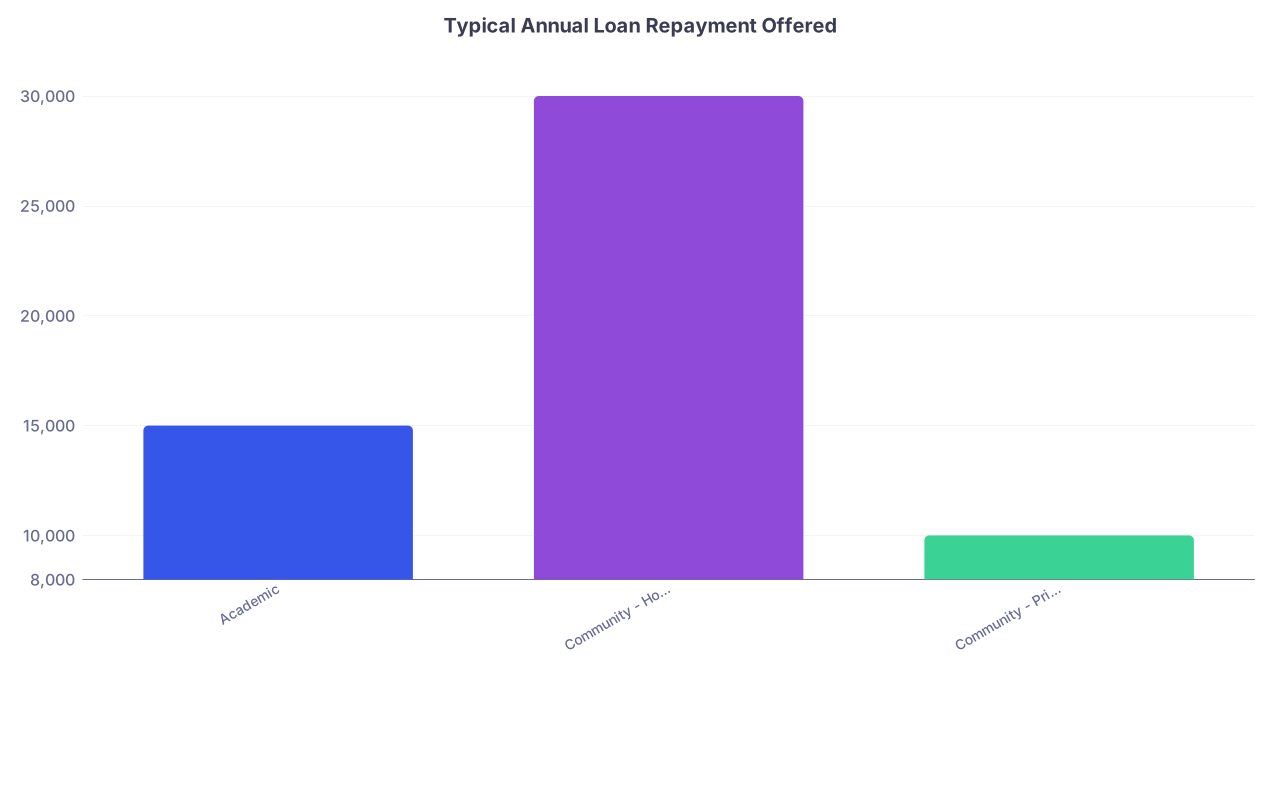
| Category | Value |
|---|---|
| Academic | 15000 |
| Community - Hospital | 30000 |
| Community - Private | 10000 |
These numbers are approximate, but the pattern is real. Academic centers rarely blow you away with direct employer loan repayment. The real kicker is PSLF + lower payments over 10 years.
Where academics win: PSLF plus longevity
Example I see often:
- Debt: $400k at ~7%
- Academic hospitalist job:
- Salary: $220k
- PSLF‑eligible
- IDR payment: maybe ~$1,600–$1,800/month starting
- Employer loan benefit: $10k/year for 5 years
Versus:
- Community hospitalist job (for‑profit group):
- Salary: $320k
- No PSLF
- Aggressive payoff in 7 years: $6k/month or more
Run those two scenarios in a real loan calculator. Over 10 years:
Academic + PSLF:
- Total out‑of‑pocket payments far lower
- Large chunk of principal forgiven tax‑free after 120 payments
- Employer loan benefit essentially accelerates payoff or reduces burden
Community, no PSLF:
- Higher payments
- Total repaid principal + interest frequently exceeds academic track
- But you have higher income now and more cash flow every month
For high‑debt, modestly‑paid specialties (peds, FM, psych, lower‑pay subspecialties), academic + PSLF is often mathematically dominant.
Where I see people screw it up: they take a PSLF‑eligible academic job, then refinance to a private lender in year 2 because the lower interest rate “felt good.” PSLF destroyed instantly. That is a six‑figure unforced error.
Academic contract landmines
Academic offers often look softer, but still have teeth. Watch for:
- “Loan forgiveness” that is really taxable income with service obligation
- Multi‑year commitments with front‑loaded payments (you leave in year 2, but most benefit was in year 5)
- Automatic renewal of obligations when your contract renews or promotion changes rank
You want explicit language:
- Total dollar amount
- Payment schedule
- Where payments go (you or servicer)
- What happens if:
- You go part‑time
- Move to another department within the same institution
- Take an unpaid leave
- Switch from academic track to research or vice versa
I have seen faculty lose future loan perks because they changed FTE or track, with no warning that it would affect eligibility. The policy was in a separate HR document no one read.
3. How Community Offers Play the Loan Game
Community groups know they cannot offer PSLF. So they throw money at you. The trick is understanding how real that money is and what you are giving up.
Three main community patterns
- Straight sign‑on bonus labeled as “loan repayment”
- Structured loan repayment to servicer with multi‑year service obligation
- Hybrid: stipend + relocation + smaller annual “loan” payments
The biggest differences from academic:
- Higher salaries
- Shorter or more aggressive clawback language
- Often practice‑owned or private equity influence, which changes long‑term stability

Example: Community hospitalist with “$200k loan repayment”
Offer language (realistic version I have seen):
- Base salary: $310k
- “Loan repayment”: $50k per year for 4 years
- Payments made as taxable income, not directly to servicer
- 4‑year commitment with prorated repayment if you leave early
What this actually means:
- You are getting $50k/year pre‑tax. After taxes, maybe $30k–$33k.
- The $200k number is marketing.
- If you leave at 2 years:
- You have received ~ $100k gross
- Contract may require you to pay back the unvested portion (often $25k/year left or similar formula)
This is not “loan forgiveness.” This is a retention bonus structure. Fine if you understand that. Expensive if you romanticize it and walk out early.
Real loan repayment vs fake perks
Ask these questions bluntly:
- Is the loan repayment a separate line item from my base salary, or is it just a larger base with a label slapped on?
- Are payments:
- To me, as W2 income?
- Directly to my loan servicer?
- What exactly do I owe back if I leave at:
- 12 months
- 24 months
- 36 months
Get the math in writing. In dollars, not percentages.
You want to see language like:
- “$X per year of loan repayment, paid quarterly, with $Y forgiven for each completed quarter of service.”
- “Repayment obligation will be reduced to zero after Z years of service.”
You do not want:
- “Physician agrees to repay all loan amounts in full if employment terminates prior to completion of five (5) years of service.”
That is a trap for anyone even mildly unsure they will want to stay.
4. Tax, PSLF, and Contract Interaction: Where People Get Burned
Loan perks touch three different regimes: federal tax law, PSLF regulations, and private contract terms. Those three do not care about each other.
You have to mentally layer them.
Tax side: Most employer loan repayment is taxable
Unless the employer is using a qualified educational assistance program (Section 127) with careful structuring — and most are not — any “loan repayment” is ordinary W2 income.
Even Section 127 programs are limited (currently up to $5,250 per year tax‑free through at least 2025; anything above that is taxable). And many hospitals are not bothering to optimize this.
Result:
- That “$30k annual loan repayment” may net you ~$18k–$20k after federal + state + payroll taxes depending on your bracket.
- If they pay your servicer directly, it is still taxable to you. Just invisible until tax time.
PSLF side: Employer payments do not count as “payments” you make
This one catches people off guard.
PSLF cares about:
- Your IDR plan
- The payment amount you make or is due under that plan
- 120 months of qualifying payments
If your employer pays extra money towards principal:
- Great, your balance shrinks faster
- But that does not reduce your required monthly IDR payment going forward unless you recertify with lower AGI (and often your AGI is high from that same job)
So employer loan repayment is financially helpful, but it does not substitute for making 120 PSLF payments.
You still have to:
- Be on IDR
- Make your monthly payments for 10 years
Beware this combo mistake:
- PSLF‑eligible academic job
- Great employer repayment program
- You refinance privately to lower interest and “use” their loan repayment more efficiently
- You have just nuked PSLF
I have actually seen faculty do this on advice from a well‑meaning financial advisor who did not understand PSLF rules. Do not be that cautionary tale.
5. Academic vs Community: How to Actually Compare Offers
You do not compare these jobs by staring at the headline numbers in the recruiter’s email. You compare scenarios.
Step 1: Clarify your debt and trajectory
You need three things on paper:
- Total federal debt, interest rates, and current repayment plan
- Any private/refinanced debt (not PSLF‑eligible)
- Your likely family situation (filing status, future spouse income if known, kids affecting IDR, etc.)
Ballpark thresholds:
- If you owe >2x your expected academic salary and are PSLF‑eligible, PSLF should be seriously in play.
- If your debt is relatively modest (say $120k–$150k) and you can pay it off in 3–5 years with higher community pay, PSLF matters less.
Step 2: Translate each offer into a 10‑year projection
You do not need perfect precision. You need directionally accurate numbers to highlight dominant strategies.
For each offer, sketch:
- Total expected compensation over 10 years (salary + bonuses + loan repayment, after estimating taxes).
- Projected loan payments and forgiveness (PSLF vs no PSLF vs private refinance).
- Net worth at year 10:
- Assets (savings/investments if you live on the same post‑tax income in both scenarios)
- Minus remaining debt
You are comparing: “If I live on $X per month after tax in either job, which path leaves me richer or poorer at year 10?”
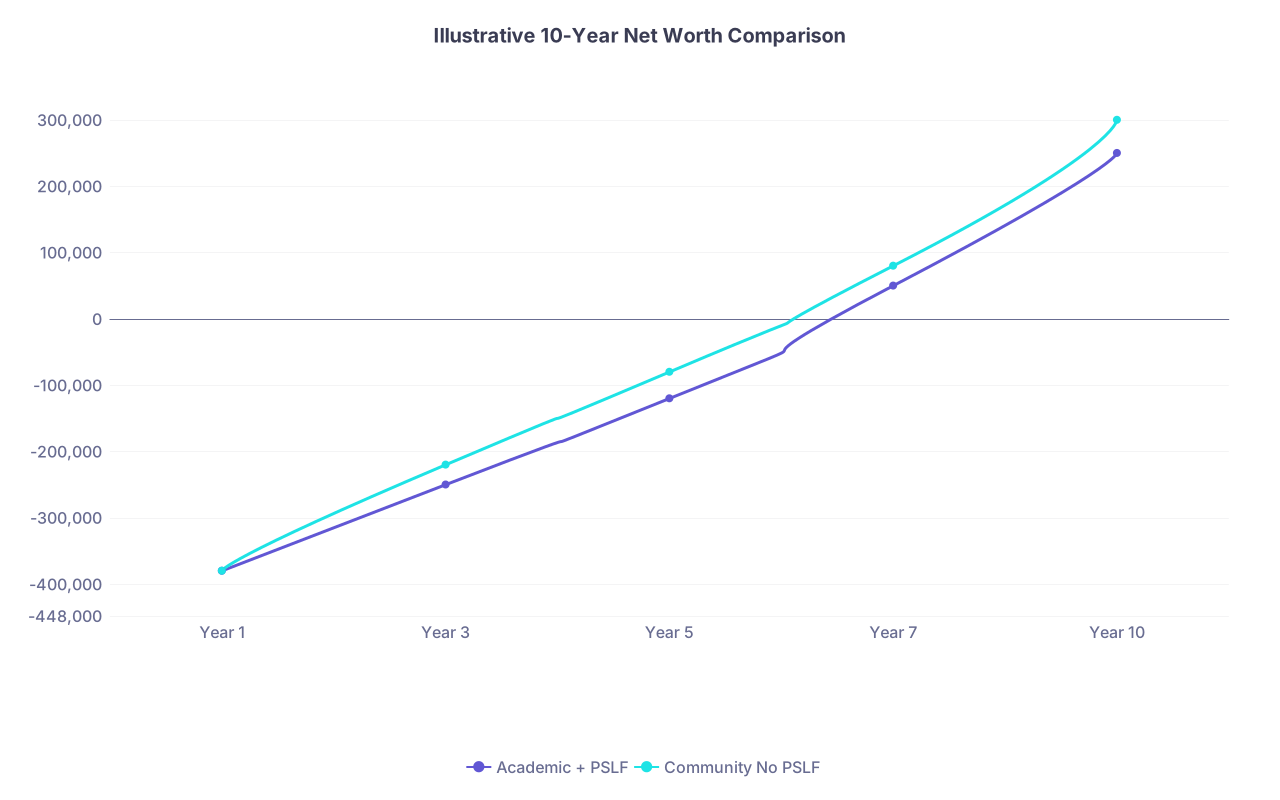
| Category | Academic + PSLF | Community No PSLF |
|---|---|---|
| Year 1 | -380000 | -380000 |
| Year 3 | -250000 | -220000 |
| Year 5 | -120000 | -80000 |
| Year 7 | 50000 | 80000 |
| Year 10 | 250000 | 300000 |
These are generic illustrative numbers, but here is the reality: sometimes PSLF wins. Sometimes community money crushes PSLF. It depends heavily on:
- Debt level
- Salary spread between offers
- How disciplined you are at actually using that higher salary to pay loans and invest (and not just inflate your lifestyle)
Step 3: Layer qualitative risk
Hard truth: Contracts are not forever. Employers change. Admins flip. Private equity shows up.
You need to ask:
- How likely is it that I actually stay the full service period tied to the loan benefits?
- How stable is this institution or group?
- How tolerable is the schedule and culture?
If a community group offers “$200k in loan repayment” but everyone leaves by year 3 because the schedule is brutal, how much is that really worth?
If your academic department is constantly losing faculty, your odds of quietly completing 10 PSLF years there might be lower than you think.
6. Concrete Red Flags and Green Flags in Contract Language
This is where I start circling sentences in red ink.
Red flags — walk away or renegotiate
- “Repayment of all loan assistance upon termination for any reason prior to [X] years.”
- No clear total dollar amount cap for loan repayment.
- Vague language: “Employer may provide loan forgiveness at its discretion.”
- Loan repayment tied to metrics you cannot control (RVUs in a department with poor staffing, unreasonably high panel expectations, etc.).
- For PSLF‑reliant paths: institution not willing to sign PSLF employer certification forms or HR clueless about PSLF status.
Green flags — these actually protect you
- Clearly prorated vesting schedule (e.g., 25% of loan benefit forgiven per completed year of service).
- Separate addendum for loan repayment detailing:
- Annual amount
- Payment timing
- Destination (you vs servicer)
- Tax treatment (at least acknowledged)
- Carve‑outs where repayment is waived:
- Employer breach of contract
- Significant relocation of worksite
- Major schedule change without your consent

If you see red flag language tied to six‑figure dollar amounts, you pay a physician contract attorney a few hundred bucks to review. That is non‑negotiable. The people who “save” that money routinely lose tens of thousands.
7. Special Cases: State, NHSC, and Hospital-Backed Programs
Academic vs community is not the whole story. Some offers piggyback on external programs:
- National Health Service Corps (NHSC)
- State loan repayment programs
- Hospital‑funded rural or shortage area incentives
These can show up in both academic and community settings.
Key questions:
- Who is the actual counterparty? You and the state? You and NHSC? You and the hospital?
- If your employment ends but the hospital keeps its designation, who is on the hook?
- Do these interact with PSLF or conflict with it?
Many of these programs:
- Pay loan servicers directly
- Have federal or state clawback rules independent of your employment contract
- Can coexist with PSLF (you get both), but timing and eligibility matter
You want written clarity from both:
- The employer
- The program administrator (NHSC, state office, etc.)
Do not assume HR understands all the moving parts. They often do not.
8. Decision Framework: When Academic Wins vs When Community Wins
I am going to generalize, because you need starting points.
Academic + PSLF + modest employer repayment usually wins when:
- Debt is very high: >$300k–$400k
- Specialty is lower‑pay or academic pay gap vs community is huge (peds, FM, psych, some IM subspecialties)
- You can tolerate 10 years in PSLF‑eligible roles reasonably well
- You are not tempted to refinance
Community with large loan repayment and high salary usually wins when:
- Debt is moderate relative to income (e.g., $150k–$250k and you can pay it off in <7 years)
- Specialty is well‑compensated in community (EM, anesthesia, ortho, GI, etc.)
- PSLF path would require big pay cut and does not wipe out a massive balance
- You are disciplined about using extra income to brutally pay off debt and invest
The wrong combo is common:
- Modest debt, academic job “for PSLF,” 10 years of artificially low pay, and the forgiven amount is trivial compared to the income you sacrificed.
- Huge debt, community job with okay “loan perks,” you refuse PSLF, refinance, and then never actually pay aggressively — ending up paying more over longer time with no forgiveness.

| Step | Description |
|---|---|
| Step 1 | High Debt > 300k |
| Step 2 | Model PSLF 10 Years |
| Step 3 | Model Aggressive Payoff |
| Step 4 | Moderate Debt < 250k |
| Step 5 | Community Likely Better |
| Step 6 | Compare PSLF vs Standard |
| Step 7 | PSLF Eligible Offer? |
| Step 8 | Community Pay Much Higher? |
This is the mental tree you should actually be running.
9. How to Negotiate Loan Repayment Terms (Without Being Annoying)
You have more leverage on structure than on raw dollars.
Things worth pushing on:
- Prorated forgiveness: “Can we structure this so that a quarter of the amount is forgiven for each year completed, rather than all‑or‑nothing at the end of year four?”
- Destination of payments: “Can these go directly to my loan servicer and be documented as employer loan repayment?”
- Clarity on triggers: “Can we specify that if my FTE is reduced at employer request, it does not trigger repayment?”
- Timing: “Instead of a lump sum in year 3, can we spread this evenly over each year to reduce my risk if circumstances change?”
You are not asking them to change their philosophy. You are asking them to share risk more evenly. Reasonable employers — academic or community — will often move at least a little.
10. Pulling It Together
At the end of the day, you are comparing two bundles:
- Compensation
- Loan treatment
- Risk and flexibility
Academic and community environments each have patterns, but individual contracts vary wildly. I have seen community hospitals with excellent, fair loan repayment structures and academic centers with opaque, borderline exploitative terms. And vice versa.
You will make a smarter decision than your peers if you:
- Read the actual loan clauses.
- Build two or three 10‑year scenarios on paper — not in your head.
- Assume your future self might want to leave earlier than you think.

Key points to remember:
- “Loan repayment” in a contract is usually taxable compensation tied to a service obligation, not magic forgiveness. Read the exact clawback and vesting language.
- Academic vs community is really PSLF‑eligible vs higher pay; run 10‑year numbers to see which produces higher net worth given your specific debt and discipline.
- Structure matters more than headline amounts: prorated forgiveness, direct‑to‑servicer payments, and clear exceptions protect you far more than an extra $10k dangled in marketing language.