
The worst thing you can do with a physician signing bonus is treat it like free money.
You either weaponize that bonus against your student loans, or it quietly evaporates into taxes and lifestyle creep. There is no middle ground.
Let me break down exactly how to structure, negotiate, and deploy a signing bonus so it actually moves the needle on your loan balance—especially in the first 1–3 years when compounding either starts working for you or continues crushing you.
1. First principles: what a signing bonus really is (and is not)
A signing bonus is not a gift. It is:
- Taxable W‑2 income in the year paid
- An advance on your future labor
- Often tied to a repayment obligation if you leave early
Most young physicians misunderstand two core points:
- The “$50,000 bonus” in your offer letter is not $50,000 in your checking account.
- How and when that bonus is paid matters almost as much as the headline number.
Signing bonuses usually show up in one of a few structures:
- Lump-sum at the start date
- Split payments (e.g., half at start, half at 12 months)
- Monthly or quarterly “sign-on installments” over 1–3 years
- “Forgivable loan” that is paid up front and then forgiven over time
The last one is where people get burned if they do not read the fine print.
Typical tax reality
In a standard W‑2 employed setting:
- A $50,000 signing bonus will be taxed as supplemental wages
- Many employers withhold ~22–30% federal, plus state, plus FICA
- Your actual take-home may be closer to $30,000–$35,000
You need to plan your loan strategy around the after-tax number, not the shiny pre-tax marketing line.
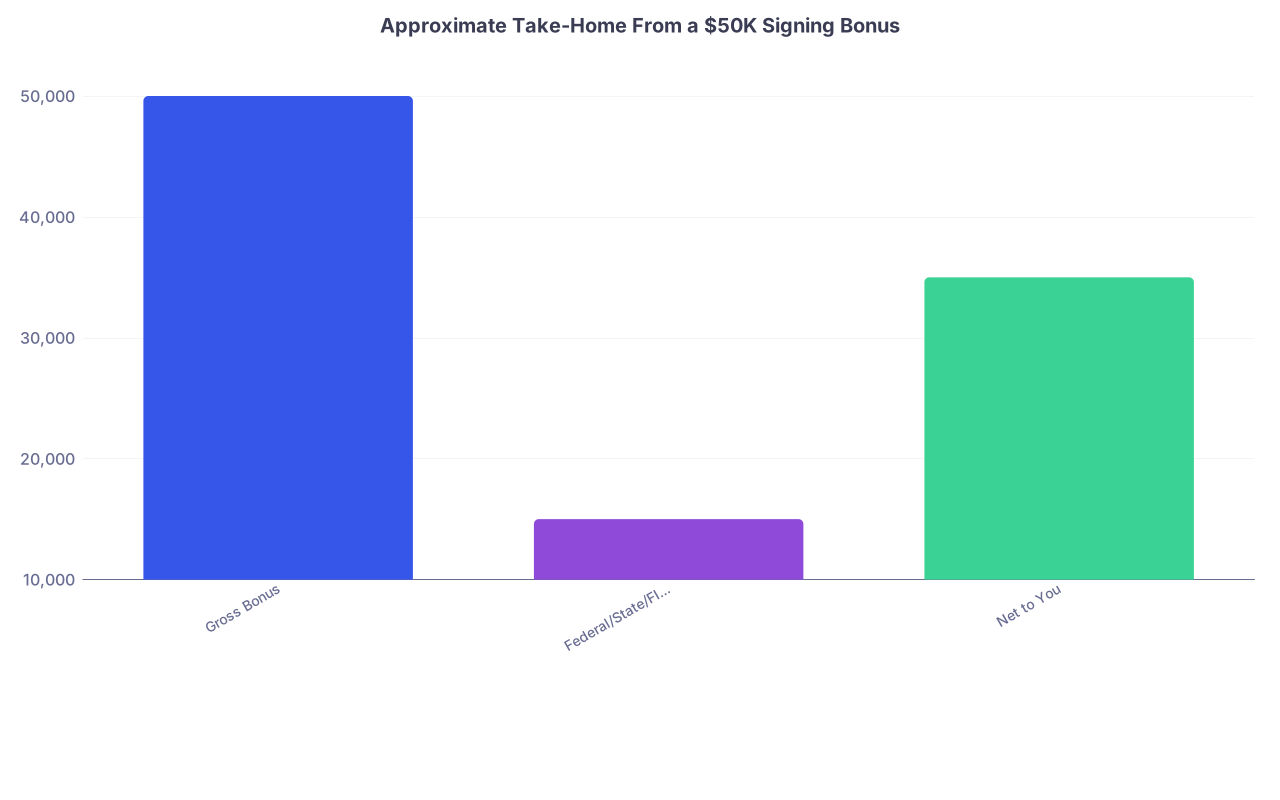
| Category | Value |
|---|---|
| Gross Bonus | 50000 |
| Federal/State/FICA Tax | 15000 |
| Net to You | 35000 |
2. Know your loan ecosystem before you touch the bonus
If you deploy a signing bonus without first mapping your loan landscape, you are guessing.
You must know, in writing:
- Federal vs private balances
- Interest rates (by loan group)
- Repayment plan (IDR, standard, private refi, etc.)
- Whether you are pursuing forgiveness (PSLF or IDR) or not
- Your anticipated attending income and spouse income (if any)
Here is the key split that changes everything:
- If you are pursuing PSLF or long-term federal forgiveness → aggressive lump-sum paydown is often a bad move.
- If you are not pursuing forgiveness and have high-rate private or refi loans → bonus-directed paydown can be extremely powerful, especially early.
| Loan Path | Best Use of Signing Bonus |
|---|---|
| PSLF track (federal) | Build cash buffer, retirement, small targeted paydown |
| IDR with long-term forgiveness | Similar to PSLF, focus on savings/investing |
| Private loans >7% | Aggressive principal paydown |
| Recently refinanced 4–6% | Balanced: some paydown, some savings |
| Mixed federal + private | Attack private first, protect federal flexibility |
If you tell me:
- $280K federal loans, PSLF-eligible job at a 501(c)(3), on REPAYE/SAVE
- $70K private loan at 9% from med school
- $50K signing bonus in an employed hospitalist job
I do not need a spreadsheet to tell you: PSLF-eligible loans should mostly be left alone; the 9% private loan is the first target.
3. The structure of the bonus matters more than you think
Most physicians accept the default structure in the offer letter. That is lazy and expensive.
There are four main levers you can negotiate:
- Timing of payment
- Form of payment (bonus vs forgivable loan)
- Installment vs lump sum
- Clawback terms
3.1 Lump-sum vs installments for loan paydown
For loan targeting, a lump sum early in your contract is usually better than installments. Why?
- Loans accrue interest daily
- Early principal reduction reduces total lifetime interest
- You control the cash strategically instead of waiting on the employer’s schedule
That said, there are exceptions:
- If your job stability is questionable and the clawback is harsh, slow installments can actually be safer.
- If the bonus is structured as a forgivable loan that gets written down monthly, that is effectively a hidden salary bump, not a lump-sum.
3.2 Beware “forgivable loan” signing bonuses
Common structure:
- Employer “loans” you $100,000 at the start
- For every month you stay, 1/36th (for a 3-year commitment) is forgiven
- Leave early, and the unforgiven portion is due back, often immediately
This looks good until someone wants to leave at 18 months with a toxic group.
If you must take this structure, you design your loan paydown accordingly:
- Do not throw the entire $100K at your student loans on day one.
- Keep a solid chunk in a separate high-yield savings account as a “clawback fund.”
- Only redirect portions to loans as more of the bonus is actually forgiven.
If you do not, and you leave early, you can end up borrowing at credit card rates to repay the unforgiven “bonus” that you already sent to FedLoan.
4. Tax-smart structuring: do not hand extra money to the IRS
You cannot make a tax-free signing bonus. But you can decide whether that bonus is:
- Regular W‑2 signing bonus income, or
- Spread into your base compensation (higher RVU rate, higher salary, relocation reimbursements, etc.)
Sometimes the smartest “signing bonus” structure is: remove the bonus and increase the base.
4.1 Bonus vs base for loan strategy
For many employed physicians, a signing bonus is just front-loaded W‑2 income. If your marginal tax rate is already high, then:
- A $40K bump in base salary spread over 12 months may not hurt as much psychologically
- But a $40K “bonus” that gets taxed and partially blown on lifestyle will not change your loans
If you are disciplined and explicitly earmark a bonus for loans, lump sum can be excellent. If you are not, trading that bonus for higher base pay might be safer, because it raises your ongoing income to support higher monthly loan payments.
5. Concrete structures that maximize loan paydown impact
Now let us get specific. I will walk through actual structures I have seen residents/attendings use effectively.
5.1 Scenario A: Non-PSLF, big private loans, large bonus, stable job
Facts:
- $300K total loans: $150K federal at ~6.5%, $150K private at 8.5%
- No PSLF eligibility, working in private practice group
- $75K true lump-sum signing bonus, paid 60 days after start
- Plan to refinance all loans after 6 months of attending income
Recommended structure:
Before bonus hits
- Build a minimal emergency fund (e.g., $5–10K) from residency savings or early attending income.
- Get quotes for refinance but wait until you have attending pay stubs.
When bonus hits (say $75K gross, ~$50K net)
- Immediately carve out a clawback buffer equal to any potential repayment obligation (if terms say you owe it back if you leave in 2 years, set aside at least half in savings, more if risk is high).
- From the remainder, direct the bulk to the highest-rate private loans.
After refinance
- If you refinance private loans down to ~4–5%, then new bonus-driven lump sum payments have less raw interest arbitrage. Still helpful, but emergency fund and retirement start to compete more strongly.
Effect on interest:
Paying $30–40K of private principal in month 2 instead of dribbling it out over three years can easily save many thousands in interest, especially if you do it before a refinance (since you are knocking down the highest-rate debt early).
5.2 Scenario B: PSLF-eligible, mostly federal loans, moderate bonus
Facts:
- $350K federal loans, all Direct, average rate 6.3%
- Employed at large nonprofit hospital, clearly PSLF-eligible
- On SAVE or PAYE, planning the full 10-year PSLF path
- $40K signing bonus, paid as a forgivable loan over 3 years
Here, aggressive paydown is usually a mistake.
Structure:
- Treat PSLF-eligible loans as a tax-advantaged liability. You are trying to maximize forgiveness, not eliminate principal.
- Use the signing bonus to:
- Build a 3–6 month emergency fund
- Maximize pre-tax retirement (401(k)/403(b), 457(b) if appropriate)
- Maybe pay down any non-PSLF-eligible debt (credit cards, car loans, high-rate private loans if any)
For the forgivable loan component:
- Track exactly how much is forgiven each year
- As more of the “bonus” is permanently yours, you can direct a portion to small discretionary prepayments on loans if you really want, but that is usually marginal benefit at best given PSLF.
Where people screw up here: they get PSLF-eligible, then feel “responsible” and dump their entire signing bonus into federal loans. That often backfires when a job change, family event, or burnout forces them out of the PSLF path after 4–5 years.
6. Loan mechanics that amplify your bonus impact
If you are going to throw tens of thousands of dollars at your loans, do it correctly. The servicers will not optimize this for you.
6.1 Target the right loans first
Basic order (for non-PSLF borrowers):
- High-rate private loans (especially >7–8%)
- Remaining private loans
- Refi’d loans, depending on rate
- Federal loans not on forgiveness paths
- PSLF-targeted federal loans last
Within a single servicer, ask them to:
- Apply extra payments to the highest interest rate loan group first
- Apply extra as principal-only, not as a prepayment of future installments
You usually must specify this in writing or via online instructions, otherwise they will simply push your next due date forward and neutralize some of the benefit.
6.2 Timing of payments within the month
Interest accrues daily on your principal balance. For lump sums, two practical points:
- Making the big payment right after your usual monthly payment can maximize principal impact (interest for the month has posted, and your entire bonus now hits principal).
- Some servicers amortize oddly—always confirm on the next statement that the majority went to principal and not just paying “projected” interest.
For those aggressively refinancing and paying down:
- One large annual or semiannual lump sum (from bonus) + strong monthly payments often beats trying to micromanage weekly payments.
7. Negotiating and redesigning the bonus to serve your loan plan
You are not obligated to accept the first draft of the contract.
Physicians routinely leave $10–30K of effective value on the table by focusing only on the face value and not the structure.
Here are specific negotiation levers that directly improve loan paydown potential:
7.1 Ask for earlier access to funds
Instead of:
- $50K paid after 12 months employment
Ask for:
- $25K at start date, $25K at 12 months
Rationale: You get half the money a year earlier, use it for immediate principal reduction, and still have some retention incentive for the employer.
7.2 Convert silly “relocation” games into usable cash
Some groups love to split money into:
- $10K relocation reimbursement
- $30K signing bonus
- $10K “loan repayment” paid to your servicer
You can often restructure:
- Increase signing bonus or loan repayment pool, simplify documentation
- Or negotiate the “loan repayment” to be paid as cash to you (some employers insist on sending directly to lender—fine, as long as you can direct which loans).
7.3 Replace part of the bonus with direct loan repayment
A number of hospital systems offer formal loan repayment programs on top of or instead of a signing bonus. That can look like:
- $20K per year for 3 years paid directly to your loan servicer
- Often restricted to student loan debt only
This structure has pros and cons:
Pros:
- Encourages steady principal reduction
- Sometimes more politically acceptable to admin than a giant cash bonus
- Clearly earmarked for loans → less temptation to spend
Cons:
- You do not control exact timing as well
- If you are PSLF-bound, this can reduce forgiveness and make less sense
This is where you must connect the dots: PSLF + heavy direct loan repayment from employer can be self-defeating. But if you are non-PSLF with ugly private loans, this kind of structured employer repayment is basically free yield.
8. Sample structures: what I’d actually do in common real-world situations
Let me lay out three realistic sample plans. Assume marginal tax rate ~35% combined.
Case 1: New EM attending, rural contract, $100K bonus
- Loans: $400K mixed, $200K federal at 6.8%, $200K private at 8.25%
- No PSLF, independent contractor soon after, practice seems stable, 3-year commitment
If the $100K is a true lump sum, clawback only if leaving before 3 years:
- Expect ~$65K net.
- Reserve $25–30K in a separate savings account as a clawback safety and partial emergency fund.
- Drop $35–40K immediately onto the 8.25% private loans.
- Over next 12–18 months, as confidence in the job rises, slowly move more of the reserved cash to the same high-rate loans.
Long-term benefit: this one move can save five figures in lifetime interest.
Case 2: Academic hospitalist, PSLF path, $25K bonus
- Loans: $300K federal only, on SAVE, near-certain PSLF path
- $25K signing bonus, paid as $12.5K at hire, $12.5K at year 1
If someone in this position tells me they want to throw the entire $25K at loans, I push back hard.
Better structure:
Use first $12.5K:
- Build $8–10K emergency fund.
- Put remaining $2.5–4.5K into Roth IRA (if eligible) or 403(b).
Use second $12.5K similarly, maybe add small lump sum to any non-PSLF eligible debt (cars, credit cards).
Net effect: PSLF is preserved; financial resilience and net worth actually grow instead of pumping extra money into a balance that is likely to be forgiven.
Case 3: Mixed loans, community hospital, $60K bonus as forgivable loan
- Loans: $250K federal, $50K private at 10%
- $60K “signing bonus” paid day one as forgivable over 4 years
I have seen people mistakenly throw the full $60K at loans immediately. Then hate themselves at 18 months when they leave and owe back $37.5K.
Smarter sequence:
- Net after tax maybe ~$39K.
- Park all of it in high-yield savings initially. This is your “employer risk fund.”
- Each year as 25% of the bonus is forgiven (~$9.75K real after tax), you can safely peel off $8–9K and throw it at the 10% private loan.
- Within a couple years that 10% loan is gone, but if the job goes bad early, you can repay the unforgiven portion without going further into debt.
Not as sexy as hammering loans on day one, but it prevents the “trapped by clawback” nightmare.
9. Turn the bonus into a system, not a one-off event
The last piece people miss: a signing bonus works best when it is the first move in a larger system, not a one-time splash.
What that looks like:
- Year 0: Use signing bonus to kill or shrink highest-rate loans, build an emergency fund, and protect against clawback.
- Year 1–2: As income stabilizes, refinance if appropriate, and redirect the monthly cash flow you freed up into:
- Higher fixed monthly loan payments
- Maxing retirement accounts
- Investment accounts once loans are at reasonable rates
Your goal is that, three years in, you are not still mentally living off that bonus. The bonus should have bought you:
- Lower total loan balance
- Lower required payment (or faster payoff date)
- Increased resilience
- And a structure where even if every future bonus disappeared, your loan trajectory is still solid

| Step | Description |
|---|---|
| Step 1 | Signing Bonus Offer |
| Step 2 | Check loan path PSLF or not |
| Step 3 | Prioritize savings and retirement |
| Step 4 | Identify highest rate loans |
| Step 5 | Review clawback terms |
| Step 6 | Hold bonus in savings reserve |
| Step 7 | Apply lump sum to high rate principal |
| Step 8 | Emergency fund then investing |
| Step 9 | Refinance if appropriate |
| Step 10 | Gradual paydown as bonus forgiven |
FAQ (4 questions)
1. Should I ever use a signing bonus for a house down payment instead of loan payoff?
Yes, sometimes. If you are stable in a region, not doing PSLF, and have very high rent, using part of the bonus as a down payment can be rational. But only after you have: (a) a basic emergency fund, and (b) a clear plan for your highest-rate loans. I see too many new attendings stretch into a big home, then feel “stuck” with large mortgages and sluggish loan progress. If you do it, keep the house modest and the student loan plan aggressive.
2. Can I ask an employer to pay my student loans directly instead of a signing bonus?
Yes, and some will. Many systems already have HR processes for “student loan repayment assistance.” You can propose converting some or all of the signing bonus into a structured loan repayment program. Just remember: for PSLF-bound physicians, this can reduce eventual forgiveness, and the tax treatment is usually still W‑2 income to you, even if paid straight to the servicer.
3. How much of my signing bonus should I keep in cash for a clawback risk?
If the bonus is structured as a forgivable loan with a multi-year commitment, a conservative rule is: keep at least the percentage that is not yet forgiven. Early on, that can be 75–100%. As each year passes and more is forgiven, you can safely redirect that portion to loans or investments. If the clawback is mild (e.g., prorated over time, long notice period, stable job), you can be more aggressive. But never ignore clawback language; people lose sleep and money over this.
4. Is it ever smart to delay refinancing until after using my signing bonus?
Yes. If you currently carry very high private rates (9–10%+) and are about to receive a large signing bonus, it can make sense to hammer down the principal at the higher rate first, then refinance the smaller balance at a lower rate. That way you maximize interest savings on the worst-rate dollars. The tradeoff is that you temporarily carry those higher rates a bit longer. I usually weigh: expected size and timing of the bonus, current vs potential refinance rates, and your job security.
Key points:
- Do not let the structure of the signing bonus (forgivable loans, delayed payments, clawbacks) blindside you; redesign it where you can.
- Align the bonus with your actual loan path: PSLF and forgiveness strategies often favor saving and investing, while non-PSLF with high-rate loans favors aggressive principal reduction.
- Treat the signing bonus as the opening move in a multi-year system, not a one-off windfall, and you will feel the impact long after the direct deposit disappears.