
The contract you’re about to sign can silently blow up a decade of student loan planning—and nobody at your new job is going to warn you.
I’ve watched new attendings walk into my office in tears because a single line in their contract nuked Public Service Loan Forgiveness eligibility, triggered a five‑figure bonus clawback, or forced them into a tax bomb they didn’t see coming. HR shrugged. The recruiter said “that’s standard.” The lawyer they used never asked a single question about loans.
Let me walk you through what actually wrecks young doctors’ loan payoff plans—because it’s almost never the stuff you’re obsessing over.
The Big Lie: “It’s Just a Job Contract, Not a Loan Document”
Here’s the ugly truth: most physician employment contracts are written as if you have no loans, no PSLF strategy, and no clue about how income‑driven repayment works. And most hospital lawyers prefer it that way.
On paper, it’s an agreement for your time and services.
In reality, it controls:
- What counts as your qualifying “full‑time” work for PSLF
- How your income is structured (and what your servicer sees)
- Whether you can stay in a qualifying job long enough to actually hit 120 payments
- Whether you’re forced into geography or hours that sabotage your loan plan
The contract doesn’t mention PSLF or IDR anywhere. But the structure buries landmines that blow them up anyway.
Here’s the pattern I see over and over:
A resident finishes training with a PSLF plan in motion. 4–7 years of qualifying payments already done. They sign their first attending contract at a “nonprofit” hospital, assume they’re safe, and then three years later find out that:
- The entity on their W‑2 isn’t PSLF‑eligible
- They weren’t actually full‑time as defined by PSLF
- Their “independent contractor” status disqualifies everything
The loan servicer will happily accept your payment for ten years. They will not tell you you’re in the wrong job until you apply for forgiveness and get denied.
By then? Too late.
Clause #1: The Employer That Looks Nonprofit But Isn’t
This is the quiet killer for PSLF applicants.
You match or sign with “Big Regional Health” that markets itself everywhere as a nonprofit, mission‑driven system. You see 501(c)(3) in their hospital literature. You assume you’re fine.
Then your contract arrives, and the employer line says something like:
“You will be employed by Regional Physician Services, LLC”
or
“This agreement is between you and HealthyLife Medical Group, Inc.”
That little LLC or Inc is the problem.
Many large nonprofit systems run their physician groups as separate, for‑profit subsidiaries. Those entities do not qualify for PSLF, even though you’re working in the same building with the same badge, seeing the same patients as hospital‑employed colleagues who are qualifying.
I’ve sat in PSLF denial appeals where the doctor says, “But I work at St. __________, it’s a nonprofit.”
And FedLoan/MOHELA responds: “Your W‑2 lists XYZ Medical Group, LLC. That entity is not a qualifying employer.”
They don’t care about the logo on your coat. They care about the EIN on your tax forms.
So what do you actually do before signing?
You confirm three things in writing:
- The legal name of the entity that will appear on your W‑2
- Whether that entity is:
- a government organization, or
- a 501(c)(3) tax‑exempt organization
- Whether HR/legal will sign the PSLF Employment Certification Form using that exact entity
If they hedge or say “the system is nonprofit but the group itself isn’t technically,” and you’re counting on PSLF? That’s a dealbreaker. Or at least a massive renegotiation point.
I’ve seen smart residents ask for—and get—reassignment on paper to the hospital entity instead of the for‑profit group, with no change in duties. But only because they asked before signing. After you join? Forget it.
Clause #2: The “Full‑Time” Definition That Isn’t PSLF Full‑Time
PSLF does not care what your contract calls “full‑time.”
PSLF has its own rule: you must work at least 30 hours per week on average OR meet your employer’s full‑time standard, whichever is greater. Many of you assume 0.8 FTE or 0.9 FTE is fine as long as your employer says it’s full‑time for benefits.
I’ve reviewed contracts where:
- Full‑time is defined as 36 patient‑contact hours, explicitly excluding admin, charting, and call
- “Part‑time” 0.8 FTE is 28 hours of clinic but with heavy call
- FTE is defined in RVUs, not hours—0.7 FTE clinically but 60+ hours a week in reality
If PSLF audits you, they don’t want “this feels full‑time.” They want clean math.
I’ve watched PSLF forms come back flagged because HR entered 0.8 FTE under “Average hours per week: 24–28.” That’s under 30. That’s non‑qualifying. Years missed.
You want the contract to do two things:
- Define full‑time in a way that clearly meets or exceeds 30 hours/week of combined clinical, admin, and required meetings
- Make your FTE percentage unambiguous if it’s less than 1.0
A better clause looks like:
“Full‑time employment is defined as a minimum average of 32 hours per week of combined direct patient care, administrative duties, required meetings, and on‑call responsibilities.”
And if you’re intentionally going 0.8 for lifestyle reasons but still want PSLF, you need explicit language that your 0.8 role still meets 30 hours/week. I don’t care if your mentor said “everyone does 4 days and gets PSLF.” If HR writes “0.8 FTE – 24 hours weekly” on your PSLF form, that’s what counts.
Do you have to say the word “PSLF” in your contract? No. But your definition of hours better line up with it whether they realize it or not.
Clause #3: “Professional Services Agreement” That Makes You a Non‑Employee
This is the scammy one.
You think you’re being employed by the hospital. What you’re actually signing is a professional services agreement as an “independent contractor” or “1099 physician.”
Your recruiter will pitch it as “more flexibility” or “higher take‑home pay.” What they’re not telling you: independent contractors do not qualify as employees for PSLF. Period.
Key red flags buried in the contract:
- Language like “Contractor,” “Independent Contractor,” “You are not an employee of Hospital X”
- Payment by 1099 with no W‑2, no benefits, no employer FICA contribution
- Requirements that you pay your own malpractice (even if they reimburse later)
I saw a hospitalist who had done 9 years of qualifying PSLF payments during residency and fellowship. He joined a “hospitalist group” that worked exclusively at a nonprofit hospital. The group was a private 1099 arrangement. He assumed he was safe because the hospital was nonprofit and his badge said their name.
PSLF denial letter at year 10: every single attending year thrown out. Zero qualifying payments. He had been paying under REPAYE the entire time.
Do not let “you work at a nonprofit hospital” lull you into ignoring the status language. PSLF is about your employer type, not your worksite.
If the job you love only comes as 1099 and you’re fine abandoning PSLF, that’s a separate decision. But you should know you’re doing it. Not discover it a decade later.
Clause #4: Income Structuring That Wrecks IDR Strategy and Taxes
This one is more subtle and it burns the “I’m going to refinance and pay this off in 5 years” crowd.
Your contract tells you how you’ll be paid:
- Base salary
- Productivity bonus (RVU or collections‑based)
- Sign‑on bonus
- Relocation allowance
- Quality or citizenship bonuses
Those pieces matter a lot for how your real income shows up on your tax return—which is what your loan servicer uses to calculate income‑driven repayment.
Two common problems:
1. Massive front‑loaded income spike
I watched one cardiology fellow step into a deal like this:
- $275k base
- $75k sign‑on
- $40k “loan repayment” stipend per year
- $15k relocation
Year 1 taxable income: closer to $400k than $275k. Which meant:
- His IDR payments jumped dramatically after his first tax return
- His plan to aggressively overpay loans while “keeping IDR low” was dead on arrival
- His withholdings were wrong, he owed a tax bill on top of giant loan payments
You want to see how every “bonus” and “loan repayment” item is reported:
- As W‑2 taxable income?
- On what schedule (paid out over time vs lump sum)?
- With or without specific repayment obligations (clawbacks)?
That last one leads directly to the next trap.
2. “Loan Repayment Assistance” That’s Really a Tax Time Bomb
Hospitals love to advertise “$150,000 in loan repayment!” in big font.
Behind the scenes, the contract says:
“Employer will pay up to $30,000 per year for up to 5 years toward Employee’s educational loans. These payments will be treated as additional taxable income to Employee.”
Translation: They’re just giving you extra salary and calling it “loan repayment.” You owe income tax on it. Your IDR payment goes up because your AGI goes up. And if you were actually planning on PSLF, those employer payments may be misallocated or even wasted.
Even worse: some of them don’t even pay your servicer directly. They pay you. If you forget or delay sending it to your servicer, that money’s just… salary. No extra benefit. IDR goes up anyway.
The smarter play, if you’re on track for PSLF, is often to negotiate those “loan repayment” dollars into higher base pay or a retention bonus instead. Then you control how you use it, and you’re not advertising a benefit that conflicts with your forgiveness plan.
If you’re refinancing privately and paying your loans off fast, then yes, employer repayment can be useful. But you need to see the tax and repayment implications clearly on paper.
Clause #5: Noncompetes and Geographic Traps That Box You Out of PSLF
Noncompete clauses aren’t just about where you can work.
They control whether you can stay in PSLF‑eligible employment in your specialty and region if the first job is toxic or the hospital merges.
Here’s the scenario I keep seeing:
- You sign with a for‑profit group in a city that also has a big academic nonprofit center
- Contract says you can’t work within 25 miles of any of the group’s clinics or hospitals for 1–2 years after leaving
- You discover a year in that the job is destroying your health
- The only PSLF‑qualifying job in town is at the academic medical center
- Your noncompete blocks you from working there without moving your family, pulling your kids from school, or waiting years
That’s how people unintentionally destroy PSLF: not by being careless, but by being trapped.
A noncompete that seems “standard” can be devastating if it boxes you out of the only reasonable PSLF employer in your area. You need to map noncompete geography against where the nonprofit hospitals, FQHCs, academic centers, and county systems are.
This is where a real health‑care‑savvy lawyer plus your own research beats any recruiter reassurance. I’ve seen programs quietly “forget” to mention a new affiliated hospital that effectively turns a 15‑mile radius into 60.
If you’re serious about PSLF:
- Narrow noncompete radius
- Narrow the list of competing employers (name them rather than “any similar facility”)
- Shorten the restricted time period as much as possible
You want the ability to jump to another PSLF‑qualifying employer in the same city if needed. Not because you expect it, but because burnout and mergers are not theoretical anymore.
Clause #6: Termination and “Cause” Language That Destroys Continuity
PSLF requires 120 qualifying monthly payments while working full‑time at a qualifying employer. Breaks in employment can mess with the count. Unexpected terminations mess with them even more.
Contracts usually split termination into:
- With cause (you did something “wrong”)
- Without cause (they just decide to part ways)
The “with cause” definitions can be so broad that an admin who doesn’t like you can technically pull the trigger and label you as the problem. That can:
- Trigger immediate loss of income
- Trigger repayment of sign‑on bonuses or relocation
- Force you to scramble into a non‑PSLF job just to pay the bills
Now your PSLF timeline is shattered.
You want “cause” to be narrowly and clearly defined:
Actual misconduct. Loss of license. Criminal behavior. Clear, objective failures. Not vague “failure to maintain satisfactory productivity as determined by Employer.”
I’ve literally heard an admin say in a closed meeting: “If someone’s not a culture fit, we’ll find a way to make it cause.” That’s how loose some definitions are.
On top of that, look at the required notice for “without cause” terminations. If they can release you with 30 days’ notice, you have one month to find a new job that’s PSLF‑eligible, get hired, and start. Good luck.
You want as long a notice period as you can get away with (90–180 days is better). That gives you breathing room to find another qualifying employer and keep your timeline intact.
Clause #7: The Clawbacks That Chain You to the Wrong Job
This is the one that traps people in non‑qualifying or toxic jobs years longer than they intended: clawbacks on sign‑on bonuses, relocation, and “loan repayment.”
Look at the actual text:
“If Employee terminates employment or is terminated for cause within three (3) years of the Effective Date, Employee shall repay Employer the full amount of the Signing Bonus.”
or worse:
“Repayment shall not be prorated.”
Meaning: even if you’ve worked 35 months of a 36‑month commitment, you owe 100% of that $30k back if you leave.
Now combine that with:
- Realizing the job is not PSLF‑eligible
- Or realizing your hours aren’t qualifying
- Or realizing the culture is toxic and your mental health is shot
You’re boxed in by your own fear of writing a huge check.
I’ve seen bright young attendings say, “I’ll just stick it out three more years, then switch to PSLF.” Suddenly eight or nine years have gone by in non‑qualifying jobs. PSLF is gone. They’re too far in to get much benefit shifting strategies.
You want to negotiate clawbacks to be:
- Prorated (each month reduces what you owe)
- Narrow (apply only to voluntary resignation, not mutual separation or hospital restructuring)
- Tied to a reasonable commitment period (not 5+ years)
This isn’t just about “being treated fairly.” It’s about having the ability to course‑correct your loan plan if the job you thought would be perfect is a disaster.
Clause #8: Arbitration and Gag Clauses That Keep You in the Dark
This one’s less about dollars and more about information.
Mandatory arbitration and non‑disparagement clauses make it very hard for you to find out what actually happened to the last doctor who tried to leave early because their PSLF plan was compromised.
That’s why you don’t see online horror stories with full details and names. People are muzzled.
I’ve sat in closed‑door discussions where:
- An attending tried to argue that they were misled about nonprofit status
- A physician group quietly settled to avoid litigation about misclassified employment status
- A hospital refused to adjust hours on PSLF forms to match reality because “we don’t want to set a precedent”
None of that ever sees the light of day because of these gag clauses. So every new hire walks in naïve.
I’m not saying you can always strip these out. Many big systems won’t budge. But you at least need to understand that the absence of public complaints doesn’t mean “no problems.” It usually means “problems were handled under NDA.”
So you don’t rely on Google and Glassdoor to tell you whether a place is PSLF‑friendly. You ask specific questions. You demand specific written answers. You verify with the PSLF employment form before signing.
A Quick Comparison: PSLF‑Friendly vs PSLF‑Hostile Contracts
| Feature | PSLF‑Friendly Version | PSLF‑Hostile Version |
|---|---|---|
| Employer entity | 501(c)(3) hospital listed on W‑2 | For‑profit physician group LLC or 1099 arrangement |
| Employment status | W‑2 employee | Independent contractor / professional services only |
| Full‑time definition | ≥30 hrs/wk including admin and call | Clinic hours only, FTE below 30 hrs/wk |
| Loan repayment benefit | Optional, coordinated with PSLF plan | Taxable “loan repayment” locked to long clawback |
| Noncompete | Narrow radius, short duration | Broad radius covering all regional PSLF employers |
How to Actually Protect Yourself Before You Sign
You’re not going to turn into a health‑care lawyer overnight. But you can stop being an easy mark.
First, stop treating the contract as a formality. That “standard” document can cost you six figures in destroyed PSLF value or forced extra interest.
Second, involve the right people. Not your uncle who’s a real estate lawyer. You want at least:
- A physician‑contract attorney who understands PSLF and student loan strategies
- A student loan specialist (yes, pay someone a few hundred bucks if you have six‑figure debt) to model your paths with and without PSLF under that income structure
And here’s the move most residents never do but should: before you sign, send the PSLF Employment Certification Form to HR using the draft employer entity and job details. See what they fill out. See if they even know how.
If they refuse to complete it or they’re clearly confused? Huge red flag.
Visual: Typical Income Bump and Why It Matters for Loans
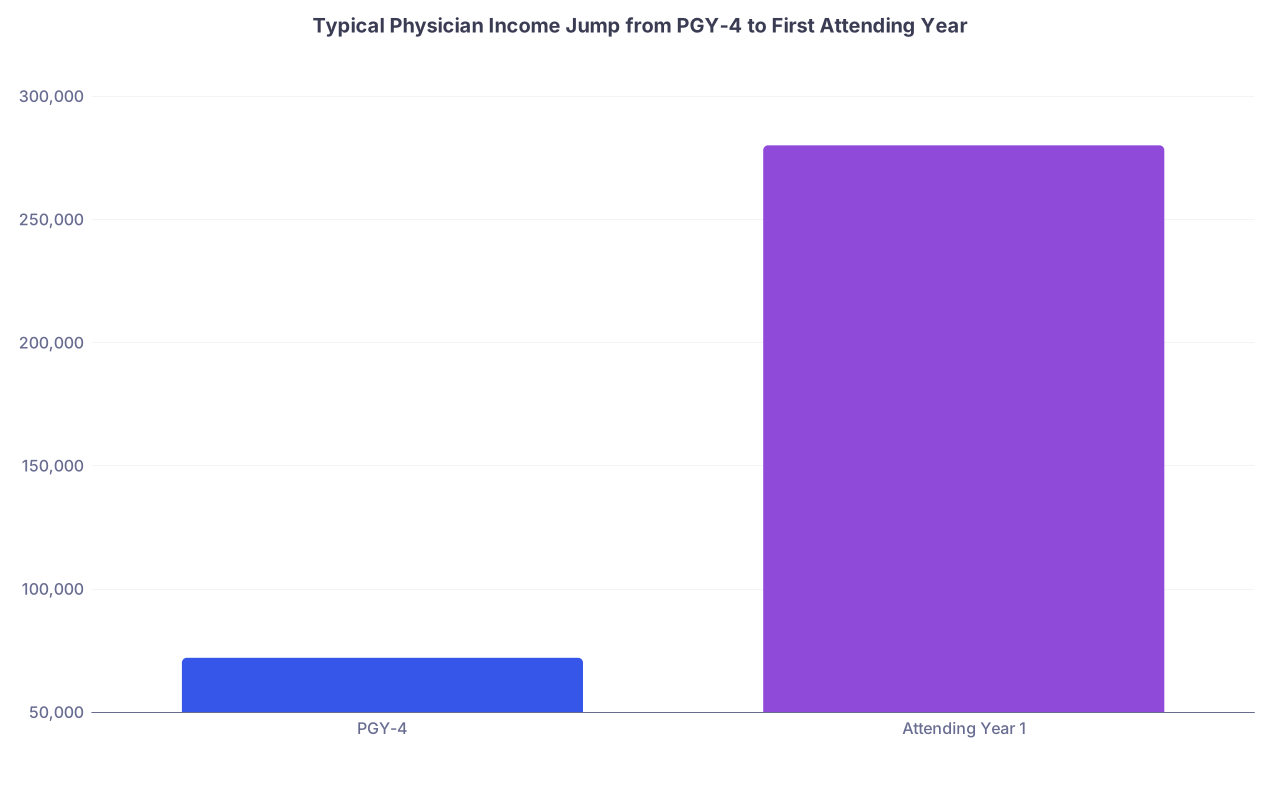
| Category | Value |
|---|---|
| PGY-4 | 72000 |
| Attending Year 1 | 280000 |
That jump is what your loan servicer is reacting to. Your contract determines whether it’s a clean salary, a bonus‑heavy spike, or a messy mix that sabotages carefully planned IDR payments.
Timeline: How Contract and PSLF Interact Across Your Training
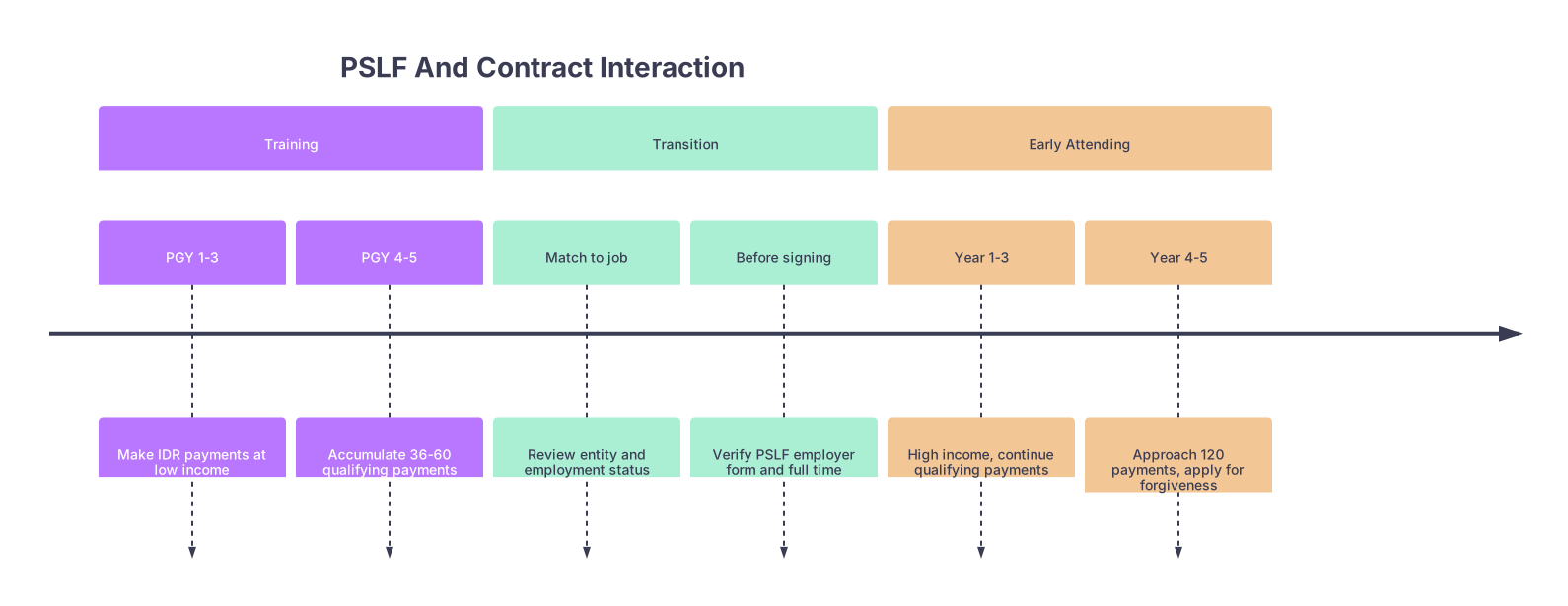
| Period | Event |
|---|---|
| Training - PGY 1-3 | Make IDR payments at low income |
| Training - PGY 4-5 | Accumulate 36-60 qualifying payments |
| Transition - Match to job | Review entity and employment status |
| Transition - Before signing | Verify PSLF employer form and full time |
| Early Attending - Year 1-3 | High income, continue qualifying payments |
| Early Attending - Year 4-5 | Approach 120 payments, apply for forgiveness |
When you sign that attending contract, you’re not just negotiating a job. You’re deciding whether those 4–7 years of low‑income qualifying payments were a smart investment—or a complete waste.
What I’d Tell You If We Were Sitting In the Workroom
If you were a senior resident scrolling through your email between pages and you showed me a draft contract, here’s what I’d tell you without sugarcoating it.
First, decide your real loan strategy before you fall in love with any job:
- PSLF and IDR optimization
- Fast payoff with refinancing
- Hybrid “keep federal flexibility, pay more aggressively”
Then look at the contract through that lens only. Not the marketing. Not the signing bonus.
If PSLF is your path, you walk away from 1099 “great money” jobs at for‑profit groups no matter how shiny they look. You insist on W‑2 employment by a qualifying entity. You fight for a clear full‑time definition that passes the 30‑hour test. You don’t let them box you into noncompetes that trap you away from nonprofit employers.
If you’re refinancing and crushing the debt, you pay more attention to income volatility, bonus structure, and clawbacks. Because you’re taking on interest‑rate risk and job risk simultaneously. You can’t afford a contract that cuts your legs out from under you if RVUs dip or admin decides your clinic needs “right‑sizing.”
And either way, you stop assuming any of this is “standard.” I’ve seen two doctors in the same department, hired three months apart, with wildly different clawbacks, noncompetes, and loan repayment language. The difference? One just signed. The other negotiated like a professional with a plan.
The system won’t protect you here. HR is not your advocate. Your program director doesn’t read these contracts. Your co‑residents are just as blind as you are.
You either get serious about how your contract interacts with your loans—or you pay for it, for years.



Boiled Down: What Actually Matters
Three things decide whether your contract wrecks your loan payoff plan:
Who employs you and how you’re classified. W‑2 by a qualifying nonprofit/government entity versus for‑profit group or 1099 contractor. That single line can save or cost you hundreds of thousands.
How your “full‑time” and income are structured. Hours, FTE definitions, and bonus/loan repayment clauses change both PSLF eligibility and your IDR payments far more than most young doctors realize.
Whether you can escape without financial handcuffs. Noncompetes, clawbacks, and “cause” language control your ability to pivot jobs and protect your long‑term loan strategy when reality doesn’t match the recruiter’s pitch.
If you understand those three levers, you’re already ahead of 90% of your peers. And you stop letting hidden contract clauses decide your financial future for you.