
Last month I watched a 42‑year‑old hospitalist stare at his phone between admissions. His salary is north of $300k, his kids are in private school, he drives a late‑model SUV. On paper, he’s “made it.” But he had just calculated that if he keeps going the way he’s going, he’ll still be paying medical school loans when his oldest starts college.
That’s the part you do not see on the glossy med school brochures. Attendings with perfect white coats and messy financial lives, quietly cursing the decisions they made about loans in M1, M2, residency… and even as junior faculty. Let me walk you through what they actually regret—so you do not repeat it.
The First Big Regret: Treating Loans as Monopoly Money
By far the most common confession I hear is some version of: “I had no clue what I was signing.”
Not an exaggeration. I’ve watched full professors—people who can recite obscure guidelines from memory—admit they didn’t know the difference between unsubsidized, Grad PLUS, and private refinance until after fellowship.
The underlying regret isn’t just “I borrowed a lot.” It’s how they borrowed.
Regret #1: Blindly taking Grad PLUS and maxing it out
Here’s how this usually went:
Financial aid office: “Your cost of attendance is $78,000. Federal loans will cover it.”
M1 student who has never seen $78,000: “Okay.”
No one explains that Grad PLUS loans often carry a higher interest rate and fees than Direct Unsubsidized loans and that “cost of attendance” is padded because schools want you comfortable enough not to drop out. So people took the entire amount. Every year. Some added “just in case” money because it felt free.
Result four years later: $300k–$450k of principal, much of it at 7–8%, compounding the entire time.
Regret #2: Not understanding capitalization
Here’s the quiet killer. Many attendings will tell you, “I thought I was borrowing $250k. I actually ended residency with $340k.”
That jump? Capitalization.
Interest accrues while you’re in school and in most residency situations. Certain events trigger capitalization—interest gets added to your principal, and then you get charged interest on the interest.
Common triggers they didn’t understand back then:
- Leaving deferment/forbearance
- Consolidating loans at the wrong time
- Exiting grace periods into repayment
- Changing repayment plans in certain ways
I’ve sat in loan counseling meetings with attendings who realized they had capitalized interest twice for no good reason. Tens of thousands of dollars added just because they clicked the wrong button at the wrong time.
The Residency Trap: Forbearance, Forbearance, Forbearance
If you want the single biggest “if I could do it over” moment, it’s this: choosing forbearance in residency.
Over and over, attendings say, “I put everything in forbearance because that’s what the PGY‑2s told me to do.” Or because the GME office casually mentioned it during orientation with zero nuance.
Let me be blunt: long-term forbearance during residency has financially wrecked more attendings than any single other decision.
What actually happens in forbearance
You do not make payments. Your loans sit there. Interest keeps building at full freight. For federal loans, that interest is not subsidized for med students/residents anymore.
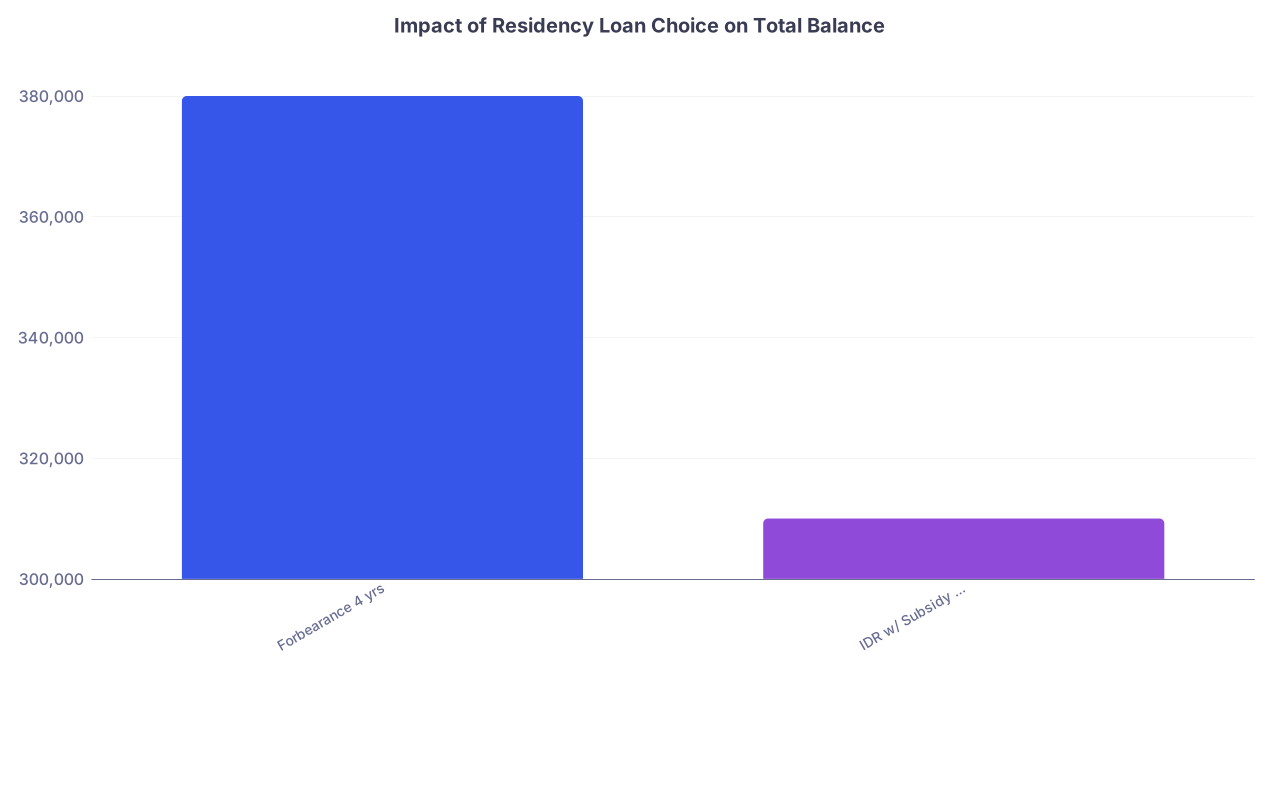
After a year or two, the servicer capitalizes it. Now your principal is larger, so next year’s interest hits you even harder. I’ve seen residents with $250k at graduation turn into attendings with $380k because of a “simple” choice to delay dealing with it.
The worst part? Most of them could have afforded an income‑driven plan during residency, especially if they were single and had low AGI from a partial tax year.
They just didn’t know that:
- REPAYE (now replaced by SAVE) and similar plans could give very low required payments
- Some plans offered partial unpaid interest subsidies
- Those low payments could have counted toward forgiveness or PSLF if they structured things correctly
So they lost years of qualifying payments for Public Service Loan Forgiveness (PSLF) and bloated their balances instead.
| Category | Value |
|---|---|
| Forbearance 4 yrs | 380000 |
| IDR w/ Subsidy 4 yrs | 310000 |
I’ve watched a cardiology attending realize that if he’d just paid $150/month on REPAYE for six years of residency/fellowship, he would have shaved almost $70k off his eventual payoff and started PSLF six years earlier. Six. Years.
PSLF Confusion and the Cost of Bad Information
There is a very specific regret I hear from academic and hospital-employed attendings: “I didn’t take PSLF seriously, and I lost a decade.”
When PSLF first came out, everyone thought it was a scam that would be repealed. Even some program directors and hospital HR people told trainees not to rely on it.
I was in meetings where attendings laughed about it: “You think the government will actually forgive $300k? Good luck.” That noise filtered down to residents, who then never consolidated, never enrolled in qualifying plans, and never certified employment.
Ten years later, guess who’s getting six figures forgiven tax‑free? The handful of people who quietly filled out the forms and stuck with it. The skeptics are writing giant checks in their 40s, often working the exact same hospital-employed jobs that would have qualified.
Specific PSLF regrets I see over and over
Never consolidating older FFEL or Perkins loans.
Those did not qualify for PSLF unless consolidated into a Direct Consolidation loan. A ton of pre‑2010 grads simply ignored that step. They did 10+ years in a qualifying hospital and then learned only some of their loans were ever eligible.Being on the wrong repayment plan.
Graduated or extended plans don’t count. Standard 10‑year would have, but almost no resident chose that because it was unaffordable. Meanwhile, IDR plans like PAYE/IBR/REPAYE would have counted, but no one walked them through it.Not certifying employment annually.
People waited until year 10 to send in all their HR forms. HR departments lose records. Hospitals merge. Systems change names. I’ve watched physicians scramble to prove 8 years of employment because nobody told them to certify each year.Switching to private practice in year 7 or 8 with no clue what they were giving up.
They went to private groups for a salary bump, not realizing they had walked away from six figures of future forgiveness because they never modeled the numbers.

| Step | Description |
|---|---|
| Step 1 | Med School Loans |
| Step 2 | Residency Forbearance |
| Step 3 | Academic Job |
| Step 4 | Never Consolidate |
| Step 5 | Wrong Repayment Plan |
| Step 6 | No PSLF Credit |
Ask any attending who has seen colleagues get $300k+ forgiven what they think now. The ones who missed PSLF don’t shrug. They grit their teeth.
The Private Refinance Mistakes Attendings Don’t Talk About
Once people hit attending salary, there’s a predictable pattern: someone in the physician’s lounge bragging about refinancing to 2–4% with a private company. Then everyone rushes to follow.
Here are the regrets that come a few years later.
Regret: Refinancing out of federal loans too early
I’ve met multiple attendings who refinanced to private during fellowship because they were sick of the interest rate, only to:
- Later take an academic or 501(c)(3) hospital job
- Or decide to cut back to 0.7 FTE for childcare
- Or develop a health issue
- Or decide to go do another fellowship or sabbatical
Once those loans are private, PSLF is gone. IDR safety nets are gone. Pandemic‑style interest pauses? Forget it. You’re at the mercy of that private contract.
I know a pediatric subspecialist who refinanced $220k to a 3.5% private loan as a new attending in 2017. Looked smart at the time. Then COVID hit, federal borrowers went to 0% with paused payments, PSLF credits kept accruing… and she kept making full payments with interest. Over those three years she missed out on more than $40k of effective benefit because she jumped to private too early.
Regret: Chasing the absolute lowest rate with the stiffest terms
Some of the “best” refinance deals assume you’ll never:
- Need forbearance
- Reduce your hours
- Take a long unpaid leave
- Change to a lower‑paying job
But life happens. Babies, illness, burnout, sick parents, divorce. I’ve seen people with brutal prepayment penalties, weak death/disability clauses, and almost no flexibility because they were seduced by a shiny sub‑3% rate.
An attending once told me, “I picked the company because they offered the lowest rate by 0.25%. Then my wife got cancer. My income dropped. Their ‘hardship’ options were a joke.”
The point: a slightly higher rate with humane terms is often a better bet than a rock‑bottom rate chained to inflexible rules. No one tells you that when everything looks rosy and your W‑2 just jumped.
Lifestyle Creep: The Silent Co‑Conspirator
Here’s the dirty secret: most attendings could dig out of bad loan decisions in 5–7 years if they really wanted to. The reason they don’t is simple.
Lifestyle creep.
I’ve watched the same movie on repeat:
- New attending signs a $300k contract
- Finishes fellowship, moves cities
- Buys a “starter” house that’s already at the top of what they qualify for
- Leases two new cars
- Private school, nicer vacations, furniture financed
Suddenly, the idea of throwing $6–8k/month at loans for a few intense years feels “impossible” because their monthly fixed costs are already massive. The regret isn’t just, “I borrowed too much.” It’s, “Once I started making money, I acted like the loans didn’t exist.”

I remember an ortho attending saying this in a committee meeting: “I could have been debt‑free by 40. Instead, I’ll still be paying at 55 because I wanted the ‘doctor life’ right away.”
He wasn’t joking.
The insult to injury? Many of them keep paying the minimum on a 20‑ or 30‑year schedule, which maximizes interest and keeps the psychological weight of the debt on their shoulders almost their entire career. They could attack it. They just structurally locked themselves into not being able to.
The Technical Things They Wish They’d Understood Sooner
Let me condense the small, technical regrets that add up.
Not understanding how IDR really works
Many attendings now realize:
- It’s based on taxable income (AGI), not gross.
- Filing married filing separately in some situations can dramatically change IDR payments.
- Choosing between SAVE, PAYE, IBR, etc., isn’t cosmetic; it can change their 20‑year cost by six figures.
But they only learned this years after residency, from a random blog or a colleague, instead of upfront when it mattered most. So they spent years on sub‑optimal plans.
Missing consolidation windows
A classic: graduating med school with multiple loan servicers and then waiting too long to consolidate. That can:
- Delay IDR eligibility
- Delay PSLF clock start
- Trigger multiple capitalization events instead of one
I’ve sat in rooms where attendings found out they could have had 2–3 extra years of PSLF credit if they’d consolidated and enrolled in IDR during the tail end of MS4 and PGY‑1.
| Regret Scenario | Better Move Early On |
|---|---|
| Forbearance all residency | Low IDR payments, build PSLF/forgiveness time |
| Refinanced privately before first job | Wait until job type and plans are stable |
| Took all Grad PLUS up to COA | Tight budget, avoid unnecessary borrowing |
| Ignored PSLF as 'not real' | Certify annually, keep options open |
Not shopping med school offers at all
Older attendings especially regret not pushing on the front end: choosing the most expensive private school that accepted them, ignoring cheaper state options just because of the name.
I’ve heard more than one say, “I paid $100k more for prestige that made zero difference to my career.”
When you’re 22, the difference between $250k and $400k of projected debt doesn’t feel real. At 40, when those extra $150k balloon into $220k+ with interest, it feels very real.
What They’d Tell You If They Were Being Brutally Honest
I’ve heard some version of these lines in faculty offices, pre‑rounds coffee chats, and late‑night email rants from attendings who finally ran the numbers.
Let me translate them for you into practical takeaways.
1. “I wish I had borrowed less during school, even if it sucked.”
Attendings rarely regret living like a resident in med school. They regret subsidizing a “normal life” at 7–8% interest.
That means:
- Questioning the school’s full cost of attendance number
- House‑sharing longer, driving something old, keeping variable costs tight
- Actually tracking how much you’re borrowing each year and projecting the total
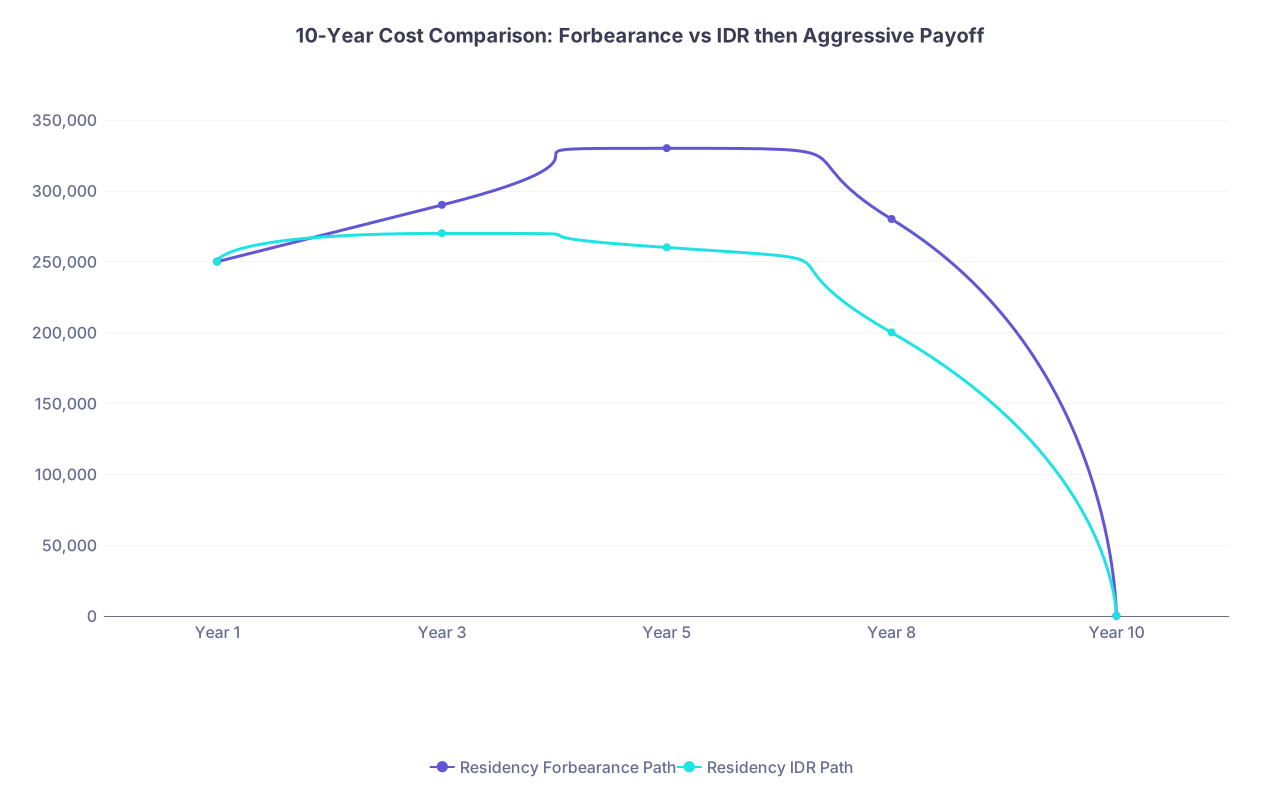
2. “I should have used IDR in residency, even if I planned to aggressively pay later.”
Yes, even if you don’t think you’ll need PSLF, IDR in residency does three things:
- Keeps your loans from exploding as much
- Often gives you some unpaid interest subsidy (especially under SAVE‑style rules)
- Preserves the option to pivot into forgiveness later if your career path changes
Putting everything in forbearance guarantees you nothing but a higher balance.
| Category | Residency Forbearance Path | Residency IDR Path |
|---|---|---|
| Year 1 | 250000 | 250000 |
| Year 3 | 290000 | 270000 |
| Year 5 | 330000 | 260000 |
| Year 8 | 280000 | 200000 |
| Year 10 | 0 | 0 |
3. “I should have taken PSLF seriously as an option, even if I wasn’t sure.”
The smart move many missed: act as if you might do PSLF, until it’s clear you won’t.
That means:
- Consolidate to Direct Loans if needed
- Enroll in a PSLF‑qualifying IDR plan
- Certify qualifying employment every year you’re at a 501(c)(3) or government employer
If you end up going private practice, fine—you can pivot. But if you go academic or hospital‑employed long term, you’ve preserved an incredibly valuable option.
4. “I rushed to refinance when I didn’t really understand my federal benefits.”
Refinance once:
- Your job type is stable
- You know you’re not using PSLF
- You understand the tradeoffs between rate and flexibility
- You have an emergency fund and some financial runway
Not because the group chat blew up with a bonus‑referral link from SoFi or Laurel Road.

How To Not Become Their Cautionary Tale
Let me be direct: you won’t avoid every mistake. The loan system is convoluted on purpose, and even seasoned attendings get tripped up.
But you can avoid the big, career‑bending regrets most of them carry.
If you remember nothing else, remember this:
- Every dollar you borrow is real, and compounding is merciless. Fight unnecessary borrowing early.
- Forbearance is almost never your friend in residency. Use income‑driven repayment strategically.
- Treat PSLF and federal benefits as options worth preserving until you are absolutely sure you do not need them. You can always refinance later; you can’t “un‑refinance” back into federal protections.
- Do not let lifestyle creep steal your flexibility as an attending before you’ve dealt with your past.
The attendings who are calm about their loans in their 40s didn’t “get lucky.” They either understood this early or course‑corrected fast. You can, too.