
The “just pay the minimum” approach to student loans is financial quicksand for new attendings.
If you carry that resident mindset into your first years as an attending, you are quietly bleeding away six figures to interest while feeling falsely “responsible” because you never miss a payment. I have watched smart, high‑earning physicians trap themselves like this for a decade. They are not reckless. They are just busy, tired, and lulled into complacency by autopay.
This is the mistake I want you to avoid.
The Trap: Why “Minimum Payment” Feels Safe But Is Not
As a resident, the minimum payment mindset makes sense. Your income is low, your options are limited, and income‑driven repayment (IDR) is often the only way to survive. Paying the minimum is survival, not strategy.
The mistake is dragging that same behavior into attending life.
Here is what happens:
You finish residency or fellowship.
You are exhausted. You sign a contract at $250,000–$400,000.
Your loan servicer “congratulates” you on your new payment: maybe $1,200–$1,800 a month under an IDR plan—or a similar required payment on the standard plan if you do not recertify.
You think:
“I am making payments. I am using a federal program. I am fine.”
No. You are not fine if:
- Your balance is barely moving each year.
- Your interest accrual is close to, equal to, or more than your annual payments.
- You have no written plan for payoff vs forgiveness, tied to real numbers.
If you are an attending and your loan strategy is “keep paying whatever the portal tells me,” you do not have a plan. You have drift. And drift with six‑figure debt and six‑figure income is expensive.
How Minimum Payments Quietly Cost You Six Figures
To see how ugly this can get, look at the math most attendings never do.
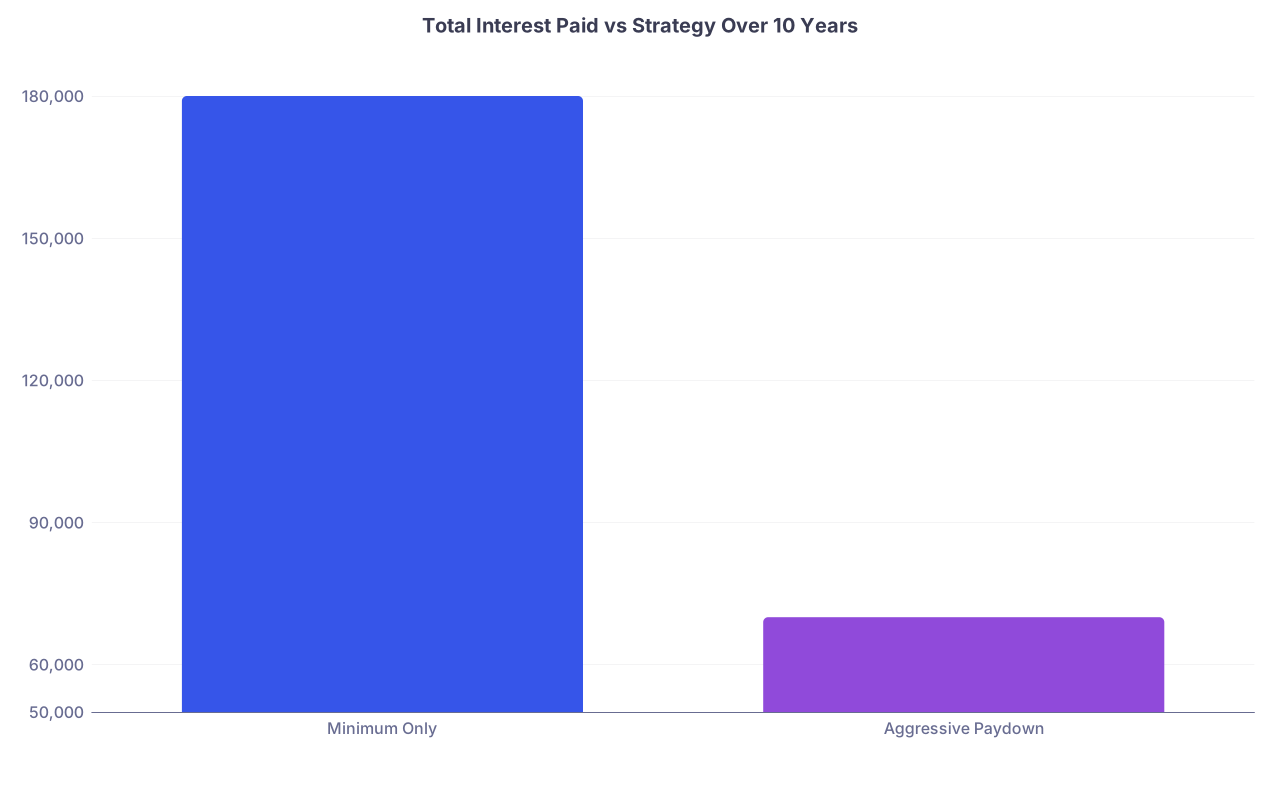
| Category | Value |
|---|---|
| Minimum Only | 180000 |
| Aggressive Paydown | 70000 |
Assume:
- Loan balance at end of training: $300,000
- Weighted average interest: 6.5%
- Attending salary: $300,000
Scenario 1: Minimum mindset on a standard 10‑year plan
- Required payment: about $3,400/month
- Total paid over 10 years: about $408,000
- Interest paid: roughly $108,000
That is if you actually stay on the 10‑year schedule.
But here is the real “minimum payment” behavior I see:
People switch to IDR when the 10‑year payment feels too high, or they stretch to 20–25 years without re‑running the math.
Now you are looking at:
- $1,500–$2,000/month for 20–25 years
- Total paid: $360,000–$500,000+
- Interest: often $150,000–$250,000
You end up paying for med school twice. Quietly. Over your entire career.
Scenario 2: Attending who refuses the minimum mindset
Same doctor. Same $300,000 starting balance.
This person:
- Lives like a resident for 2–3 more years
- Pays $6,000–$8,000/month toward loans
- Throws bonuses, moonlighting, and tax refunds at the debt
With $6,000/month:
- Debt gone in about 5.5 years
- Total paid: around $360,000
- Interest: about $60,000
With $8,000/month:
- Debt gone in about 3.8 years
- Total paid: around $330,000
- Interest: about $30,000
The difference between those mentalities is not a small rounding error.
You can either:
- Overpay the government $100,000–$200,000 over time, or
- End this chapter in under 5 years and invest that same money for yourself.
The dangerous part: both people “never missed a payment.” Only one actually got ahead.
The 5 Specific Versions of the Minimum Payment Mistake
Let me be precise, because “minimum payment mindset” shows up in different disguises.

1. Staying on income-driven repayment as an attending without a forgiveness plan
IDR is a powerful tool when used correctly. But using it “just to keep payments low” as a high‑earning attending, without genuine pursuit of Public Service Loan Forgiveness (PSLF) or 20–25 year taxable forgiveness, is a classic error.
Warning signs:
- You are in REPAYE/SAVE, PAYE, or IBR
- Your payment is “comfortable” but your principal barely shrinks
- You are in private practice or a for‑profit hospital with no PSLF eligibility
- You have never modeled what taxable forgiveness would cost in year 20 or 25
If you are not actually aiming at a forgiveness program, IDR is usually just a way of paying more interest for longer.
2. Ignoring capitalized interest when your income jumps
Residency to attending is a cliff. If you do not re‑evaluate your plan the year your income increases, you let your prior underpayments and accumulating interest sink in quietly.
Common move I see:
Resident on SAVE/REPAYE, low payment, interest partially subsidized. Attending income starts, interest subsidy shrinks or disappears, payment rises but does not match full amortization. Interest keeps piling up. Then it capitalizes at certain triggers (consolidation, leaving IDR, losing subsidy, etc.) and your balance jumps.
If your first attending year is “too busy” to review your loans, you will overpay for the next 15–20 years.
3. Letting autopay make decisions for you
Autopay is great for avoiding missed payments. It is terrible as a substitute for thinking.
The pattern:
- You set autopay once during intern year
- You get recertification emails, click through them half‑awake
- Your payments adjust automatically
- No one ever sits down and asks: “Should I just nuke this debt in 3–5 years instead?”
Servicers are not your planners. Their systems are designed to keep loans current, not to minimize your lifetime interest or maximize your net worth.
4. Deferring or forbearance “for a few months” as an attending
This one is blunt: deferral/forbearance as an attending is almost always a bad decision unless you are facing a real crisis.
Every month you do not pay, interest continues to accrue. On a $300,000 loan at 6.5%, that is about:
- $1,625 in interest every month
- $19,500 per year you are not paying down
Push pause for 12 months to “get settled,” and you just bought yourself an extra used car worth of interest, with nothing better to show for it than maybe nicer furniture and some forgettable Amazon purchases.
5. Refinancing to a low monthly payment but not using the savings to pay faster
Private refinancing is a tool, not a solution by itself.
The upgraded version of the minimum mindset looks like this:
- You refinance $300,000 from 6.5% to 4%
- You choose the 15‑year term because the payment “fits better”
- You feel smart because rate went down and payment went down
Then you simply pay the new minimum and stretch the pain for 15 years.
The problem is not the refinance. The problem is not using the lower rate to attack the principal aggressively. You “won” a rate cut and then gave the victory back by extending the timeline and sticking to the floor payment.
When Minimum Actually Makes Sense (Short List)
I am not going to pretend the minimum payment is always wrong. It is not. It is just overused and misused.
Minimum or near‑minimum payments can make sense if:
You are clearly on track for PSLF
You work full‑time at a qualifying 501(c)(3) or government employer, you are committed to staying 10 years, you are counting qualifying payments, and you have modeled what your total paid vs forgiven will look like.You are in a low‑income period with a plan to increase payments later
For example, early fellowship in a competitive subspecialty that will significantly boost your long‑term income, and you intend to throw real money at the loans once you finish.You are maximizing higher‑yield opportunities with intention
Example: You invest aggressively inside retirement accounts that give you a huge employer match or tax advantage, and the math actually shows higher long‑term net worth compared with rapid paydown—and you have modeled this, not guessed.
But here is the key difference: in all three of those cases, minimum payment is part of an explicit written strategy. It is temporary or targeted, not default.
The Right First Step: Run the Numbers Like an Attending, Not a Resident
You cannot avoid mistakes with vibes. You need to see the math.
At minimum, do this once in your first 6–12 months as an attending:
| Metric | Why It Matters |
|---|---|
| Total current balance | Defines the problem size |
| Weighted average interest rate | Drives urgency of payoff |
| Current monthly payment | Shows cash flow commitment |
| Annual interest accrual | Reveals if balance can grow |
| Projected payoff date | Tests if plan is acceptable |
If your annual interest is above $15,000–$20,000, and your career income will be $250,000+, pretending that a $1,200–$1,800 payment is “fine” is willful blindness.
You should be able to answer, on paper:
- Am I aiming for PSLF, taxable forgiveness, or full payoff?
- How many years until I am debt‑free under my current payment?
- How much total interest will I pay on that path?
If you cannot answer those three questions today, you are exactly the person this “minimum payment” warning is for.
A Better Framework: Decide, Then Align Payments To That Decision

| Step | Description |
|---|---|
| Step 1 | Finish Training |
| Step 2 | Private practice or non PSLF job |
| Step 3 | Optimize for PSLF |
| Step 4 | Run PSLF vs payoff math |
| Step 5 | Consider IDR and taxable forgiveness |
| Step 6 | Aggressive payoff 3 to 7 years |
| Step 7 | Working at PSLF eligible employer |
| Step 8 | Plan to stay 10 years total |
| Step 9 | Debt to income ratio high |
Path 1: You are a PSLF candidate
If you are at a qualifying employer and plan to remain there:
- Stay in an IDR plan that counts for PSLF (SAVE, PAYE, etc.)
- Minimize payments within legal/ethical bounds to maximize forgiveness
- Track qualifying payments meticulously
- Do not refinance federal loans privately
Here, paying more than the minimum is usually a waste because every extra dollar just reduces the amount that would have been forgiven tax‑free.
Path 2: You are not a PSLF candidate and do not trust 20–25 year forgiveness
This is most private practice attendings.
Here, the correct mindset is usually:
“How fast can I get rid of this safely without wrecking my life?”
You look at your:
- After‑tax income
- Base living expenses (not lifestyle inflation)
- Realistic savings goals (retirement contributions, basic emergency fund)
Then you set an aggressive but sustainable monthly loan target: $4,000, $6,000, $8,000+ depending on specialty and contract.
The key is that this number should feel like a real effort. If your loans do not slightly sting while you are an attending, you are probably dragging them out too long.
Lifestyle Inflation: The Real Enemy Behind the Minimum Payment
Most physicians do not cling to the minimum payment because they love interest. They cling to it because it gives them permission to inflate their lifestyle quickly.
The script I hear constantly:
“I deserve a house.”
“I need a decent car; my last one was dying every call night.”
“I cannot live like a resident forever.”
No one is asking you to live like an intern at 42. But a lot of new attendings sprint from $55,000 resident lifestyle to $250,000‑earner lifestyle in under a year. They stretch for the bigger mortgage, the private schooling, the luxury SUV “because it is safe for kids,” and then there is nothing left to hit the loans hard.
Here is the honest breakdown of where attending dollars tend to go:
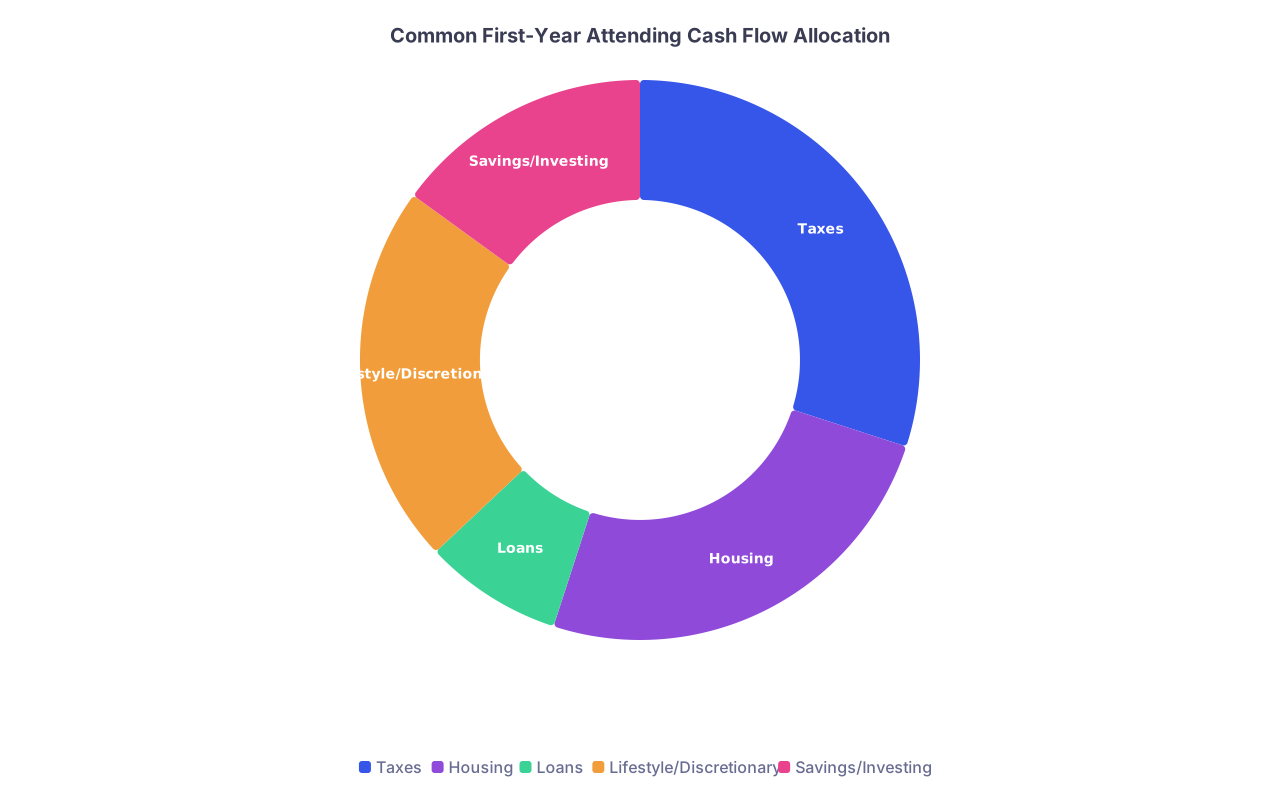
| Category | Value |
|---|---|
| Taxes | 30 |
| Housing | 25 |
| Loans | 8 |
| Lifestyle/Discretionary | 22 |
| Savings/Investing | 15 |
Notice the 8%. That is where the minimum payment mindset lives—single‑digit percent of a high six‑figure income sent to loans, while lifestyle quietly eats the difference.
Flip those last two numbers—make loans 22% and lifestyle 8–10% for 3–5 years—and you are done with this problem for life.
Practical Guardrails to Avoid the Minimum Payment Trap

You do not need a 40‑page financial plan. You need a few clear rules.
Decide on a target payoff window if not doing PSLF
Three to seven years is reasonable for most specialties outside of extremely high debt / low income combinations. If your spreadsheet says 18 years and you are not on a forgiveness track, that is a red flag.Set a minimum loan percentage of take‑home pay
For non‑PSLF attendings, I like:- 20%+ of take‑home in the first 3 attending years toward loans, or
- A fixed number that pays them off within your target window
Only refinance if you are willing to keep your timeline short
If you refinance to 10–15 years, you treat that term as a maximum, not a goal. You still pay extra to hit your 3–7 year window.Review annually on the same date
Once a year, sit down with: current balance, interest rate, payments made, projected payoff date. If your timeline has slipped because you relaxed into the minimum, correct it.Get a second set of eyes if you are unsure
A fee‑only planner who understands physician loans can quickly show you how much your “comfortable” minimum is costing you over time. The point is not to buy products. It is to see the math clearly.
The Psychological Shift: From “As Long As I Am Paying” To “Until It Is Gone”
The hardest part is not the math. It is the identity shift.
Residents think, “I am doing my best with what I have.”
Attendings need to think, “I am choosing where every dollar goes now.”
If you keep the resident brain—“I paid something, that is good enough”—you will keep resident‑style debt for most of your career.
The attendings who win this game:
- Decide early: PSLF vs payoff
- Align their housing and car choices with that decision
- Treat minimum payments as a warning sign, not a comfort
They are not better doctors. They are just doctors who took this seriously for 3–7 years instead of vaguely for 25.