
Lifestyle creep after Match is the quiet reason many doctors stay broke for a decade longer than necessary.
Not bad luck. Not “the system.” Not your specialty choice.
Lifestyle creep. Month by month. Amazon order by Amazon order. Lease by lease.
You just matched. You finally have a contract. A real salary is coming. And this is exactly when many smart, hard‑working new physicians make the single worst financial decision of their lives: they lock in a lifestyle before they have even met their first attending paycheck.
Let me walk you through the traps before you sign yourself into a corner.
What Lifestyle Creep Looks Like Right After Match
Lifestyle creep is not one big stupid purchase. That would be too obvious. It is a series of “reasonable” upgrades that collectively sabotage your student loan strategy.
Typical pattern I see in new residents:
- “I have earned a decent apartment.” → $2,500+ rent
- “I need a reliable car.” → $450/month payment + high insurance
- “My schedule is insane; I will just DoorDash.” → $400–600/month
- “I cannot wear my med student shoes anymore.” → $300+ on ‘work clothes’
- “I am a doctor now; I deserve a vacation.” → $2,000–4,000 trip on a card
Individually? Defensible. Together? You have quietly committed your future self to a financial chokehold.
Here is the catch most PGY‑1s miss: your loan obligations are optional in the short term. Your lifestyle obligations are not.
You can skip an extra loan payment. You cannot skip rent or the car note.
That is why lifestyle creep kills debt plans: fixed lifestyle costs get first claim on every paycheck, and loans get whatever scraps are left.
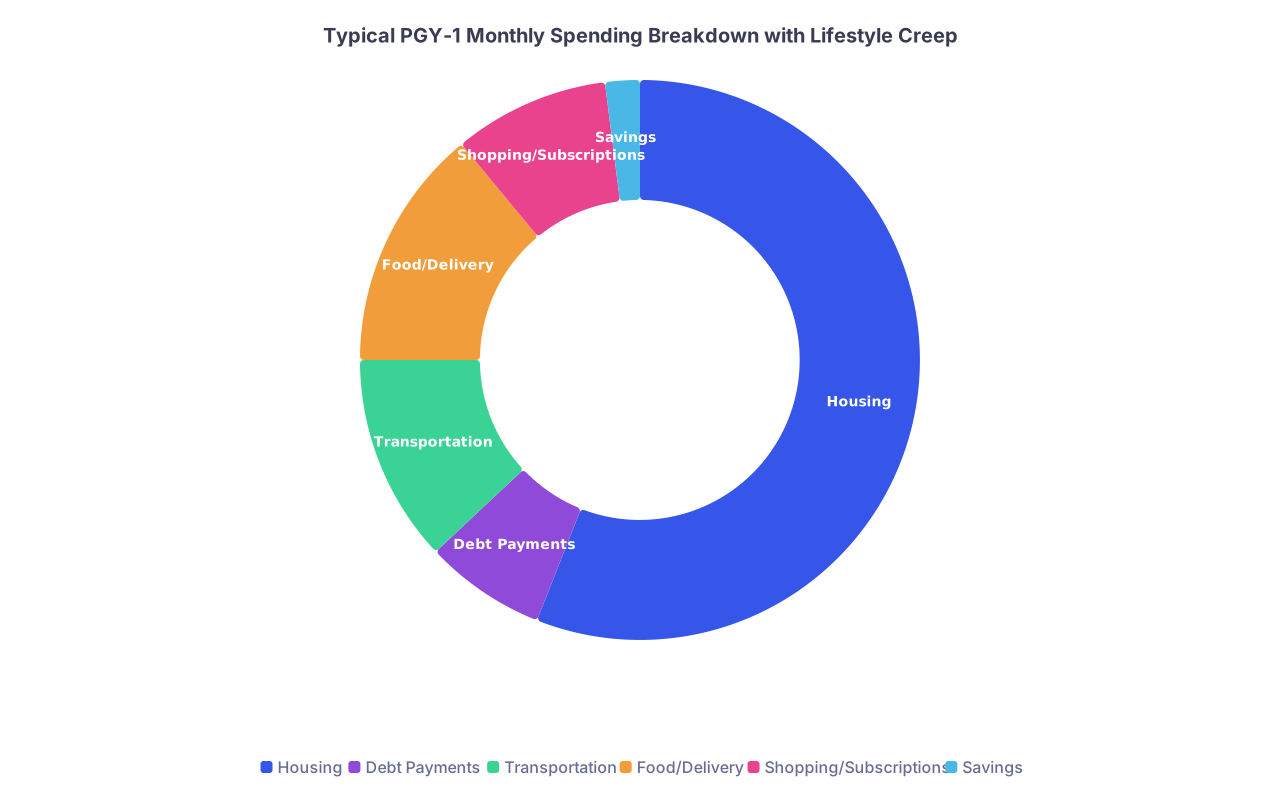
| Category | Value |
|---|---|
| Housing | 2800 |
| Debt Payments | 350 |
| Transportation | 600 |
| Food/Delivery | 700 |
| Shopping/Subscriptions | 450 |
| Savings | 100 |
The Dangerous Timing: Why Post-Match Is a High-Risk Window
You are at your most financially vulnerable right when you feel the most secure.
1. Huge emotional whiplash
You went from:
- Years of delayed gratification
- Living like a student
- Constant fear about matching
To:
- A signed contract
- A guaranteed paycheck
- Adults congratulating you and calling you “doctor”
Your brain is screaming: “Finally. I can breathe. I can spend.”
This is exactly when car dealers, landlords, and furniture salespeople eat you alive.
2. No real money experience
I have seen incoming residents sign $2,000–$3,000 leases before their first paycheck because “$65K–$75K salary is a lot compared to med school.”
Reality check: after taxes, retirement contributions, and loan payments, that salary does not stretch as far as you think.
The dangerous assumption: “I will make it work somehow.” That “somehow” often turns into increasing your income on paper by forbearance or minimal payments… while your loan balance quietly compounds.
3. Fixed costs are much harder to reverse
Look at what people sign in the three months after Match:
- 12‑month apartment lease
- 5–7 year car loan
- New phone + 2‑year service agreement
- Furniture store “0% interest for 24 months” plan
You are locking in future paychecks you have not earned yet. Missed extra loan payments for 2 years? You can make those up. Luxury apartment lease you regret? You are stuck or you pay thousands to exit.

How Lifestyle Creep Destroys Student Loan Strategies
Here is the blunt truth: your first 5–7 years out of medical school are the most powerful years for controlling your student loan trajectory. And lifestyle creep is exactly what cancels that power.
1. It kills your flexibility
Once your fixed monthly lifestyle cost is high, your options shrink:
- Want to aggressively pay down 7% private loans? “Can’t. Rent and car are due.”
- Want to max out Roth IRA, HSA, or 403(b)? “Maybe next year.” (Then another year.)
- Want to pursue PSLF and keep payments manageable? Your high taxable income from moonlighting to “afford” your lifestyle can increase your IDR payments.
You become a highly paid, highly trained professional who still feels like you are living month to month. Because you are.
2. It quietly multiplies loan costs
Here is a simple comparison over the first 3–4 years of training.
| Scenario | Rent | Car Payment | Extra Loan Payment | Result After 4 Years |
|---|---|---|---|---|
| Modest lifestyle | $1,500 | $0–$200 | $600/month | Tens of thousands less in interest |
| Lifestyle creep | $2,600 | $450 | $0–$100/month | Balance barely shrinks, may grow |
| Extreme creep | $3,200 | $650+ | $0 extra | Locked into IDR, no flexibility |
Those extra $400–$700 per month during residency? They are not small. Over 4 years, that is:
- $600/month → $28,800 in direct payments
- At 6–7% interest, that avoids thousands more in future interest
You will not feel the pain now. You will feel it when you are 41, still paying, and wondering why your loans will not die.
3. It locks you out of smart repayment choices
Bad lifestyle choices can make good repayment programs almost useless:
- PSLF – Needs 120 qualifying payments. If you are constantly broke, you may be tempted into forbearance or deferment early, losing qualifying months.
- Refinancing – Private lenders want a solid debt‑to‑income ratio and a clean payment history. High fixed expenses → higher risk → worse rates or rejections.
- Aggressive payoff – You simply cannot execute it if 70–80% of your net pay is already committed to housing, car, and lifestyle.
You will think “I am using IDR; I am fine.” Meanwhile, interest is ballooning because there is no leftover money to throw at principal.
The Sneaky Areas Where New Doctors Overspend
You expect the big stuff: cars, apartments. The more dangerous creep happens in the “normal” categories you stop watching closely.
Housing: the rent trap
Mistake pattern:
- You look at average local rents for young professionals.
- You decide you are a “young professional” now.
- You rent what they rent.
But you are not a typical young professional. You are:
- Working 60–80 hour weeks
- Carrying $200K–$400K+ in student loans
- Often in a high COL city with low resident salary relative to cost
Overpaying for housing is the single most common resident mistake I see.
Red flags:
- Your rent is more than 25–30% of gross resident pay.
- You sign a luxury building lease “for safety, amenities, and gym.”
- Your justification includes “I will hardly be home; I want the place I am home in to feel high quality.” (I have heard this almost verbatim from multiple interns.)
Car: the badge of “I made it”
Car dealerships love freshly matched residents. You have a signed contract. You feel rich. And you are exhausted; you do not want to haggle.
Common traps:
- New car leases with teaser monthly payments that balloon after 36 months
- 6–7 year loans on $30K–$50K vehicles
- Upselling to “doctor level” trims, packages, and extended warranties
The car you drive your first 3–5 years out can swing your entire loan timeline:
- $0–$200/month used car → you preserve cash flow
- $500–$700/month new car → kiss aggressive payoff goodbye
Subscriptions, delivery, and “time savers”
“I am a resident; my time is valuable. I will pay for convenience.”
Yes, your time is valuable. But be honest: is it really all “time saver” or also stress‑shopping and default choices?
Typical subscription creep:
- 3–4 streaming services
- Grocery delivery fees + markups
- Food delivery 3–5x/week
- Fitness apps + Peloton or boutique memberships
- Cloud storage, productivity tools, “doctor discount” subscriptions
Alone, each $15–$40 subscription is nothing. But ten of them plus delivery habits? You are burning hundreds monthly on things you barely notice.
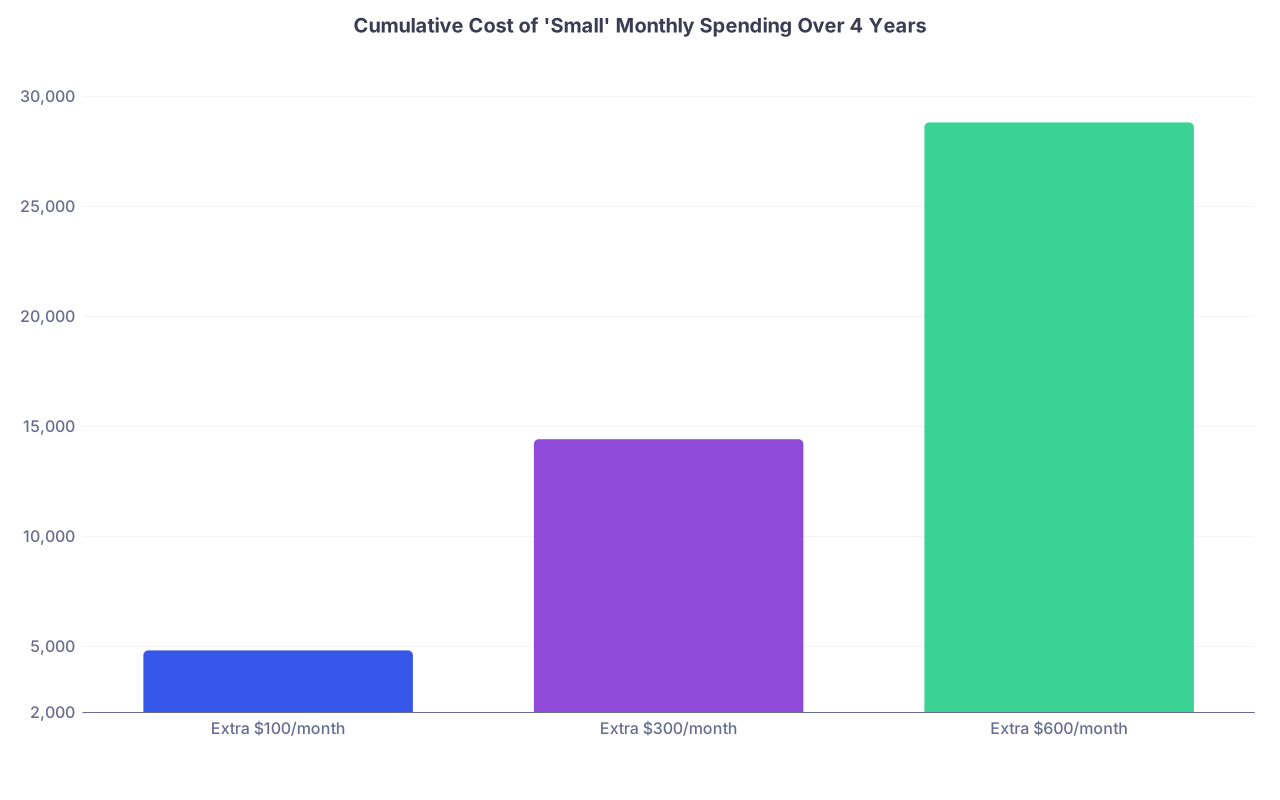
| Category | Value |
|---|---|
| Extra $100/month | 4800 |
| Extra $300/month | 14400 |
| Extra $600/month | 28800 |
That $600/month “little stuff” is $28,800 over 4 years. Money that could have:
- Knocked out a 7% private loan
- Funded a Roth IRA every year of residency
- Built a real emergency fund so you do not have to put crises on credit cards
How to Recognize You Are Already Sliding into Lifestyle Creep
Lifestyle creep is dangerous because it feels normal. You will not get a notification on your phone saying, “Congratulations, you have just sabotaged your debt freedom timeline.”
So you need objective signals.
You are likely in trouble if:
You cannot cash-flow a $500–$1,000 emergency without using a credit card.
That means your lifestyle is already too tight.You have no clear, written monthly number for extra loan payments or savings.
Vague intention = zero actual progress.Your housing + car + recurring bills exceed 50–55% of your take‑home pay.
At that point, you will struggle to do more than minimum loan payments.Your spending justification includes “I deserve it; I am finally a doctor.”
That line has been responsible for more financial wreckage than you think.Your loan balance is not moving down or is increasing year to year.
That is a direct outcome of lifestyle decisions, not fate.

Practical Guardrails: How to Enjoy Life Without Blowing Up Your Debt Plan
You do not need to live like a monk. But you do need rules. If you do not set them, the market will set them for you—and the market does not care about your loans.
1. Define your “resident lifestyle cap” in advance
Before you sign anything:
- Decide what percentage of your take‑home pay goes to:
- Fixed lifestyle (housing, utilities, car, insurance, groceries baseline)
- Financial goals (loan overpayments, retirement, emergency fund)
- Flexible fun money
Simple guardrail that works well:
- Fixed lifestyle: ≤ 50–55% of take‑home
- Financial goals: ≥ 20–25% of take‑home (even in training)
- Everything else: flexible
If you cannot hit 20% for financial goals because your rent and car are too high, that is your answer: you are over‑lifestyled.
2. House-hunt like you are still a student (for a few more years)
You only need three things from housing in residency:
- Safe
- Reasonable commute
- Affordable
You do not “need”:
- Granite counters
- Pool and rooftop lounge
- In‑building gym if it doubles your rent
Practical targets:
- Aim for housing ≤ 25–30% of gross resident salary.
- Get roommates if your city is brutal. You are hardly home.
- Avoid luxury buildings that target young professionals with high rent/amenity tradeoffs.
3. Treat car decisions as loan decisions
When you buy or lease a car during training, you are effectively saying:
“I am willing to delay my student loan payoff by X years to drive this.”
Ask yourself explicitly:
Is this car worth staying in debt 2–5 years longer?
Guardrails:
- If you absolutely must finance, keep car payments ≤ 8–10% of take‑home pay.
- Strongly prefer reliable used over new. Depreciation is not your friend when you are leveraged.
- Avoid long loans (6–7 years). Those are designed for people stretching beyond their means.
4. Pre‑decide your loan strategy before the lifestyle upgrades
Do not reverse this order:
Wrong sequence:
Lifestyle → “See what is left” → Loan strategy.
Correct sequence:
Loan strategy → Pre‑set target payment → Build lifestyle around that.
Decide first:
- Are you aiming for PSLF or serious IDR forgiveness?
- Are you planning aggressive payoff by 5–10 years out of residency?
- Are you refinancing part of your loans during or after training?
Once you know your plan:
- Put a specific monthly dollar amount on auto‑pay for loans.
- Treat that number like rent—non‑negotiable.
Whatever is left after that can support your lifestyle. Not the other way around.
The Psychological Side: How to Resist the “I Deserve This” Trap
Post‑Match, you are emotionally beat‑up and under‑rewarded. I get it. The urge to compensate with stuff is strong.
You need replacements that do not destroy your balance sheet.
- Celebrate with experiences, not recurring payments. One nice dinner, not a 12‑month car lease.
- Let your “doctor identity” show up in competence and character, not watch brands or apartment addresses.
- Build a small “guilt‑free” fun budget each month. $100–$200 you can blow without thinking. Ironically, that prevents bigger binge spending.
Remind yourself:
The real flex is being debt‑free at 35, not driving a $60,000 car at 29 with $350,000 in loans still hanging over your head.
A Simple Process to Keep Yourself Out of Trouble
Use a quick check like this before you sign anything large post‑Match:

| Step | Description |
|---|---|
| Step 1 | Want to sign new expense |
| Step 2 | One time cost |
| Step 3 | Fixed recurring cost |
| Step 4 | Probably OK |
| Step 5 | Delay or downsize |
| Step 6 | Do not sign. Reduce cost |
| Step 7 | OK but recheck total fixed costs |
| Step 8 | Will it last 1 year or more |
| Step 9 | Exceeds fun budget |
| Step 10 | Can I still hit 20 percent to loans or savings |
If a new commitment pushes your ability to put 20–25% of take‑home toward loans/savings off the table, the correct move is simple:
Do not sign it. Reduce it. Or delay it.
FAQ (4 Questions)
1. Is lifestyle creep really that bad if I am planning on PSLF anyway?
Yes. PSLF forgives your remaining federal loan balance after 120 qualifying payments, but it does not fix everything. Lifestyle creep still hurts you because:
- You may be forced to use forbearance or miss payments early due to cash strain, which delays PSLF.
- You miss years of potential retirement contributions and emergency fund building.
- If something changes (you switch to private practice, PSLF rules shift, or you move employers), you will wish you had not assumed forgiveness would bail you out. PSLF is a tool, not a permission slip to overspend.
2. How modest is “too modest” during residency? I do not want to be miserable.
If your budget is so tight that you cannot buy a coffee, see friends occasionally, or travel once in a while, you have over‑corrected. The goal is controlled spending, not self‑punishment. A good sign you are in a healthy range:
- You can cover small emergencies without stress.
- You are paying something meaningful toward loans or savings each month.
- You still have a bit of money you can enjoy without guilt.
If you are hitting those, you are not “too modest.”
3. Should I pay loans aggressively in residency, or wait until I am an attending?
The worst choice is not a particular strategy. It is indecision. If your loans are mostly high‑interest private loans, early extra payments can save a significant amount. If your loans are federal and you are a strong PSLF candidate, you might prioritize minimum qualifying payments and retirement savings instead. The mistake is burning thousands on lifestyle first and only then asking, “What should I do with my loans?” Decide your strategy now, then align spending around it.
4. What if I already signed an expensive lease and car loan—am I just stuck?
You are not doomed, but you need to stop compounding the problem. Steps:
- Freeze lifestyle upgrades immediately; no more big recurring commitments.
- Aggressively cut flexible spending (subscriptions, delivery, impulse buys) to free up cash.
- When feasible, consider house‑hacking with a roommate or subletting if your lease allows it.
- For the car, see if refinancing or even selling and downsizing is realistic once you understand the numbers.
Your next set of decisions matters more than the last ones. The real mistake is recognizing you are overextended and then doing nothing.
Takeaway:
- Your first years after Match are the most dangerous for lifestyle creep—and the most powerful for shaping your loan future.
- Fixed lifestyle decisions (rent, car, subscriptions) will either protect or destroy your debt plan, so set strict guardrails before you sign anything.
- Choose your loan strategy first, then build a life that fits around it—not the other way around.