
You just signed your first “real” job contract. There’s a fat $15,000–$50,000 signing bonus in there, and your brain immediately jumps to your student loans.
“Should I just throw this entire thing at my debt and get a huge head start?”
Here’s the honest answer: sometimes that’s smart. Sometimes it’s financially efficient but personally dumb. And occasionally, it’s just straight‑up risky.
Let’s walk through when it is smart, when it isn’t, and how to make the call without overthinking it.
Short answer: No, not always — you should decide in this order
If you want the blunt framework:
Protect yourself:
Build a small emergency fund and cover any immediate obligations before you touch your loans.Capture “free money”:
Get your full employer retirement match if you have one. That beats extra loan payoff in most cases.Then decide:
With what’s left of the signing bonus, it can be smart to pay loans aggressively if:- You’re not pursuing loan forgiveness, and
- Your interest rate is meaningfully higher than safe investment returns (think 6–7%+), and
- You’re not wiping out your last dollar of cash.
If you are going for PSLF, IDR forgiveness, or have low‑rate loans, using the entire signing bonus for payoff is usually a mistake.
Step 1: Understand your loans before you throw money at them
Before you decide anything, you need to know exactly what you’re dealing with. Not “I owe around 80k.” Exact numbers and types.
Here’s what to pull up:
- Total loan balance
- Interest rate on each loan
- Loan type (Direct, FFEL, Perkins, private)
- Whether they’re federal or private
- Whether you’re on an income‑driven repayment (IDR) plan, and if you’re pursuing forgiveness (PSLF or 20–25 year IDR)
Then sort them. High‑interest at the top, low‑interest at the bottom.
If your top loans are:
- Private loans at 8–10%? Paying those down with your bonus can be very smart.
- Federal loans at 3–4% and you might work at a nonprofit or government? Throwing your whole bonus at them might be dumb.
You cannot answer “Should I use my entire signing bonus on loans?” without knowing those rates and your forgiveness path. That’s the ballgame.
Step 2: The emergency fund test (don’t skip this)
I’ve watched plenty of new grads do this:
- Get a $20k signing bonus
- Blast $20k at loans
- Two months later: car dies, they put $6k on a 25% APR credit card
Mathematically, that’s a disaster.
You do this first:
- Aim for at least 1 month of bare‑bones expenses in cash right away
- Work toward 3–6 months over time, but don’t feel like you need that fully funded before any extra loan payoff
Bare‑bones = rent, food, utilities, transportation, insurance, minimum debt payments. Not vacations, DoorDash, or Peloton.
If you currently have $0–$1,000 in savings, your signing bonus is not a loan payoff tool yet. It’s a “stop me from being destroyed by one bad month” tool.
In that scenario, I’d tell you straight:
Using your entire signing bonus for loans is usually not smart.
Using part of it might be.
Step 3: Interest rate vs. investment return — who wins?
Here’s the math lens, without fluff.
Paying down debt gives you a guaranteed return equal to the interest rate.
- Pay extra on a 7% loan? That’s a guaranteed 7% “return.”
- Compare that to:
- Employer retirement match (often >100% return on your contribution up to the match)
- Stock market long‑term average (often cited ~7–10% before inflation, but not guaranteed, and very bumpy)
So:
If you have high‑interest debt (7–10%+):
Using a big chunk of your signing bonus to attack that is usually smart, after you’ve:- Built a basic emergency fund
- Captured your employer match
If your loans are low rate (3–5%) and you’re not emotionally drowning in them:
Mathematically, it’s less clear. Investing some of that money or keeping extra cash for flexibility may be smarter.
Rule of thumb:
Above 7–8% interest, aggressive payoff is usually right.
Below 5%, it’s more about your risk tolerance and forgiveness strategy.
Step 4: Are you pursuing forgiveness? That changes everything.
This is the part a lot of people get wrong.
If you’re aiming for:
Public Service Loan Forgiveness (PSLF)
10 years of qualifying payments while working for government or 501(c)(3), then tax‑free forgiveness.IDR forgiveness
20–25 years of income‑driven payments, then taxable forgiveness.
Then paying extra — especially a huge lump sum — can be actively harmful.
Why?
Because under these programs, the game is:
- Make the minimum qualifying payment
- Put extra money into retirement, saving for taxes (for IDR forgiveness), or building wealth
You don’t get “partial credit” for paying extra. You just reduce the amount that would have been forgiven.
So if:
- You’re a new attending planning to work at an academic hospital
- Or a teacher, NP, PA, social worker, etc. in public service
and you’re on an IDR plan heading toward PSLF…
Throwing your entire signing bonus at loans is usually not smart. Often very not smart.
Step 5: The psychological side (yes, it matters)
Numbers aren’t the only thing. You’re not a spreadsheet.
There are a few real psychological benefits to big paydowns:
- Momentum. Knocking $20k off a $100k loan changes how it feels.
- Simplicity. Killing a small high‑rate loan entirely can give you one less bill and mental tab open.
- Sleep. Some people just sleep better seeing that balance drop fast, even if an economist would argue with them.
On the flip side:
- Having $0 in cash and a slightly smaller loan balance feels awful when something goes wrong.
- Watching your entire bonus vanish into a loan black hole can feel demoralizing.
I usually push people toward a hybrid:
- Use part of the signing bonus for financial stability and life setup (move, furniture, deposits, small emergency fund)
- Use part strategically for loans (targeted at the worst offender)
You respect both the math and your mental health.
Smart ways to actually use your signing bonus
Let’s make it concrete with some structures.
Assume: $20,000 signing bonus after tax.
Scenario A: High‑interest private loans, no forgiveness plan
- Emergency savings now: $1,000
- Private loans at 9%: $30k
- Federal loans at 5%: $90k
- No PSLF or forgiveness plan
A reasonable split:
- $4,000 – bring emergency fund to ~1 month expenses
- $10,000 – lump sum directly to the 9% private loans
- $6,000 – keep in cash or short‑term savings while you settle into the new job and see your real budget
Using all $20k on loans and leaving yourself with $1,000 in the bank? High risk. I’d call that unwise, even though it looks “responsible” on paper.
Scenario B: PSLF candidate
- Federal Direct loans at 6%: $180k
- Working at a nonprofit hospital, on PSLF path
- On IDR plan
Here’s what usually makes sense:
- Do not throw the entire bonus at the loans.
- Consider:
- $3,000–$6,000 to top off an emergency fund
- Increase retirement contributions (especially pre‑tax) to lower AGI and thus lower IDR payments
- Possibly set aside money for future financial goals (house down payment, etc.)
Any huge extra payment here? Probably reduces what would’ve been forgiven later. That’s just burning money for the illusion of progress.
Scenario C: Low balance, moderate rate, hates debt
- Loans: $18k at 5%
- Emergency fund: $6k
- Signing bonus: $15k after tax
- No forgiveness plans. You’re private sector.
In this case?
Wiping out the whole loan with most of the bonus can be totally reasonable.
You’d maybe:
- Keep $2k–$3k from the bonus to pad savings or invest
- Use the rest and just be done
This is where using “almost the entire” signing bonus for loan payoff is both emotionally and financially clean.
Legal and contract details you cannot ignore
People forget this part and get burned.
Check your contract for:
Repayment clauses / clawbacks
Many signing bonuses vest over 1–3 years. If you leave early, you owe some or all of it back.Timing
Is the bonus paid on your first paycheck? After credentialing? After 90 days?
Why this matters:
If your $30k bonus is technically “earned” over 3 years, and you send all $30k to your loans on day one, then quit or get terminated at 6 months…
You might owe back $25k you already spent. Awful situation.
Best move:
- Keep enough in cash that if you had to repay the prorated portion, you could.
- Or wait a bit before making a giant lump sum payment until you feel confident you’re staying.
If the contract says:
- “If employee leaves within 24 months, they must repay the bonus in full or pro rata”
Treat that money as slightly radioactive until you’re sure.
Tax angle: Your “signing bonus” is just regular income
Don’t overcomplicate the tax part:
- Your signing bonus is taxed as ordinary income.
- The employer might withhold at a flat supplemental rate (like 22% federal in the US), but your real tax is based on your total income for the year.
- There’s no special student loan deduction for using bonus money.
A couple smart moves:
- If you’re early in the year and haven’t started the job yet, you can:
- Increase your 401(k)/403(b) contribution rate to shelter some of that income from taxes
- This indirectly gives you more after‑tax benefit than throwing the entire untaxed gross at loans would.
But bottom line:
You’re deciding what to do with after‑tax money. Don’t imagine some magic deduction for “using it on loans.” That doesn’t exist at meaningful scale.
Putting it together: a simple decision flow
Here’s the stripped‑down logic I’d use with you one‑on‑one:
Do you have at least 1 month of bare‑bones expenses in cash?
- No → Use part of the bonus to get there. Stop here before overpaying loans.
- Yes → move on.
Are you pursuing PSLF or long‑term IDR forgiveness?
- Yes → Using the entire bonus on loans is usually not smart. Focus on:
- Emergency fund
- Retirement contributions
- Future goals
- No → move on.
- Yes → Using the entire bonus on loans is usually not smart. Focus on:
Do you have loans >7–8% interest?
- Yes → Strong case for using a large chunk of the bonus to attack those specifically.
- No → move on.
Do you have a contract clawback on the signing bonus?
- Yes → Don’t commit 100% to loans until you’re stable and comfortable at the job.
- No → more flexibility.
After that, what matters more to you:
- Faster debt freedom
- Or higher cash cushion / investments
Then split the money accordingly. Very few people should go 0% to loans or 100% to loans. The smart play is usually somewhere in between.
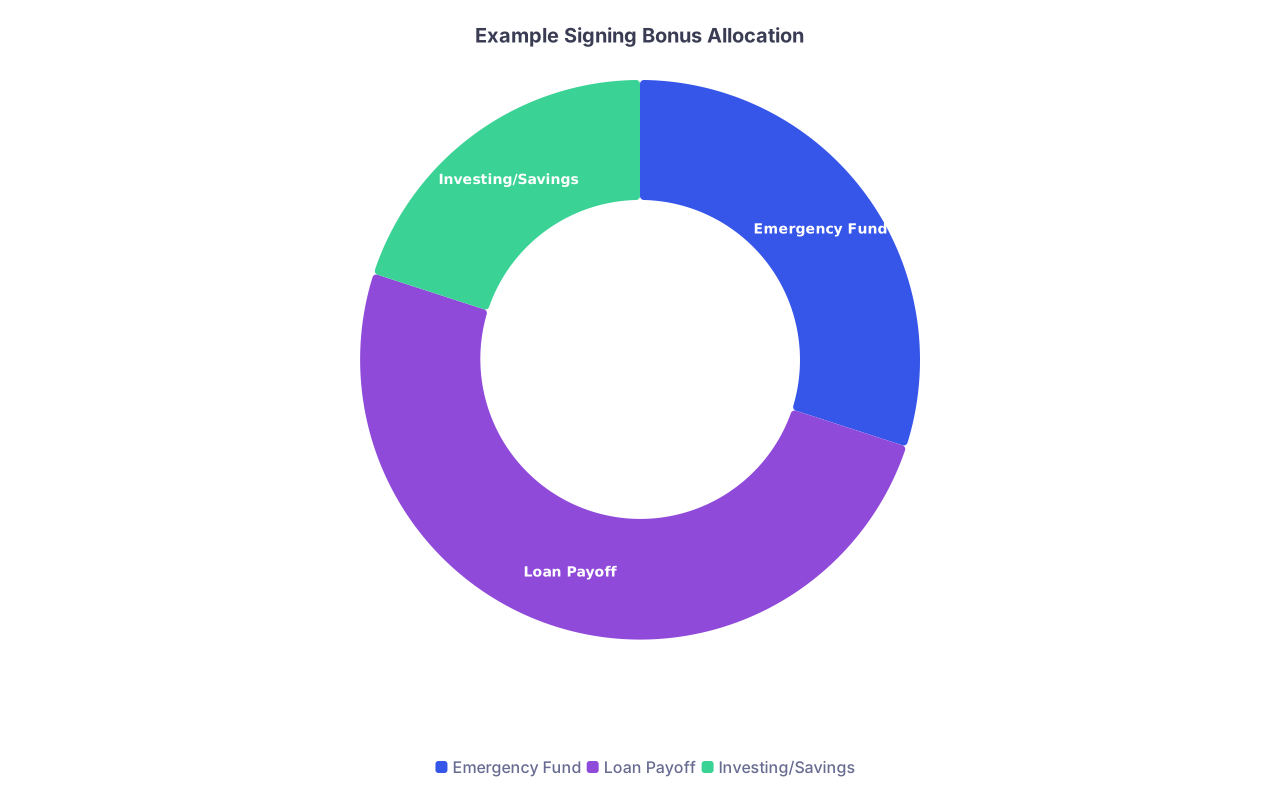
| Category | Value |
|---|---|
| Emergency Fund | 30 |
| Loan Payoff | 50 |
| Investing/Savings | 20 |

| Step | Description |
|---|---|
| Step 1 | Get Signing Bonus |
| Step 2 | Build emergency fund |
| Step 3 | Prioritize savings and investing |
| Step 4 | Use chunk on high interest loans |
| Step 5 | Split between loans and savings |
| Step 6 | 1 month emergency fund? |
| Step 7 | Pursuing PSLF or IDR forgiveness? |
| Step 8 | Loans above 7 percent? |
| Situation | Using Most of Bonus on Loans? |
|---|---|
| No emergency fund, unstable situation | Usually No |
| High-rate private loans, no forgiveness | Often Yes |
| PSLF track, large federal balance | Usually No |
| Small remaining balance, stable savings | Often Yes |
| Bonus has strong clawback if you leave | Be Cautious |
FAQ (5 questions)
1. If my loans are at 6–7%, is it always best to throw my whole signing bonus at them?
No. The rate is high enough that extra payments are attractive, but not so high that you should ignore everything else. You still need an emergency fund, you still should take advantage of an employer retirement match, and you shouldn’t ignore any clawback language in your contract. A big chunk toward 6–7% loans can be smart, but “entire bonus no matter what” is too extreme for most people.
2. What if my signing bonus is small, like $3,000–$5,000? Does the same logic apply?
Yes, just scaled down. With a smaller bonus, I’d lean even harder toward stability first. If you have almost no savings, that money is more powerful as an emergency buffer than as an extra loan payment. If you’re already stable, then using it to wipe out a small, annoying high‑rate loan can be great. Same framework, smaller numbers.
3. Should I refinance my loans and then use my signing bonus to pay them down?
Maybe. If you have high‑rate private loans and strong income, refinancing to a lower rate can make sense, and then you can use the signing bonus to hammer the new lower‑rate balance. But do not refinance federal loans if you might want PSLF or IDR protections — you’ll lose them. The sequence matters: understand your forgiveness options first, then decide on refinancing, then decide how much of the bonus to throw at the new or existing loans.
4. What if I’m starting residency or a lower‑pay job with a bonus? Should that change my approach?
Yes, you have more risk and less income cushion. For residents, teachers, early nonprofit workers, I’d be very slow to send a huge lump sum to loans. You’re often PSLF candidates, your income is modest, and you need cash flexibility. I’d usually suggest: build a real emergency fund, make required payments (often IDR), and maybe only a small targeted extra payment if at all.
5. Is it ever a mistake to not use a signing bonus on loans?
The only clear “mistake” is when you ignore high‑interest debt (9–12%+) and blow the entire bonus on lifestyle upgrades while keeping no savings. Passing on a big loan payment to build an emergency fund, get a match, or avoid future credit‑card debt is not a mistake; it’s smart risk management. As long as you’re making intentional choices—based on your rates, forgiveness options, and cash safety—you’re not doing it wrong.
Key points to keep in your head:
- Don’t sacrifice basic safety (emergency fund, stability) just to see a lower loan balance.
- Forgiveness plans and interest rates matter more than “I feel like being aggressive.”
- All‑or‑nothing thinking (“use the entire bonus or none of it”) is usually the wrong frame. A smart split almost always wins.